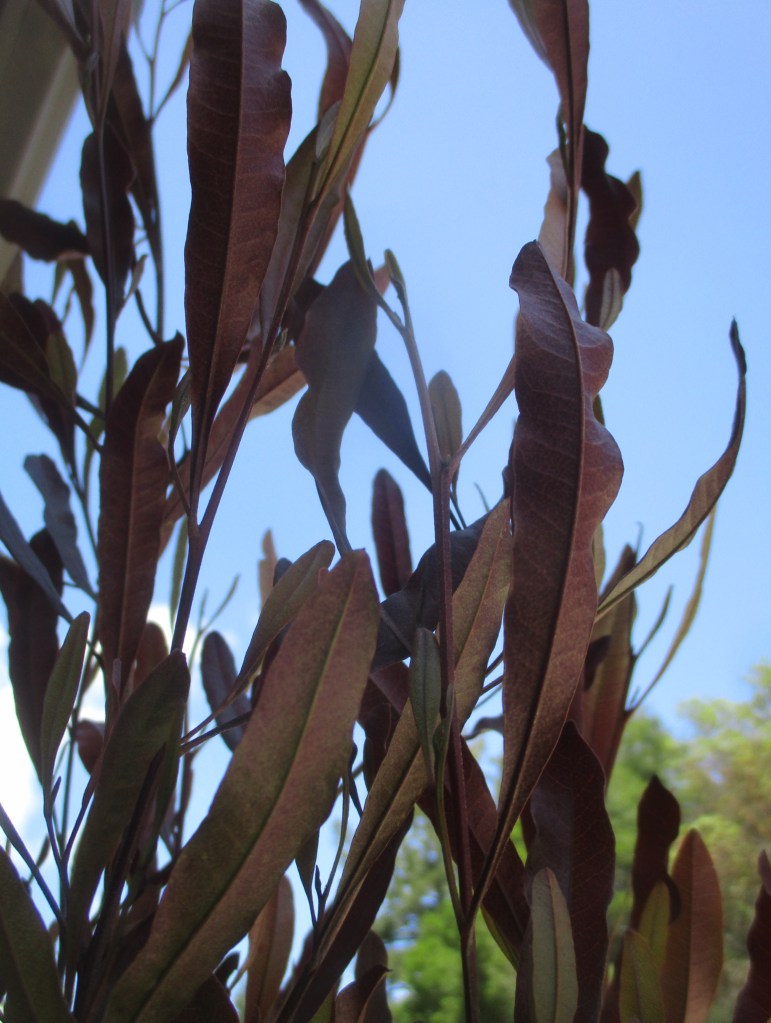
Its silly name is actually justifiable. The papery fruits of Hopbush, Dodonea viscosa, can be useful as a substitute for hops. Almost all hopbush are female, so produce such fruits. However, bloom and subsequent fruit production is variable. Vigorous plants are likely to produce less fruit. Also, some specimens might become male, and therefore be fruitless.
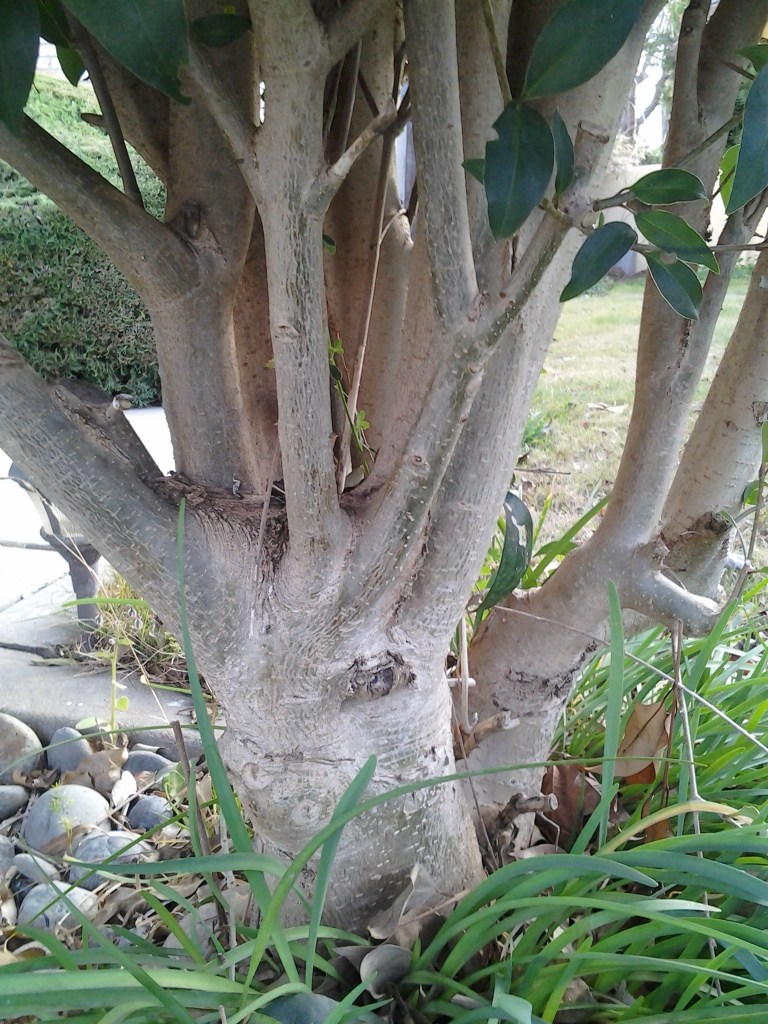
Hopbush is most popular as an informal evergreen hedge. It also works well as a formal hedge. With selective pruning, it can become a small tree with shaggy bark on sculptural trunks. It develops a narrowly upright form while young, but may eventually grow ten feet wide. It grows about twice as tall. Overgrown specimens are quite conducive to pruning.
Hopbush exhibits a uniformly fine foliar texture. Individual leaves are two or three inches long, but narrow. Foliar color is soft bronzy green. ‘Purpurea’ is more purplish bronze, but is not quite as vigorous. Roots are very complaisant, but do not disperse well if irrigation is too generous. Established hopbush is undemanding, so does not require much water. It tolerates soil of inferior quality too.
So many really nifty small trees never get an opportunity to perform to their best potential. Many function so well as shrubbery that there is no need to prune them into tree form. Many just get shorn down because that is the most obvious option.
There certainly is no problem with maintaining large shrubbery as shrubbery if that is the intended function. Oleander, photinia, privet, bottlebrush and various pittosporums are all excellent shrubbery, and except for oleander, can be shorn into hedges. Yet, any of them can alternatively be grown into small trees.
‘Standards’ are shrubs that are trained onto single staked trunks. Small shrubs trained as standards, such as boxwood, azalea and euryops, are really only shrubbery on a stick. The larger shrubs though, are more often trained onto trunks about six feet tall so that they can develop as small trees with single trunks.
However, they do not necessarily need single straight trunks. Many have naturally sculptural trunks that are worthy of display. They can be planted as shrubbery, and simply trained up on a few of the trunks that they are naturally equipped with. They only need lower growth pruned away as they mature, instead of getting pruned down.
Overgrown shrubbery that has become so obtrusive that it might otherwise need to be removed can often be salvaged by getting pruned up as small trees. For example, if a New Zealand tea tree or myoporum has gotten so wide at the base that it is awkward to work around, the basal growth can be pruned away so that only upper grown that has adequate clearance remains suspended on exposed trunks. The gnarly trunks within are often more appealing than the abused foliage that obscured them.
Japanese maple, crape myrtle, water gum (Tristania laurina) and various podocarpus really are small trees, but often get shorn instead of pruned properly by ‘mow, blow and go’ gardeners who do not know any better. Olive, coast live oak and saucer magnolia are substantial trees that often get shorn into shrubbery before they can grow beyond the reach of abusive gardeners.
Hollywood juniper as well as some of the other larger junipers naturally develop into sculptural small trees that are just as appealing with or without their lower growth. The gnarly foliated stems are just as sculptural as the trunks and stems within. If space allows, they can be left to grow somewhat wildly with only occasional pruning of superfluous stems.
 Tony Tomeo