Road to Nowhere

Music videos were so artistic in the 1980s. Some of them said as much as their associated music. The Talking Heads composed a music video for Road to Nowhere that, although it seems ridiculous now, was captivating at the time. It seemed to be about how life is dynamic with deviations from that which is expected. To me, it also seemed to be about enjoyment of being here now, or perhaps, there then. After all, it was filmed near Hi Vista in 1985, far away and long ago.

I did not experience Hi Vista in 1985, but did manage to get to Littlerock in about 1987, about two years later and thirty miles to the southwest. I am glad to have seen the region then. It has changed so much that I sort of hope to never see it again. Although I do not intend to avoid it if there is ever any reason for me to return, I would prefer to remember it how it was about thirty-seven years ago. There are plenty of other scenic regions of the Mojave Desert to tour.

While in the region, I noticed that a few interchanges on the highways that we drove on were more substantial than the highways were. They were proportionate to the urban development that was expected for the region. The portions of the highways between the interchanges were upgraded later, which is now a long time ago. So much of what I remember as rural is now suburban or urban.

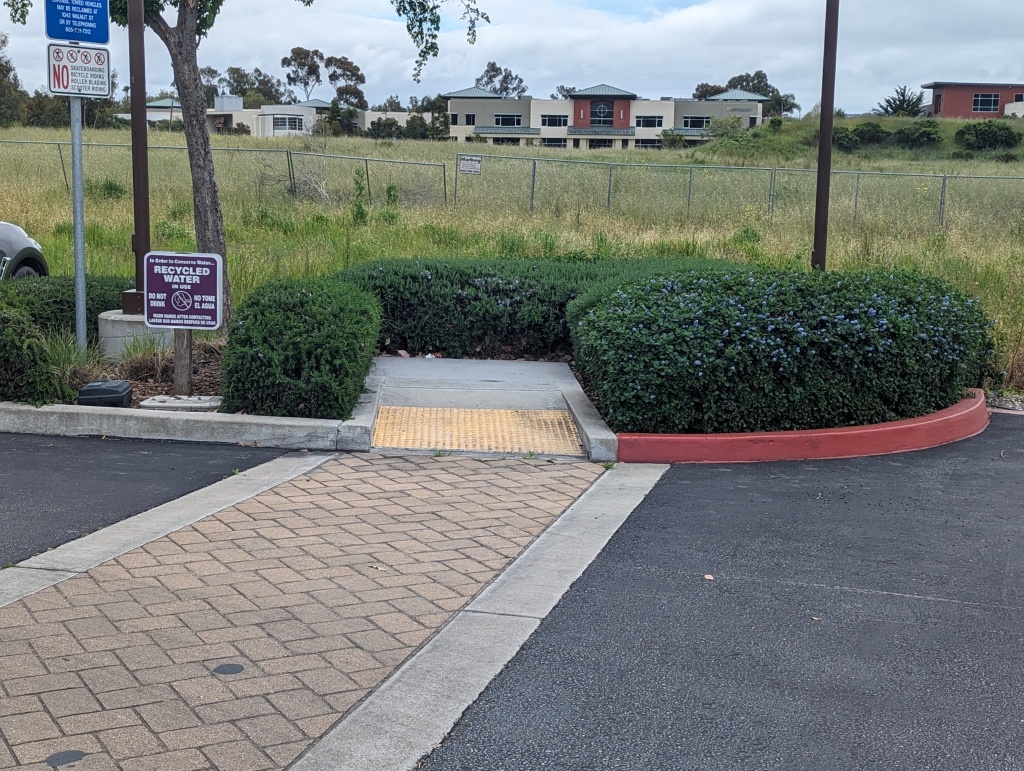
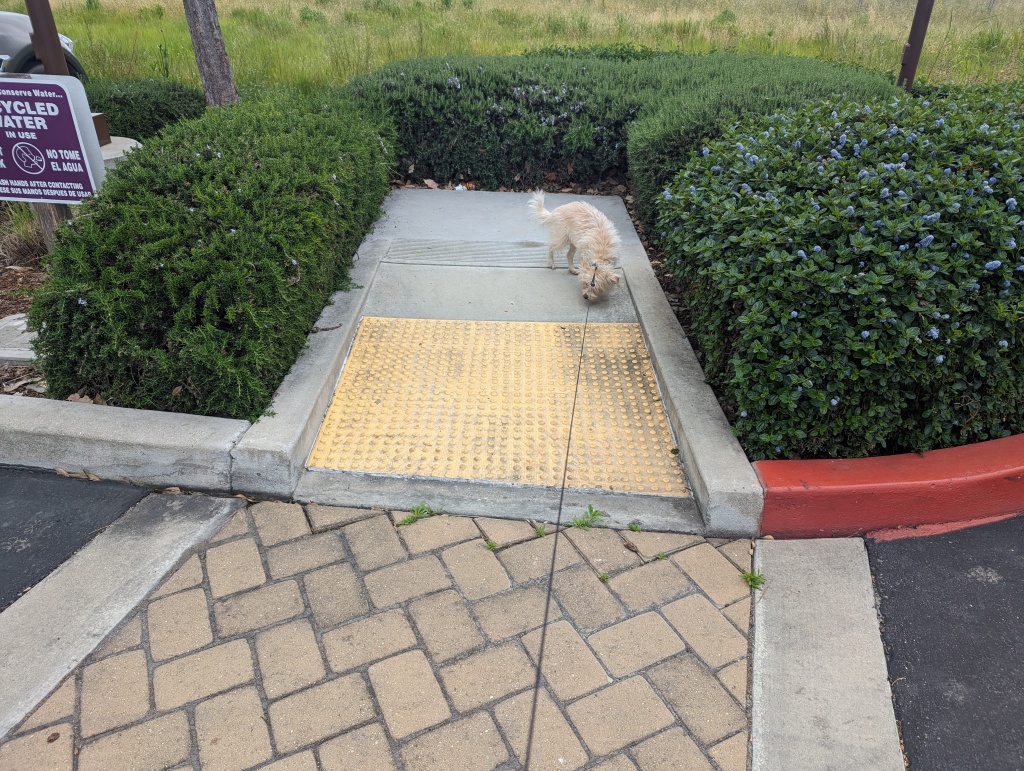
That is what this landscape reminded me of. It is near my formerly rural home south of San Luis Obispo, where I lived while in college. Although this parking lot was here before I was, it has since been renovated. The area beyond was merely pasture occupied by cattle. This long and prominent crosswalk crosses the parking lot as if going somewhere important, only to terminate at this empty landing, which is surrounded by ceanothus. It certainly looks odd. Obviously, the walkway is intended to continue in some form into development that is planned for the adjacent site. I had not been here in about thirty-four years, so should not be surprised by such changes. Perhaps I am no more surprised than I am amused by this landscape and its associated road to nowhere.
Streets Might Benefit From Shade

Proportion is important for street trees.

Shade has become less of a priority for modern urban gardens than it still is for older and more spacious suburban gardens. Significantly less sunlight reaches the ground of such confined gardens among taller and shadier homes and fences. Even where shade might be desirable, space for shade trees might be minimal. Streets are the primary exception.

Streets, and associated curbs and sidewalks, are generally the sunniest situations within modern urban neighborhoods. They collect and radiate ambient heat that warms nearby homes and gardens, even if the weather is already unpleasantly warm. Cars that park on pavement without shade are vulnerable to the most heat, which accelerates weathering.

It is an unfortunate waste. Sunshine that is useless and undesirable on streets would be useful within gardens. Although sunlight is not transferable from one situation to another, it might be partially abatable with shade. Streets are certainly no place for gardening; but the space above them may have potential to accommodate the canopies of shade trees.

Street trees are simply trees that flank streets and other roadways. Most are shady. A few are merely visually appealing. They may inhabit parkstrips, treewells or gardens that are adjacent to sidewalks. Many municipalities prescribe street trees for most of their streets. Conforming street trees are standard accessories for streets within new residential tracts.

Of course, street trees must be appropriate to their particular applications. They must get tall enough for clearance above the largest of vehicles that use the roadways below. For commercial districts, some must also stay above storefront signs. Contrarily, a few street trees must stay below aerial utilities. Street lamps, high or low, require clearance as well.

Size and form are not the only considerations. Roots of street trees must be complaisant with infrastructure. Mess should be as minimal as practical. The most complaisant street trees might stay too small to attain adequate clearance or provide much shade. The most visually appealing might be too messy. Selection of appropriate street trees necessitates significant research regarding every potential option.

Concrete And Jungle Can Be Compatible

80620thumbConcrete is one of the most common of landscape materials. There are probably more landscapes that include concrete of one form or another than there are landscapes that include lawn, and most landscapes include lawn. There are more landscapes that lack shade trees than there are without concrete. We do not notice it much because, once it is installed, we do not do much to it.

Concrete gets poured into our gardens as a liquid like slurry of cement and sand and gravel aggregates that cures into a stone-like solid. It is not ‘cement’, but cement is the component that binds it all together. Almost all modern concrete is reinforced with steel of some sort to prevent it from breaking as easily as old unreinforced pavement does. It can be as permanent as we want it to be.

Concrete is used to pave patios, driveways and sidewalks, and gets molded into stairs, curbs, and the foundations and slabs for our homes and garages. The visible surfaces of concrete can be colored, textured or outfitted with stone to look better in the landscape than simple bare concrete. It is relatively ‘low-maintenance’, but should sometimes get swept or blown if debris accumulates.

Concrete is a versatile and durable material, but is no more perfect than anything else in the garden. It inhibits percolation of moisture and gas exchange in the soil below. Because it is inflexible, it fractures if displaced by roots or settling soil. Glare from paved surfaces can enhance sun exposure enough to roast sensitive foliage and exposed bark. Certain foliar debris can stain concrete.

Concrete limits plant selection. Conversely, the presence of mature trees limits the location and quantity (surface area) of concrete to be installed. Trees with aggressive roots or big trunks should not be planted so close to concrete that they will have no choice but to displace it. Root barriers help with mid sized trees, but are not always effective forever. Dogwoods,Japanese maples and other plants with sensitive foliage or bark, are more vulnerable to exposure if concrete around them is also exposed.