Six on Saturday: Making Up For Lost Time

A few late bloomers are making up for lost time. Hydrangea, although late, is somewhat earlier than it typically is. Bluegum is not blooming, but contributes its own sort of color with bark.

1. Eucalyptus globulus, bluegum remains canned because it grows too big too vigorously to go into the ground. Ultimately, it will likely need to be destroyed. For now, it provides both aromatic juvenile foliage and pretty adult foliage. It also has pretty watercolor bark.

2. Yucca recurvifolia, curve leaf yucca is known as Yucca gloriosa var. tristis now. What was wrong with its former botanical name? Its boring common name should be changed instead. Anyway, I am impressed that it is blooming so soon after relocation last winter.

3. Hibbertia scandens, guinea gold vine grew like a weed from a cutting last year, and is now beginning to bloom for the first time. This is the first of many flower buds to unfurl. Its bloom was expected, but its profusion is unexpectedly impressive. It remains canned.

4. Hemerocallis fulva, daylily was similarly expected to bloom and is similarly blooming with unexpected profusion. I have no idea what cultivar this is, but I suspect that it may be the straight species. We grow just one other daylily cultivar, and it is relatively docile.

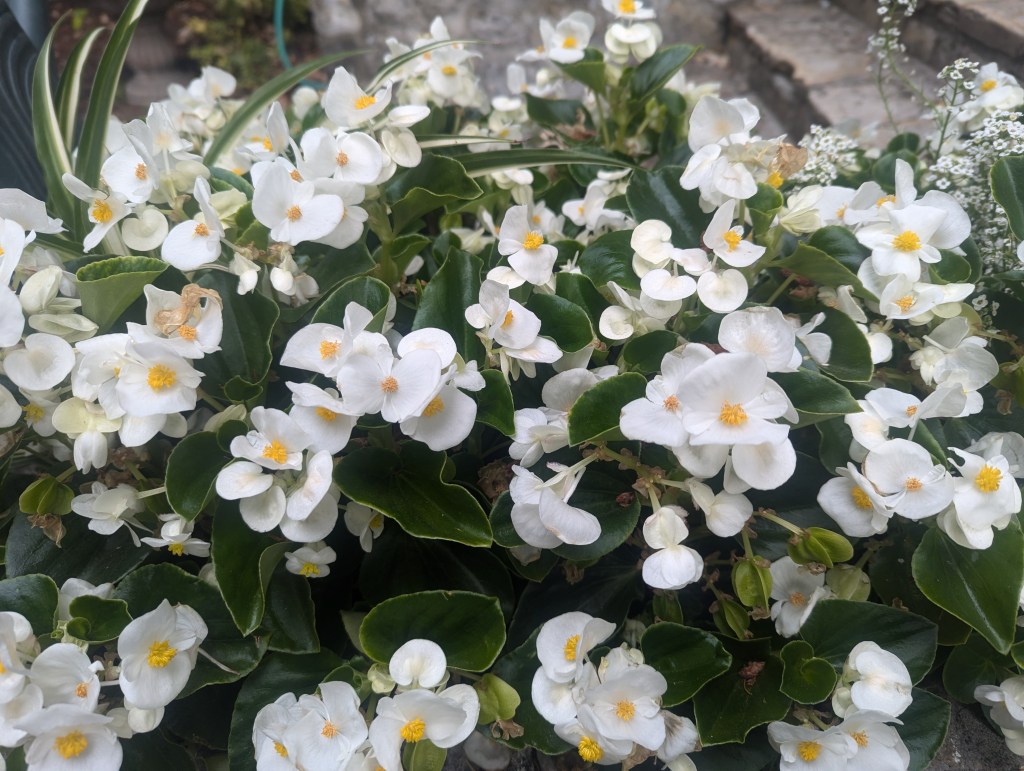
5. Begonia semperflorens-cultorum, wax begonia had languished for years in its planter box full of aggressive redwood roots. It now grows much more happily in its new planter box within its old planter box, which is elevated on cinder blocks above an empty space.

6. Hydrangea macrophylla, hydrangea typically blooms later on axillary stems because I prune the terminal buds off with winter dormant pruning. My concern was that, if I left the canes intact as I should, they would flop over. They are flopping, but it was worth it.

This is the link for Six on Saturday, for anyone else who would like to participate: https://thepropagatorblog.wordpress.com/2017/09/18/six-on-saturday-a-participant-guide/
Six on Saturday: Going Bananas Again

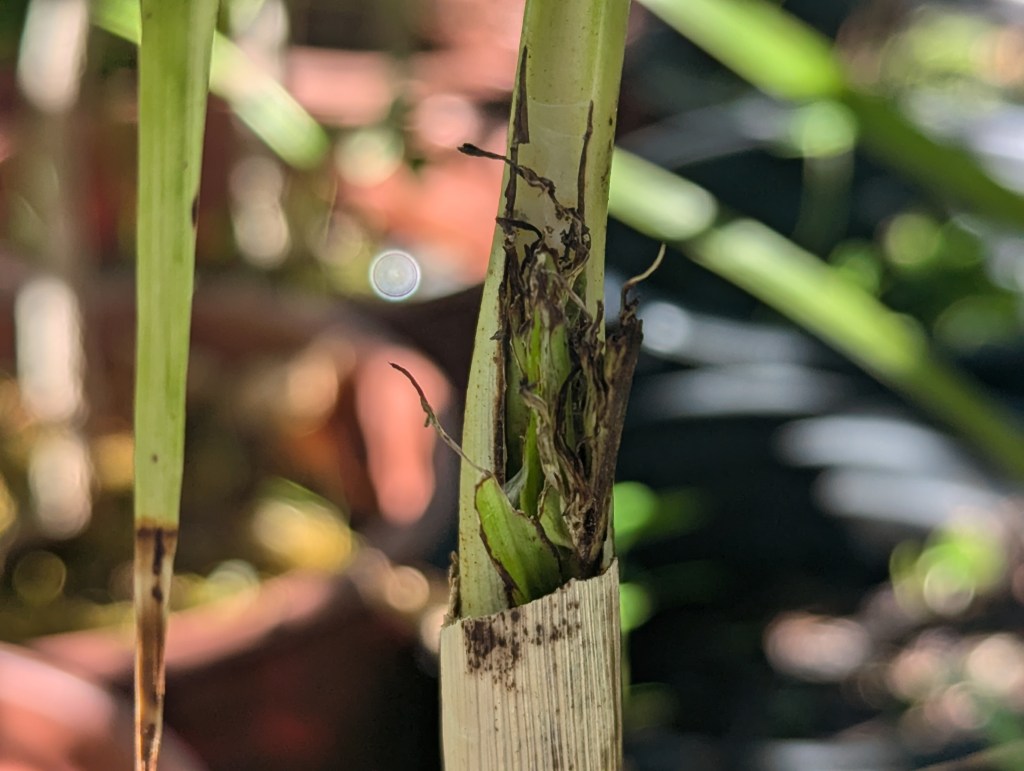
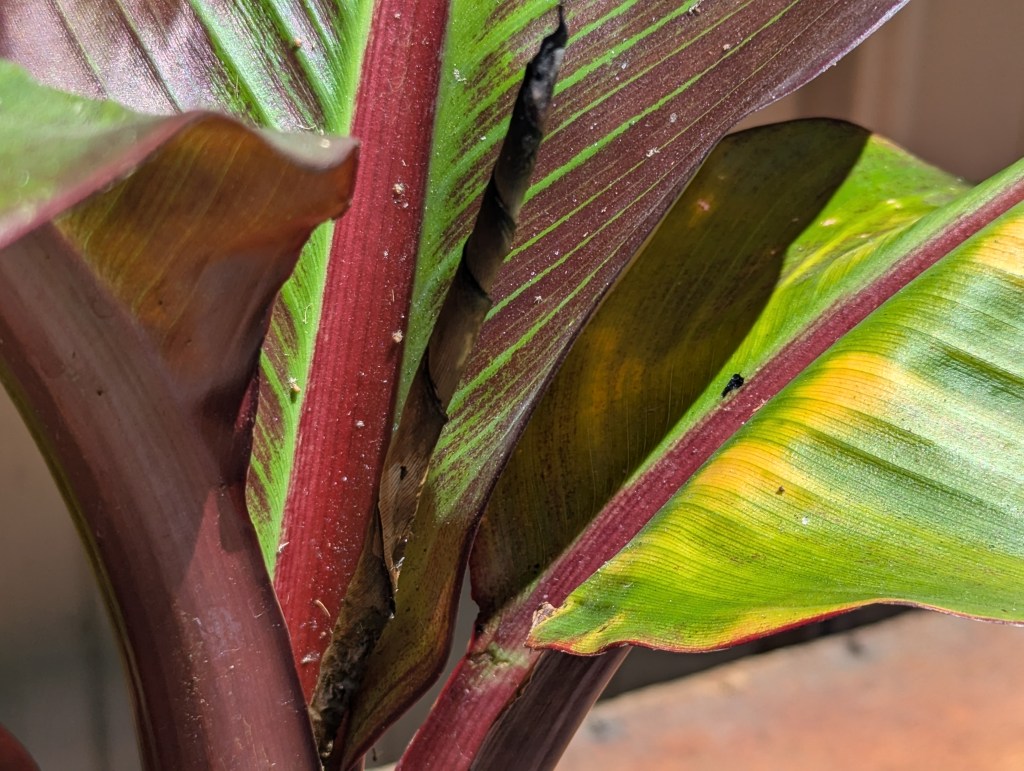
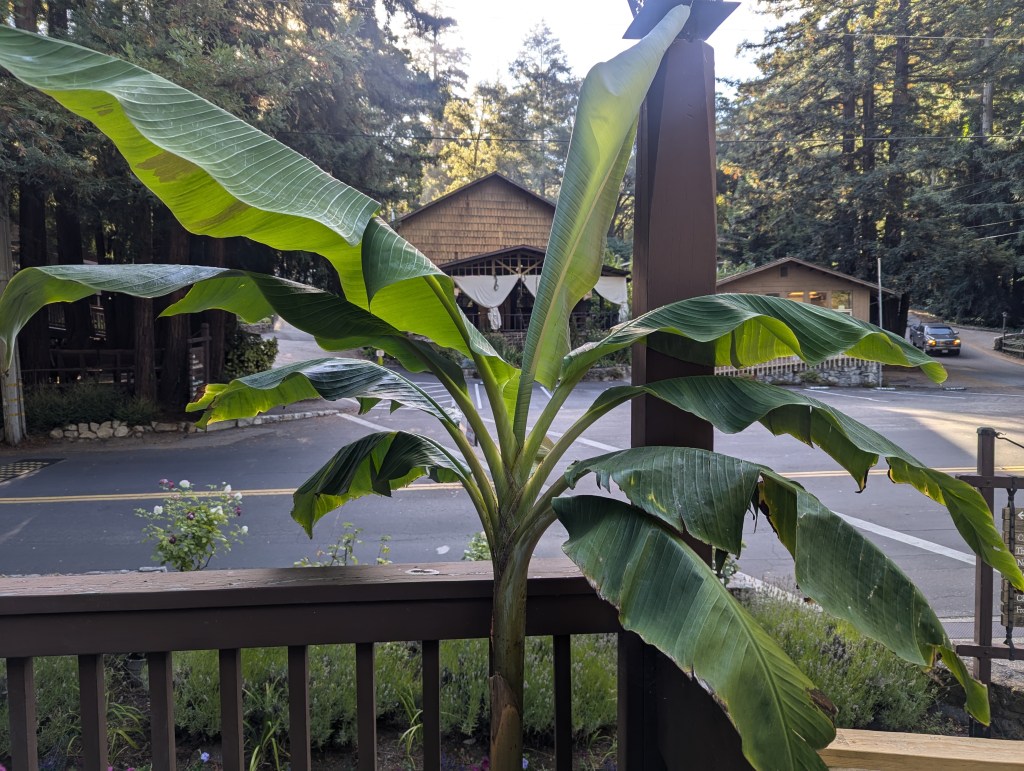
Banana trees have grown slowly through the oddly cool weather of spring. They are only now beginning to slowly recover from last winter.

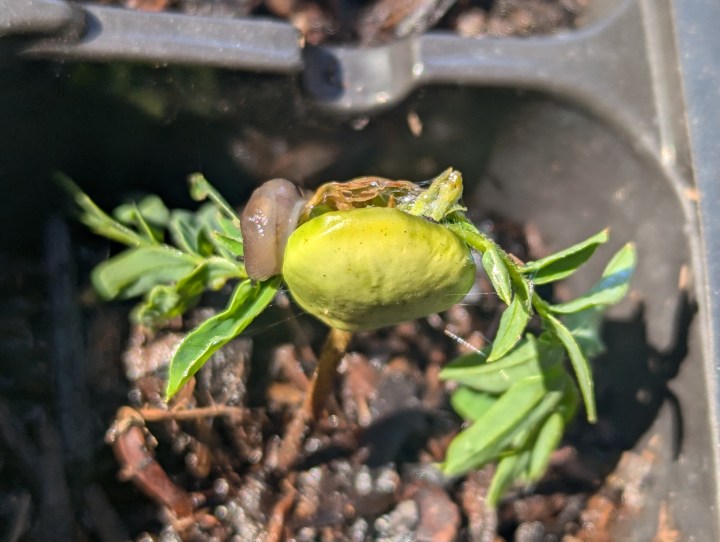
1. Ariolimax columbinanus, banana slug is obviously unrelated to bananas, but seems as if it should not be. It is about as big as a small banana, but fortunately does not consume much viable vegetation. It prefers redwood detritus. It is rarely out during arid weather.

2. Actinidia deliciosa, kiwi vine is obviously as unrelated to bananas as a mollusk, but is something that I want to show off. These remaining three of five original cuttings are my second attempt to grow a male pollinator for a female vine that grew here two years ago.

3. Musa ingens, oem or giant highland banana produced a pup that grew big enough for separation. A smaller secondary pup remains attached as a potential replacement for the primary trunk when it finishes, but additional pups will likely develop through summer.

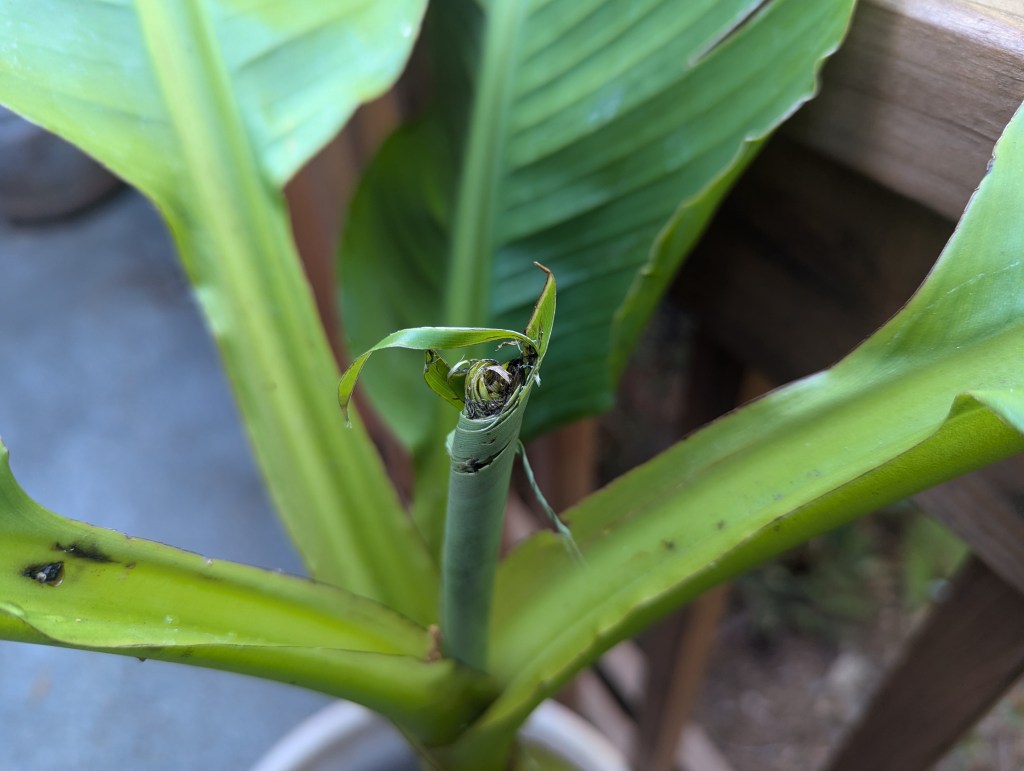
4. Musa itinerans var. xishuangbannaensis ‘Mekong giant’ banana also produced a pup. It is still dinky and now seems to be blinding out without a new leaf within its latest leaf. Another pup is only beginning to appear. I hope that more pups will eventually develop.

5. Musa, banana of an unidentified species and cultivar is recovering slowly from winter. It was here through last summer, so, unless it is a dwarf, it should be bigger by now. The shabbier specimen to its far left is Musa X balbisiana ‘Blue Java’ or ‘Ice Cream’ banana.

6. Rhody is who everyone who reads my Six on Saturday really wants to see. I have been negligent in posting pictures of him. He is not exactly easy to get a good picture of. Even this picture should have been centered better. Obviously, he knows his fans do not mind.

This is the link for Six on Saturday, for anyone else who would like to participate: https://thepropagatorblog.wordpress.com/2017/09/18/six-on-saturday-a-participant-guide/

Six on Saturday: Neither Rhododendrons Nor Roses

This is an intentional attempt to eschew the most obvious options.

1. Tanacetum parthenium ‘Aureum’, golden feverfew is the only of these six that I know the cultivar of, but only because it is the only cultivar that I am aware of with such sickly chartreuse foliar color that passes for golden. Its little daisy flowers are splendid though.

2. Dianthus caryophyllus, mini carnation is one of those cool season annuals that never gets removed at the end of its season. It neither flourishes nor dies, so has been here for several years. It will probably die back partially now that the weather is getting warmer.

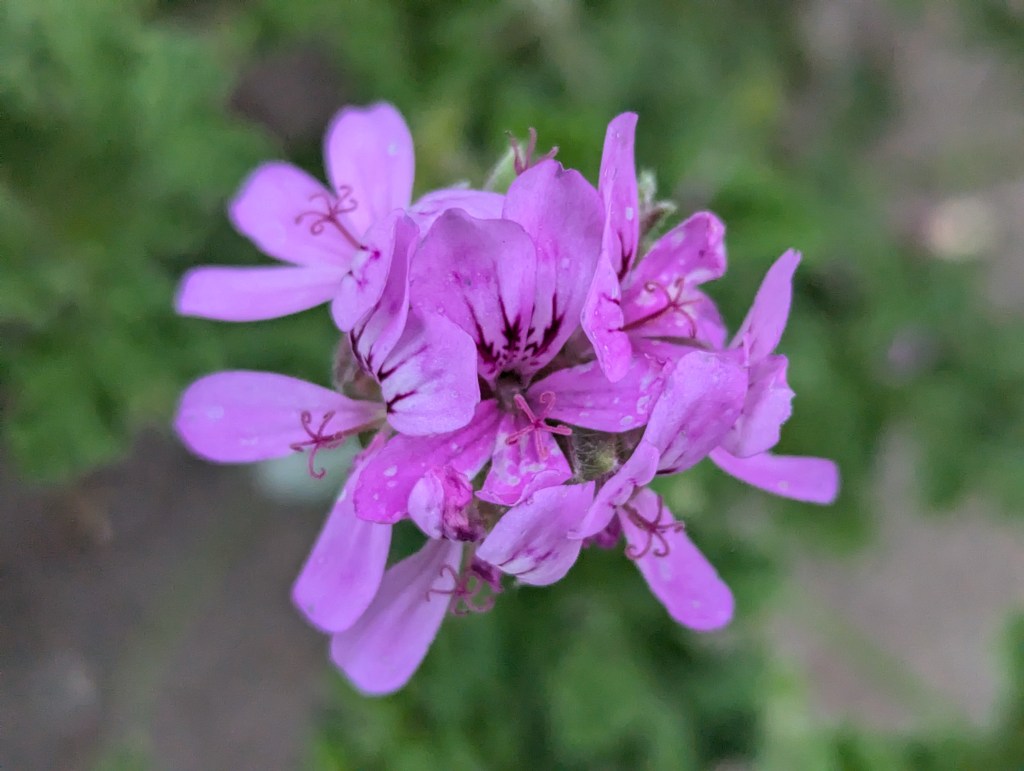
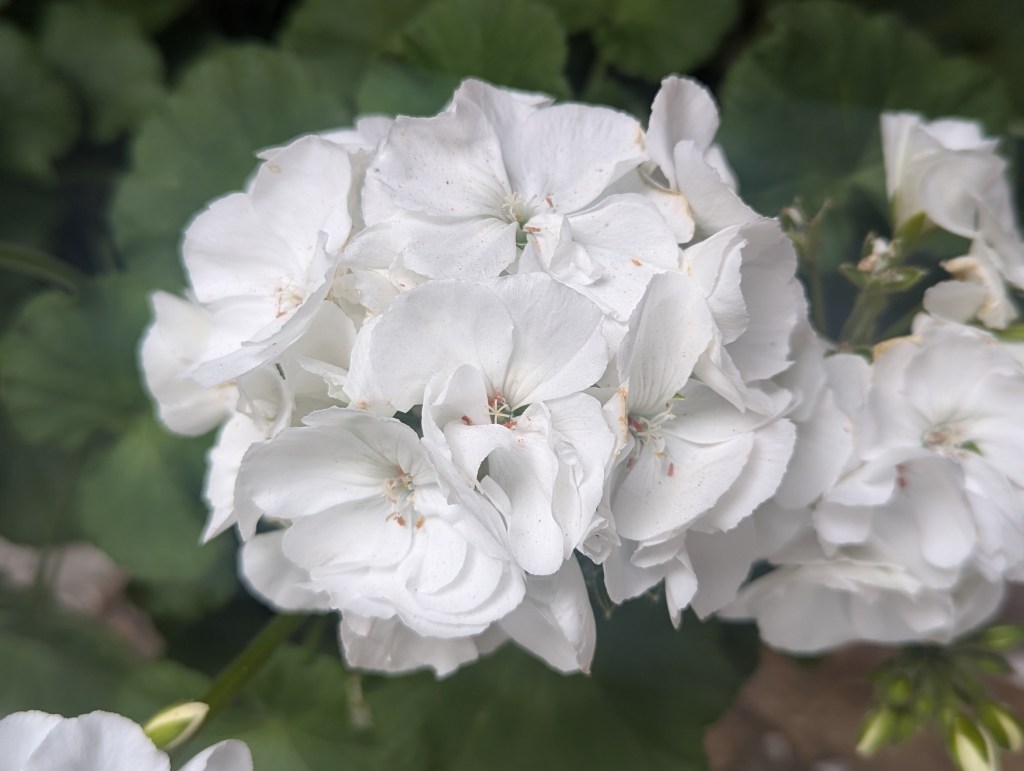
3. Pelargonium X hortorum, zonal geranium may seem to be cheap and common, but it has been very reliable. Besides, I happen to be fond of them. They were some of the first perennials that I grew during my childhood. This and others like it are modern cultivars.

4. Alstroemeria spp., Peruvian lily was the first large scale cut flower crop that I worked with during the summer of 1986, while I was studying horticulture at Cal Poly, San Luis Obispo. This and a few cultivars at work seem to be as old fashioned as those from 1986.

5. Lilium auratum, Asiatic lily was a gift from a neighbor while its bulbs were dormant a few winters ago. It was not expected to perform as well as it has. Not only has it become reliably perennial, but it has multiplied so much that I must eventually dig and divide it.

6. Cornus florida, flowering dogwood is the last dogwood to bloom so late. This could be because of distress associated with its relocation last winter. I do not remember when it bloomed last year, or if it should bloom as late next year. I suppose that we will see then.

This is the link for Six on Saturday, for anyone else who would like to participate: https://thepropagatorblog.wordpress.com/2017/09/18/six-on-saturday-a-participant-guide/

Six on Saturday: Bark

Bark was actually not Rhody’s suggestion. It was simply a convenient theme while it was difficult for me to get out to take other pictures. These are six trees that I worked around yesterday. I could recycle this theme for native species.

1. Sequoia sempervirens, coastal redwood is the Official State Tree of California, and the tallest tree species in the World. Although native, this particular specimen was grown in a nursery, and is the cultivar ‘Soquel’. It was installed into its landscape likely after 1989.

2. Metasequoia glyptostroboides, dawn redwood is the only of three species of redwood that is not native to California. It is also the only deciduous redwood. Sequoia gigantea, giant redwood, is also represented by a young tree, but I did not get a picture of its bark.

3. Prunus serrulata, flowering cherry seems to be the cultivar ‘Kwanzan’. Perhaps shade from surrounding redwoods, birches, sweetgums and dogwoods interfere with its bloom profusion. Individual flowers are a bit smaller than they should be for typical ‘Kwanzan’.

4. Betula pendula, European white birch has distinctly white bark, but also exhibits dark brown or black furrowed bark at the bases of large trunks. I tried to take pictures of both for contrast, but the white bark seemed too gray. I could have gotten both in one picture.

5. Liquidambar styraciflua, sweetgum bark goes through different phases as it matures. Young twigs initially exhibit smooth bark. Then, their smooth bark develops corky wings that grow as the stems grow. Somehow, mature bark shows no evidence of former wings.

6. Cornus florida, flowering dogwood is supposedly easy to identify by its ruff bark. I do not get it, though. Of these Six, only flowering cherry has more finely textured bark. This particular tree does not bloom so well, but produces spectacular foliar color for autumn.

This is the link for Six on Saturday, for anyone else who would like to participate: https://thepropagatorblog.wordpress.com/2017/09/18/six-on-saturday-a-participant-guide/

Six on Saturday: Elderberry Foliage

Only six of ten elderberries here were selected for “Six on Saturday”. Four were omitted:

Sambucus canadensis ‘Nova’ and ‘York’ American elderberry

Sambucus caerulea, blue elderberry

Sambucus nigra ‘Black Tower’ European black elderberry

I would have liked to include all of them, but realistically, American elderberry and blue elderberry are not much to see, and I was unmotivated to take a picture of ‘Black Tower’ European black elderberry. Although it is my favorite of the European black elderberries here, taking its picture after neglecting to do so while there earlier yesterday would have necessitated a short drive and a long walk. These six are in the storage nursery, either as cuttings, or because they were not installed into a landscape yet.

1. Sambucus racemosa, red elderberry is a gift from Skyler of Tangly Cottage Gardening. They are a group of four seedlings, so can pollinate each other, as well as a more recently acquired ‘Lemony Lace’. The species is native and grows wild in Tangly Cottage Garden.

2. ‘Lemony Lace’ is a cultivar of red elderberry that I acquired with three European black elderberry cultivars, in a manner that is not illegal. I am very pleased that it is a progeny of ‘Sutherland Gold’, which I had been coveting in the garden of The Random Gardener.

3. ‘Black Lace’ is the cultivar of Sambucus nigra, European black elderberry, that started it all. It was here before my time. I was not so keen on it, but learned to like it because so many admired it in the landscape. I procured ‘Madonna’ as a pollinator, and kept going.

4. ‘Madonna’ and ‘Black Lace’ are so MTV in 1989. This ‘Madonna’ is not so exciting. Its chartreuse variegation looks sickly while it is small. I know it will be prettier as it grows. It arrived two years prior to the three other newly acquired European black elderberries.

5. ‘Purpurea’ is one of the three recently acquired cultivars of European black elderberry that arrived with the ‘Lemony Lace’ red elderberry. I am unimpressed by its bland foliar color, but will learn to appreciate it if I work with it long enough. I like its foliar texture.

6. ‘Albomarginata’ was the European black elderberry cultivar that I initially wanted as a pollinator for ‘Black Lace’, but it was unavailable two years ago. I prefer its creamy white variegation and larger size to the chartreuse variegation and compact size of ‘Madonna’.

This is the link for Six on Saturday, for anyone else who would like to participate: https://thepropagatorblog.wordpress.com/2017/09/18/six-on-saturday-a-participant-guide/

Six on Saturday: Here & Now

These six lack a theme. They are just random pictures of a few flowers that are blooming here and now.

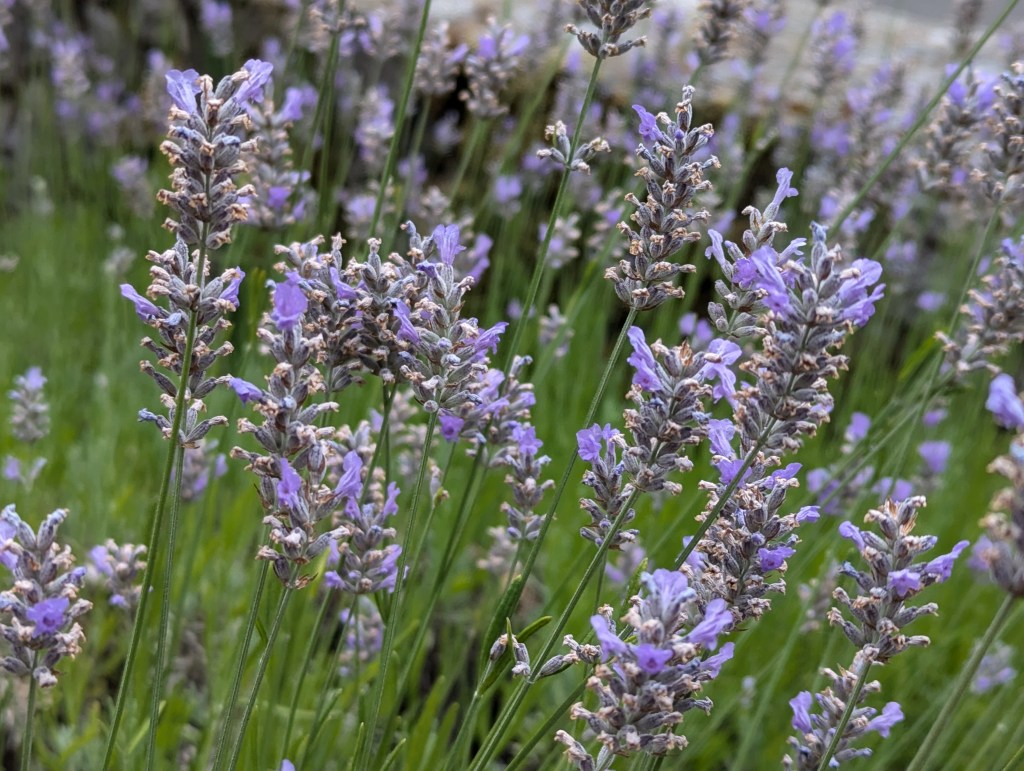
1. Lavandula stoechas, Spanish lavender posed for this picture, which was not adequate for the gardening column, but is too pretty to delete without sharing here. It looks like it is about to fly away with those long wings. A bee posed with it for the gardening column.

2. (Hespero)Yucca whipplei, chaparral yucca is blooming again after blooming last year. This floral truss is about twelve feet tall, and still growing. Seed that it provided last year is now growing abundantly. It is the first species of Yucca that I met in the wild in 1985.

3. Scilla peruviana, Peruvian squill has been reliably perennial for about three years but has not grown much. Although the floral trusses are bigger than they were last year, they are no more numerous. Just nine remain in three groups of three, just as I planted them.

4. Rhododendron spp., like the bearded iris and cymbidium orchid, is of an unidentified cultivar. Many others are blooming now also. I refrained from posting six pictures of six different rhododendrons like I usually do though, because that can get a bit predictable.

5. Iris X germanica, bearded iris was difficult to take a good picture of at the time of day that I encountered it. Its pale color did not help. I am fond of this iris though, since I got it from Cedar Lodge at Kidder Creek, on the way to the Pacific Northwest two years ago.

6. Cymbidium spp., has been blooming very slowly. The buds appeared over winter, and have been extending since then, but only recently opened. I never liked this orchid much anyway. A white orchid that typically blooms so impressively here did nothing this year.

This is the link for Six on Saturday, for anyone else who would like to participate: https://thepropagatorblog.wordpress.com/2017/09/18/six-on-saturday-a-participant-guide/


Six on Saturday: Unidentified Hybrids

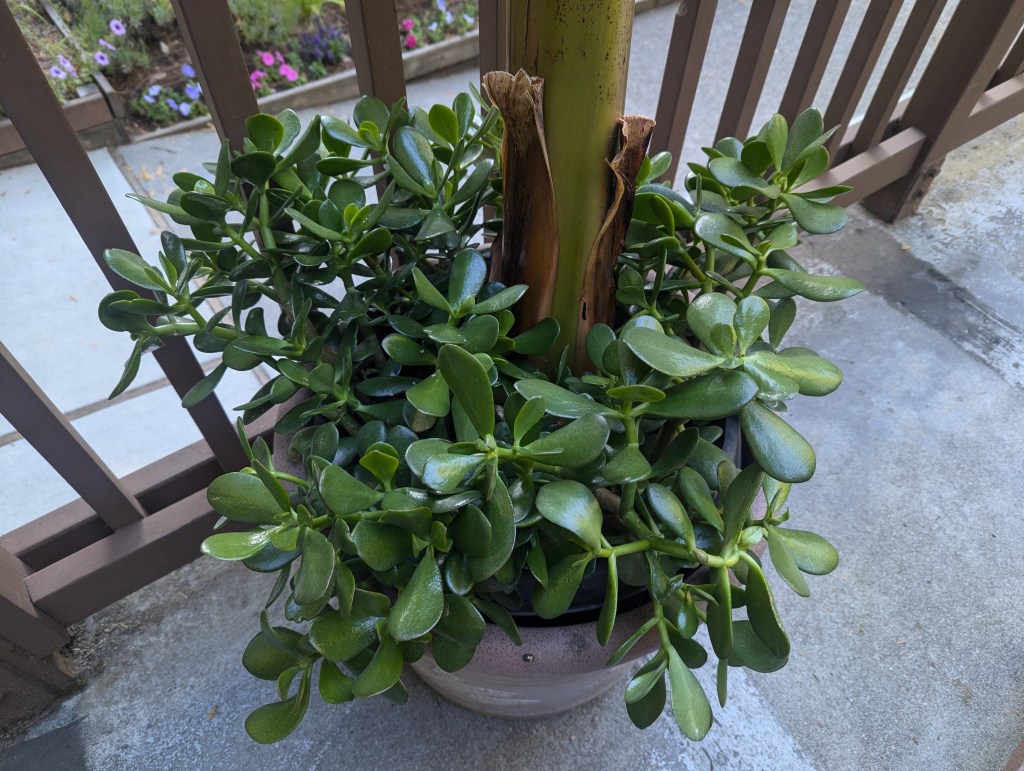
Camellia japonica seems to be too diverse to be a single species. Several of its countless cultivars seem to be either other distinct species or hybrids of other species. Regardless, they are all products of selection and breeding from within their single species, which is why the camellia pictured below is the only one of these six without an “X” in the middle of its name. The other five are hybrids, and three are the same hybrid species. However, one commonality of all six is that their cultivars are unidentified. I guessed a cultivar for the rose in the past. Columbine grew from a feral seed of a hybrid parent that apparently was not particularly sterile.

1. Iris X pacifica, Pacific Coast iris are hybrids of various native species, although mostly Iris douglasiana. Different cultivars can have different ancestry. These are unidentified.

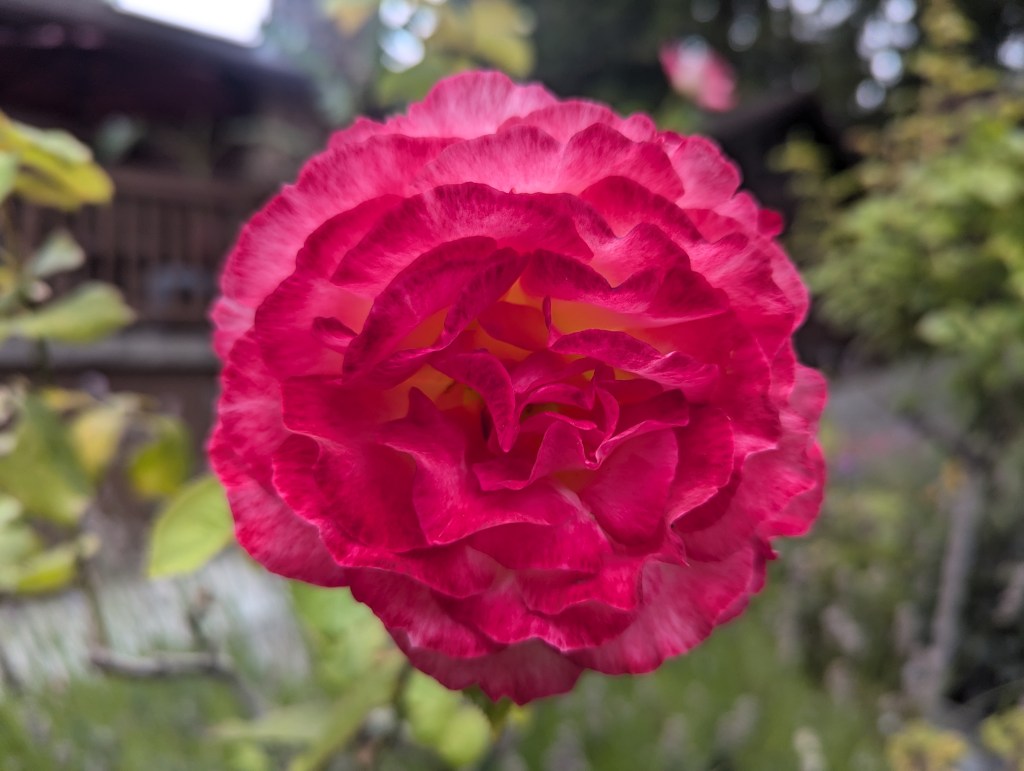
2. Rosa X hybrida, rose is also an unidentified hybrid of unidentified ancestry. It seems to be a floribunda rose, with a few secondary floral buds behind each primary floral bud.

3. Iris X pacifica, Pacific Coast iris is my favorite color, but is actually not my favorite of the cultivars here. Blue, purple and burgundy red are too velvety exquisite to not prefer.

4. Aquilegia X hybrida, columbine grew in an awkward location from the seed of others that did not want to grow where planted. It stayed because it is the only columbine here.

5. Iris X pacifica, Pacific Coast iris in yellow is a bit more colorful than the white cultivar but not as richly colorful as the others. Blue, purple and burgundy red are done already.

6. Camellia japonica, camellia is as unidentifiable as the other five of these six but is not an interspecific hybrid, which is why it lacks an “X” in the middle of the botanical name.

This is the link for Six on Saturday, for anyone else who would like to participate: https://thepropagatorblog.wordpress.com/2017/09/18/six-on-saturday-a-participant-guide/
Six on Saturday: Bearded Iris 2025

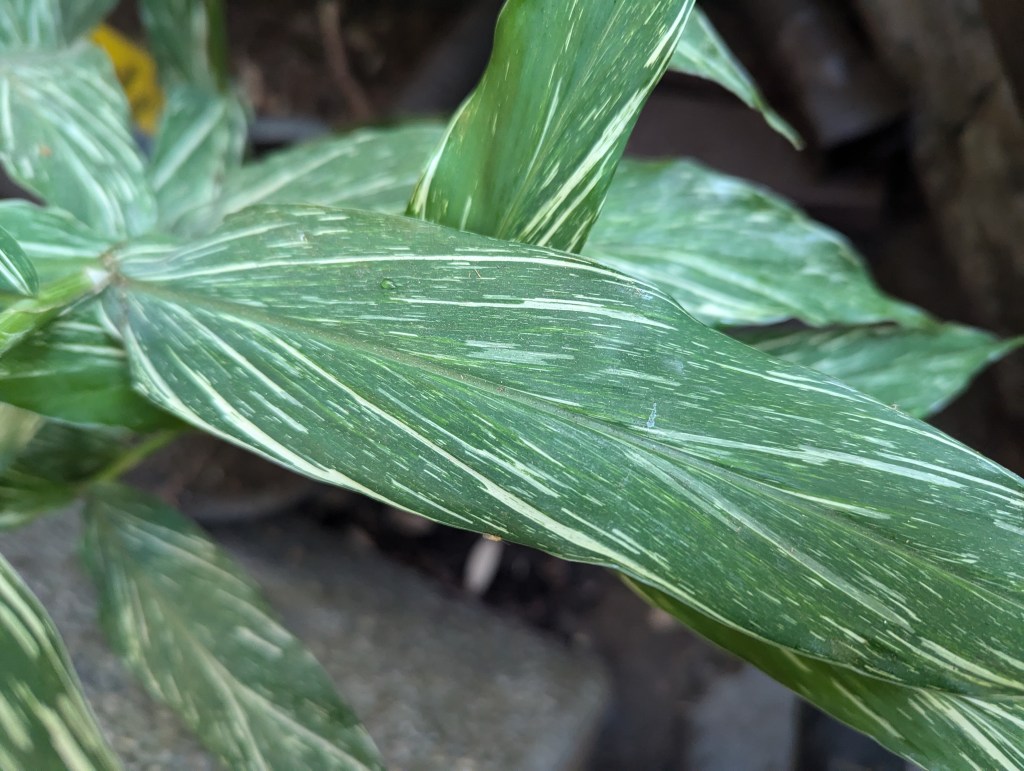
Too many iris are blooming now to document. Therefore, I limited my selection to a few bearded iris, which includes one that is not within the landscapes at work. Perhaps some of the other species can be featured next Saturday. With so much in bloom, it is difficult to be selective.

1. Of these Six, only this one does not inhabit the Iris Garden at work. It inhabits a small roadside planter in front of the totally awesome White Raven Coffee Shoppe in Felton. I believe that it is more caramel and charcoal colored than it appears to be in this picture.

2. Of these Six, only this one is likely identified. It conforms precisely to the descriptions of ‘Rosalie Figge’, including its habit of blooming sporadically throughout the year, with abundant bloom about now. Another participant of Six on Saturday identified it as such.

3. This relatively small pale yellow but nicely fragrant iris might be feral. It was found at a dumpsite for landscape debris, so could have grown from a deadheaded seed. It would likely be bigger and more colorful if it had grown from a discarded rhizome of a cultivar.

4. This big blue iris is as floppy as beagle ears, and is so heavy that its tall stems fall over if not staked. That is why its nearly horizontal stalk is obscured in its background behind it instead of visible below it. It is not actually as purplish as it seems to be in this picture.

5. Although more billowy and likely a bit bulkier, this garish iris needs no staking. Its tall and rather thin floral stems are sturdier than they seem to be. This happens to be one of my favorite bearded iris in this particular group. It was originally a gift from a neighbor.

6. Color is again deficient. This bearded iris is not as purplish as it seems to be here. It is actually a rich burgundy red. I remember the origins of all the other iris here but can not remember how this one was acquired. I do not remember ever seeing it before this year.

This is the link for Six on Saturday, for anyone else who would like to participate: https://thepropagatorblog.wordpress.com/2017/09/18/six-on-saturday-a-participant-guide/
Six on Saturday: Azaleas 2025

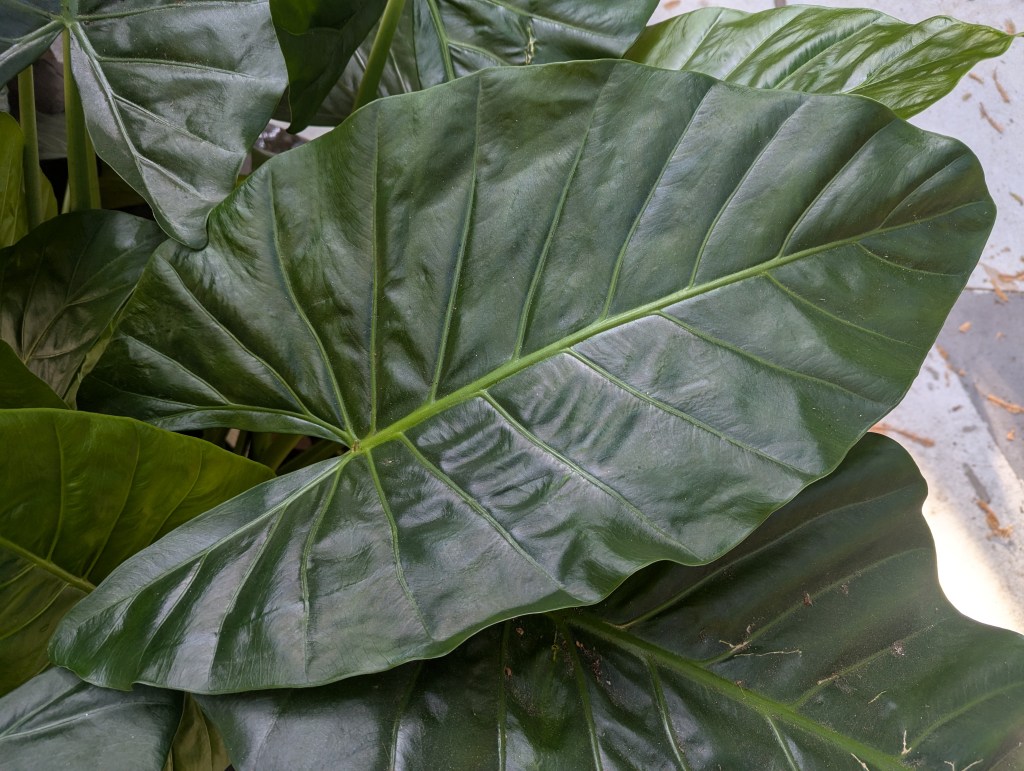
Azaleas make it difficult to limit this post to only six pictures. So many cultivars are now in bloom. However, azaleas also make it easy to comply with suggestion #7 of the Six on Saturday participation guide, which suggests minimal verbiage. There is not much to say about them, since I do not know much about them, or even what cultivars they are. I can only guess the identities of half of them. Even if I could identify the cultivars, I could not identify the species. I only know that all azaleas are of the same genus of Rhododendron. I suppose that, in this regard, they could qualify as a few more of Rhody’s rhodies.

1. ‘Hino Crimson’ happens to look very much like this. The small leaves are dark, but not quite bronzed presently. They were bronzed, but only during the coldest winter weather.

2. ‘Coral Bells’ happens to look very much like this. It is the most common azalea within the landscapes at work, and is remarkably reliable with its remarkably abundant bloom.

3. The bloom of this cultivar seems to be even more abundant because almost none of its foliage is visible beneath it. These flowers are little, but bigger than those of ‘Coral Bells’.

4. This azalea seems to be a ‘florist’ cultivar rather than a landscape cultivar. It was likely left by someone who worked in a nearby office years ago, and then found by a gardener.

5. Within the spacious landscapes here, each cultivar of azalea is installed in groups of at least a few individual specimens. Like the florist azalea, there is only one of this cultivar.

6. ‘Fielder’s White’, which is my favorite of the common azalea cultivars, happens to look very much like this. After restating this phrase thrice, I still can not identify any of these.

This is the link for Six on Saturday, for anyone else who would like to participate: https://thepropagatorblog.wordpress.com/2017/09/18/six-on-saturday-a-participant-guide/
Six on Saturday: More Gifts from Tangly Cottage Gardening

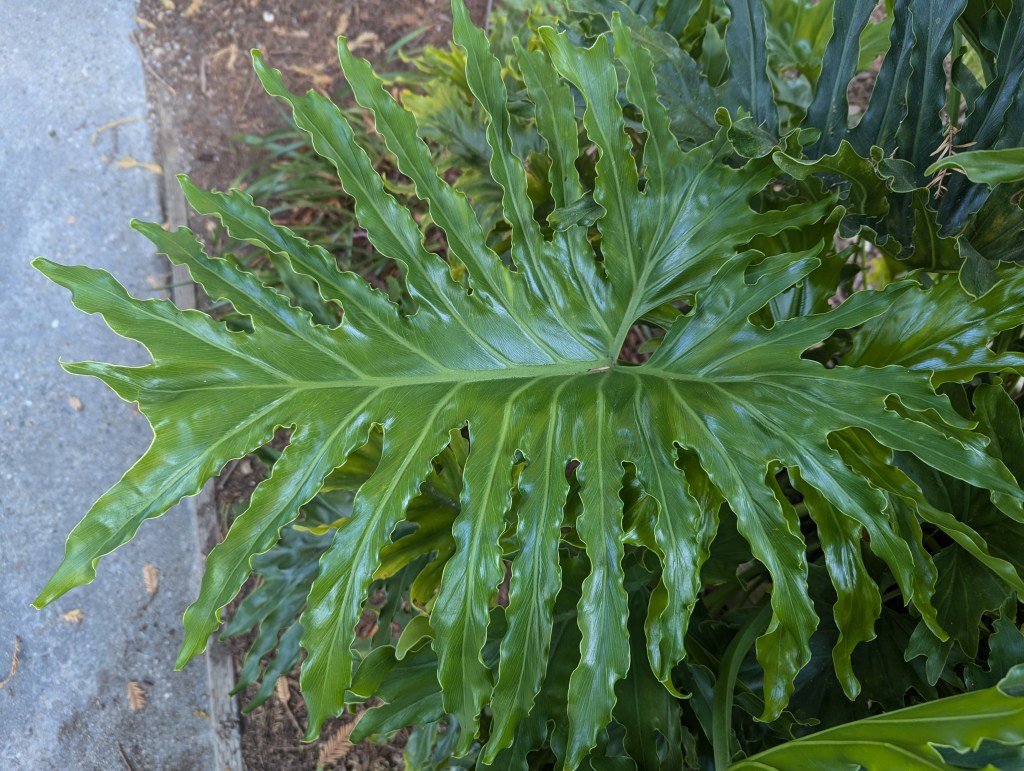
Tangly Cottage Gardening was a primary destination of my vacation. I posted pictures of it last week. These are six more species that I received as gifts.

1. Acanthus spinosus, armed bear’s breech has the strangest common name of these six. Is the bear armed or just its butt? Regardless, I happen to like common Acanthus mollis, and had coincidentally been wanting to try this less common species as well. Now, I will.

2. Echinops ritro, globe thistle was a minor crop where I worked with cut flowers during the summer of 1986. I did not enjoy harvesting it then, but recently, I had coincidentally been wanting to add a single specimen to my garden. I just could not think of an excuse.

3. Helenium autumnale, common sneezeweed also has an amusing common name. I am unfamiliar with this species, although its botanical name somehow seems to be familiar. I got three distinct cultivars of it now! If we were not already acquainted, we will be now.

4. Brachyglottis greyi, daisy bush has a contrarily mundane common name. Many other species could easily qualify for its name. Somehow though, it makes it more compelling. Now, I want to see what makes it distinct from all other daisies, bushes or daisy bushes.

5. Leycesteria formosa, Himalayan honeysuckle or pheasant berry is yet another species that I had coincidentally been wanting to acquire. I embarrassingly did not recognize its name initially. I was told that I would find its flowers to be more appealing than its fruit.

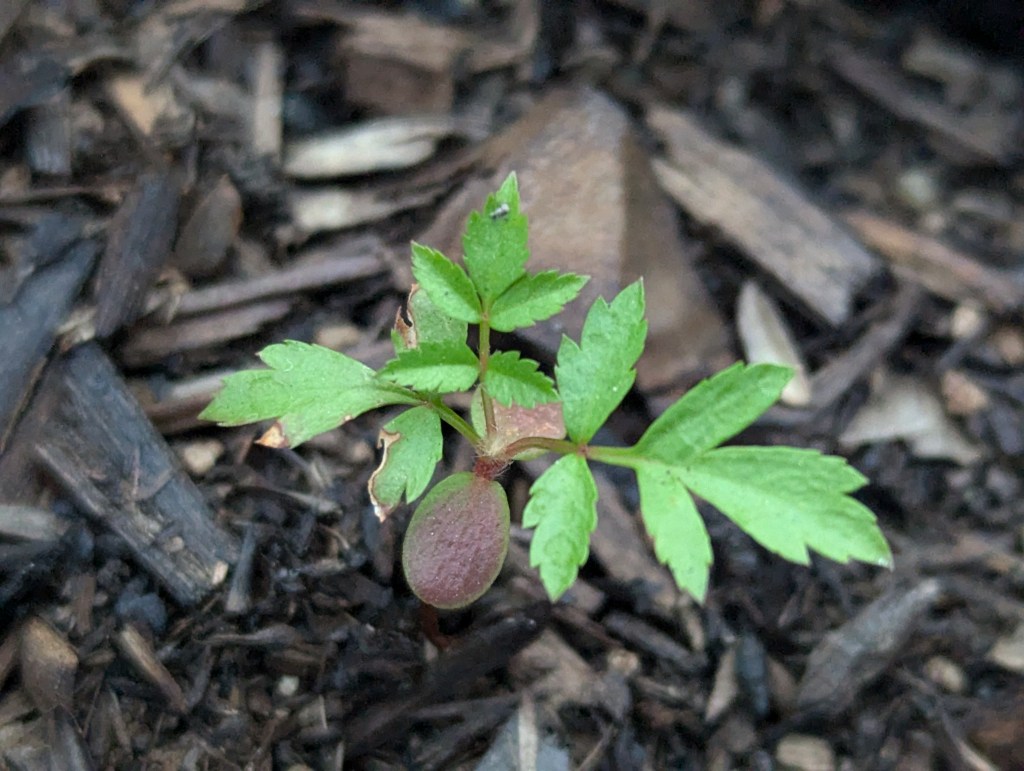
6. Lupinus, lupine is regifted and unidentified. I do not know if it is annual or perennial. Because it was grown in a can rather than merely shared as seed as annuals should be, I suspect that it is perennial. I will find out. This one can contains several swell seedlings.

This is the link for Six on Saturday, for anyone else who would like to participate: https://thepropagatorblog.wordpress.com/2017/09/18/six-on-saturday-a-participant-guide/