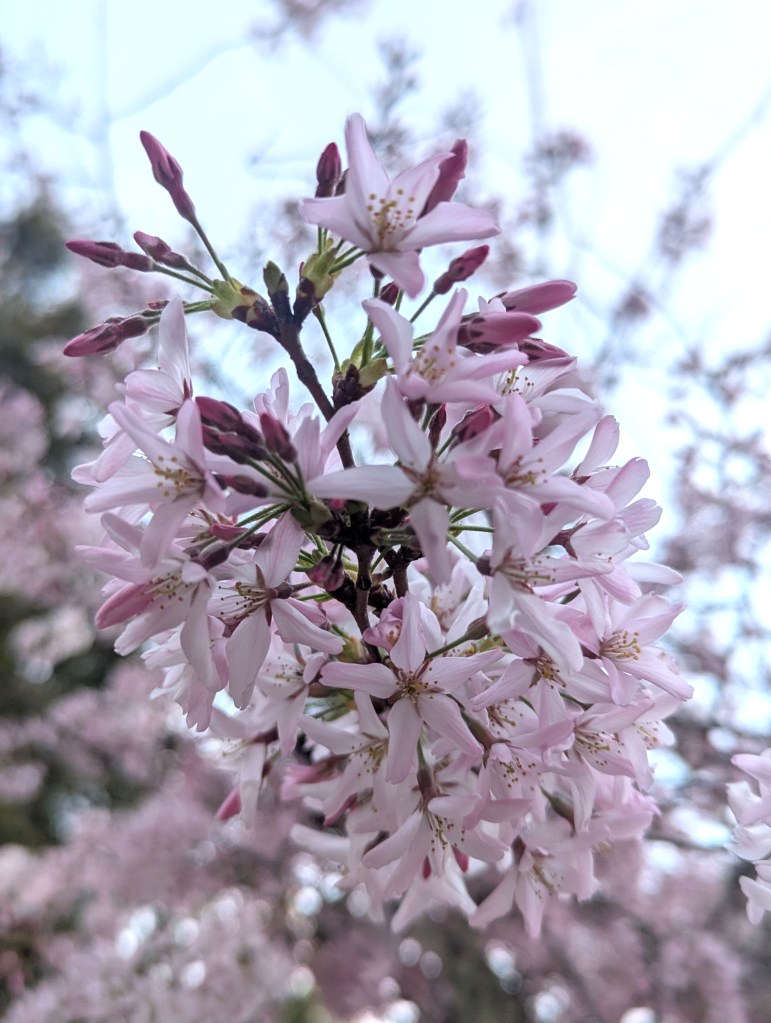
Flowering cherries are a complicated group of many distinct hybrids, of several species. Japanese cherry, Prunus serrulata, is the most common ancestor of almost all of them. It is a relatively small deciduous tree that does not get much more than twenty five feet tall. The wild species produces unpalatable fruit, but its many hybrids are generally fruitless.
Most flowering cherries exhibit splendid autumn foliar color, with yellow, orange and red. Weeping cultivars develop strikingly pendulous form. Birch bark cherry exhibits distinctly smooth and chestnut brown bark, with broad lenticels. Weeping cultivars are sometimes grafted onto birch bark cherry trunks. This combines pendulous form with smooth trunks.
The primary allure of flowering cherries, though, is their profusions of early spring bloom. Floral color ranges from bright white to rosy pink, although most cultivars are pastel pink. Flowers can be delicately single or billowy double. Some cultivars bloom slightly earlier or later than others, but all bloom quite early. Their blooming stems are pretty cut flowers.
Flowering cherries are not necessarily the first of the flowering trees to bloom. Flowering apricot, Prunus mume, is even earlier than all but the winter flowering cherry. Many have bloomed already, and as early as a month ago. The latest will bloom soon. Their flowers are more resilient to weather than those of flowering cherry. However, they bloom briefly.
Although generally fruitless, a few cultivars produce fruit for pickling, as umeboshi. Such fruit, without pickling, is rather unpalatable. Some cultivars of flowering apricot are useful as understock for related trees. Actually, some local flowering apricot trees grew from the roots of other flowering plums. New trees are very rarely available from nurseries locally.
Mature flowering apricot trees are ten to nearly twenty feet tall and almost as broad. They bloom before they foliate. Abundant bloom on big trees can be mildly fragrant. Individual flowers are about an inch wide. They are pastel pink, but can be white or deep rosy pink. Blooming stems can be exquisite as cut flowers, although they may not last for very long. Such stems are a traditional component of ikebana.
Not many fruit trees have been in cultivation for as long. After several thousands of years of breeding, there are quite too many cultivars to count. Pomegranate, Punica granatum, is now common in many regions throughout the World. It is particularly productive within Mediterranean climates, including locally. Bare root trees are now available in nurseries.
Without pruning, old trees can grow fifteen feet tall, with dense and thorny thicket growth. Fruit is easier to collect from tamer trees that are subject to regular thinning and pruning. Individual trees typically develop a few trunks, but can have only one. They may survive for centuries. Ruddy orange flowers bloom for spring. Foliage yellows prior to defoliation.
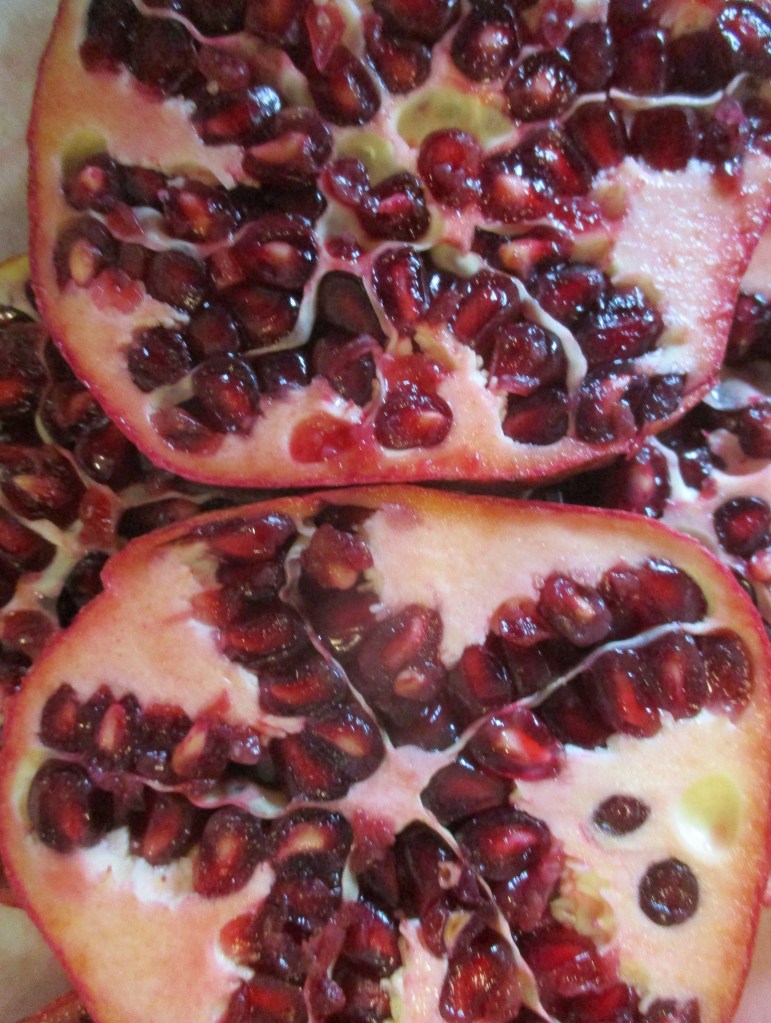
Pomegranate fruit ripens so late during autumn that it can linger after autumn defoliation. It is generally brownish red. Individual fruits are about three or four inches wide, but may be wider. They contain hundreds of seeds, which are surrounded by juicy and succulent flesh. Such flesh is generally garnet red, but might be purplish, pinkish or even colorless. Flowers are edible too.
One of the less common and certainly least familiar of junipers happens to be the most culturally and environmental significant juniper in North America, even though it is not even known as a juniper. Juniperus virginiana is instead known as the Eastern red cedar. It has a vast range, including every state east of Colorado, as well as Quebec, Ontario and even Oregon to the west. In some areas within and near the natural range, fire suppression has allowed Eastern red cedar to become invasive.
Mature trees are mostly less than fifty feet tall, but are the biggest evergreen trees in Kansas nonetheless. The largest Eastern red cedars can get almost ninety feet tall. Most are well branched from top to bottom unless pruned for clearance. The fibrous bark is ruddy brown, but not often seed from the outside.
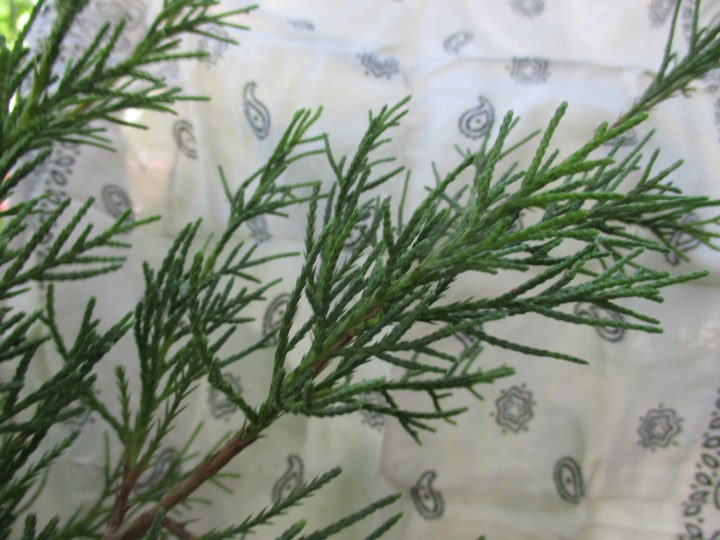
Foliage and fruit are rather variable. The prickly juvenile leaves of young plants and interior stems of mature plants can be rather annoying. The scale-like adult leaves are more typical of junipers. Male trees produce pollen that can be a significant allergen. Female trees produce sporadic, small berries in blue or purplish black, that are quite popular with certain birds through winter.
Prior to the discovery of the incense cedar in the west, Eastern red cedar was the common aromatic cedar that was used to make pencils and to laminate cedar chests and closets to protect woolens and natural fibers from moths. Since it is so repellent to insects and decay, it is commonly used as fence posts. Native American Indians also used posts of Eastern red cedar, painted red with blood of the animals they hunted, to mark the boundaries of their hunting ranges. The name of Baton Rouge, which means ‘red stick’, was actually derived from such marking posts.
During the Dust Bowl drought of the 1930s, and before becoming known as a potentially invasive species, Eastern red cedar was promoted by the Prairie States Forest Project as a resilient wind break. They tolerate drought, harsh exposure and inferior soil. They can be planted close together to fill out and gain height more efficiently. More information about Eastern red cedar can be found where I got much of this information, at the Great Plains Nature Center.
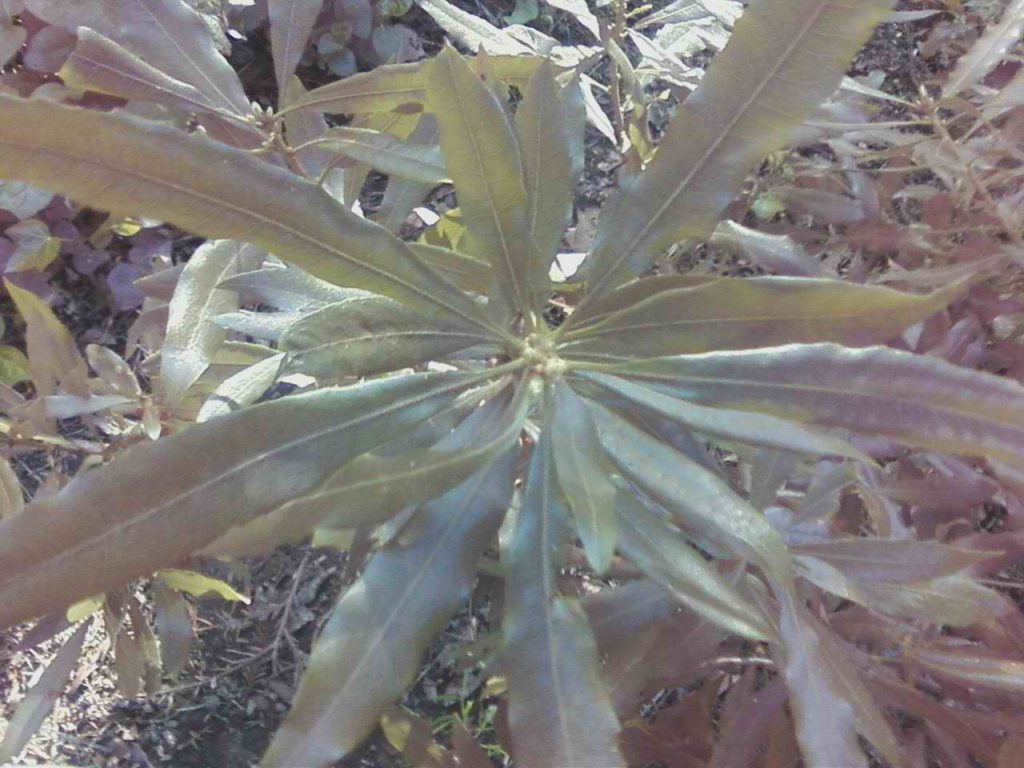
Its silly name is actually justifiable. The papery fruits of Hopbush, Dodonea viscosa, can be useful as a substitute for hops. Almost all hopbush are female, so produce such fruits. However, bloom and subsequent fruit production is variable. Vigorous plants are likely to produce less fruit. Also, some specimens might become male, and therefore be fruitless.
Hopbush is most popular as an informal evergreen hedge. It also works well as a formal hedge. With selective pruning, it can become a small tree with shaggy bark on sculptural trunks. It develops a narrowly upright form while young, but may eventually grow ten feet wide. It grows about twice as tall. Overgrown specimens are quite conducive to pruning.
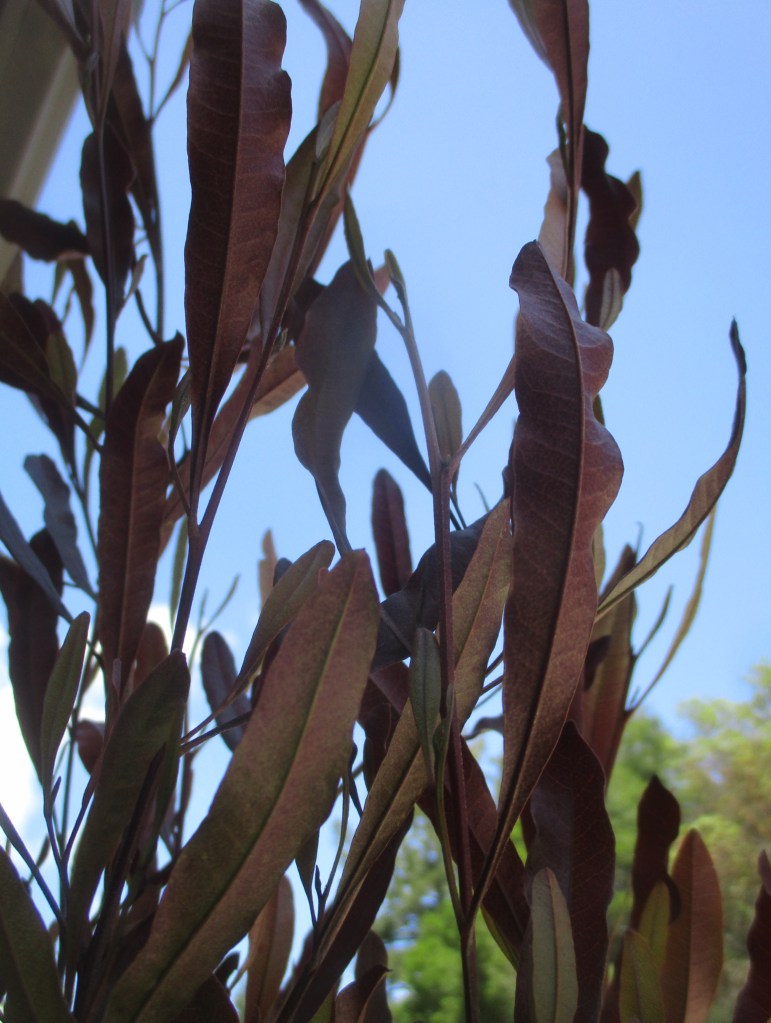
Hopbush exhibits a uniformly fine foliar texture. Individual leaves are two or three inches long, but narrow. Foliar color is soft bronzy green. ‘Purpurea’ is more purplish bronze, but is not quite as vigorous. Roots are very complaisant, but do not disperse well if irrigation is too generous. Established hopbush is undemanding, so does not require much water. It tolerates soil of inferior quality too.
Pacific wax myrtle is the native version of bayberry.
From Washington to Southern California, the Pacific wax myrtle, Myrica californica, is native to coastal regions. It is the western counterpart to the bayberry, Myrica pen(n)sylvanica (or caroliniensis), of the East Coast. It makes a nice informal hedge with only occasional shearing, or an informal screen that only gets trimmed back when it gets too big. Mature plants can get nearly thirty feet tall in sheltered areas, but rarely get half as tall and wide, even if allowed to grow unimpeded. The glossy three inch long leaves are narrow with slightly undulate margins with small teeth.
Pacific wax myrtle functions something like glossy privet or some of the pittosporums that make good hedges, but is not so resilient to frequent shearing. Big stems that get cut back to not always produce new growth. The advantage of Pacific wax myrtle is that it is native, so does not want much water once established, so is happy in out of the way places that do not get watered or maintained. Like privets and pittosporums, Pacific wax myrtle can be pruned up as a small tree with multiple exposed trunks.
There are actually several different purple leaf plums, Prunus cerasifera, to provide colorful white or pink bloom sometime between the middle of winter and the middle of spring, followed by colorful bronzy or purplish foliage through summer. Some also provide good fruit, which can unfortunately be messy if it is not harvested. Most stay quite compact, less than twenty feet tall and broad, so are proportionate to small garden spaces. ‘Hollywood’ is the largest, but rarely gets more than thirty feet tall, and not quite as broad. Prunus X cistena does not get much more than six feet tall and broad.
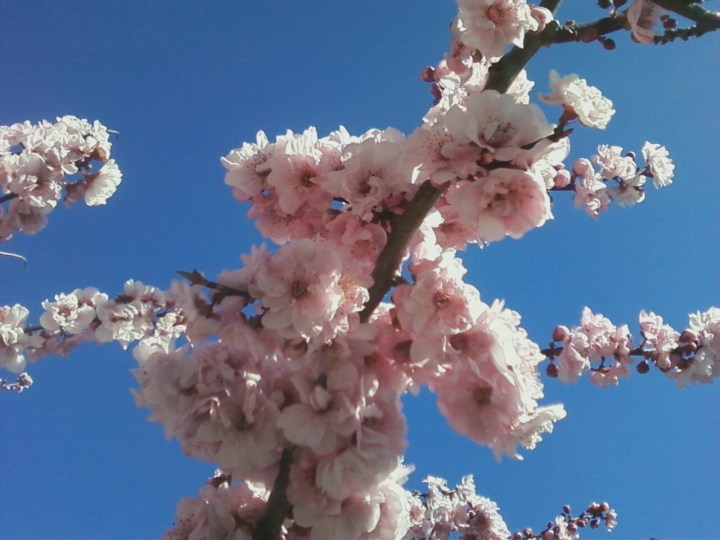
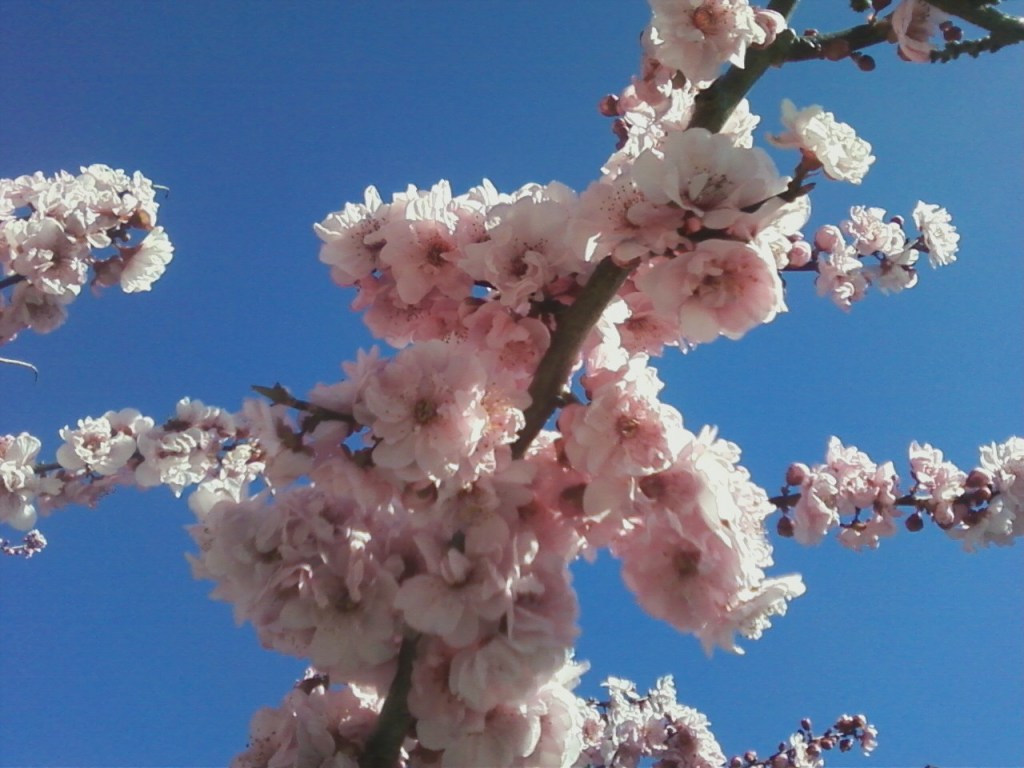
Because each cultivar has a distinct personality, it is important to match trees when adding or replacing trees in a grove. The fruitful ‘Atropurpurea’ has single white flowers in spring, followed by bronzy red new growth that turns purplish in summer and reddish brown in autumn. ‘Krauter Vesuvius’ has single pale pink flowers and the darkest foliage, but lacks fruit. ‘Thundercloud’ has similar or paler flowers, lighter or more bronzy foliage, and sometimes produces tangy red fruit about an inch wide. Prunus X blireiana (illustrated) fades to bronzy green by summer, but has handsome branch structure and double pink flowers that are slightly fragrant. Unlike plums that are grown for larger and more abundant fruit, purple leaf plums do not need much pruning.
Purple leaf plum bloom is more colorful than its purplish foliage.
There are actually several different purple leaf plums, Prunus cerasifera, to provide colorful white or pink bloom sometime between the middle of winter and the middle of spring, followed by colorful bronzy or purplish foliage through summer. Some also provide good fruit, which can unfortunately be messy if it is not harvested. Most stay quite compact, less than twenty feet tall and broad, so are proportionate to small garden spaces. ‘Hollywood’ is the largest, but rarely gets more than thirty feet tall, and not quite as broad. Prunus X cistena does not get much more than six feet tall and broad.
Because each cultivar has a distinct personality, it is important to match trees when adding or replacing trees in a grove. The fruitful ‘Atropurpurea’ has single white flowers in spring, followed by bronzy red new growth that turns purplish in summer and reddish brown in autumn. ‘Krauter Vesuvius’ has single pale pink flowers and the darkest foliage, but lacks fruit. ‘Thundercloud’ has similar or paler flowers, lighter or more bronzy foliage, and sometimes produces tangy red fruit about an inch wide. Prunus X blireiana (illustrated) fades to bronzy green by summer, but has handsome branch structure and double pink flowers that are slightly fragrant. Unlike plums that are grown for larger and more abundant fruit, purple leaf plums do not need much pruning.
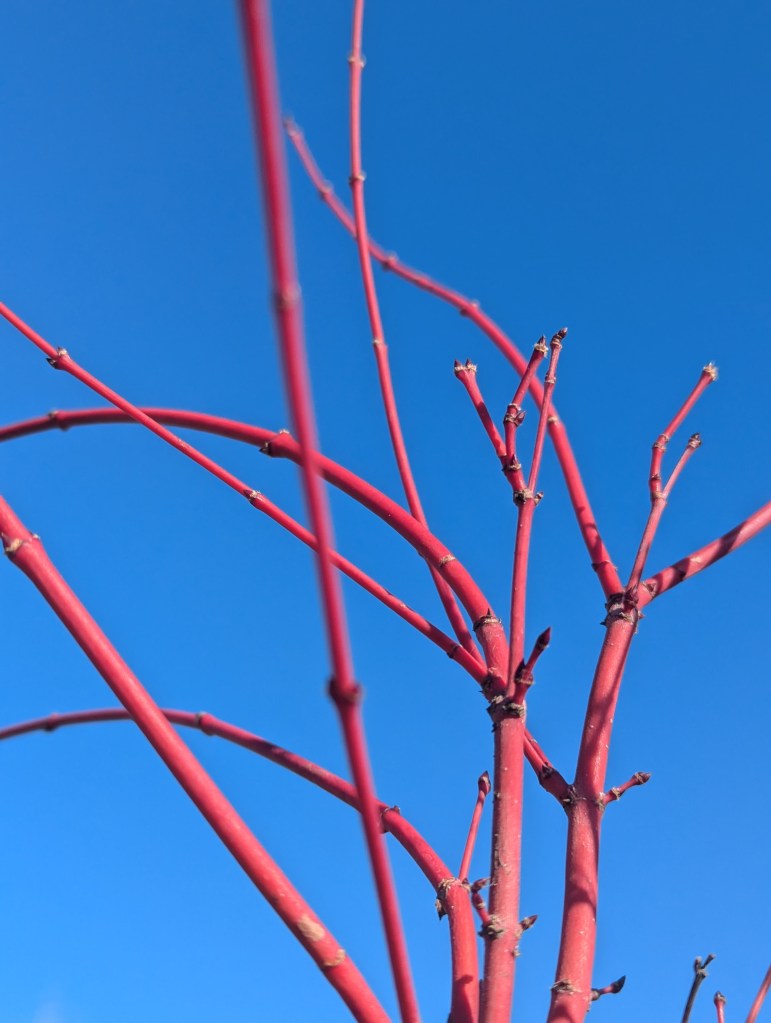
Bloom is probably the favorite component of home gardens. Foliage is likely the second favorite component. Japanese maples are popular as much for their form as for any other characteristic. The intricate textures and autumn color of their foliage is likely secondary. Coral bark Japanese maple, Acer palmatum ‘Sango Kaku’, is even a bit more distinctive.
Relative to other cultivars of Japanese maples, its foliage is not remarkable. Actually, it is more vulnerable to foliar scorch with arid warmth. Its form is not overly remarkable either. For coral bark Japanese maple, the bright red bark of its young twigs is its primary allure. It is obscured by foliage for most of the year, to be revealed by defoliation through winter.
Coral bark Japanese maple is an understory tree, so can tolerate partial shade. With full sun exposure, it particularly dislikes arid wind. It can grow as tall as twenty feet, or might stay as short as ten feet. It naturally produces many long and limber stems with shiny red bark. Severe pruning to promote growth of such stems is likely to ruin its sculptural form.
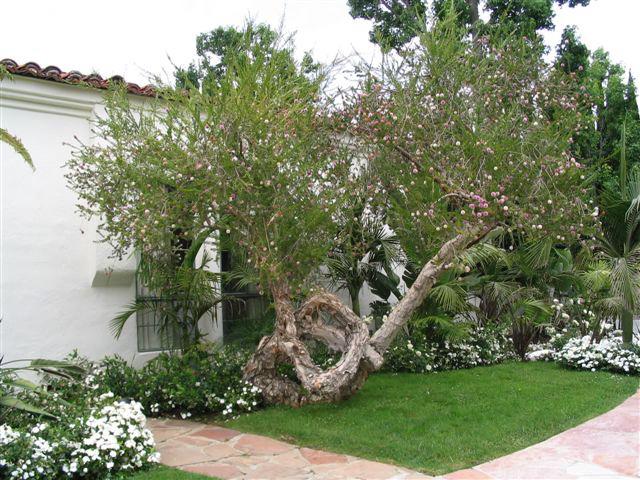
Golden Gate Park in San Francisco has some of the most impressive mature specimens of pink melaleuca, Melaleuca nesophila, outside of their native homeland in Australia. Although most are naturally less than twenty feet tall and wide, their disproportionately bulky trunks are remarkably gnarled and sculptural, as if they have been growing there for centuries. Pink melaleuca actually grows and develops trunk and limb structure rather fast while young, without ever becoming too obtrusively large. Spongy pale tan bark covers the distinguished trunks and limbs like a thick parka.
Sculptural small trees are not the only function of pink melaleuca. They also make nice informal hedges and screens, and can be shorn occasionally if necessary. The round inch long leaves are quite thick. Round inch wide trusses of small staminate flowers bloom slightly purplish pink and fade to pale white through most of the year, except where shorn. (Staminate flowers are showy because of distended stamens instead of petals.) Hummingbirds are grateful for the flowers while not much else blooms through winter. Hard seed capsules that remain in dense cylindrical formation on twigs after blooms are long gone are sometimes used as dried flowers. Like all melaleucas, pink melaleuca is easy to care for, and tolerant of harsh exposure, inferior soil, minimal watering and neglect.

 Tony Tomeo