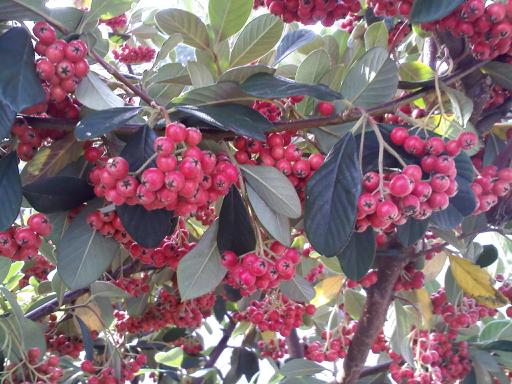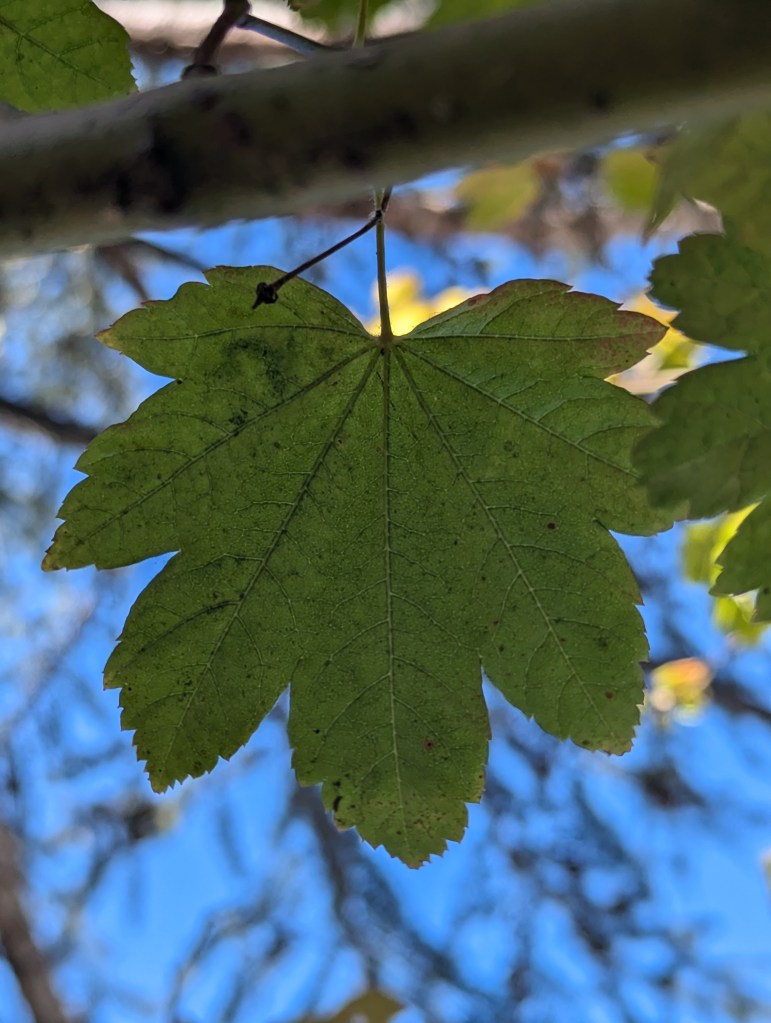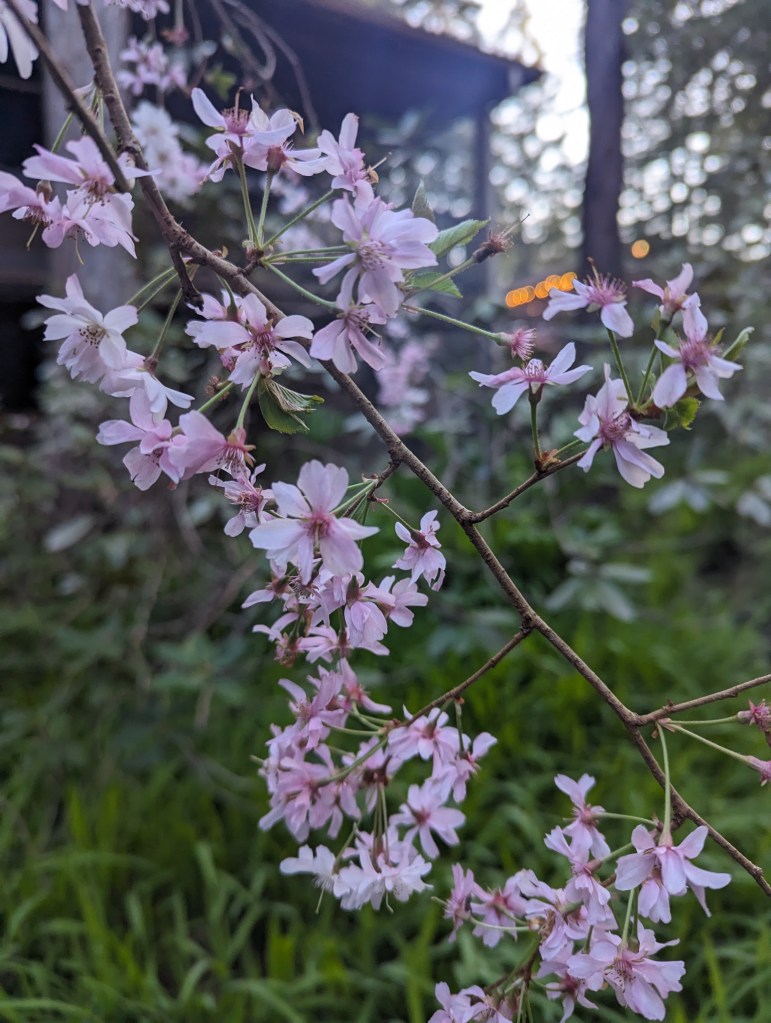
Flowering crabapple is more colorful than crabapples that are grown more for fruit.
This picture resembles flowering cherry, but is actually a flowering crabapple, Malus spp.. Both provide impressively abundant spring bloom before foliation in spring. Both may have single, semidouble or double flowers in various shades ranging from white to rich pink. Some flowering crabapples though have nearly red flowers. Flowering crabapples get slightly larger, more than twenty feet tall and broad; but some stay as short as five feet, and others get taller than thirty feet! Some have bronzy or purplish foliage through summer. The half inch to nearly two inch wide yellow, orange or red fruit can be colorful into autumn, and some makes good jelly; but it can also be messy. The main advantage of flowering crabapples is that they are somewhat less susceptible to rot than flowering cherries are in dense slowly draining soil.
Its name describes it simply. Winter flowering cherry, Prunus X subhirtella, is a flowering cherry that blooms for winter. It is more popular where winters are cool enough to inhibit other bloom. It is less common here only because of other options for wintry floral color. Besides, slightly more floriferous flowering cherries bloom almost immediately afterward.
WIntertime bloom is actually a bit more reliable here than where it is more popular. Frost is too mild locally to damage it much, and mostly occurs earlier. Rain is mostly too light and too brief to dislodge much of the bloom. Bloom is a bit less profuse than that of other cherries because it is a bit more continuous. Therefore, it recovers from minor damage.
The relatively common sort of this uncommon flowering cherry blooms for late winter. Its bloom is slightly lavenderish pink. Some rare cultivars can bloom as early as autumn or as late as spring. A few are pendulous. Floral color ranges from white to pink. Floral form is mostly single but can be double. Deciduous foliage turns yellow or orange for autumn.
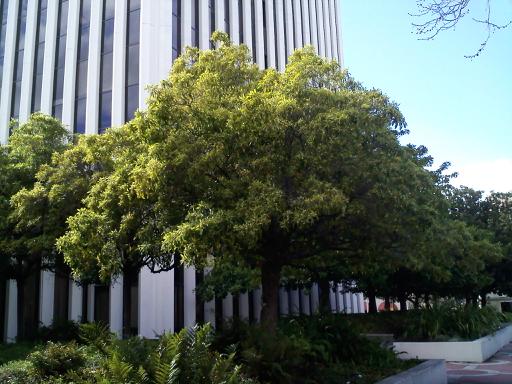
In the right situation, Victorian box, Pittosporum undulatum, is a nice small to mid-sized shade tree with dense foliage, sculptural branch structure and pleasantly fragrant spring bloom. In the wrong situation, it drops enough leaves, flowers and sticky seeds and bits of seed capsules to make quite a mess. This finely textured and sometimes sticky debris is easily absorbed into thick, shade tolerant ground cover like Algerian ivy, but is difficult to rake from pavement and to clean from roof gutters. Besides, even though Victorian box is not a large tree, the roots can eventually become aggressive enough to displace pavement.
Young trees grow rather vigorously to about ten feet tall and wide, and then slow down somewhat as they continue to grow to as much as three times as tall and wide. They are easily contained with occasional selective pruning. The small, clustered flowers are not as impressive as their fragrance, adding only a bit of pale yellowish white color over the exterior of the rounded canopy. Some people, as well as birds, like the greenish olive-sized fruit that turns orange and eventually splits open to reveal sticky orange seeds within. (‘Pittosporum’ translates into ‘sticky seed’.) Leaves are about two or three inches long, or longer, with ‘undulating’ margins.
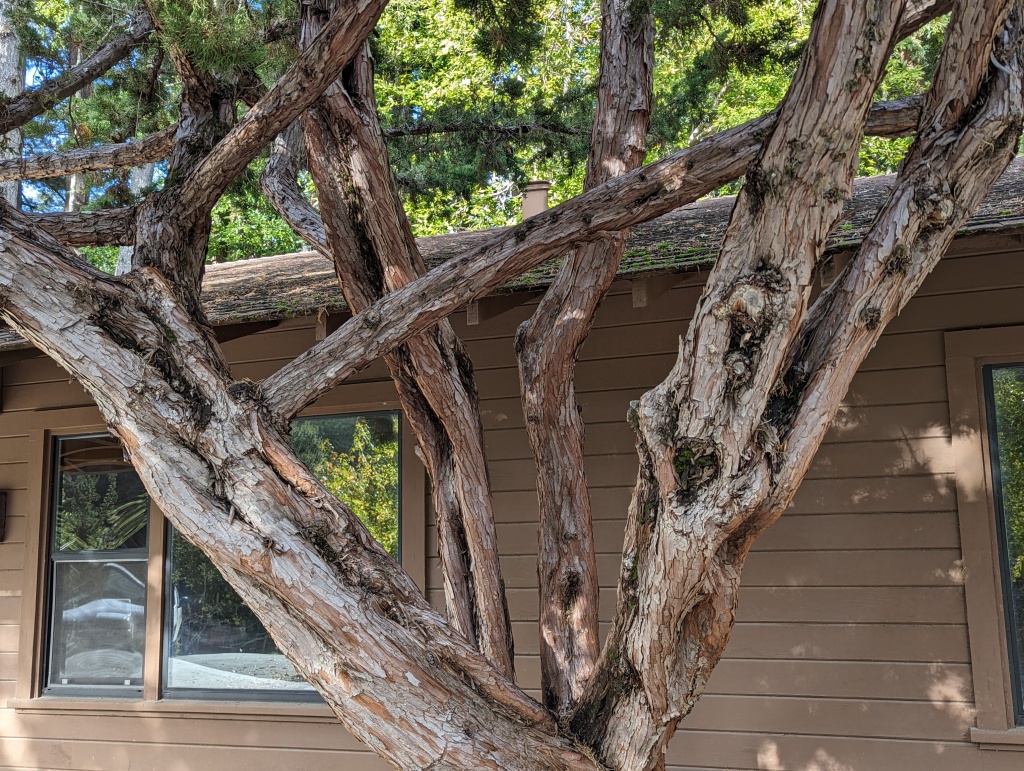
This is an exemplary specimen of Juniperus chinensis ‘Kaizuka’, Hollywood juniper
Juniperus chinensis ‘Kaizuka’, Hollywood juniper is one of my favorite junipers. The few North American junipers that I prefer more are not as appealing for prominent positions within refined landscapes. Hollywood juniper is distinctly sculptural with its strikingly gnarly form. The dense, finely textured and deep green foliage contrasts stylishly with the more coarsely textured and rusty reddish brown bark. Whether a large shrub or a small tree, properly groomed Hollywood juniper can be an elegant trophy tree.
The illustration above is from my ‘Six on Saturday’ post from two weeks ago. It shows one of the largest specimens of Hollywood juniper that I have ever worked with. Initially, I pruned it for clearance from the roof and parking spaces that it extends its canopy over. I also thinned it somewhat. I intended to elevate and thin it a bit more this year or next.
Instead, it became firewood. Sadly, it grew too big and obtrusive for its situation. One of its large roots was displacing the asphalt pavement of the parking spaces in front of it. Another was beginning to do the same. It was very saddening to see it dismembered and processed, as the foliar canopy was discarded to compost into the forest, and the trunk and limbs were taken to a woodpile.
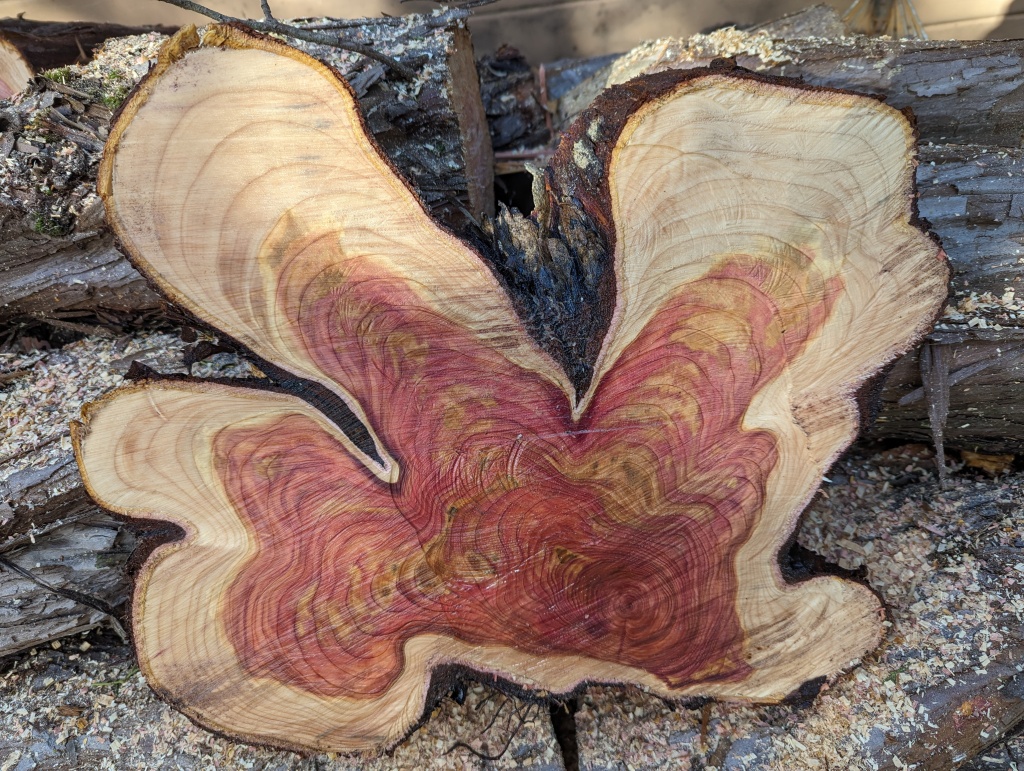
Even as firewood, it retained unique beauty. The illustration below shows the contrast of the red heartwood and blond younger wood within the interior of the gnarly trunk. If it resembles the interior of a cedar chest, it is because it is related to the Juniperus virginiana, Eastern redcedar, which is the cedar within cedar chests (but is not actually a real cedar). Although not visible within the illustration, the woodsy aroma of the exposed wood is very similar to that of a cedar chest.
Japanese pine is more proportionate to confined urban home gardens than more common species.
Not many large specimens of Japanese black pine, Pinus thunbergiana, can be seen around the Santa Clara Valley. They can get taller than a hundred feet on straight trunks in their natural range on the coast of Japan, but locally, rarely get more than a quarter as tall on leaning and irregular trunks. They just are not quite as happy in the dry air here (minimal humidity). They are purported to be more tolerant of smog than most other pines that were so sensitive to the nasty smog of the 1970’s, but are more likely to become infested with insect pathogens as they get old.
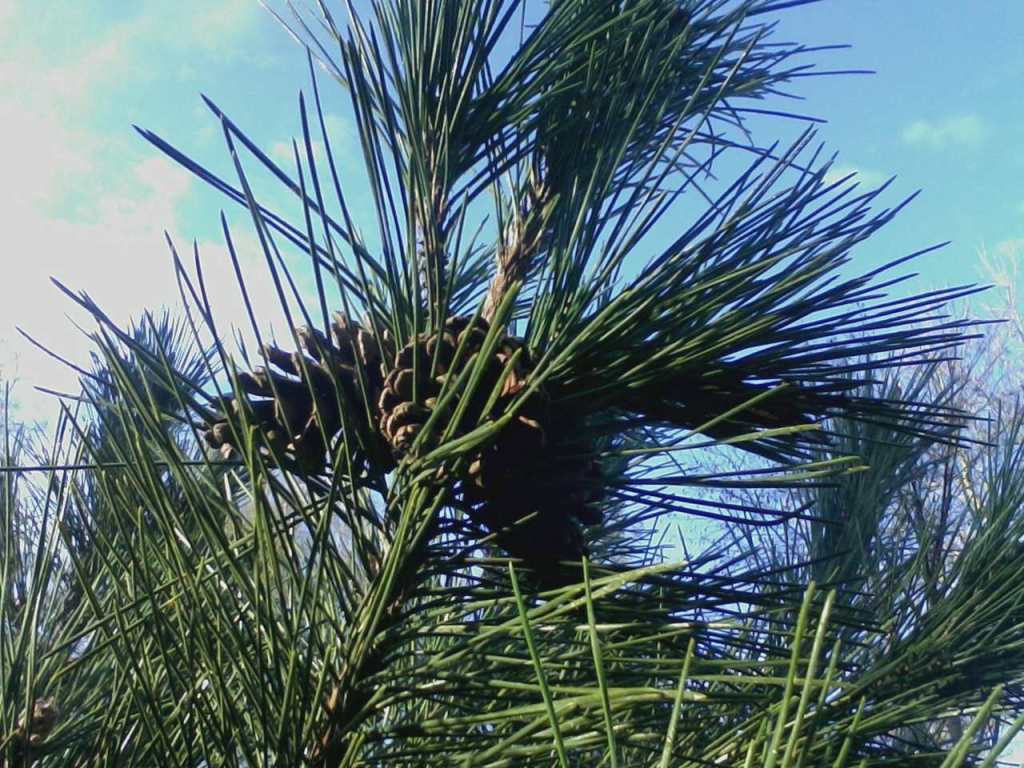
With their angular and somewhat open growth, and classic pine foliage and cones, Japanese black pines are one of the more distinctive pines. Since they do not get too large, they can work well as sculptural specimen trees in small garden spaces and atriums. Even if they grow up above the eaves, their leaning trunks and outstretched lower limbs with rough gray bark are as distinguished as those of larger trees.
The paired somewhat stiff needles are about three or four inches long. The small but stout cones stay green through most of their first year of development, and then turn brown as they mature and open to disperse their seed in the second year. They are only about two inches long, but can become annoyingly abundant among aging trees.
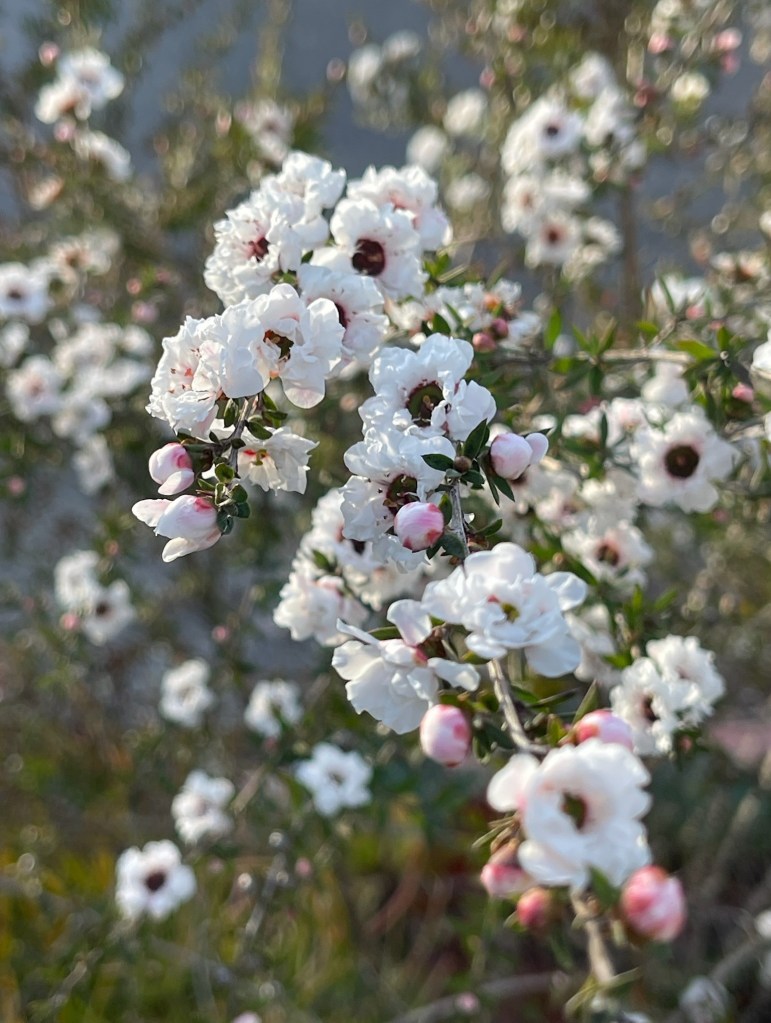
Bloom should probably be most profuse for late spring or early summer. In actuality, New Zealand tea tree, Leptospermum scoparium, blooms whenever and however it wants to. Now that it seems to be blooming prematurely, it might continue to bloom in phases until autumn. Minor bloom phases might even continue randomly through autumn and winter.
Floral color is white, pink or red, including deep ruby red. The tiny flowers are sometimes sporadic but sometimes quite profuse. A few cultivars have plump double flowers. Foliar color is olive drab green or bronze green. The finely textured evergreen foliage is slightly scratchy. Its tiny leaves have pointed tips. The fibrous brown bark is handsomely shaggy.
New Zealand tea tree works very well as a blooming informal hedge. Frequent shearing of formal hedges compromises both bloom and natural form. Elimination of lower growth exposes appealingly sculptural trunks supporting little trees. Some modern cultivars will not reach first floor eaves. Some reach second floor eaves. All demand sunny exposure.
Hollywood juniper had formerly been the only popular juniper of tree form. As it became less popular during the past few decades, cultivars of the once obscure Rocky Mountain juniper, Juniperus scopulorum, became more popular. Also, a few more modern cultivars became available. Now, the once overly common Hollywood juniper is quite uncommon.
Rocky Mountain juniper is naturally rather grayish for protection from the harsh exposure of the high elevations which it inhabits. Cultivars are grayer, bluish or silvery, and mostly develop symmetrically conical form. Old specimens that were initially conical eventually grow as small trees with rounded and relatively dense canopies, perhaps on bare trunks.
‘Skyrocket’ and ‘Blue Arrow’ are very narrow like Italian cypress that grow only fifteen feet tall. ‘Wichita Blue’ and ‘Moonglow’ are stoutly conical. ‘Blue Arrow’ and ‘Wichita Blue’ are bluish green. ‘Skyrocket’ and ‘Moonglow’ are silvery gray. Established specimens do not require much water, but develop better foliar color with warmth and occasional watering.
By the end of the Victorian Period, dracaena palm, Cordyline australis, had become very popular, both as small trees and as foliar plants. The largest specimens were only about twenty feet tall and half as wide. Removal of trunks that grew too tall for short foliar plants induced fresh basal growth. The drab leaves grew three feet long and three inches wide.
Cultivars with bronzed foliage became more popular after the Victorian Period, although not as common as the original. They grew slower and stayed smaller. The many modern cultivars of the past few decades stay even smaller, with even more impressively colorful foliage. Most are purply bronze or variegated with creamy white, pale yellow, pink or tan.
Modern cultivars generally mature efficiently, but then attain height too slowly to function as small trees. Some do not develop substantial trunks. They are therefore more popular for their delightful foliar color and texture. Many generate appealingly pendulous foliage. However, a few eventually develop sculptural form with exposed corky trunks and limbs. Removal of unimpressive floral panicles prior to bloom removes floral frass before it gets messy.
The strikingly glaucous juvenile foliage of silver mountain gum, Eucalyptus pulverulenta, is likely more familiar within floral design than in home gardens. Actually, it is uncommon within home gardens, although quite popular as cut foliage among florists. Its paired and sessile leaves are oval or bluntly cordate (‘heart shaped’), and about an inch or two long.
Adult growth is rare, even among established trees. However, small white flowers bloom from the axils of juvenile leaves that are a year old. (Juvenile growth of most species can not bloom.) Bloom might continue from spring until autumn, as blooming stems sag from the weight of younger distal growth. The aromatic and evergreen leaves stiffen with age.
Low and shrubby specimens with a few trunks may not get much higher than fifteen feet. They have potential to get twice as tall though, particularly if pruned up onto bare trunks. Lignotubers expand below the trunks. Strips of old bark shed to reveal fresh matte brown bark. Incidentally, the Latin name of this species often transposes for Eucalyptus cinerea.
Pittosporum eugenioides leaves have distinctively wavy margins.
Large shorn hedges or informal screens are the more popular functions of Pittosporum eugenioides. It works like a modern and more relaxed option to privet. What few garden enthusiasts know is that it can alternatively be allowed grow into a small tree, either as a standard (on a single trunk) or with multiple trunks. It grows rather efficiently to more than twenty feet tall and about half as broad while young, and as it matures, can eventually get about thirty feet tall and broad.
The glossy leaves have appealingly wavy margins and distinctively pale midribs. The slightly fragrant flowers are only pale yellow, and are not abundant among young trees. Big old trees often bloom enough in autumn to be pleasantly fragrant. Stems and foliage are lemony fragrant when pruned or shorn. However, the common name of ‘lemonwood’ (or tarata) is not so common locally for Pittosporum eugenioides.