Slugs & Snails

hor d’oeuvres

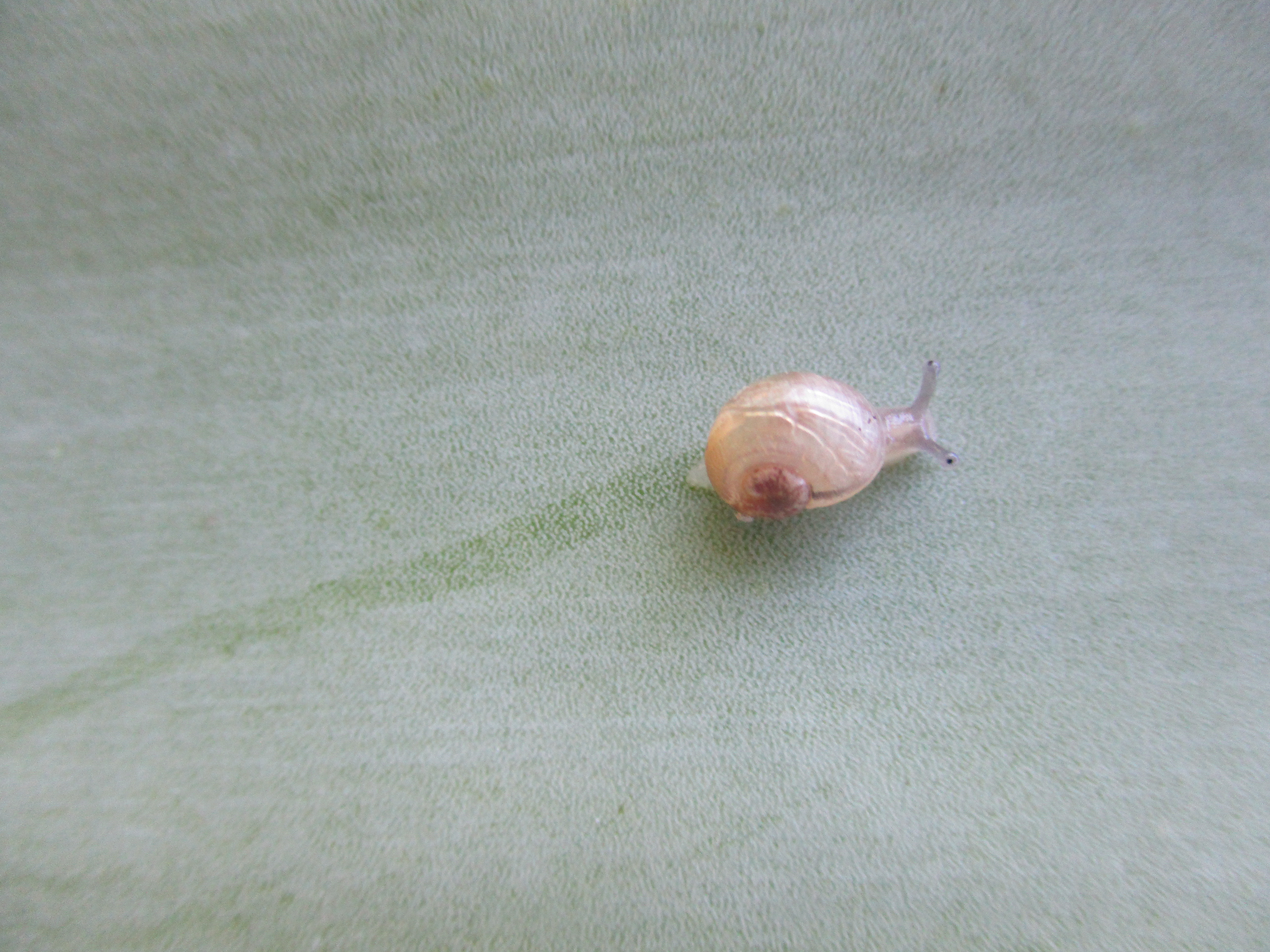
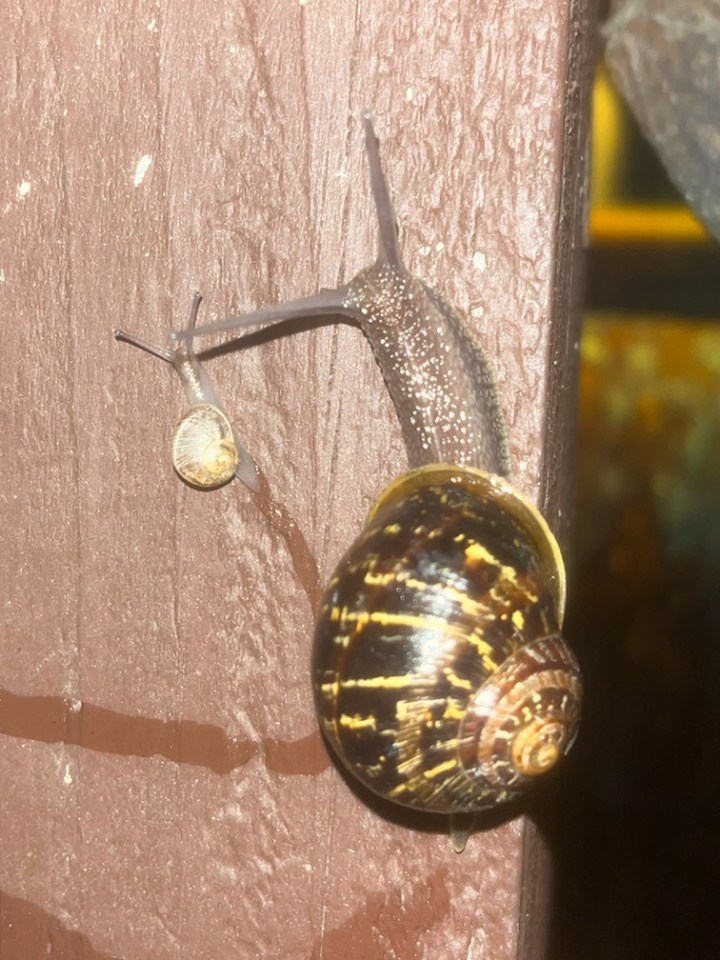
The British Invasion by the Beatles may not have been much of a problem to American gardens; but the French Invasion by brown snails is. Since getting imported as escargot, they eat much more than they get eaten, tearing apart flowers and foliage and devouring young seedlings completely. They tend to hide during the day, and emerge after sunset to graze voraciously until dawn.

Snails as well as slugs are most active this time of year, while the garden is still damp from winter rain, but getting warmer with springtime weather. Fresh vegetation that grows and starts to bloom about now is more than abundant enough to sustain them. Slugs and snails may be slow and ‘sluggish’, but have immense appetites.

Unfortunately, lush foliage that is most susceptible to the wrath of snails and slugs is also the most conducive to their proliferation. Overgrown foliage and plants with large leaves provide plenty of cool damp shade for snails and slugs to hide in during the day. Removing big weeds, fallen leaves and any debris eliminates some of the shelter that they crave while the sun is up.

Snails and slugs are neither elusive nor fast. Hunting them should be easier than it actually is. They are of course easiest to catch while they are out at night. Shallow containers, like saucers for potted plants, containing puddles of beer purportedly get snails to stay out drinking until the sun comes up and roasts them, but this technique is probably more work than it is worth. It wastes beer and seems to catch only a few victims at a time. Besides, the beer gets washed away whenever the garden gets watered.

It is easier and just as sneaky to leave boards or cardboard out overnight for snails and slugs to hide under in the morning, and then surprise the deceived snails and slugs during the day by depriving them of their shelter. They are objectionable to handle, but otherwise easy to collect. Your imagination is probably more useful than any recommendations about how to dispose of them once collected.

Copper tape that can be found in nurseries and hardware stores is a barrier to snails and slugs. It can be self adhesive, or stapled to wooden planter boxes. Plants must be contained within a copper barrier to prevent slugs and snails from getting over the barrier on any plant part that extends within their reach.

Bare copper wire can also be effective. Because trees are actively growing this time of year, copper wire wrapped as a barrier around tree trunks should have some slack, such as a flat ‘S’ shaped curve, to accommodate for trunk expansion.

Salt should not be used to control snails and slugs because it can be harmful to plants. Too much would be needed to surround susceptible plants, and like beer, it would get rinsed away when the protected plants get watered. Keeping drainage saucers filled with water as protective moats for potted plants inhibits drainage, and provides a place for mosquitoes to proliferate.
Snail Season

Very fresh escargot

The problem with escargot that is too fresh is that it grazes – a lot! Snails, as well as slugs, lurk in our own gardens, waiting for nightfall, or sometimes not, to emerge and devour any tender plant parts that appeal to them. They tear apart large leaves and fresh flowers, and eat seedlings completely. They are particularly problematic this time of year, while the garden is still damp, but the weather is getting warmer, and especially since there is so much fresh new vegetation for them to eat.

The most effective means of controlling these troublesome mollusks is to eliminate their hiding places where they camp out during the day. This involves pulling large weeds and removing any debris that may be laying about the garden. Leave no stone unturned. Of course, this is not so easy in lush gardens with abundant or overgrown foliage, and features like large pots and statuary. In such situations, cunning and diligence are in order.

I have found bare copper wire wrapped around pots, planters and tree trunks to be an effective deterrent. Copper tape sold in nurseries and garden centers is probably better since it is wider. It can be self adhesive, or stapled to wooden containers or shelves. Snails can get past the copper though, on any plant parts than hang over where the snails can reach. Wire should be removed from tree trunks after ‘snail season’, or wrapped in a manner that accommodates for trunk expansion. For example, an ‘S’ shaped curve in the circling wire set flatly against a tree trunk provides enough slack for a bit of expansion.

It is also good to hunt snails as they come out after dark or before they go in for the morning. They are neither elusive nor fast. They are merely objectionable to handle. Laying a piece of cardboard or similar material out for them to hide under, and then surprising them during the day is a sneaky trick, but effective. Putting small puddles of beer out in shallow containers, such as saucers for potted plants, is more work, but not often as effective. It is sneakier though, since it entices the snails to stay out drinking until they die in the sunlight.   

Escargots

French hors d’oeuvres are somehow among the most bothersome of garden pests within California. They are voracious. They are very prolific. They are sneaky. They are more resilient to attempts to limit their damage than they had been in the past. Furthermore, attempts to limit their damage are less effective than they had been in the past.

Molluscicides, which are the pesticides that are formulated to be toxic to molluscs such as snails, are not nearly as toxic as they had formerly been. Years ago, they were so toxic that they had potential to be dangerous to cats, dogs, wildlife or children. They are safer for everyone now, including the molluscs that they should be toxic for. Some snails succumb after consuming such molluscicides, but some survive.

The progeny of snails who survive consumption of molluscicide are genetically more likely to also survive consumption of the same molluscicide than snails who did not survive to proliferate. Those who do not inherit such genetic resilience do not survive to proliferate. Consequently, each subsequent generation is more resistant to the particular molluscicide than its preceding generation. Although a different molluscicide would be more effective temporarily, a few snails survive it also, to proliferate and repeat the process. It is how they ‘develop resistance’.

Besides, many garden enthusiasts are hesitant to apply molluscicides because of how toxic such pesticides had been in the past, and how, regardless of how much safer they now are, they must still be toxic to some degree in order to be effective.

Lushly landscaped and generously irrigated home gardens are ideal habitats for snails. Vegetation within such landscapes is damp and sheltered, and provides an abundance of sustenance. Skunks, foxes, ducks and other wildlife that eat snails generally avoid or lack access to many urban home gardens. Opossums and raccoons are either uncommon, or more interested in eating fruits, vegetables, trash or dog and cat food.

Late Night Terror For Foliage

Snails and slugs really crave hostas.

Snails and slugs really enjoy all the new seedlings and fresh foliage that is growing in the garden while the soil is still damp from earlier rain, and the weather is getting warmer. They are neither too smart nor too fast, but they are very hungry, and do their damage at night when no one is watching. They hide before the sun comes up.

The same lush foliage that they eat is also where they often live. However, they also live among lily-of-the-Nile and some ferns that they do not damage very much, as if they think that no one will look for them there. They also hide under any sort of debris and in valve boxes. Removing such debris and unwanted weed foliage diminishes their habitat.

Pieces of damp cardboard intentionally left out in cool and damp spots in the garden overnight can attract snails and slugs as they seek shelter in the morning, and then be flipped over during the day to collect and dispose of the surprised snails beneath. It is sneaky, but effective. People who happen to be up late can hunt for snails while they are out and about. Otherwise, hunting for hiding snails and slugs by daylight takes a bit more diligence.

Saucers or plastic lids containing puddles of beer is supposed to keep snails and slugs out drinking until they get roasted when the sun comes up. The problem is that the beer gets washed away whenever the garden gets watered. Besides, it does not really kill very many victims. Salt around the most susceptible plants likewise gets washed away, and can be toxic to the plants that it is supposed to protect. Keeping water in drainage saucers below potted plants is a problem for drainage, and allows mosquitoes to proliferate.

Copper tape that can be purchased from nurseries or hardware stores is an effective barrier for snails and slugs, but only if the susceptible plants are completely surrounded, and only if leaves or stems that extend over the copper do not touch anything outside. Copper tape can be self adhesive or stapled to wooden planters. Bare copper wire is just as effective. If wrapped around tree trunks, copper tape or wire should have some slack to allow for growth. An extra bit of self adhesive copper tape pressed against itself to form a tab that it can be pulled apart as needed should work well. Copper wire only needs a small loop of extra wire.

Snails, Weeds And Falling Leaves

Gardening does not slow for autumn.

The coloring of foliage is a bit slow this autumn. The cooling nights after such warm weather is bringing some of the deciduous foliage down while it is barely yellowing. Honeylocust and black oak have already gotten notably sparse without much notable color. Hopefully, the more colorful sweetgum, flowering pear, pistache and gingko trees will retain their foliage later into cooler weather, so that they can put on a worthy show before filling compost piles.
It is probably slightly too early to clean gutters and downspouts. Unless the rainy season somehow starts first, this should probably wait until most of the foliage that is expected to fall has already fallen. Lawns, certain ground covers, decks and pavement should be raked as needed though. Decks and pavement can get stained from the tannins that leach from decomposing foliage. Lawn and ground cover do not like the shade under the debris.

However, slugs and snails really dig the mess. Fallen foliage keeps the ground cool, damp and shaded. Raking leaves does not eliminate slugs and snails, but inhibits their proliferation. There are always plenty of other hiding places. As the weather eventually gets cooler and damp, snails that stay out in the early morning should be collected and disposed of. Of course this technique is not convenient for everyone, since most snails hide before the sun comes up. Small slugs hide earlier in the morning and are even more unpleasant to handle.

Once found, neither slugs nor snails are too elusive . . . or fast. Yet, plucking and collecting them is not a fun job. Once collected, no one knows what to do with them. They can be put into plastic bags and disposed of; and will eventually succumb. Some people prefer to simply toss them onto a dry and sunny driveway or roof where they succumb more quickly and get taken by birds. Snails may need to be squashed to limit mobility.

Even though it is too late to prevent most types of weeds from dispersing their seed, a few types continue to disperse seed as they deteriorate through autumn and winter. Weeds in areas that get watered last longer and disperse their seed later than those without watering. Perennial weeds that are still green in dry areas areas will be easier to pull after the first rain.

Snails, Weeds And Falling Leaves

P90713KThe coloring of foliage is a bit slow this autumn. The cooling nights after such warm weather is bringing some of the deciduous foliage down while it is barely yellowing. Honeylocust and black oak have already gotten notably sparse without much notable color. Hopefully, the more colorful sweetgum, flowering pear, pistache and gingko trees will retain their foliage later into cooler weather, so that they can put on a worthy show before filling compost piles.

It is probably slightly too early to clean gutters and downspouts. Unless the rainy season somehow starts first, this should probably wait until most of the foliage that is expected to fall has already fallen. Lawns, certain ground covers, decks and pavement should be raked as needed though. Decks and pavement can get stained from the tannins that leach from decomposing foliage. Lawn and ground cover do not like the shade under the debris.

However, slugs and snails really dig the mess. Fallen foliage keeps the ground cool, damp and shaded. Raking leaves does not eliminate slugs and snails, but inhibits their proliferation. There are always plenty of other hiding places. As the weather eventually gets cooler and damp, snails that stay out in the early morning should be collected and disposed of. Of course this technique is not convenient for everyone, since most snails hide before the sun comes up. Small slugs hide earlier in the morning and are even more unpleasant to handle.

Once found, neither slugs nor snails are too elusive . . . or fast. Yet, plucking and collecting them is not a fun job. Once collected, no one knows what to do with them. They can be put into plastic bags and disposed of; and will eventually succumb. Some people prefer to simply toss them onto a dry and sunny driveway or roof where they succumb more quickly and get taken by birds. Snails may need to be squashed to limit mobility.

Even though it is too late to prevent most types of weeds from dispersing their seed, a few types continue to disperse seed as they deteriorate through autumn and winter. Weeds in areas that get watered last longer and disperse their seed later than those without watering. Perennial weeds that are still green in dry areas areas will be easier to pull after the first rain.

Banana Slug

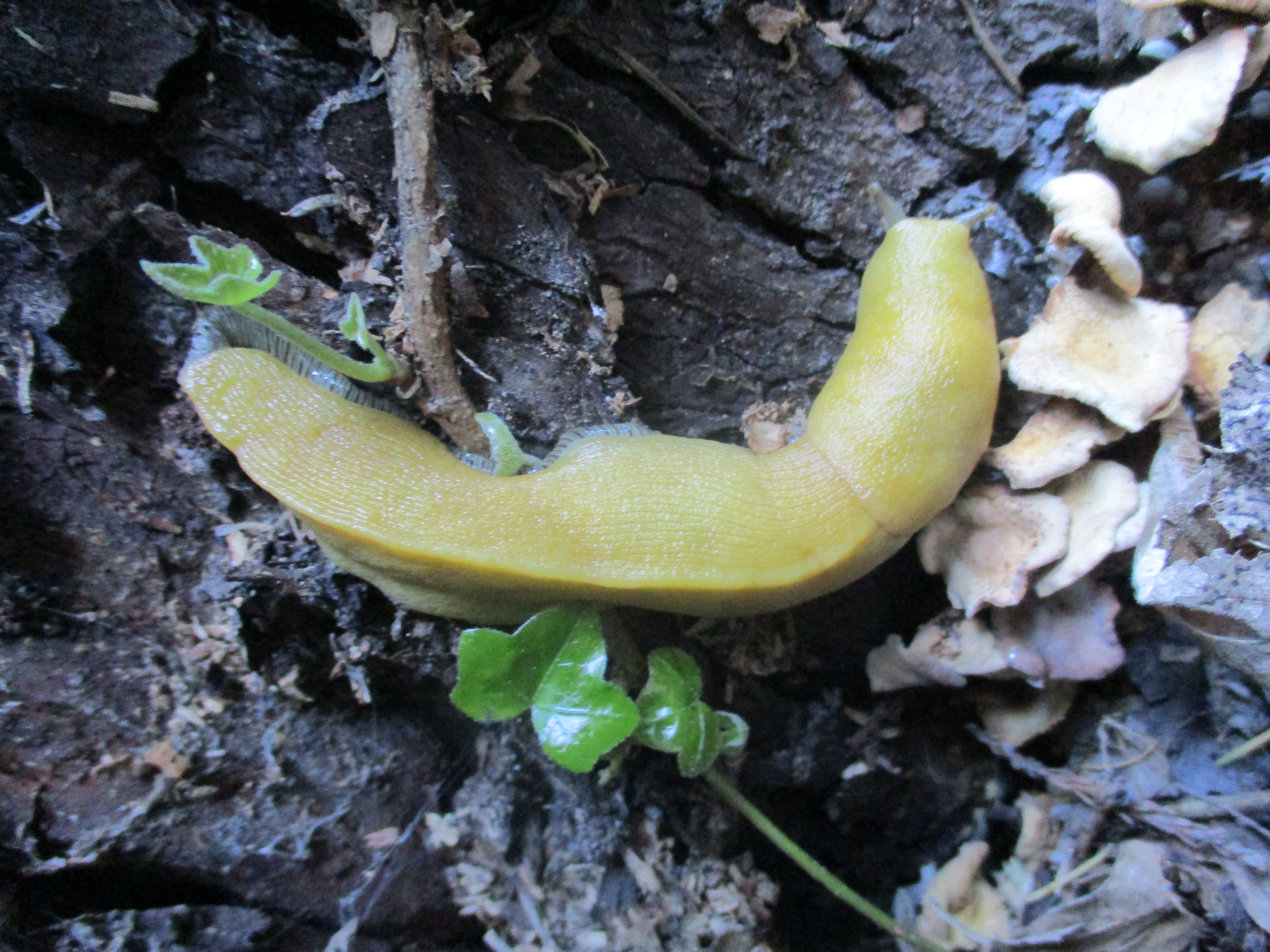
P90421They are not as dangerous as they look. Really. If they were, just one could do more damage than an entire herd of average slugs. The fortunate truth is that banana slugs consume only decaying plant parts and fungus. Yes, they literally cruise about the garden eating bits of decomposing debris that we may not want there anyway, and converting it into a very nutritious and nitrogen rich ‘fertilizer’. They are actually beneficial to home gardening.
Of course, this does not necessarily mean that we ‘want’ them in our gardens. They really do look scary. This one is only about four inches long, but larger ones can get nearly twice as long! Some rats are not that big! Their bright yellow color, which is typically brighter yellow than this one is, is an expression of defiance. They only stay out of the way because they prefer damp and shady situations. Otherwise, they do not care if we see them.
Contrary to popular belief, they do not really taste like chicken. They taste more like the blandest of escargot. If not purged with corn meal and partly deslimed with vinegar, they can taste much worse. Even if the myth about the slime on their undersides containing more vitamin C than a bucket of oranges is true, it does not justify licking them. It is more degrading to you than it is to them; and no one needs that much vitamin C anyway!
As revolting as they are, they are not completely disdainful. It is fun to point them out to friends who have never seen them before, but only after they have gotten close enough to be startled, and jump away as if being chased by something that can actually move . . . quickly. Banana slug races are also fun.