Historic Bloom

‘Stuttgart’ Canna to the left and an unidentified tall Canna with red bloom and green foliage to the right

It is not as important as it sounds. Two varieties of Canna bloomed for the first time here during the past few weeks. They are important only to me because of their origins. With very few exceptions, such as the still elusive ‘San Jose’ bearded iris, I do not pursue rare or unusual species, varieties or cultivars. Actually, most of my favorites are quite common, and most that are rare here are common where they came from. I obtained some from places I have travelled to. Most were gifts from friends, neighbors and colleagues. The Canna to the left is ‘Stuttgart’ from Tangly Cottage Gardening. This is its second season here, but it did not bloom successfully before autumn chill last year. It is the second of three different Canna musifolia here. The first has moderately bronzed foliage. The third has simple green foliage. ‘Stuttgart’ has the most distinctive foliage that is variegated with variable white bands. All three bloom with similarly subdued and pastel orange flowers, but for this first bloom, ‘Stuttgart’ is blooming with a bit more peachy pink. The Canna to the right was a gift from a friend of a friend last winter. It is the third red Canna here, but the first is an unidentified compact cultivar that gets only about half as tall with garishly big flowers, and the second is ‘Australia’ with darkly bronzed foliage. This new unidentified cultivar is quite tall with simple green foliage, which is actually what I prefer for my own garden. (Although, I like the short cultivar also because it has been here longer than anyone can remember; and I like ‘Australia’ because everyone else likes the impressively darkly bronzed foliar color. Furthermore, I like the moderately bronzed Canna musifolia because it has also been here for a very long time; and I like the simple green Canna musifolia because it was a gift from a neighbor, and it is the biggest Canna here.)

Travel

This does not happen often. Actually, it is quite rare, which is one of the consequences of enjoying my horticultural professions a bit too much. I almost never crave travel as I have been lately. Why should I? I live and work in such an excellent region which is excellent for horticulture and just about anything else. It is the sort of region that those who are not here travel to. Furthermore, there is nothing here that I want to get away from. In order to travel, I must first make obligations where I intend to travel to. Then, I can not change my plans for such travel. Even then, some of my obligations are horticultural pursuits, as if I must make work where I intend to go to compensate for my inability to take all of my work with me. I prune apple trees when I go to the Pacific Northwest. I procure regionally rare species where they are more available when I go to the Southwest. While vacationing in the region of Los Angeles last May, I spent a day greeting guests at one of Brent’s three landscapes that were featured on ‘Blooms With a View’, the Spring Garden Tour of View Park and Ladera Heights. I have no such plans anywhere yet. Now that it is late summer, it would be inconvenient to leave here for more than three days anyway. So, why should I so arbitrarily want to travel? I do not know. I suppose that I could go to the region of San Luis Obispo for Monday and Tuesday. I would like to find a pup of the regional variety of Hesperoyucca whipplei spp. whipplei that I first encountered while studying horticulture at Cal Poly there. But of course, I need no excuse to travel.

Cicada

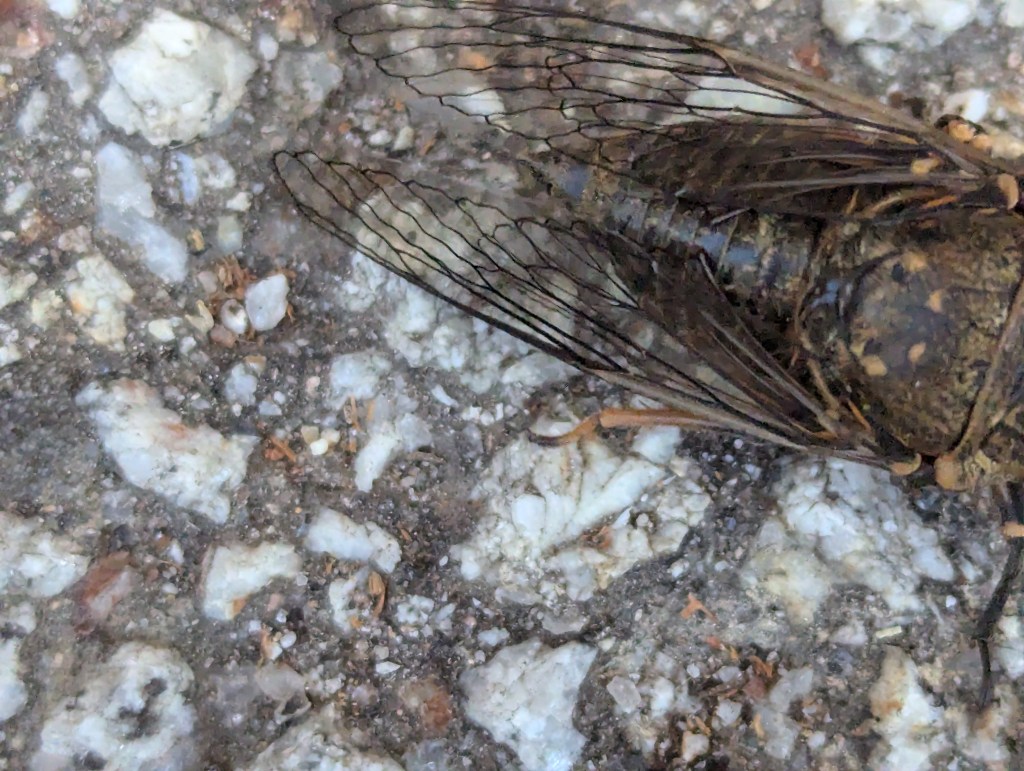
The left wing seems to be injured.

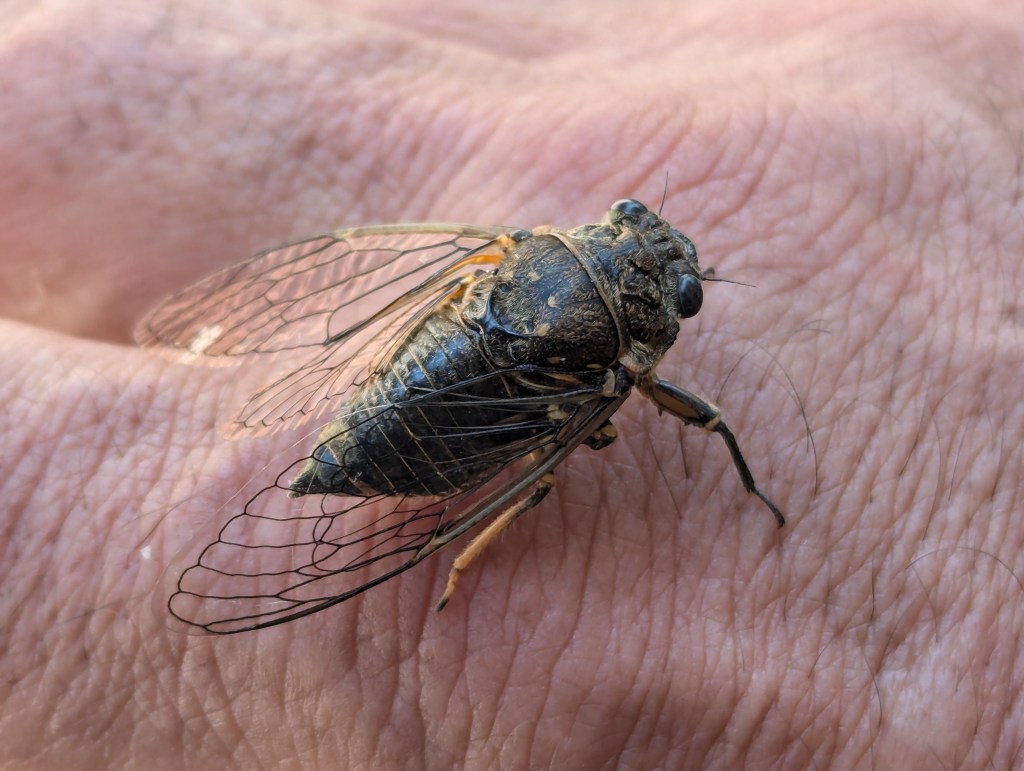
Contrary to common belief, cicadas are native to California. There are actually more native species here than in any other state. Of course, that is partly because California is so big, with so many distinctly diverse ecoregions. Cicadas are merely less prominent here because they are less numerous than they are within dense hardwood forests farther east. Within most regions here, they are somewhat rare. Even where they are most numerous, they do not congregate to form obnoxiously loud populations as they do elsewhere. Some native species are content to share their relatively mixed western forests with relatively few individuals of their own kind, and perhaps a few individuals of other cicada species. They are loud enough to find each other over significant distances. This cicada found its way to where I was enjoying the garden last Thursday. It was quite intimidating when it arrived with loud buzzing of its wings. It flew awkwardly before bashing into a steel building with a loud ‘PING’ that sounded more like a fat acorn falling onto the roof. I should have fled. It circled on the ground briefly before getting airborne again, and coming after me! It landed on my collar. I managed to maintain my composure as I removed it. I could see that one of its wings was impaired, as is evident in the picture above. That did not stop it from trying to fly again. It did not get far before landing on the asphalt driveway. It did not cooperate for the second picture below, which, although not of good quality, demonstrates that the impaired wing is not so impaired. It was likely merely out of whack from crashing into the wall. Before we could get acquainted, this no longer so intimidating cicada flew away as awkwardly as it arrived.

Both wings seem to be fine now. (This cicada did not want its picture taken.)

Botanical Names Should Simplify Horticulture

Buick is a distinct automotive genus.

Botanical names of the vegetation that home gardening involves may seem complicated. Some are difficult to pronounce or spell. A few seem to be as lengthy as sentences. They seem to be a foreign language because most are Latin. Some are Greek. However, they are more valid than common names. What is common here might be uncommon abroad.

For example, Acer pseudoplatanus is a type of maple here in North America. However, it is a type of sycamore in England. Its common name is regionally inconsistent, so can be confusing. Its botanical name, though, is the same everywhere. Incidentally, Acer is Latin for “maple”. Pseudoplatanus is Latin for “false sycamore”. Technically, it truly is a maple.

Technically though, only a few cedars are truly cedars. Both deodar and blue Atlas cedar are species of Cedrus, which is Latin for “cedar”. However, incense cedar is a species of Calocedrus, which is a separate genus. Western and northern red cedars are species of Thuja, which is arborvitae. Again, botanical names are more valid than common names.

Nomenclature is a standardized application of names. Simple botanical nomenclature is binomial, which indicates that it involves two names. The first is the “general” or “genus” name, which is capitalized. The second is the “specific” or “species” name, which is not capitalized. Both are italicized. Species is singular and plural. Genera is plural of genus.

Botanical names are actually very similar to automotive names. Only italicization and the lack of capitalization of the species are different. Buick, Chrysler and Mercury are all like genera. Electra, Imperial and Grand Marquis are all like species. Sequoia sempervirens uses the same binomial format as Buick Electra. Botanical names really are that simple.

Many automotive species include variants, such as Limited, Custom and LSE. These are like varieties or cultivars of plant species. Such variants are evident by single quotes, but lack italicization. For example, ‘Soquel’ is the cultivar of Sequoia sempervirens ‘Soquel’. (‘Cultivars’ are ‘cult’ivated ‘var’ieties that are true to type only by vegetative propagation. Varieties can be naturally true to type by seed.)

Simple Species

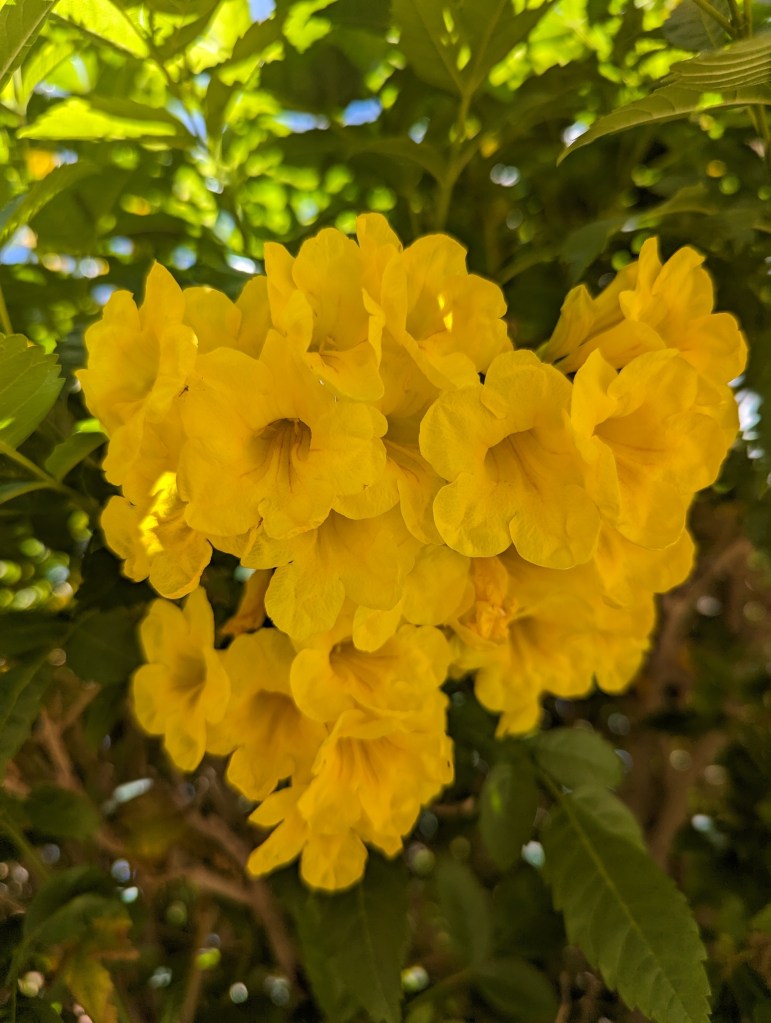
Unidentified cultivar of Tecoma stans

Tecoma stans is somewhat popular within the neighborhood where I stayed while in Arizona. It is available in nurseries also. I suppose that I could have purchased one or more for my garden. I had wanted to grow it for a long time. I refrained. I can explain.

The Tecoma stans that I can get from nurseries is an improved cultivar, or actually, about three cultivars. They are not the simple species, as it would be found growing wild. I realize that improved cultivars are known as ‘improved’ for a reason, but ultimately, I want to grow the simple species.

Crazy Green Thumbs sent me the seed for the simple species of Tecoma stans that I want to grow. That is all I need. Other colleagues have sent me seed, seedlings or cuttings for simple species of American beautyberry, American holly, American persimmon, pawpaw, red mulberry, red elderberry and perhaps too many other species to list briefly. In the future, I suppose that I could try cultivars of some of these species. I would like to get acquainted with them first though.

For most species, I suppose that I prefer cultivars. I want to grow the same ‘Moorpark’ and ‘Blenheim’ apricots that I grew up with. Eventually, I want to grow ‘John F. Kennedy’ rose. Cultivars serve a purpose also.

There are a few reasons why I want simple species rather than cultivars of some species. For American beautyberry, American holly and red elderberry, I want to grow what most other garden enthusiasts within the native ranges of these species grow merely because such species appear uninvited in their gardens. For American persimmon, pawpaw and red mulberry, I want to grow a few of the fruits that people enjoyed for culinary application prior to the development of relatively modern cultivars.

Butterfly Amaryllis

Hippeastrum papilio, butterfly amaryllis is an uncommon and weirdly epiphytic amaryllis. It may not be as pretty as the countless more colorful hybrids of the genus, but it is more reliably perennial. All of the few specimens that I have observed within home gardens are potted or in the ground, either because they are easier to grow that way, or because those who grow them are not aware that they are epiphytic. After all, that is quite weird.

This specimen, from my Six on Saturday post earlier this morning, is blooming in Brent’s garden. As I mentioned earlier, Brent did not know what it was when he acquired it from a neighbor who left it with him when she relocated. I know that it does not look like much in this picture, but that is only because Brent is an idiot, and takes bad pictures. I intend to get a copy of this butterfly amaryllis for my garden, and may try to grow it epiphytically.

I find this species to be more appealing than prettier hybrids, both because it is reliably perennial, and because it is a simple species rather than a hybrid. This is also why I dug a few naturalized Crinum bulbispermum, Orange River lily bulbs for my garden. They are none too pretty, but will last forever. The same applies to Amaryllis belladonna, naked lady, but they are a bit too prolific and common to not potentially qualify as a weed. Their bright pink floral color can be a bit obnoxious anyway. But of course, that is why I was so very pleased to find a bulb that bloomed white, which is my favorite color. It is multiplying nicely here now, just like I know the butterfly amaryllis will once I get a fresh copy of it.

Cultivars Are Merely Cultivated Varieties

Cultivars are distinct within their species.

Nomenclature is simply the technique of naming. Botanically and horticulturally, it is also a precise method of classification. Large classifications divide into smaller and exclusive classifications, which likewise divide. Botanical families divide into many genera, which likewise divide into many species. Some species divide further into varieties or cultivars. 

For example, Schwedler maple is within the Sapindaceae family. This family divides into many genera including the maple genus of Acer. (Genera is plural of genus.) This genus divides into varied species, including the Norway maple species of platanoides. Norway maple divides into more cultivars, including ‘Schwedlerii’, which is the Schwedler maple. 

Therefore, the botanical name of the Schwedler maple is Acer platanoides ‘Schwedlerii’. Family names are omissible. Genus names justify capitalization. Species names do not. Both genus and species names appear in italics. (Incidentally, genera are more ‘genera’l than ‘speci’fic species.) Single quotation marks contain names of varieties and cultivars.

Varieties are, as their designation implies, variants of a species. Some are dwarf, like the dwarf pampas grass. Some bloom with atypical color, like the maroon Texas bluebonnet. Their variations are natural and at least somewhat inheritable. Cultivars are varieties that can not perpetuate naturally, so are reliant on cultivation. They are ‘cultiva’ted ‘var’ieties.

Some cultivars developed from breeding. Others are naturally occurring mutants that are desirable enough to perpetuate. Because their unique characteristics are not inheritable, perpetuation is artificial. Seed of cultivars that originated as mutants lacks any desirable mutation. Seed of extensively bred cultivars is genetically unstable, or may not be viable. 

Most cultivars therefore rely on cloning for perpetuation. Propagation by cutting, grafting, division, layering and tissue culture, generates genetically identical copies of an original. Although it is illegal to propagate patented cultivars for profit, most common cultivars are too old for patents. Many perennial cultivars, such as iris and canna, proliferate naturally. 

Nomenclature Was Designed For Simplicity

Simple standardized nomenclature is getting rusty.

Buick Electra used to mean something. Chrysler Imperial and Lincoln Town Car did also. That was at a time when cars were still distinguishable. Instead of random numbers with a few letters, they had distinctive names. These names, although distinct, conformed to a standardized pattern. This pattern of naming was comparable to botanical nomenclature. 

According to botanical nomenclature, plants are identifiable by genus and species. Their ‘gen’us is a more ‘gen’eral designation than their ‘speci’fic ‘speci’es designation. A family is a larger and more general classification than genus, and in turn, fits into another more general group. Most of us are not concerned with the many classifications beyond family. 

For example, the botanical name of silver maple is Acer saccharinum. Acer is the genus. saccharinum is the species. Acer saccharinum is in the Sapindaceae family. (For botany, genus and species names are italicized, and species names are not capitalized.) Buick Electra is similarly in the General Motors family. Buick is its genus. Electra is its species.

Varieties and cultivars are even more specific designations within species. Some are the products of breeding. Some are naturally occurring. A cultivar is a ‘cultivated variety’ that does not perpetuate naturally like other varieties do. Most cultivars propagate by cloning. (Variety and cultivar names are capitalized and enclosed within single quotation marks.)

For example, Acer rubrum ‘October Glory’ is a cultivar of red maple. It exhibits a distinctly rounded canopy and foliar color in autumn that is superior to that of the simple species in the wild. It might compare to a Buick Skylark Gran Sport, which is essentially a cultivar of Skylark with a stronger engine. Botanical and automotive nomenclature are quite similar. 

Such similarities of nomenclature are no advantage. While cars forfeited their distinctive titles for mundane numeric designations, plants forfeited their species names for cultivar names. Such abbreviation of nomenclature interferes with accurate identification. Those unfamiliar with it may not know if Cercis ‘Forest Pansy’ is an Eastern or Western redbud, or something else.