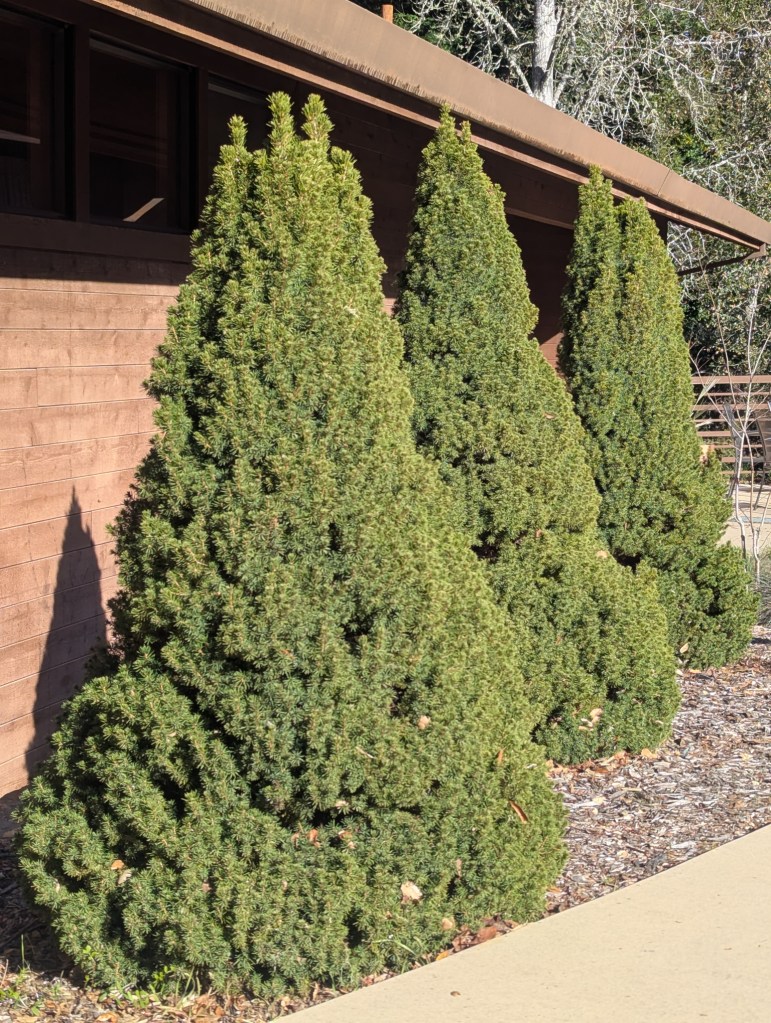
It is a diminutive tree with a big name. Picea glauca var. albertiana ‘Conica’ is commonly known as dwarf Alberta spruce. It is a type of white spruce that grows more as shrubbery than as a tree. After many years, it may be only eight feet tall and four feet wide with strict conical form. Because of its form and tame growth, it is practical as a live Christmas tree.
Potted specimens may remain potted for several years. They maintain their conical form quite naturally without shearing or pruning. Their finely textured needles are only slightly bristly. Their primary disadvantage as a Christmas tree is their foliar density. They do not extend lateral stems for Christmas ornaments to dangle from. Their foliar aroma is slight.
Dwarf Alberta spruce is splendid for formal landscapes. Alternatively, it can instill a bit of formality or symmetry into otherwise relaxed landscapes. Although it does not grow very wide, it should have room to grow. Pruning or shearing for containment compromises its strictly conical form. Potted specimens rely on frequent irrigation, but are not demanding.
Christmas trees are extreme cut foliage. They stand alone, rather than as accessories to cut flowers. Most are a few feet tall, and some are much grander. Ultimately though, they are as disposable as cut flowers. Because they are so expensive, their disposal seems to be wasteful. Realistically though, they are more practical than living Christmas trees.
Now that living Christmas trees remain after Christmas, they require attention. They are otherwise as disposable as cut trees are. Large specimens are too expensive to discard. They might also be difficult to maintain. Because almost all were field grown, they are in very dense and heavy soil. Such soil can retain either insufficient or excessive moisture.
Many initially healthy living Christmas trees can deteriorate through summer. Some get too shabby to function as a Christmas tree before their second Christmas. They adapt to local climates slowly after leaving the climates in which they grew. Some do not survive. They are happier in the ground than in a tub, but as such, can not come in for Christmas.
Living Christmas trees are less expensive than cut trees only after a few years of service. Several of the more compact types can actually survive containment for several years. A few can survive in tubs indefinitely with occasional pruning. Otherwise, most eventually need to graduate from containment to a garden. This is not as simple as it seems to be.
Visual appeal and price limit selection of living Christmas trees. Physical characteristics of such trees should be more of a consideration. Some are more tolerant of confinement within large pots than others are. Some will eventually be quite adaptable to landscapes. The unfortunate reality is that many become very large trees that need substantial space.
Small pre-decorated trees in mylar wrap are the most common of living Christmas trees. Unfortunately, most are either Italian stone pine or Canary Island pine. Both grow too big for compact gardens. Planting living Christmas trees in the wild is not a practical option. Without irrigation, formerly confined trees can not survive long enough to disperse roots. If they could, they can damage local ecology.

 Tony Tomeo