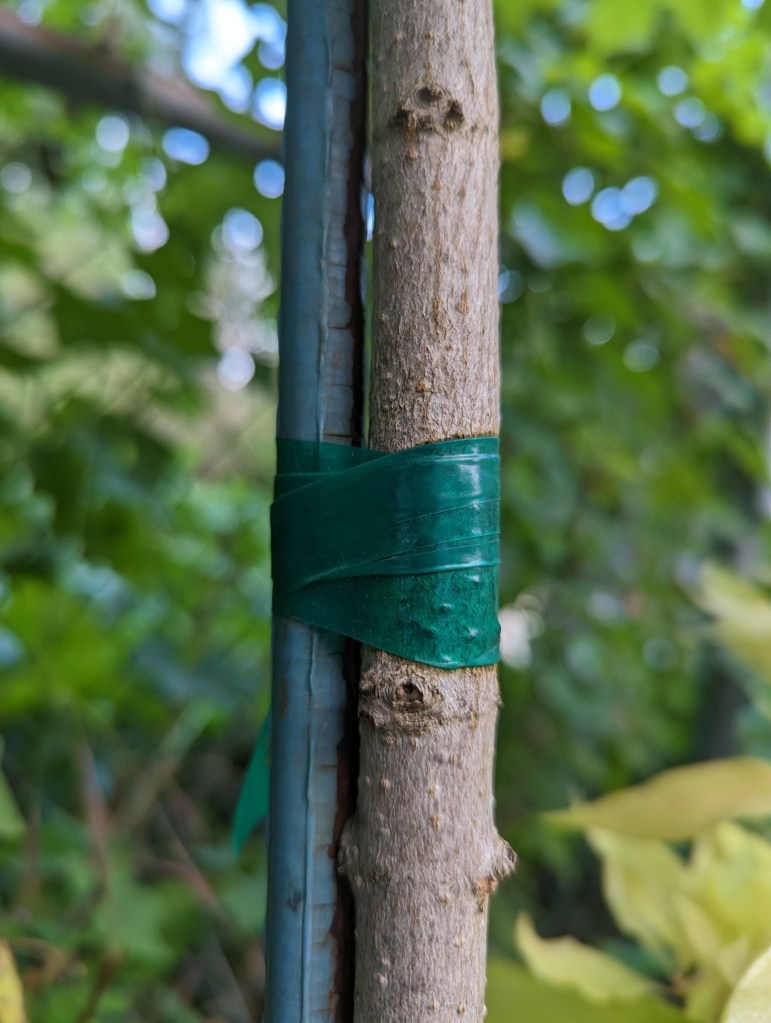
Binding For Straighter Tree Trunks

Proper binding promotes straight trunk growth.

Staking is not quite the same as binding with stakes. It is more for the benefit of the roots than the trunks, which is what binding is for. Staking should support new trees only while such trees disperse roots for adequate stability. As trees do so, stakes become obsolete. Actually, stakes that remain for too long may be detrimental to healthy tree development.

Binding with stakes promotes straight trunk growth. It is particularly practical for trees that naturally develop crooked or multiple trunks. It is a technique that is quite common within nurseries, although not home gardens. However, many trees retain binding stakes when they arrive from nurseries. For a while after planting, some continue to benefit from them.

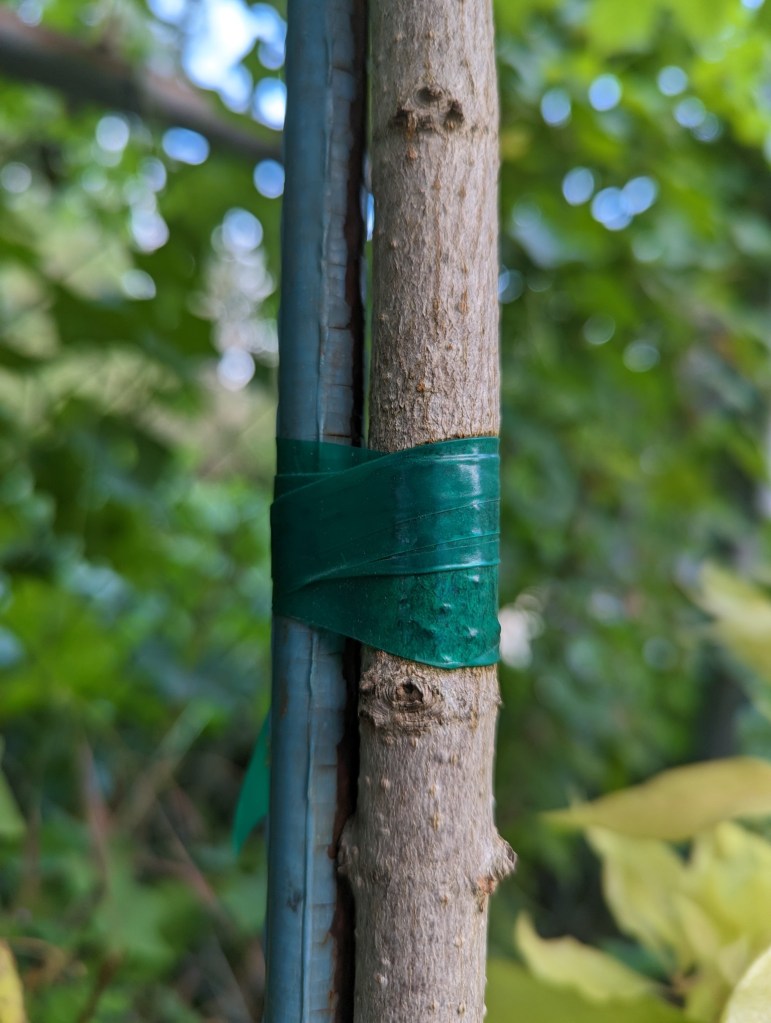
However, binding may be more detrimental than staking if it remains for too long. Trunks that become reliant on any sort of supportive stake remain weak or limber. Also, tape that binds trunks to stakes can become constrictive as trunks grow. It is important to remove it before it begins to interfere with trunk expansion. Looser tape can be useful if necessary.

For example, California pepper tree naturally develops a few irregular and limber trunks. To produce trees with single and straight trunks, nurserymen bind single trunks to stakes. They then prune out other trunks and low limbs until main trunks attain an optimal height. Because they are still limber, trees remain bound to their stakes while available for sale.

However, such stakes provide only support for trunks. They do nothing for stability while trees disperse roots into their new gardens. Additional staking with heftier stakes may be necessary for that. Such stakes must extend into undisturbed soil below the roots of such new trees. If possible, it is better to merely replace binding stakes with supportive stakes.

The next best option is to replace tape that binds young trunks to stakes with looser tape. This maintains the straight form of such trunks without inhibiting their growth. Supportive stakes, in addition to binding stakes, maintain their upright posture. Most trees need only supportive stakes, realistically. A few trees, especially new palms, need no stakes at all.

The Stakes Are High.

Binding nursery stakes should be replaced with less restrictive staking and straps.

            After all the unnatural things that plants must endure to get into gardens and landscapes, it is amazing that they are as happy as they are to perform. Most come from very different climates, only to be grown in artificial nursery conditions while confined to containers, then get shipped to other different climates where they get planted in foreign soil, and are expected to adapt. Nonetheless, they still provide flowers, fruit, vegetables, shade and all that we expect from them!

             Trees must suffer even more. Their lower growth that should enhance trunk growth gets pruned away prematurely. Trunk growth is further inhibited by staking, which is ironically necessary for straight and vertical trunks. Fortunately, most trees recover from these procedures.

            Weaning trees off their original stakes can take a bit of work though. Because of their lanky trunks and disproportionately bulky canopies, most new trees need help to stand up against the wind. Except for palms and a few stout trees that are allowed to keep their lower growth, such as redwoods and some pines, almost all trees need to be staked when planted. However, their trunks should not be bound so tightly that they rely on their stakes for support.

            Stakes that are proportionate to new trees should be installed as the trees get planted. They should ideally be a few inches away from the trees and stand as high as necessary to provide adequate support. A small tree (such as #5 or 5 gallon) may need only a single stake. A larger tree (such as #15 or 15 gallon or larger) typically needs two stakes on opposite sides. The original ‘nursery stakes’ that are bound to the trunks should then be removed as trees then get tied to their new stakes. Trees will need to be supported during this process.

            Trees like red maple or flowering pear that have stronger trunks that do not bend much may only need to be tied at the top, just above their lowest limbs. Most trees have more flexible trunks though, so also need to be tied lower down, generally about halfway between the ground and the top tie. Very flexible trees, like many eucalypti, may need to be tied in even more places. Since there are rarely branches on the trunks to keep the lower ties from sliding downward, the ties may need to be nailed to the stakes.

            Ties should wrap around the trunks and cross over before wrapping around the stakes; in a ‘figure 8’ pattern. This limits abrasion from the stake against the trunks. Ties made from recycled tires with bailing wire at the ends are ideal and easiest. For larger lodgepole stakes, recycled tire ties without wire can be nailed directly to the stakes. Ties should only support trees as they blow away from their stakes or bow from their own weight, but should not bind them firmly to the stakes. This way, trees need to become able to support their own weight.

            As trees mature and no longer need support, stakes and ties should be removed. Stakes and ties that get left too long can actually interfere with trunk development, and cause significant damage and abrasion as trunks expand.

Staking Helps Keep Trees Straight

Binding can interfere with trunk development.

Planting trees often involves staking. Until they disperse new roots, many new trees rely on stakes for stabilization. Their stability is limited by the initial confinement of their roots. Nursery stakes and their associated binding provide different support. They merely direct straight trunk growth. In a home garden, nursery stakes subordinate to landscape stakes.

This process is different for different trees. Small palm trees need no staking at all, either in nurseries or home gardens. Spruce trees are too stout to need support after they grow beyond their nursery stakes. Camphor trees may need both types of stakes concurrently. Landscape stakes maintain their stability as nursery stakes maintain their trunk integrity.

Typically though, landscape stakes completely replace nursery stakes of most trees. For adequate stability, they must extend into undisturbed soil below excavated soil. For most trees with bare trunks, such staking should reach lower limbs. Some trees need only one stake. Some, particularly those with large canopies, may need a pair of opposing stakes.

Straps that attach trees to their landscape stakes need proper installation also. They are more durable than nursery binding, but must not be too restrictive. They should only hold trees upright without interfering with their natural development. Straps should be as high as practical on their respective stakes. Additional ties may be needed to prevent bowing.

Some old fashioned straps are strips of old tires with bailing wire at each end. Others are simple bailing wire through bits of old hose. Modern straps are more refined and diverse to facilitate staking for diverse subjects. They should cross over between the stakes and the trees they support to limit abrasion. Short nails may attach them firmly to their stakes.

Staking should be as unobtrusive as possible. Trunks that can move somewhat freely in mild wind are studier than those that can not. Binding for trees that initially require it with staking should be as loose as practical. Incremental loosening might be safer for weakly limber trunks. Without loosening, tight binding might harmfully constrict trunk expansion.

Stakes And Binding For Trees

Binding merely straightens developing tree trunks.

Few trees that inhabit home gardens begin their residency as nature intended them to. Most are exotic, from other ecosystems, regions and climates. Almost all initially grew in nurseries, with their roots confined to cans of soilless media. Most rely on pruning and binding to develop straight and tall trunks. In the garden, most rely on stakes for stability.

Nursery stakes are different from landscape stakes. They support the developing trunks of young trees as they grow in nurseries. They can do the same for very young trees that grow directly into home gardens. Such stakes do not stabilize trees. Within confinement of nursery cans, they can not extend into the soil below. They guide trunk development.

Some young trees with very limber trunks rely on constrictive binding to nursery stakes. Most trees need only loose binding. Ideally, binding should be as loose as possible, and is only temporary. Trunks that move with wind are less reliant on support as they mature. Once straight trunks develop, temporary nursery stakes should no longer be necessary.

Landscape stakes stabilize new trees after installation into a garden. Most of such trees lack stability while their roots are initially very confined. Root dispersion stabilizes trees as they mature. Landscape stakes are only temporary during this process. They should not be so constraining that trees rely on them for support. They must be sturdy though.

As important as it is for many trees, staking can interfere with trunk development. It limits motion from wind that stimulates trunk expansion and root dispersion. Timely removal of stakes when no longer needed promotes healthier development. Yet, some very limber trees may briefly need both nursery and landscape stakes. Timing of removal is critical.

Small trees may need only a single landscape stake after installation. Larger trees may need a pair of stakes. Some stout trees may need no stake at all. Ties that loosely attach trees to stakes should cross over between the trees and stakes. This forms a figure eight pattern that limits abrasion between trees and stakes. Short nails can hold ties in place.

The Stakes Could Be High

Some unfortunate trees become so reliant on staking and straps that they are never able to support their own weight.

The irony of landscaping and gardening to bring nature closer to the home is that it is so very unnatural. Plant specie are imported from all over the world, grown in synthetic environments, and then expected to perform in unfamiliar climates and soils far from home. Most plants have been bred for optimal retail appeal at the expense of their natural adaptations.

Trees grown in nurseries need to be staked tightly to develop the sort of straight trunks that branch at just the right height to be marketable. In the landscape, trees need to be staked because they have become so dependent on the stakes that they grew up with. Eventually though, trees need to learn how to carry their own weight.

When new trees get planted and staked loosely with heftier stakes that stand up to wind, old tightly bound nursery stakes should be removed since the tight binding interferes with trunk development. By the time trees gets planted, the nursery stakes are probably nearly rotten through at the ground anyway. The new heftier stakes should not hold trees tightly in place, but simply be there to keep them from getting blown over.

Straps should likewise not be tightly bound, but instead allow for a bit of motion with the breeze. Straps should cross over in a ‘figure eight’ pattern between trees and their stakes, so that trunks do not rub so abrasively against the stakes. Most trees need only two straps each, or two pairs of straps if two stakes are used, with support up high, and lower support to prevent outward bowing. If there are no branches to hold straps in place, straps must be nailed or otherwise attached to the stakes.

Some sturdy trees, like well developed redwood trees and small magnolias, may not need stakes. Palms and yucca certainly do not. However, limber trees like the various eucalyptus may need more support than just two straps. The problem is that many trees become dependent on their stakes and will not develop strong trunks if they do not need to.

It is better to prune maturing staked trees to limit weight and wind resistance (that might cause them to blow over) than to provide more support with heftier stakes. If a maturing young tree is relying on stakes and straps for support, it needs to be pruned. A young unstaked tree that begins to lean from the weight of its canopy should likewise be pruned until it regains its posture without getting staked and bound. Trees should never be tied to other trees, buildings or anything else that can be damaged by the tension.

Horridculture – Well Done Stakes Are Rare

P81128++

Stakes are temporary. That is what so called maintenance ‘gardeners’ do not seem to understand. Stakes should not stay any longer than necessary, so need to be removed sooner than later, depending on their function. Stakes that are left too long can interfere with the healthy development of the trees and vines that they were intended to help.
Nursery stakes are used either to straighten the trunks of developing trees, or to support climbing vines. They must be removed when the trees or vines that they worked for get installed into the landscape, or as soon after installation as possible. Some flimsy trees may need their stakes for more than their first year.
The problem with leaving trees bound to their nursery stakes for too long is that they rely on the stakes for support as they grow, so do not put much effort into supporting their own weight.
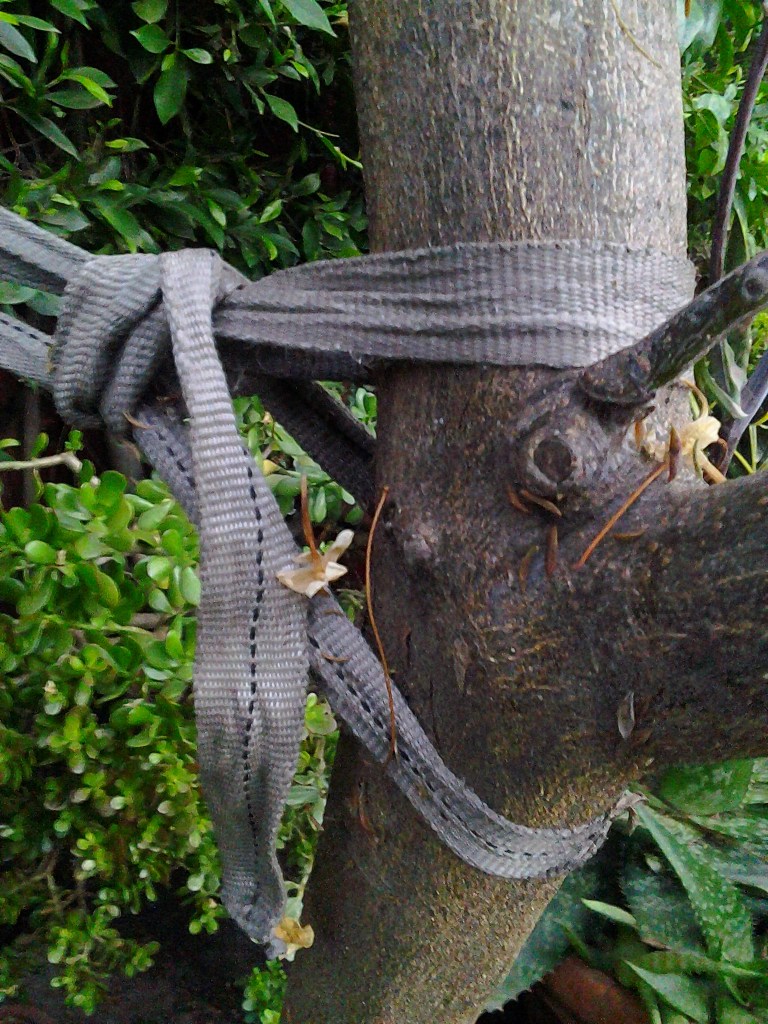
The picture above shows a coast live oak that was staked properly with landscape stakes to the side, but while still bound to the original nursery stake. Because the tree was bound for too long as it grew, it may be too flimsy to support itself without bending when the binding nursery stakes eventually gets removed. For this particular tree, the bindings may need to be removed in phases so that the tree can learn to support itself before the last binding is cut loose.
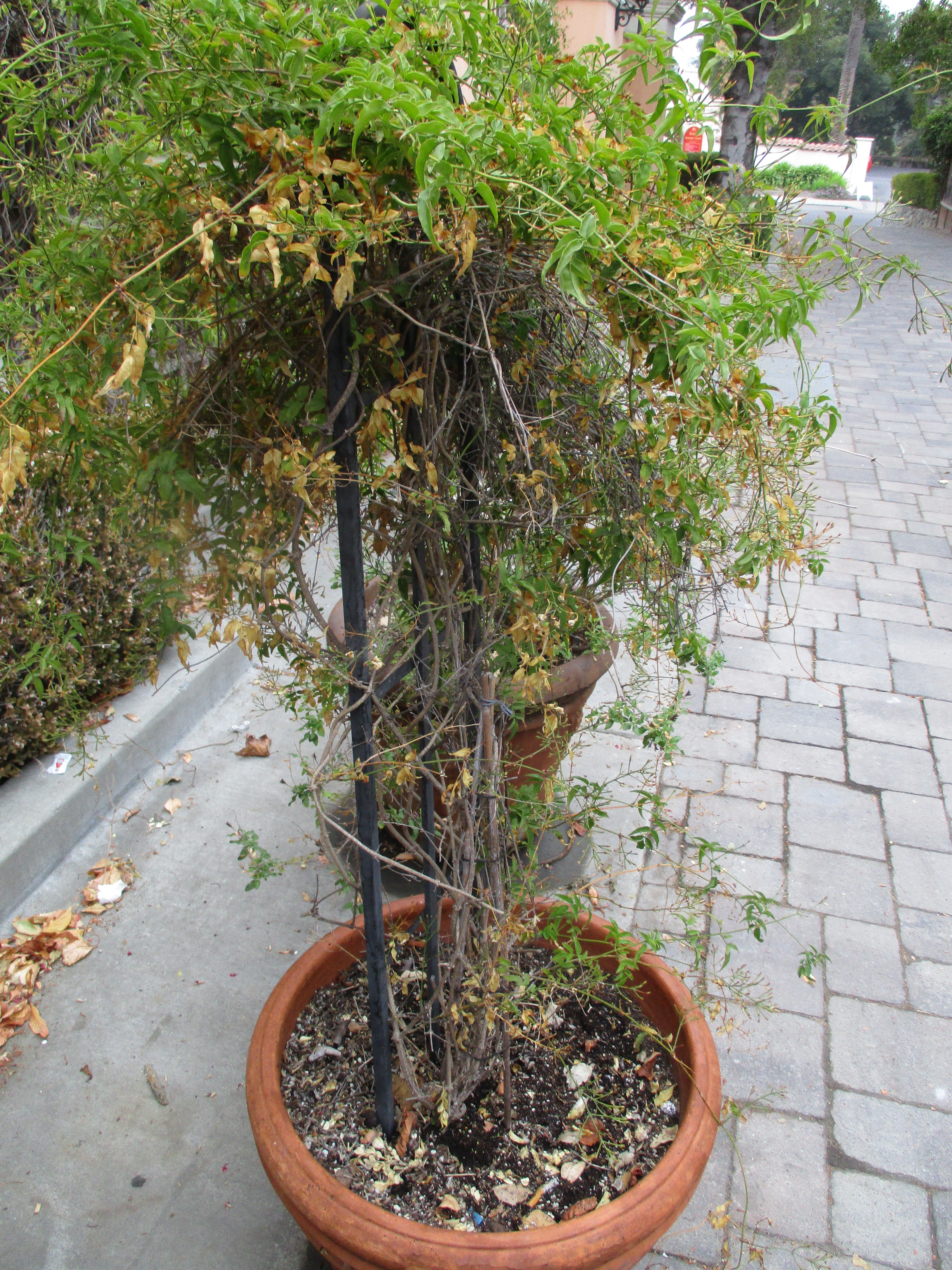
The problem with leaving vines bound to their nursery stakes is that they remain bundled in the middle while new growth spreads out more naturally. Vines should instead be unbound and spread out onto their support, even if they need to be bound to the new support like they were bound to their nursery stake. Only a few vines that will get cut to the ground annually or after their first growing season, such as Boston ivy and creeping fig, can remain bound through their first year, only because the whole mess will be pruned to the ground, and replaced with new growth later.
The picture below shows a pink jasmine vine that is still bound to its stake, right in front of a disproportionately small trellis. The bundled mess of stems in the middle is partially obscured only because the tangled upper growth is so overgrown. There are so many problems with this unfortunate potted pink jasmine that it will be a topic for next week.P81128+

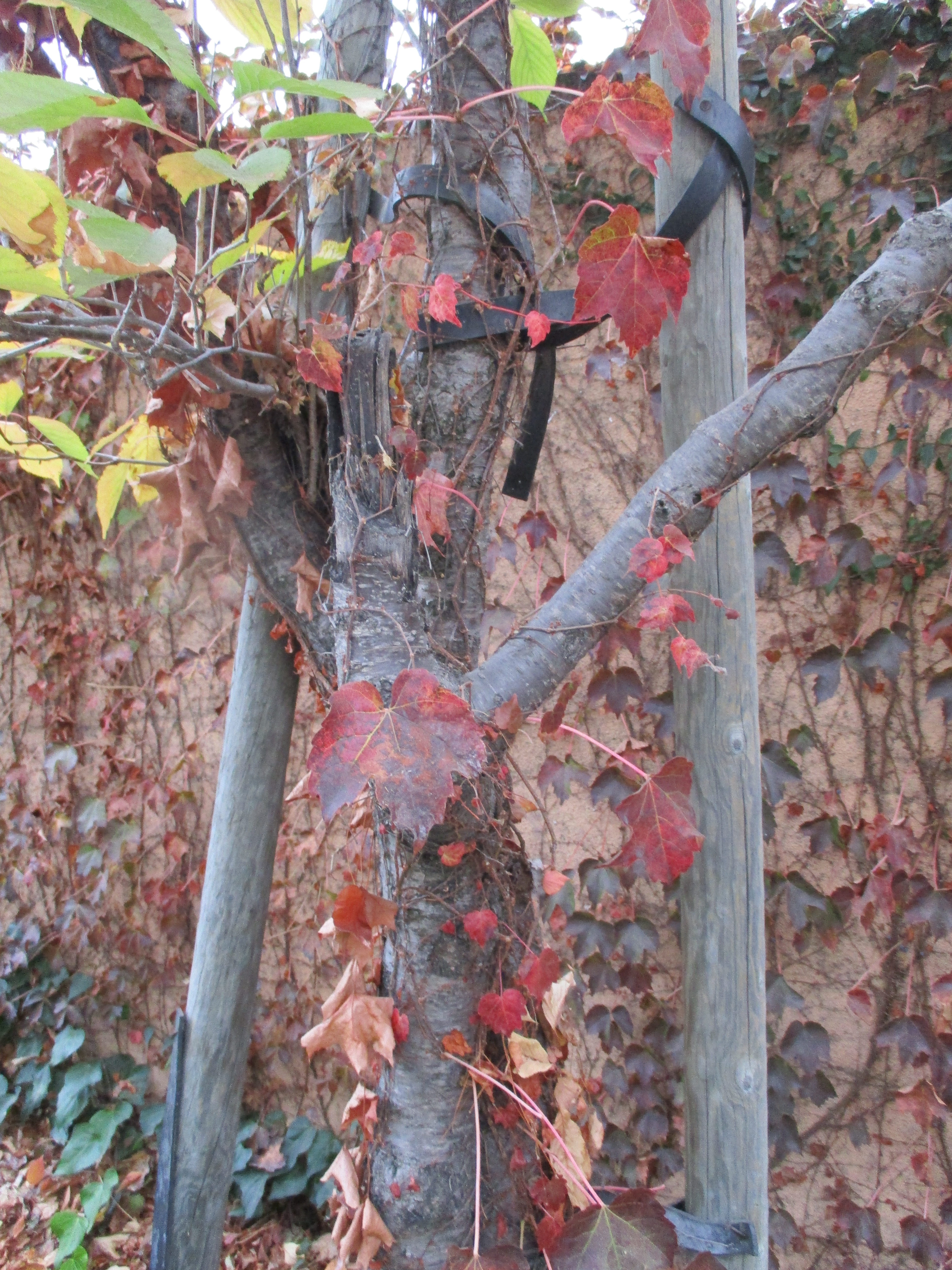
Landscape stakes are very different from nursery stakes. They are not needed to straighten trunks of trees, but are merely used for a little bit of support while new trees disperse their roots. When trees have adequately dispersed their roots and are stable enough to stand up to a bit of wind on their own, landscape stakes must be removed. They are not as likely to interfere with the development of structural integrity like nursery stakes do, but can interfere with root dispersion and development of adequate stability if trees become reliant on them for support.
The flowering cherry tree in the picture below obviously does not need the support of the unsightly landscape stakes that remain partly strapped to the trunk. The stakes did not compromise stability only because the tree is so naturally stout. The stakes really are unsightly though. So is the overgrown Boston ivy on the trunk and up into the canopy, . . . and the mutilated stubs and stems that were ‘pruned’ by the maintenance ‘gardeners’. Seriously; what kind of ‘gardener’ does this sort of atrocious work?! Well, those topics can be addressed at another time.P81128

Straight And Narrow For Trees

30731thumbIn the wild, trees do just fine without any help from anyone else. They certainly are not stupid. Their roots disperse for adequate stability. Their trunks grow upward as limbs spread outward for adequate structural integrity. Trees only need help in landscape situations because they are expected to perform so unnaturally. From the very beginning, their trunks are bound and their roots are confined.

While they are growing in the nursery, trees are bound tightly to stakes to keep their trunks straight. Unfortunately, this binding inhibits natural development of trunk caliper. Since they can rely on stakes for support, trees do not waste resources on developing the strength of their own trunks. The various eucalypti are particularly sensitive, and can bend over to reach the ground when unbound.

Roots are confined to cans (pots) or boxes because that is how trees are grown in the nursery. Even in regions where trees are field grown, roots must be severed when trees get dug and moved. Many types of trees do not mind much, and are eager to disperse roots into a new landscape as soon as possible. However, oaks, pines and many others do not recover as efficiently from confinement.

Once in a new landscape, most trees need to be staked to recover from being staked and confined in the nursery. New sturdier stakes that extend below the confined root system into soil below should stabilize newly planted trees. This is particularly important for evergreen trees that will be blown more by wind than bare deciduous trees, and particularly because most trees get planted in autumn and winter.

These new stakes should be installed a few inches away from the tree trunks so that they can support the trunks loosely when the tightly binding nursery stakes gets removed. To prevent abrasion, new straps should be somewhat loose, and cross over between the trunks and stakes. A pair of opposing stakes, with straps supporting in opposing directions, is sturdier than a single stake. A few straps may be necessary.

The new crepe myrtle trees in the picture above remain  bound to the stakes that they were grown with in the nursery. Sturdier stakes that can support the trunk in a less constrictive manner have yet to be installed.