 In the wild, trees do just fine without any help from anyone else. They certainly are not stupid. Their roots disperse for adequate stability. Their trunks grow upward as limbs spread outward for adequate structural integrity. Trees only need help in landscape situations because they are expected to perform so unnaturally. From the very beginning, their trunks are bound and their roots are confined.
While they are growing in the nursery, trees are bound tightly to stakes to keep their trunks straight. Unfortunately, this binding inhibits natural development of trunk caliper. Since they can rely on stakes for support, trees do not waste resources on developing the strength of their own trunks. The various eucalypti are particularly sensitive, and can bend over to reach the ground when unbound.
Roots are confined to cans (pots) or boxes because that is how trees are grown in the nursery. Even in regions where trees are field grown, roots must be severed when trees get dug and moved. Many types of trees do not mind much, and are eager to disperse roots into a new landscape as soon as possible. However, oaks, pines and many others do not recover as efficiently from confinement.
Once in a new landscape, most trees need to be staked to recover from being staked and confined in the nursery. New sturdier stakes that extend below the confined root system into soil below should stabilize newly planted trees. This is particularly important for evergreen trees that will be blown more by wind than bare deciduous trees, and particularly because most trees get planted in autumn and winter.
These new stakes should be installed a few inches away from the tree trunks so that they can support the trunks loosely when the tightly binding nursery stakes gets removed. To prevent abrasion, new straps should be somewhat loose, and cross over between the trunks and stakes. A pair of opposing stakes, with straps supporting in opposing directions, is sturdier than a single stake. A few straps may be necessary.
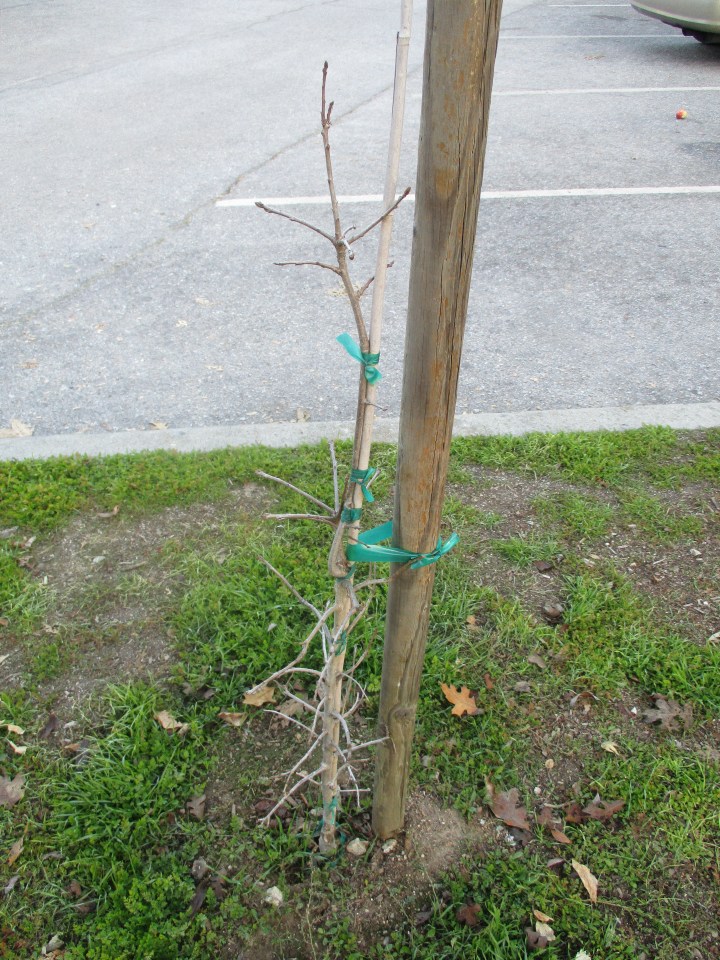
The new crepe myrtle trees in the picture above remain bound to the stakes that they were grown with in the nursery. Sturdier stakes that can support the trunk in a less constrictive manner have yet to be installed.
 The sad little Scofield Tree in Felton Covered Bridge Park did not do much this year. (
