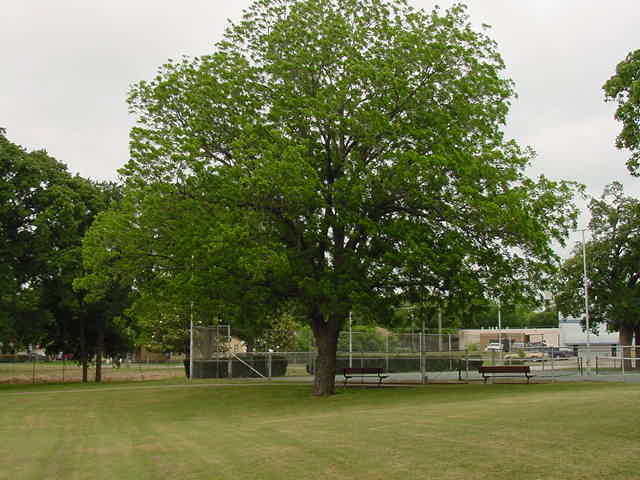
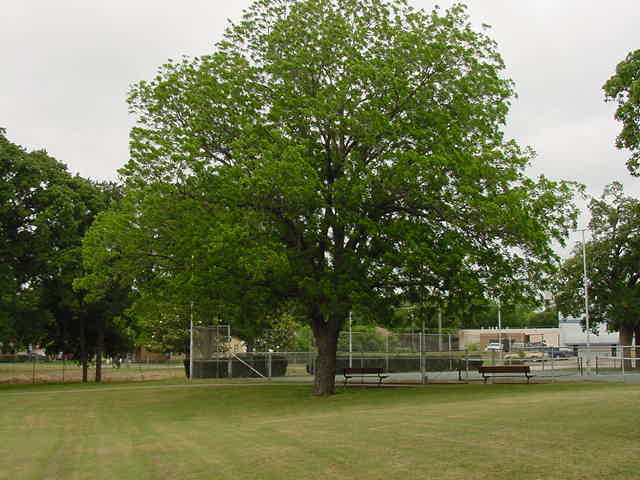
Texas selected a distinctive state tree; the pecan, Carya illinoensis. It is happy in the south and middle mid-west, where naturally grows about seventy feet tall. It can get almost as large here, so is best in big spaces. Summers are a bit too mild for reliable nut production in autumn, but single trees can sometimes make plenty. Two different trees (to pollinate each other) can actually be quite productive, although not quite as well flavored as in warmer climates. The pinnately compound leaves have about eleven individual leaflets that are about five or six inches long. Shade is not too dark.
Classification of this species may be complicated. About five distinct varieties of Arizona cypress, Cupressus arizonica, occur naturally. Some may sometimes classify as distinct species. Some grow no higher than twenty feet, with stout and shrubby form. Some grow fifty feet high, with sculpturally irregular form. Botanists may not agree on their identities.
Old trees that mostly grew from seed are typically noticeably variable. Some exhibit nice bluish green foliar color. Others are more grayish green. Modern trees are mostly modern cultivars with strikingly uniform silvery blue foliar color. Some are supposedly conducive to hedging, which enhances foliar color. Although evergreen, foliage is freshest in spring.
Without hedging, Arizona cypress develops splendid natural forms. Whether sculpturally irregular or compactly shrubby, it may need only minor grooming. Its finely textured foliar debris disappears into any ground cover below. However, such foliage can have a mildly herbicidal effect on lawns. Arizona cypress trees in a row can be an effective windbreak.
If “verde” translates to “green”, then what color is blue palo verde, Parkinsonia florida? It is simply a bit more bluish green than other species that are a bit more yellowish. Its bark contains chlorophyll to photosynthesize without foliage. Blue palo verde is deciduous so defoliates for winter. Then, it defoliates in response to dryness through much of summer.
Blue palo verde in the wild may develop and retain foliage only during early spring. With landscape irrigation, it can retain some foliage through summer. It can also produce a bit more prior to late autumn defoliation. However, frequent irrigation promotes vigorous but structurally deficient growth. Few blue palo verdes thrive for a century within landscapes.
Blue palo verde can grow almost forty feet tall, but typically grows only about half as tall. It naturally grows as large shrubbery. Removal of lower growth exposes sculptural trunks for small tree form. With staking, trees can develop single trunks. Light yellow flowers are tiny but profuse during spring bloom. Blue palo verde is the Official State Tree of Arizona.
This is what taking sides looks like. The right side was taken completely off, leaving only the left. The view from the other side would show that the left side was taken completely off, leaving only the right. It is not such a good picture because it is difficult to distinguish the extent of the damage from what is going on in the background. Realistically though, a better picture would be even worse, since the extent of the damage would be more obvious. The justification for such damage here is more obvious, since, obviously, this is a bad situation, with no room for balanced growth. Although survival is possible, this is not what nature intended. Natural growth should be an asset, and efficiently directed to where it can be useful, which would most likely be much more balanced than this. Incidentally, this is a coastal redwood, which is the Official State Tree of California. This sort of pruning would be just as damaging to Western hemlock, Douglas fir or blue spruce. For that matter, it would be just as damaging to longleaf pine, Western white pine or Ponderosa pine. Ultimately, it is bad technique for any tree in any situation.
Not every garden can accommodate coastal redwood, Sequoia sempervirens. Wild trees can grow hundreds of feet tall, with trunks as wide as thirty feet! None are so big in home gardens, but only because they are still young. They can live for more than two thousand years. By that time, those in urban landscapes are very likely to become major concerns.
Realistically though, urban trees are generally more compact than wild trees. There is no need for extreme height without competition from other similarly tall trees. Besides, lower trees are less vulnerable to wind. Warm and dry wind can desiccate foliage. Strong wind can dislodge branches. Limbs that fall from very high canopies are extremely hazardous.
Almost all modern coastal redwoods from nurseries are of the cultivar ‘Soquel’. They are strictly conical and symmetrical in form, with uniform foliation. ‘Aptos Blue’ exhibits more relaxed form and very slightly bluish foliage. ‘Santa Cruz’ should be more available than it is since it is more resilient to arid warmth. Old seed grow trees are genetically variable. For old formal gardens, they are less formal than younger trees.
Texas selected a distinctive state tree; the pecan, Carya illinoensis. It is happy in the south and middle mid-west, where naturally grows about seventy feet tall. It can get almost as large here, so is best in big spaces. Summers are a bit too mild for reliable nut production in autumn, but single trees can sometimes make plenty. Two different trees (to pollinate each other) can actually be quite productive, although not quite as well flavored as in warmer climates. The pinnately compound leaves have about eleven individual leaflets that are about five or six inches long. Shade is not too dark.
Just coincidentally, a few of the flowers that have been blooming here are State Flowers. These are four of them. Grand specimens of the State Tree of California live here, but the picture here shows unimpressive specimens that are not here, which is actually why they are amusing. The four State Flowers are those of California, Alaska, Idaho and Oregon. State Flowers of Washington and West Virginia are lacking.
1. Sequoia sempervirens, coastal redwood is not actually a State Flower, but is the State Tree of California. The two specimens at the center of this picture are unremarkable, but happen to be in Poulsbo in Washington, nearly five hundred miles north of their natural range. They seem to be three specimens only because the specimen on the right has two trunks. They are from the same old crop that went to become street trees in Los Angeles.
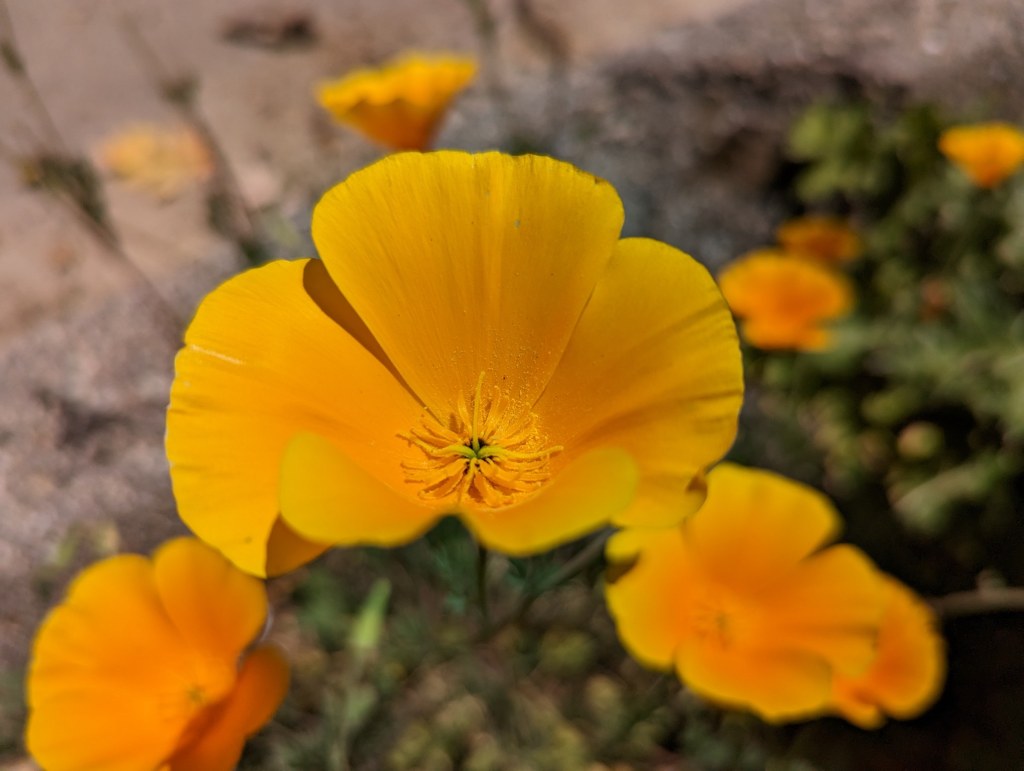
2. Eschscholzia californica, California poppy, as its name suggests, is the State Flower of California. It exemplifies Californian diversity, and in native to all but only two counties.
3. Myosotis sylvatica var. alpestris, forget-me-not is the State Flower of Alaska! It is not native, but it and Myosotis latifolia are naturalized. I do not know which species this is.
4. Philadelphus lewisii, mock orange is the State Flower of Idaho! It is native nearby but is naturalized here. Some bloom with fluffier double flowers like fancy modern cultivars.
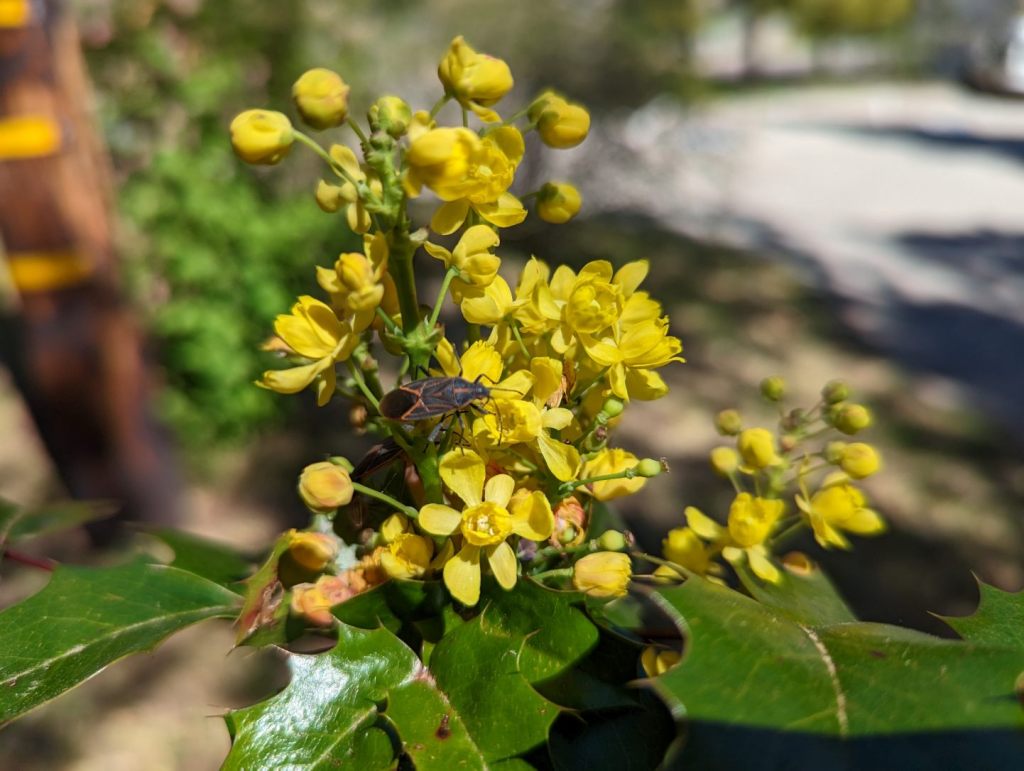
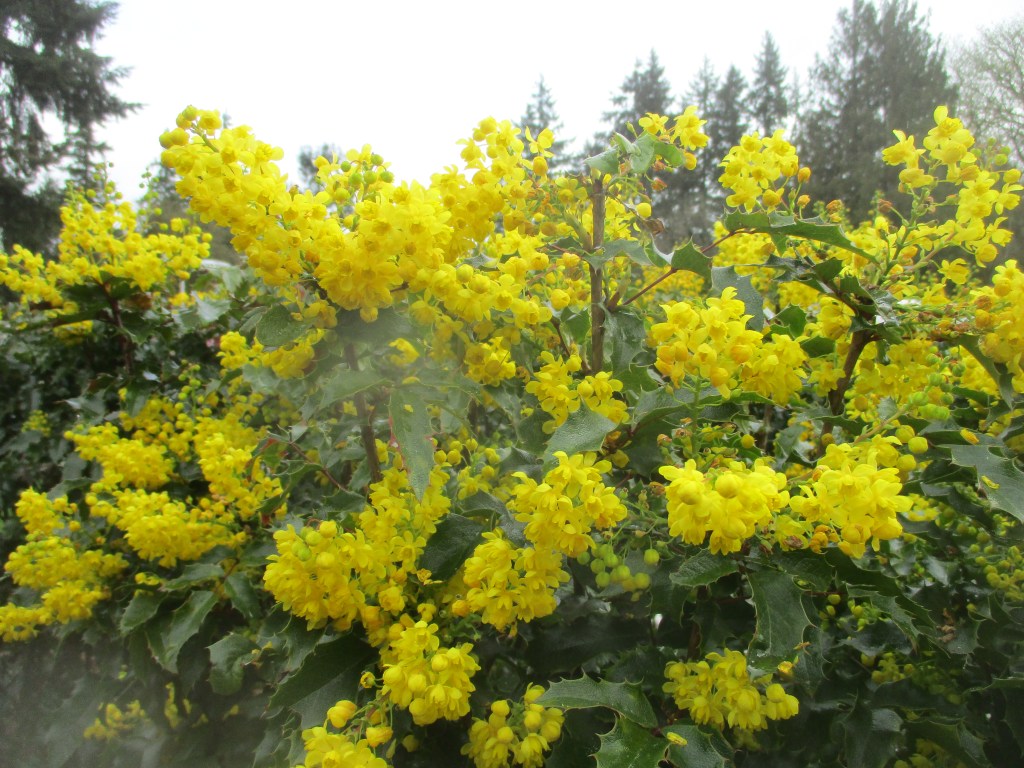
5. Mahonia aquifolium, Oregon grape, like California poppy, is named for the State that it is the State Flower of, which is Oregon. It is unrelated to actual grape. It is native here.
6. Rhody is similarly unrelated to Rhododendron macrophyllum, Pacific rhododendron, which is the State Flower of Washington, or Rhododendron maximum, great or rosebay rhododendron, which is the State Flower of West Virginia. The former of these is native.
Oregon, which is one of the most excellent states in America, was merely a drive through state with this trip. We spent our first night just south of the Southern Border of Oregon, and then spent our second night on the North Shore of the Columbia River, which is the Northern Border of Oregon. I really should have planned to spend more time in Oregon, particularly between Portland and Astoria. Well, I also should have stayed longer within the regions of Ilwaco. Anyway, our return trip was just as efficient, within only two days. We stopped at many of the rest stops on Highway 5 though.
1. What is this? I saw it at various places north of California. I do not remember where I first encountered it. It may have been just across the border, in the Siskiyou Mountains.
2. Oregon grape is nothing special at home. It gets shabby and only blooms sporadically. I wondered why that grumpy wannabe nandina is the Oregon State Flower. This is why.
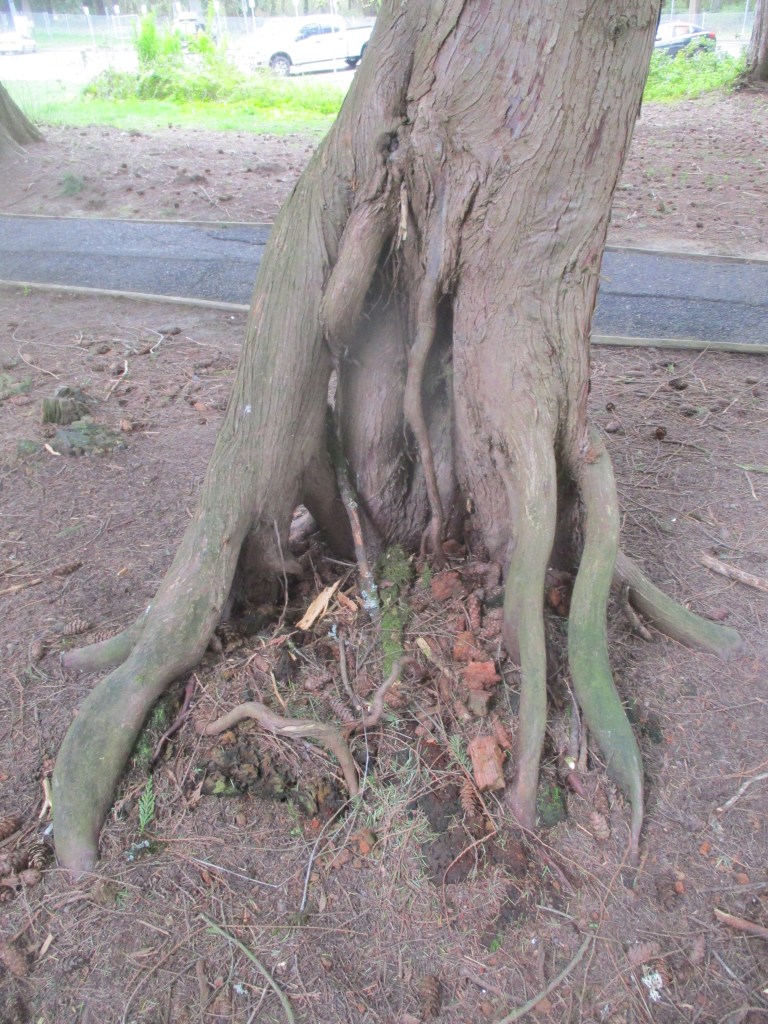
3. Western red cedar grew on top of a tree stump and dispersed its roots mostly between the decaying wood and bark, so now stands on its roots above decayed bits of the stump.
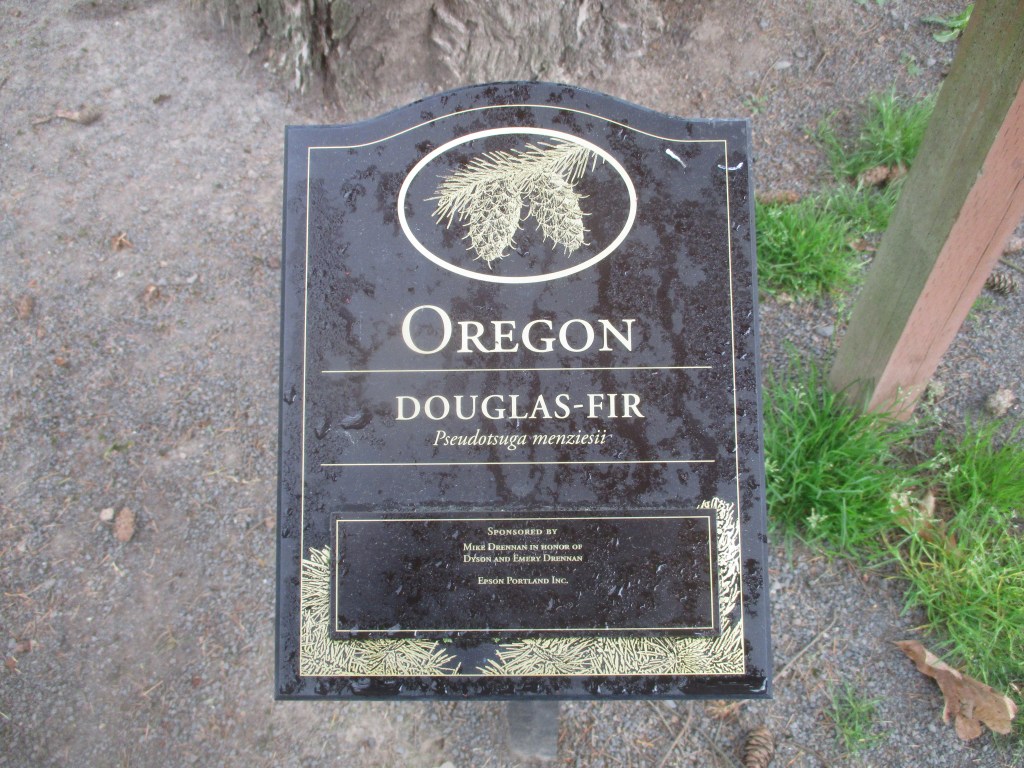
4. Grove of the States; what a splendid idea! However, a few State Trees do not live here, so required substitution. Furthermore, many were replaced with random or wrong trees.
5. Douglas fir, which is the Oregon State Tree, grows wild locally, so the specimen within the Grove of the States is exemplary. It is not visible in this picture of its plaque though.
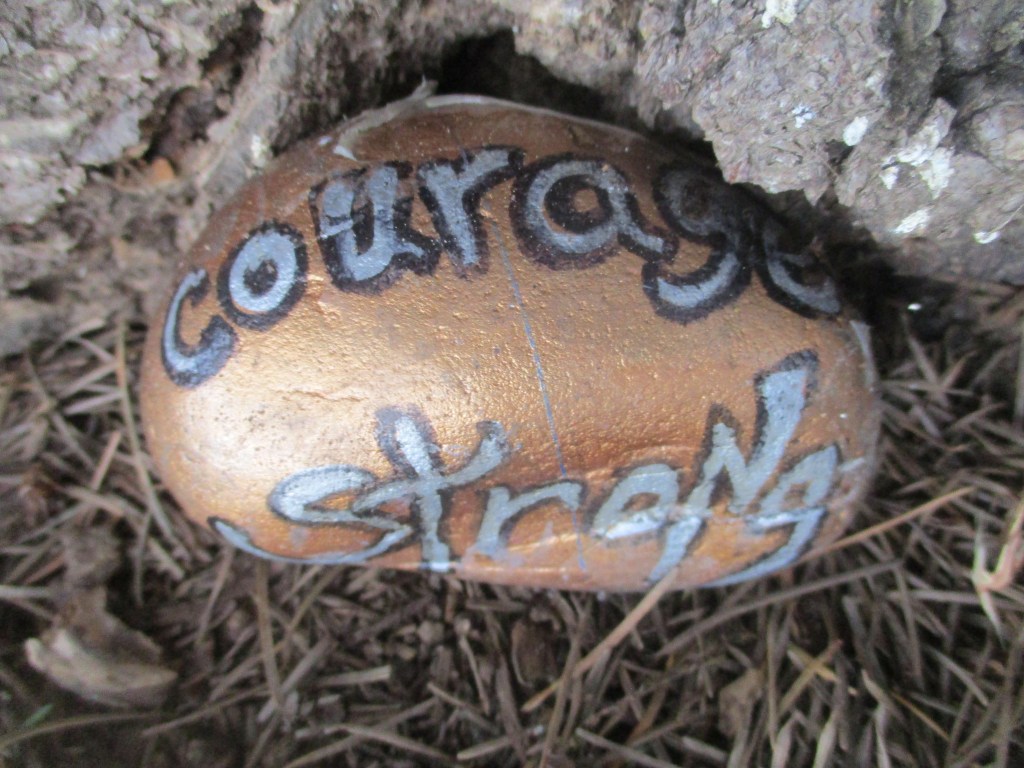
6. Rocks are still a ‘thing’. This one was at the base of a tree that I believe to be a mature Oregon white oak. Goodness; we stopped so much that I do not remember where this is.
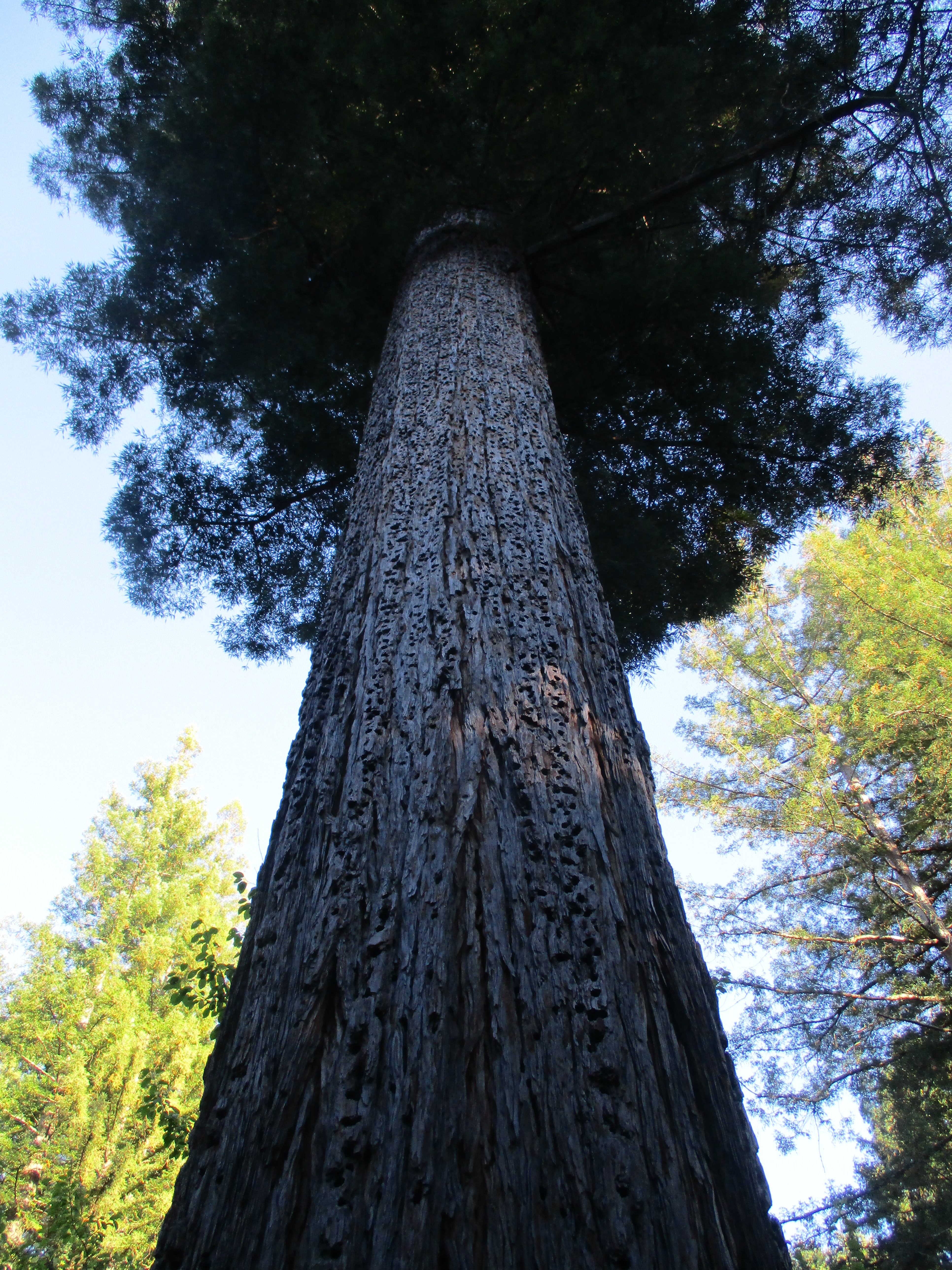
Of all the Official State Trees, the coastal redwood, Sequoia sempervirens, of California is the grandest. Seriously, it is the tallest tree in the World, so it really ‘is’ the grandest! The tallest is 380 feet tall! Although the related giant redwood of the Sierra Nevada develops bigger trunks, the bulkiest coastal redwoods are thirty feet wide at the base! The oldest are more than 2,000 years old!
All that sensationalism is not so practical for home gardens though. A thirty foot wide trunk on a sixty foot wide city lot would likely be a serious obstacle to gardening for whoever lives there 2,000 years from now. Although, those below the thirty-fifth floors of adjacent buildings might appreciate the foliage. Redwoods are exquisite evergreens in the right situations, but need plenty of space.
Cultivars are more compact than wild trees are, with more strictly conical form. ‘Soquel’ is the most popular. Redwoods are incredibly stable, but as they age, can eventually drop limbs from great height. Trunks are nearly vertical. Limbs are nearly horizontal, and sag with age. Leaves are less than an inch long, but messy as their flat browned tufts shed in abundance through late summer.


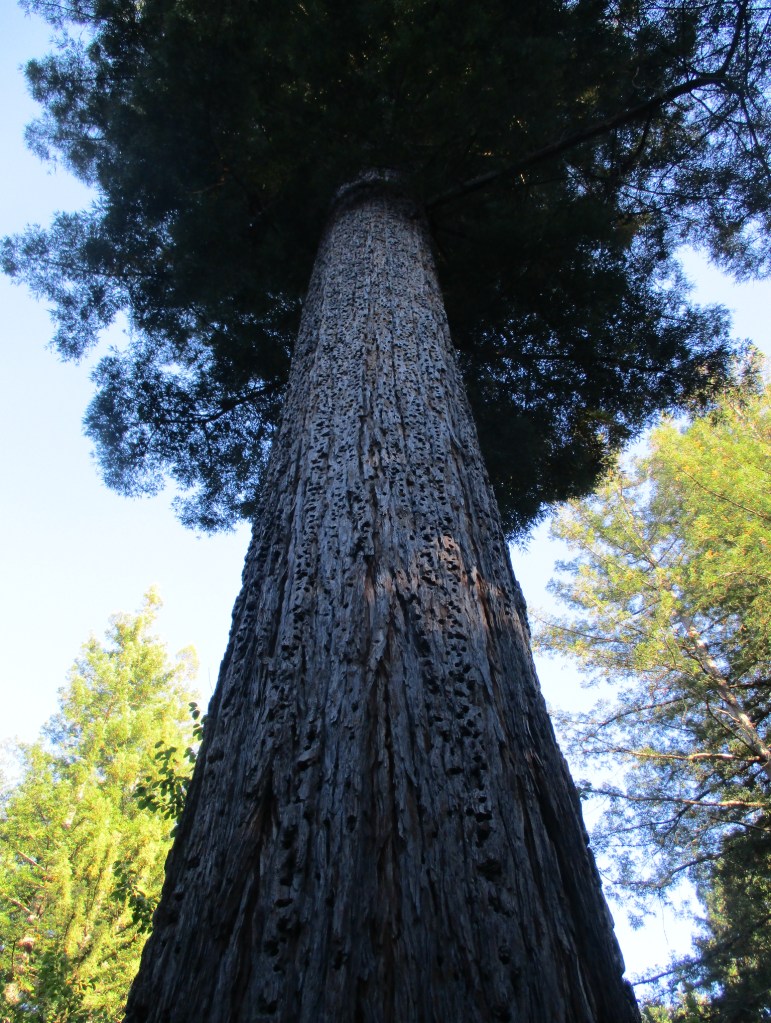






 Of all the Official State Trees, the coastal redwood, Sequoia sempervirens, of California is the grandest. Seriously, it is the tallest tree in the World, so it really ‘is’ the grandest! The tallest is 380 feet tall! Although the related giant redwood of the Sierra Nevada develops bigger trunks, the bulkiest coastal redwoods are thirty feet wide at the base! The oldest are more than 2,000 years old!
 Tony Tomeo