Bark Up The Right Tree

Bark can contribute color and texture.

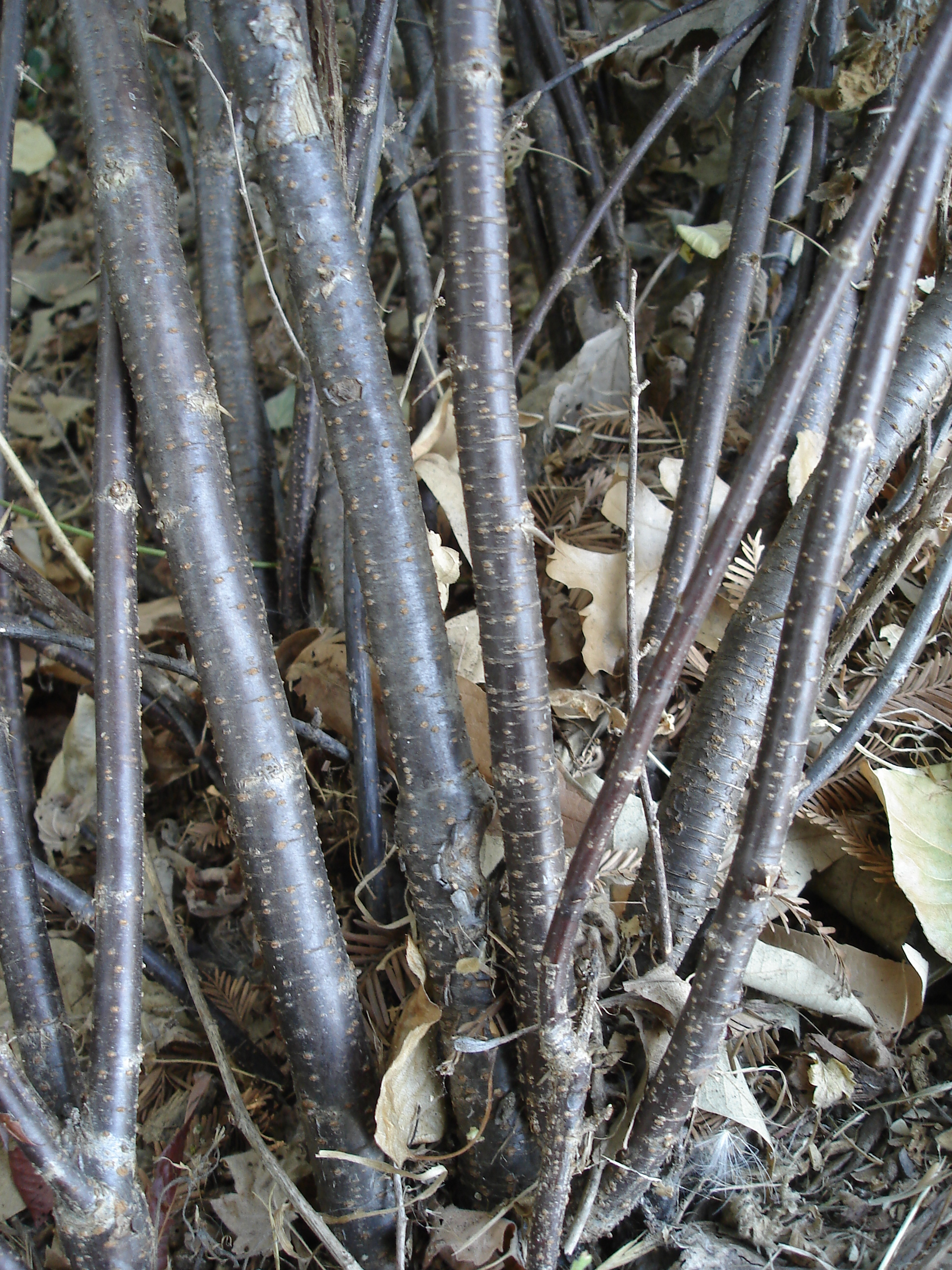
Autumn foliar color does not seem to last long enough. As it dissipates, though, it reveals silhouettes of bare deciduous trees. Some are delightfully sculptural, with strikingly pale bark on their trunks and stems. Others develop distinctively reddish twigs. Some display interesting bark textures or patterns. Color, texture and patterns are remarkably variable.

Of course, for most species, bark does not change much throughout the year. It becomes more prominent now merely because defoliation increases its exposure. In fact, some of the most distinctive bark belongs to evergreen species. Some belongs to flowering trees, fruiting trees or arboriform shrubbery. The sources are as variable as the characteristics.

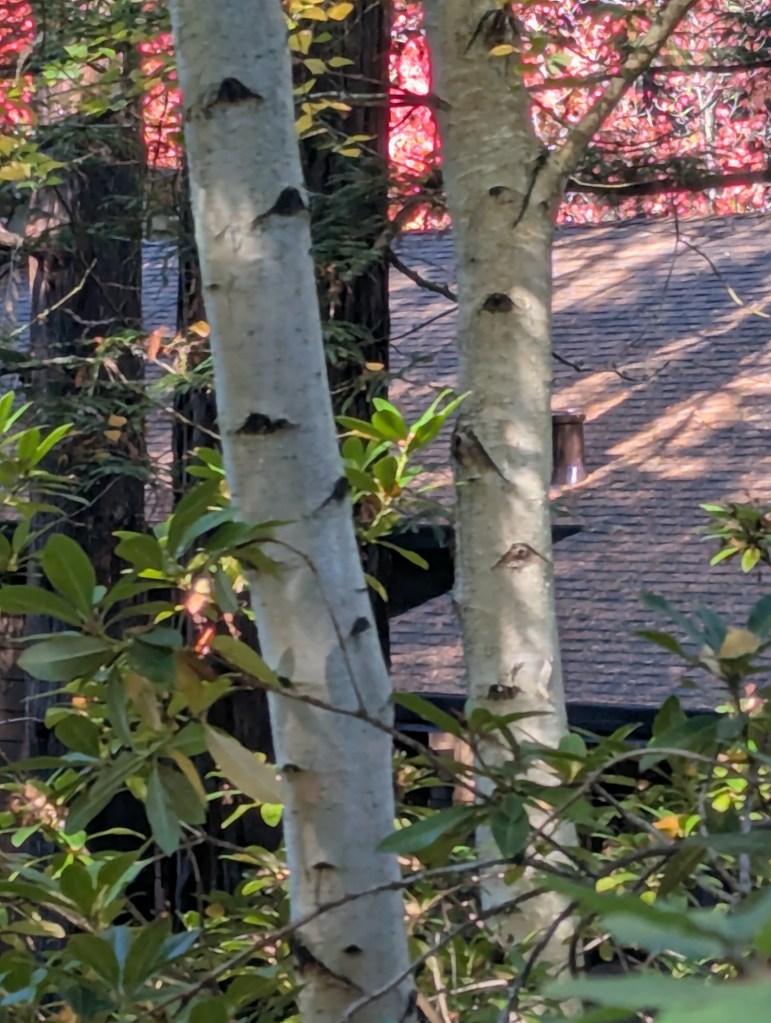
European white birch is likely the most familiar tree with white bark. Jacquemontii birch is even whiter. California sycamore is a massive tree with mottled light gray and tan bark. Crape myrtle, which is more proportionate to home gardens, is more mottled. Some elms exhibit elegant tan trunks and limbs. European beech trunks develop metallic gray color.

Melaleucas are evergreen trees with distinctively shaggy trunks. Eucalyptus are likewise evergreen, but generally with pale and smooth trunks. Lemon gum is particularly tall and elegant. However, red ironbark eucalyptus has dark and notably rough trunks and limbs. ‘Marina’ madrone develops smooth trunks and limbs with brown and cinnamon red color.

Coral bark Japanese maple and osier dogwood display colorful bark differently. Theirs is on small twigs rather than trunks and main limbs. Color actually develops in response to autumn chill and defoliation. Coral bark Japanese maple develops, pinkish orange color. Osier dogwood is more brownish red, although some cultivars are orangish or yellowish.

Trees that exhibit distinctive bark are subject to the same constraints as all other trees. In other words, they must be appropriate to their particular landscapes. California sycamore for example, is much too large for compact urban gardens. Osier dogwood can grow as a thicket without intensive maintenance. Any new tree or shrubbery should be sustainable.
Cut Flower Alternatives

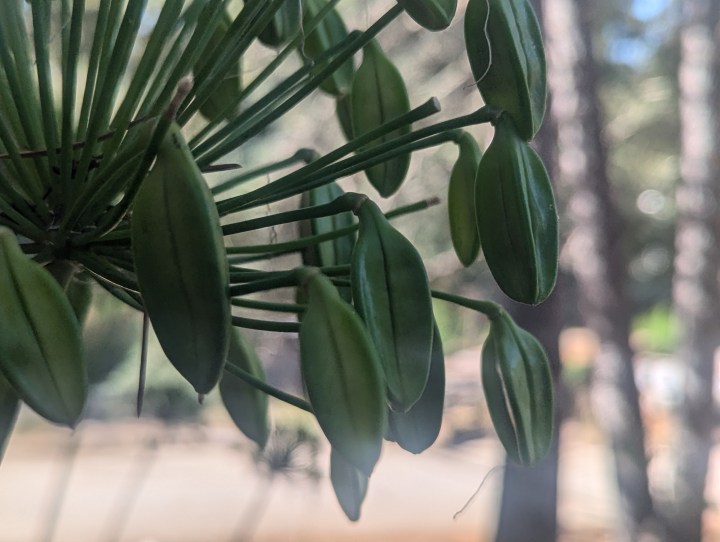
Lily of the Nile floral trusses are appealing even without bloom.

Most flowers bloom in spring. Many bloom a bit later and though summer. Not nearly so many start to bloom in autumn or though winter. This time of year, there is more to clean up from fading blooms than there are fresh blooms to cut and bring in.

Much of the color in the garden through autumn is provided by colorful foliage or foliage that gets colorful as the weather gets cooler. Later in winter, some plants have colorful bark and stems that gets revealed by winter defoliation. Coral bark Japanese maple, red twig dogwood and some arctic willows have remarkably colorful twigs.

Blooms of a few plants are sometimes cut and recycled after they fade because their dried flowers, flower stems or seed pods are appealing. Hydrangeas are not so attractive as they deteriorate out in the garden, but can be cut and hung upside down to dry to substitute for fresh flowers later. If done quickly, many types hold their color somewhat. Those that do not hold their fresh color may turn an appealing shade of brown.

Queen Anne’s lace can likewise be a nice dried flower, but is not so easy to hide in the garden while it dries. If cut and hung to dry, individual stems should be hung separately, since they bend and are difficult to separate if hung in clusters. Their flat-topped flower trusses curve inward as they dry, so they look nothing like they do fresh.

The rigid flower stems of New Zealand flax are rather sculptural protruding from their softer foliage. These same stems can be cut, plucked of seed pods, and like dried hydrangeas, used as cut flowers when there is not much else to get out of the garden. Ironically, New Zealand flax flowers sometimes get cut before they bloom, since not everyone appreciates their contrast against their own softly textured foliage.

Years ago, New Zealand flax flower stems were actually dried and spray painted! For those daring to try this technique, it also works well with lily -of-the-Nile flowers stems and trusses (plucked of their seed pods), Heavenly bamboo flower stems, and even dried pampas grass blooms. However, pampas grass blooms are deprived of their fluffiness and most appealing quality by spray paint. Bird-of-Paradise leaves twist interestingly as they dry, to provide texture with or without paint.

Fronds (leaves) of some fan palms can provide bold cut foliage. Mediterranean fan palm is difficult to handle because of the nasty teeth on the stalks, but has nice rounded leave that fan out nicely behind other flowers. They can be cut into smaller fans, or even other not so rounded shapes. Windmill palm is much easier to handle, but is a bit larger, so is more likely to need to be trimmed to shape. All are easy to cut with common scissors, and can be dried and spray painted.

There is probably more in the garden to substitute for cut flowers than would be guessed. Useful plant parts can be found in the least expected of places.

Sticks on Fire

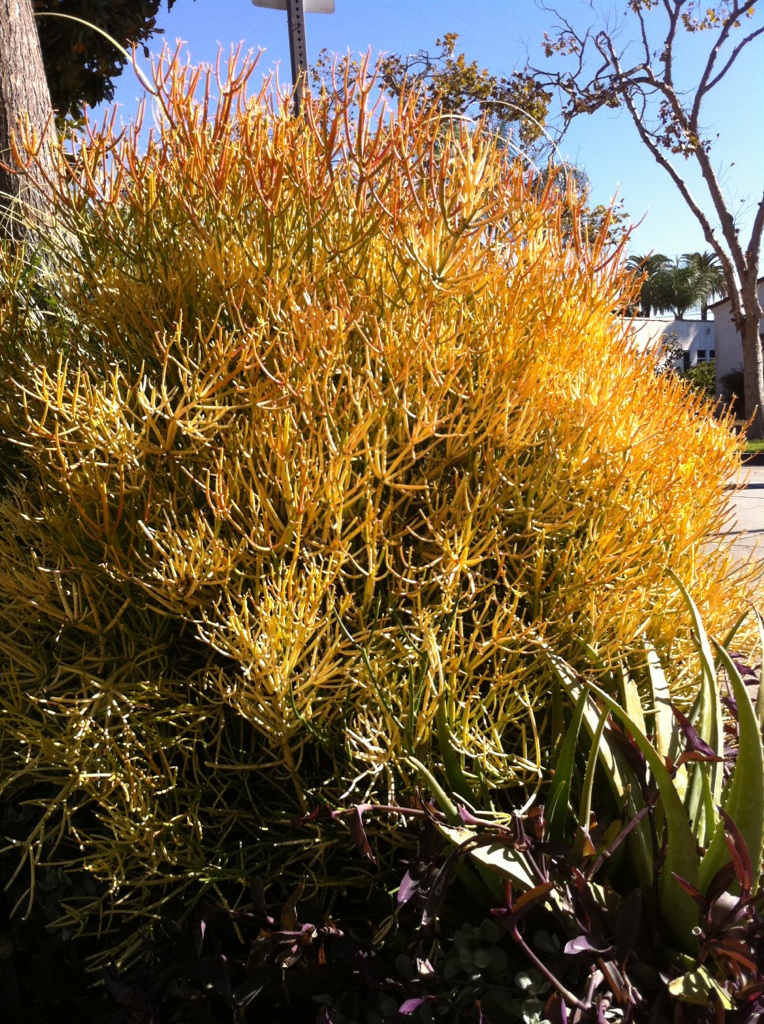
Sticks on fire is a more colorful and more compact version of pencil tree.

The old fashioned pencil tree, with leafless, succulent stems is a strikingly strange plant already. In mild climates of coastal Southern California, it can get quite large, nearly ten feet broad and twice as high. Sticks on Fire, Euphorbia tirucalli ‘Sticks on Fire’, stays less than half as large, but is even weirder because the stems are so oddly colored.

The inconspicuous leaves drop almost as soon as they develop, leaving distended fleshy stems that are either reddish or yellowish orange. Stems fade to softer yellow through summer, and then turn red in winter. Size and growth rate are limited by a lack of chlorophyll. Although related to poinsettia, the flowers of sticks on fire are not significant.

Sticks on fire prefers full sun exposure and warmth, but unfortunately needs protection from frost during winter. It can be happy under an eave on a south or west facing wall, or in a large tub that can be moved to shelter during winter. Plants in tubs are a bit more sensitive to rot if watered too frequently. The sap of sticks on fire is very caustic to skin and can be dangerous if it gets in the eyes.

Manzanita

Manzanita is Spanish for “little apple”.

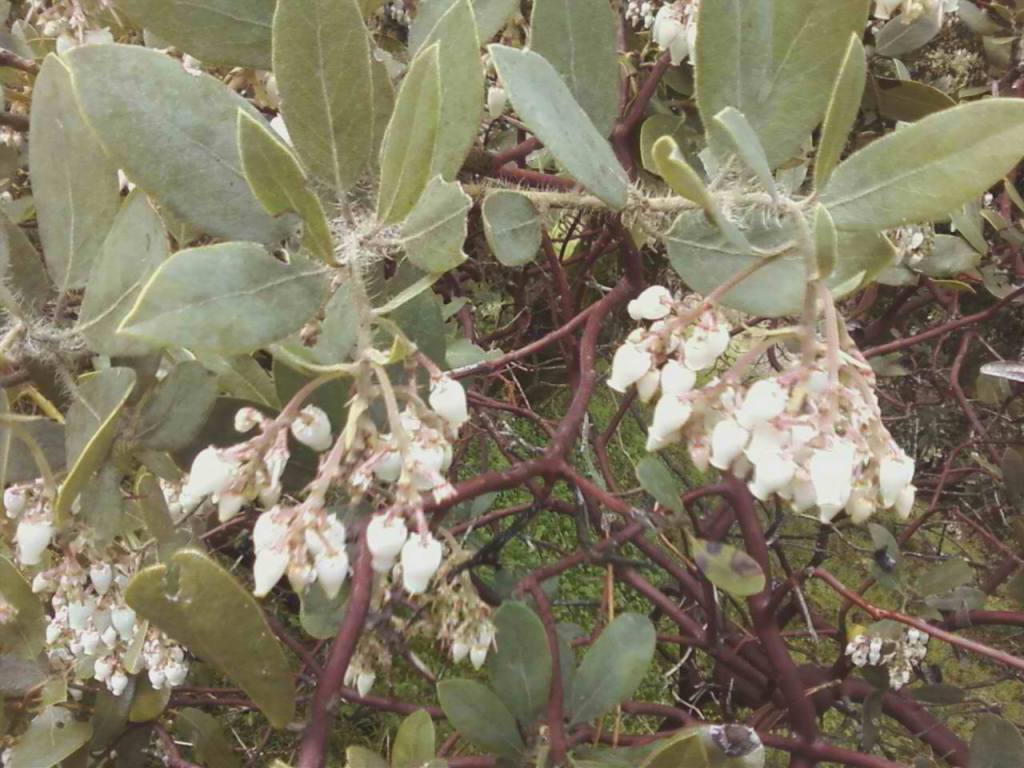
Mature common manzanita, Arctostaphylos manzanita, can get more than fifteen feet tall and about half as wide, so can be rather large shrubbery or small trees. Pruning away lower growth exposes their interestingly sculptural and smooth cinnamon red stems and trunks. The rather stiff light green leaves make light shade that smaller plants can live with. Waxy pinkish buds bloom into small pendulous clusters of tiny white lantern like flowers as winter becomes spring.

Manzanitas prefer to be neglected. They should not be pruned too much, and certainly should not get shorn. Obtrusive stems should be pruned out completely, since stems that get cut back do not regenerate. New plants should only be watered once or twice weekly through the first summer. Mature plants plants only want to be watered monthly or even less. After all, they are native to the surrounding hillsides, so are very satisfied with annual rainfall.

Osier Dogwood

The soft yellow or rusty red bare stems of osier dogwood have better color where exposed to cold and sunlight.

New spring foliage will soon be obscuring the rusty red or light yellow stems of osier dogwood, Cornus sericea (or Cornus stolonifera). Because this odd dogwood is grown for these distinctively colorful stems instead of blooms, it can be pruned harshly before foliation, to promote more twiggy growth for next winter. Unpruned plants form thickets five to ten feet high and ten or more feet broad. The flowers are actually rather pathetic relative to those of other dogwoods, since they lack colorful bracts. Where exposed to frost, the opposing two or three inch long and one or two inch wide leaves can provide nice reddish autumn color.

Even bare trees have style.

This big perennial ‘sticks of fire’ produces a thicket of bright yellowish orange stems that changes shades through the seasons.

Everyone knows that flowers provide color in the garden, particularly through spring and summer. As blooms become less abundant in autumn, fall color of deciduous plants and trees becomes more prominent. After most plants are finished blooming, and most of the fall color is gone, the garden may seem relatively bleak for winter. Only evergreen foliage remains. This is when plants that exhibit colorful bark or bare twigs really get noticed.

Various types of birch trees exhibit striking white bark all year. While the trees are bare in winter, the bark becomes even more prominent, particularly against a backdrop of evergreen trees. English walnut trees are not as striking, but are more sculptural. Fig trees (fruiting types) are more gray than white, so are more reliant on a backdrop of rich evergreen foliage or a darkly painted wall for contrast; but they grow fast enough to become interesting sculptural specimens within a few years. 

Bright white or light gray bark are certainly no substitute for the colors of flowers or foliage, but are striking nonetheless. They exploit the starkness of winter, and the sculptural nature of bare trunks and limbs.

Even without the sculptural structure of birch, walnut or fig trees, the more colorful twiggy growth of coral bark Japanese maple and osier dogwood trees can be quite an advantage in a stark winter landscape. As the name implies, coral bark Japanese maple has pinkish orange twigs. Osier dogwood can be ruddy brown, brownish orange or pale yellow. Frost improves color.

Unlike other Japanese maples that get pruned only lightly to enhance their form, coral bark Japanese maple can get pruned rather harshly just prior to spring growth in order to promote an abundance of the twiggy growth that is so colorful in winter. Osier dogwoods can get pruned down almost to the ground at the end of winter to eliminate tired older stems and promote colorful new stems for the following winter. They lack the colorful bloom that flowering dogwoods provide; so it is no bother that such harsh pruning prevents them from blooming.

Like trees with white or gray stems, coral bark Japanese maples and osier dogwoods are more striking against a backdrop of rich green foliage. Because winters are so mild here, they should be located where they will be most exposed to chill.

Curly Willow

Curly willow is also corkscrew willow.

They start out simply enough, as weirdly twisted bare stems in fancy floral arrangements. By the time the last flowers fade, the submerged parts of these bare stems develop roots and perhaps leaves. These now rooted cuttings then graduate into pots or gardens. Most curly willow, Salix matsudana ‘Tortuosa’, is therefore unplanned. It is rare from nurseries.

Mature trees should not get much taller than fifteen feet, with awkwardly irregular branch structure. Regular pruning and grooming eliminates congested and structurally deficient growth. Alternatively, pollarding or coppicing during winter dormancy promotes vigorous growth. Healthy trees can drop overburdened limbs, and might live for only twenty years. 

Curly willow, which is also corkscrew willow, is popular more for distinctively curly stems than as a small deciduous shade tree. Specimens that provide such stems for cutting do not need to be very big. If cut and dried while dormant during winter, stems can not grow roots in water. Nor will they require plucking to remove their leaves, which are also curly.

New Canes Replace Old Canes

50916thumb
Well groomed canes are not overgrown.

Heavenly bamboo, or simply ‘nandina’, is one of those many plants that almost never performs like it should. The intricately lacy foliage is so appealing while plants are young, and changes color with the seasons. The red berries can be comparable to those of holly. Unfortunately, healthy plants grow, and then ultimately get shorn into globs of disfigured leaves and stems.

The same abuse afflicts Oregon grape (mahonia), mock orange (philadelphus), forsythia, lilac, abelia and all sorts of shrubby plants that really should be pruned with more discretion. Their deteriorating older stems should be pruned to the ground as new stems grow up from the roots to replace them. It is actually not as complicated as it seems.

This pruning process, known as ‘alternating canes’, prunes the plants from below. It is a standard pruning technique for maximizing production of blackberries, raspberries and elderberries. It is similar to grooming old stalks from bamboo and giant reed, even if it does not prevent them from spreading laterally.

The deteriorating older stems, or ‘canes’, are easy to distinguish from newer growth. Old canes of Heavenly bamboo and Oregon grape become heavy on top, and flop away from the rest of the foliage. Old canes of mock orange and lilac get gnarled and less prolific with bloom. Aging abelia and forsythia canes become thickets of crowded twigs.

The newer stems are likely a bit lower, but are not so overgrown. Since the foliage is not so crowded, it is displayed on the stems better. Their blooms or berries are more abundant. By the time new growth becomes old growth, there will be more newer growth right below it. In fact, the regular removal of aging canes stimulates growth of new canes.

This is the time to prune Heavenly bamboo and Oregon grape, just because the oldest foliage is as bad as it will get after the warmth of summer. Mock orange, forsythia and lilac should get pruned while dormant through winter, but are commonly pruned just after they finish bloom early in spring. Abelia should probably wait until spring because new growth can look sad through winter.

Some Plants Impress With Bark

P80805Lemon eucalyptus, ‘Marina’ madrone, cork oak and all sorts of melaleuca trees are known more for their interesting bark than for their foliage or flowers. It helps that their distinctive trunks and branch structures are ideal for displaying their unique bark. Color and texture of bark is remarkably variable, and tends to get noticed more in winter while blooms and foliage are lacking.
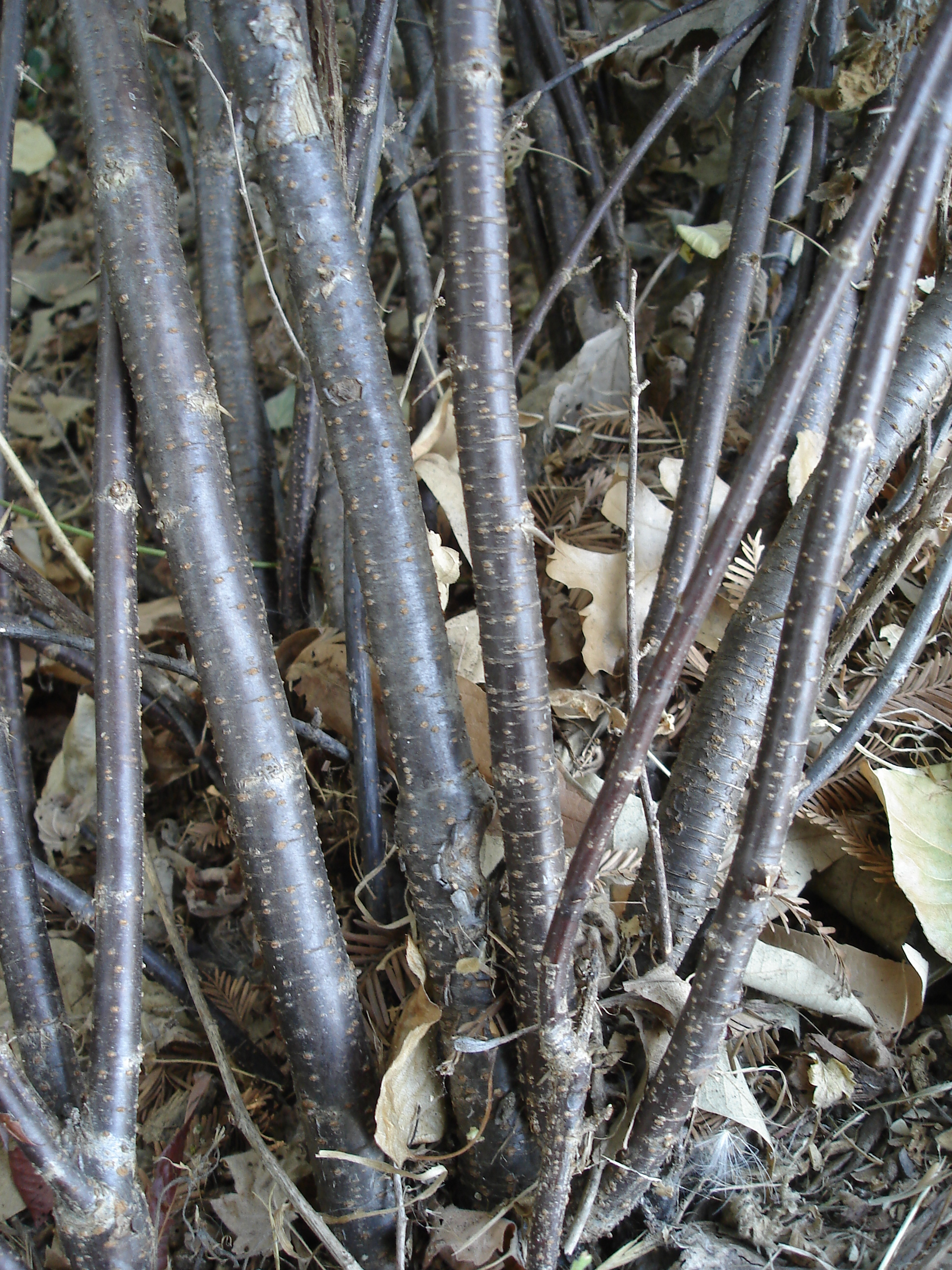
Bark of sycamores, birches, elms and crape myrtles that had been so handsome throughout the year is more visible now that it is not partially obscured or shaded by the deciduous foliage that is associated with it. Trunks and limbs of European white and Jacquemontii birches are strikingly white. ‘Natchez’ crape myrtle has distinctively blotched bark, (although the white flowers are pale.)

Because of their other assets, English walnuts, figs and saucer magnolias are not often grown for their bark. Nonetheless, their pale gray bark shows off their stocky bare branch structure nicely, especially in front of an evergreen backdrop of redwoods or pines. The smooth metallic gray bark of European beech is much more subdued, but is what makes big old trees so distinguished.

A few deciduous trees and shrubs get more colorful as winter weather gets cooler. Instead of white or pale gray, their bark turns brighter yellow, orange or red. Some plants, like sticks-of-fire, do not need much cool weather to develop good color. Others get more colorful in colder climates, and contrast spectacularly to a snowy landscape. Locally, they should be well exposed to chill.

As the name suggests, the coral bark Japanese maple (‘Sango Kaku’) develops pinkish orange bark. It can get ruddier in colder climates, but may get yellowish here. Unlike other Japanese maples that get pruned to display their delicate foliage and branch structure, the coral bark Japanese maple sometimes gets pruned more aggressively to promote more colorful twiggy growth.

Osier dogwood is a shrubby dogwood that lacks colorful bloom, but compensates with ruddy brown, brownish orange or pale yellow bark in winter. (Dogwood bark . . . There is a pun there somewhere.) Because it lacks colorful bloom, it can be pruned aggressively after winter. Older canes that do not color as well can be pruned to the ground as they get replaced by new canes.

New Canes Replace Old Canes

50916thumbHeavenly bamboo, or simply ‘nandina’, is one of those many plants that almost never performs like it should. The intricately lacy foliage is so appealing while plants are young, and changes color with the seasons. The red berries can be comparable to those of holly. Unfortunately, healthy plants grow, and then ultimately get shorn into globs of disfigured leaves and stems.

The same abuse afflicts Oregon grape (mahonia), mock orange (philadelphus), forsythia, lilac, abelia and all sorts of shrubby plants that really should be pruned with more discretion. Their deteriorating older stems should be pruned to the ground as new stems grow up from the roots to replace them. It is actually not as complicated as it seems.

This pruning process, known as ‘alternating canes’, prunes the plants from below. It is a standard pruning technique for maximizing production of blackberries, raspberries and elderberries. It is similar to grooming old stalks from bamboo and giant reed, even if it does not prevent them from spreading laterally.

The deteriorating older stems, or ‘canes’, are easy to distinguish from newer growth. Old canes of Heavenly bamboo and Oregon grape become heavy on top, and flop away from the rest of the foliage. Old canes of mock orange and lilac get gnarled and less prolific with bloom. Aging abelia and forsythia canes become thickets of crowded twigs.

The newer stems are likely a bit lower, but are not so overgrown. Since the foliage is not so crowded, it is displayed on the stems better. Their blooms or berries are more abundant. By the time new growth becomes old growth, there will be more newer growth right below it. In fact, the regular removal of aging canes stimulates growth of new canes.

This is the time to prune Heavenly bamboo and Oregon grape, just because the oldest foliage is as bad as it will get after the warmth of summer. Mock orange, forsythia and lilac should get pruned while dormant through winter, but are commonly pruned just after they finish bloom early in spring. Abelia should probably wait until spring because new growth can look sad through winter.