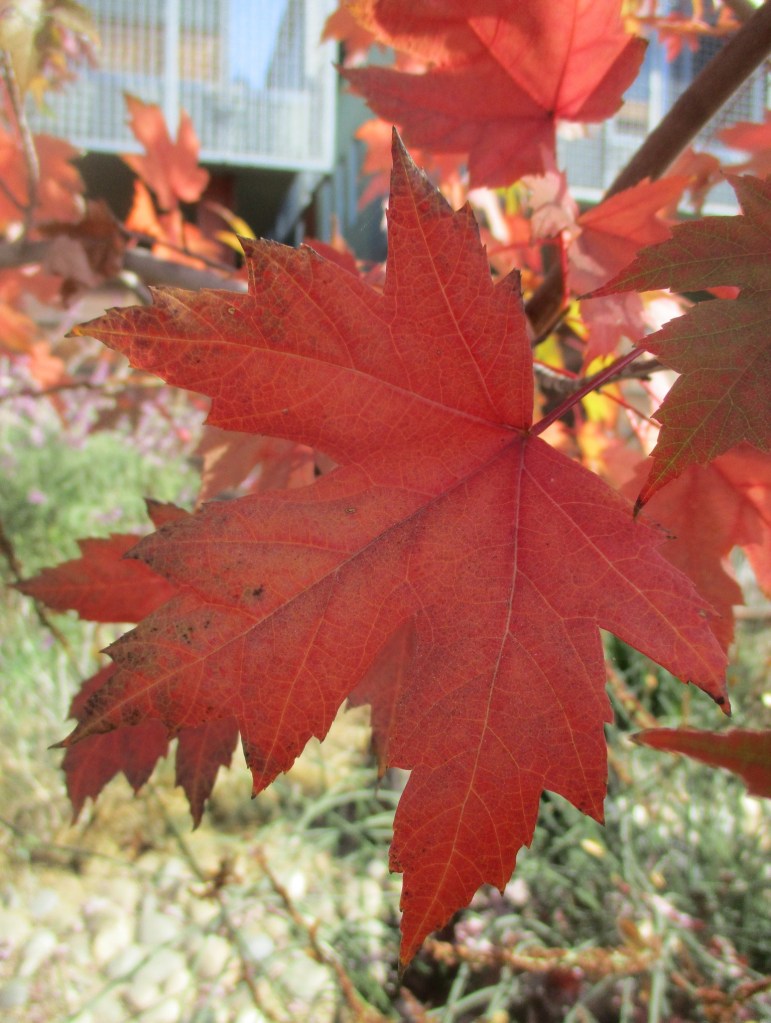
It combines the autumn foliar color of red maple with the lacier foliar form of silver maple. Freeman maple, Acer X freemanii, is a hybrid of the two. It occurs naturally where ranges of its parents overlap. However, most modern garden cultivars are products of intentional hybridization. Like silver maple, it does not need much chill to exhibit autumn foliar color.
Freeman maple inherits other attributes from both its parents. It combines rapid growth of silver maple with structural integrity of red maple. Although it gets bigger than red maple, it is not as imposing as silver maple. It develops high branches like silver maple, but also is symmetrical like red maple. Big roots are about as complaisant as those of red maple.
Mature Freeman maple trees can grow about forty feet tall and broad. Autumn foliar color is vivid orange and red, and lasts longer than that of red maple. Since Freeman maple is a hybrid, it is mostly sterile. It can not generate an annoying abundance of seed. Nor can it naturalize in favorable climates. It is an exemplary maple for mild climates such as this.
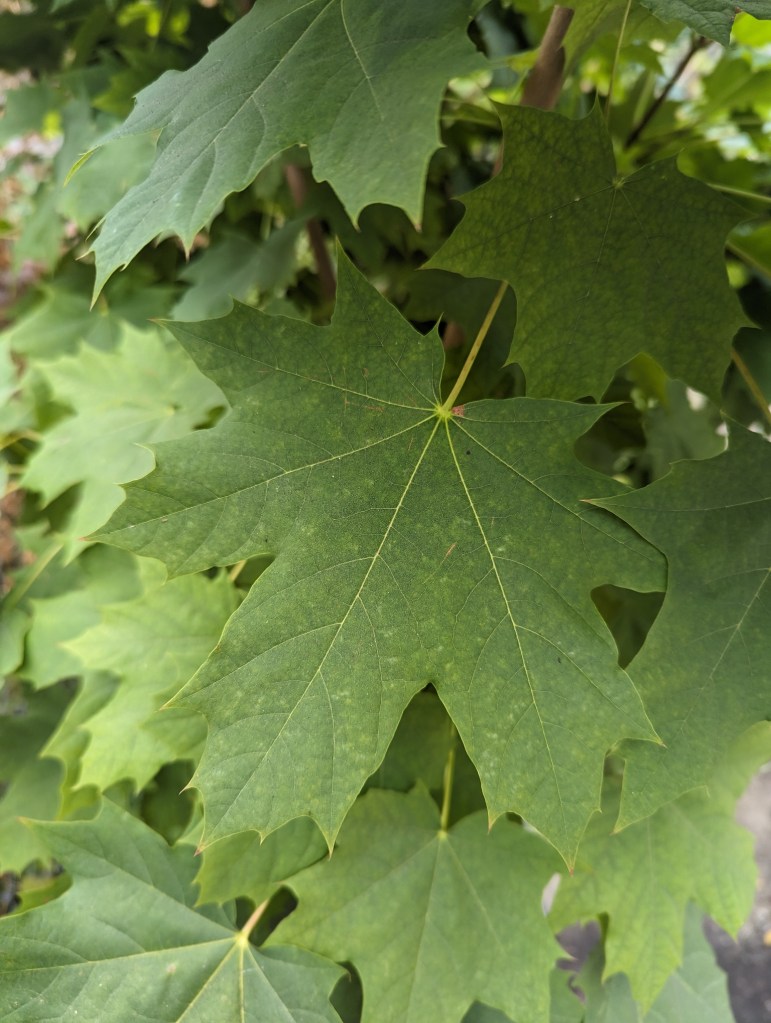
It is rare now, but Norway maple, Acer platanoides, was once common as a street tree. A few are prominent within neighborhoods that were developed in the 1950s and 1960s. It resembles the common London plane. In fact, its botanical name translates to ‘maple like a plane tree’. Unfortunately though, the roots are perhaps too aggressive with pavement.
Norway maple defoliates somewhat more efficiently than London plane tree. However, in spring, it refoliates significantly later. Otherwise, it is a splendid shade tree. A few modern cultivars exhibit bronzed foliage that yellows for autumn. One exhibits variegated foliage. Another has chartreuse foliage. ‘Schwedleri’ was once the most common bronze cultivar.
Very few Norway maples are taller than forty feet within the mild climates here. They can grow significantly larger in cooler climates, such as the Pacific Northwest. Their palmate leaves are about five to nine inches wide. New trees are rarely available from nurseries, so require special ordering. Norway maple is not overly discriminating in regard to soils. It prefers regular irrigation through summer warmth.
Many dwarf plants are very practical. The many different dwarf cultivars (cultivated varieties) of false cypress that are grown for their interesting forms, textures and foliar colors are much more proportionate to home gardens than similar specie in the wild, which are big enough to get harvested for timber. Oranges are easier to reach on dwarf trees than on standard trees, which get as big as shade trees.
However, not all plants should be bred to be dwarfs. Dwarf Southern magnolias certainly have their appeal for tight spots, but do not make as much shade as larger trees do. Compact cultivars of crape myrtles (although not actually dwarfs) take too much time to grow above truck traffic to be practical as street trees.
Many classic annuals and perennials are likewise bred to be too compact to be as practical as they were in the past. Annie of Annie’s Annuals in Richmond refers to this all too common practice as ‘boinkification’. It makes many blooming plants more marketable and resilient to shipping and installation, but deprives them of their natural form and elegance.
Short annuals and perennials certainly have their place. Lobelia, sweet alyssum, dwarf marigolds and petunias are fine along walkways and in pots with other larger plants. They also work well as bedding plants for a profusion of color. Yet, there is all too often too much of a good thing. Some flower beds are simply so big and plain, that it would be just as colorful to paint an area orange instead of planting so many marigolds.
Taller flowering annuals like nicotiana (flowering tobacco), cosmos and zinnias add depth behind lower growing annuals. Dahlias are perennials that can accomplish the same thing. Some of the older and less common varieties of familiar bedding plants that have not been so boinkified also work well. There are even petunias that can get two feet tall and wide! These taller plants also provide cut flowers; which is something that boinky plants are not so good at.
Boinkification also compromises fragrance and aroma. Bedding dianthus have almost no fragrance at all; unlike the old fashioned dianthus and carnations that had such distinctive spicy fragrance. Modern zonal geraniums are more colorful than classic varieties, but their foliage is not quite as aromatic.
Not only does increased foliar density of boinky plants promote the proliferation of many diseases and pests; but the genetic violations necessary for boinkification interfere with resistance to diseases and pests!
Pavement necessitates trees with complaisant roots.
Trees of substantial size are not as popular as they had been among old home gardens. Modern landscapes of bigger homes on smaller parcels can not accommodate as many. Clearance from various infrastructure is now more of a concern than shade. Within many modern urban gardens, most available space is in front. Such is the realm of street trees.
This is not because of a lack of obstacles, such as infrastructure that requires clearance. It is more because such obstacles are closer to the ground with more open space above. Many street trees must actually be more adaptable to certain constraints than other trees. Selection of such trees, if allowable by their municipalities, necessitates diligent scrutiny.
Street trees are, most simply, trees between curbs and sidewalks. Some inhabit medians while others are adjacent to curbside sidewalks. Many municipalities prescribe particular trees for particular situations. Anyone who is uncertain of such limitations should inquire. Many municipalities permit property owners to install any trees they prefer, or none at all.
For those who can select street trees, such trees must be appropriate to their application. They must grow high enough to not obstruct sidewalks or roadways. Both sidewalks and roadways require minimal clearances. So do street signs, streetlamps and traffic signals. However, street trees should not grow too large for the confined spaces that they inhabit.
This includes their roots. Aggressive roots of willows, poplars and sweetgum are likely to displace pavement. Oaks, although too big for confined situations, are more docile. Their roots are less likely to displace adjacent infrastructures. Crape myrtle has become overly common because it is too small to cause damage. It does not make much shade, though.
Crape myrtle might also get rather messy, which is another consideration for street trees. It drops flowers during summer, and can get infested with scale, which exude honeydew. Magnolias drop flowers that can be a slipping hazard. Whether deciduous or evergreen, street trees should be reasonably tidy. Over roads, they should not need much attention.
Not many arborists or horticulturists are fond of the unremarkable but very popular London plane tree, Platanus X acerifolia. It soon gets too large for many of the tight situations it gets planted in, more than thirty feet broad and more than forty feet tall. Although it is among the most common of street trees, it can produce aggressive buttressed roots that displace sidewalks and curbs. Fuzz (tomentum) from the leaves is irritating to the skin or if inhaled.
Older trees that were planted prior to the development of disease resistant varieties are very susceptible to anthracnose and mildew, and are likely to infect other susceptible plants. Infected trees often get their foliage late in spring (after earlier new foliage shrivels and falls), or defoliate by late summer. Otherwise, the slightly raspy eight inch wide leaves seem sickly as they turn grungy yellowish brown in autumn.
Landscapers use London plane trees too commonly merely because they are so reliable. They tolerate most soils, smog, severe exposure (such as reflected glare from pavement) and a bit too much watering. Modern varieties are not quite as susceptible to disease. ‘Yarwood’ has large rounded leaves that are resistant to mildew. ‘Bloodgood’ is less susceptible to anthracnose. ‘Columbia’ is less susceptible to both diseases.
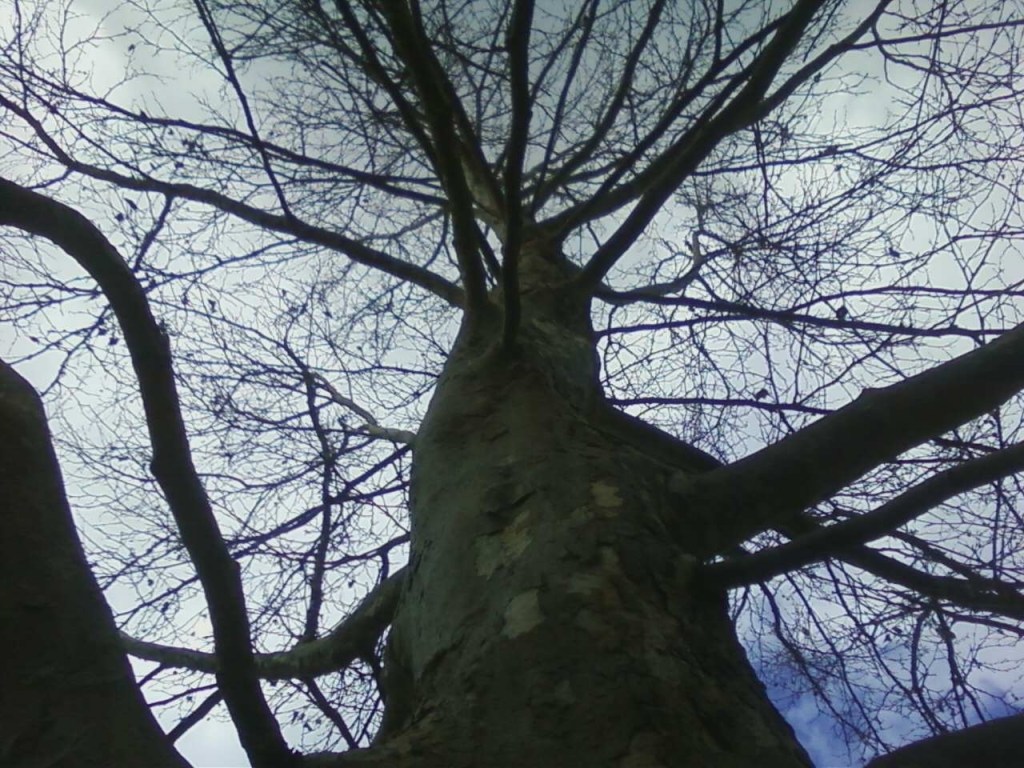
Large limbs and trunks with mottled gray and tan bark are rather sculptural while bare through winter. London plane happens to be conducive to annual pollarding, which makes the limbs even more sculpturally gnarly, and produces more vigorous growth with larger leaves that are less susceptible to disease.
Trees are the most significant components of the landscapes that they inhabit. They get larger than all other plants, and live for decades or centuries. Because inappropriate trees have such potential to cause such serious problems, and can be so difficult and expensive to remove, it is important to select trees that are appropriate to each particular application.
Size and form of trees when they mature are important considerations. Crape myrtles are small to midsized trees that fit nicely into tight spots, but are too dinky to be good street trees. London plane trees are more proportionate as street trees, but eventually displace sidewalks and curbs with their aggressive buttressed roots. Chinese elms can be good street trees, but need to be pruned regularly to maintain clearance. Red maples are a better choice because they get large enough without getting too big, have complaisant roots, and are easily pruned for adequate clearance.
Other features in the area can limit tree selection. Poplars and willows have aggressive roots that invade septic systems or old unsealed iron or terra cotta sewer pipes. Queen palms eventually reach utility cables, but can not be pruned to go around them. Any good shade tree can provide too much shade over solar panels. Partial shade from large trees or structures is a problem for most other trees, but is actually preferred by a few ‘understory’ trees like vine maples, Japanese maples and dogwoods.
Trees that are expected to provide shade through summer should probably be deciduous, like red oaks or silk trees, to allow warming sunlight through during winter, particularly close to the home. However, trees that should obscure unwanted views should be evergreen, like Southern magnolias or arborvitaes.
Some trees that need more attention than others are only appropriate where they will get the attention they need. Mexican fan palms are easy to care for while young, but eventually grow out of reach and need to be groomed by professional arborists. Of course, every tree is limited to particular climates. Various ficus trees that are common in nurseries in San Diego will not survive even a mild frost, which is why they are not available in San Jose.
Pruning techniques are very diverse to serve various purposes. Dormant pruning during winter concentrates resources for spring or summer growth. Hedging or shearing merely contains growth. Thinning or grooming removes superfluous growth to enhance sunlight diffusion. Clearance pruning directs new growth that might otherwise become obtrusive.
There are too many distinct pruning techniques to mention. Some, such as shearing and thinning, are mutually exclusive. Shearing actually initiates the sort of congested growth that thinning eliminates. Techniques such as dormant pruning and clearance pruning are mutually compatible. After all, almost all pruning is less stressful with winter dormancy.
Clearance pruning merely becomes a concern now as spring growth becomes obtrusive. Much of the worst require professional assistance. Only arboricultural professionals can safely prune trees away from high voltage cables. Such cables are extremely hazardous! Utility services generally try to arrange such procedures before major problems develop.
However, arboricultural professionals are necessary for other clearance pruning as well. Many trees are simply too large or hazardous for anyone but professionals. Some extend over roadways that need clearance for the largest of trucks. Some extend over chimneys that could ignite vegetation that gets too close. Many simply extend beyond a safe reach.
Street trees seem to require the most clearance pruning. They must be a specified height over any roadway, as well as over any sidewalk. Also, they must not obstruct street signs or views for cars backing out of driveways. Ideally, their interference with light from street lamps should be minimal. Vegetation that is closer to buildings presents other concerns.
Besides chimneys and exhaust vents, roofs also need clearance. Stems and foliage are abrasive as they move in any wind. They collect debris that causes rot and clogs gutters. Furthermore, walkways and navigable areas are more efficient with adequate clearance. Clearance pruning should direct growth away from any obstruction, rather than contain it.
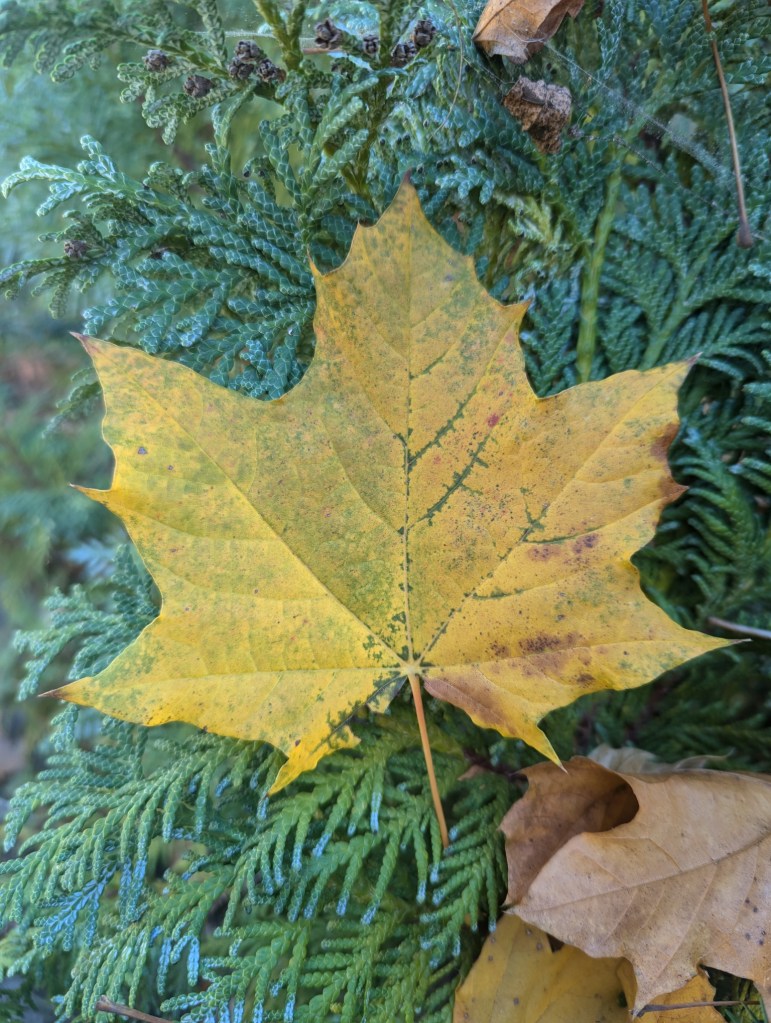
The botanical name of Norway maple, Acer platanoides, means ‘maple like a sycamore’. It resembles Platanus X acerifolia, which means ‘sycamore with maple foliage’. Platanus X acerifolia is London plane (‘sycamore’), which serves similar purposes. Norway maple lacks the irritating foliar tomentum of London plane. It has more aggressive roots though.
Norway maple was likely never a fad, but was common as a street tree during the 1950s. It naturalized as in invasive exotic species in parts of the Pacific Northwest. It is not such a nuisance locally. Most domestic trees are sterile or almost sterile cultivars. If their roots were more complaisant, they could have been ideal street trees. Their shade is splendid.
‘Schwedleri’, with bronzed foliage, was likely the most popular cultivar originally. Modern cultivars are darker bronze, golden, variegated or simple green. Their deciduous foliage is not so impressive for autumn though. It turns somewhat brownish yellow. The palmate leaves are about five to nine inches wide. Defoliation is efficient. Refoliation is quite late. Not many Norway maples get more than forty feet tall within the mild climates here.
The Post Office in town is where I go to post or collect mail. For the past few years, this small coast live oak has been getting so low that I must duck under it to get onto the sidewalk from the parking spaces, or even to get past it on the sidewalk. It is particularly annoying because it is in such a prominent location where many other people park and enter the Post Office. I have sometimes considered bringing my pole saw and other pruning tools to prune it for clearance, but because I have not driven the pickup into town for a very long time, and do not intend to do so anytime soon, I would have no means with which to dispose of the debris.
Well, someone else pruned it. Well, sort of pruned it. Well, let us just say that I no longer need to duck under it. What a hot mess of stubs, or should I say, ‘posts’. This is after all, the Post Office. How could anyone think that this was acceptable?! How difficult would it have been to cut these lower limbs properly, without leaving these horrid posts?! Even someone who is not at all concerned about the tree or proper arboriculture can see how hideous this is. Seriously, this goes beyond negligence. Someone put considerable effort into doing this so extremely improperly!
I brought my pole saw the following week to remove these posts without doing any more pruning. I figured that without all the foliage, I could fit them into the trunk of the Roadmaster. However, by the time I go there, someone, likely from the Department of Public Works, had already repaired the damage. The tree could be pruned a bit more, but at least it is not so mutilated.
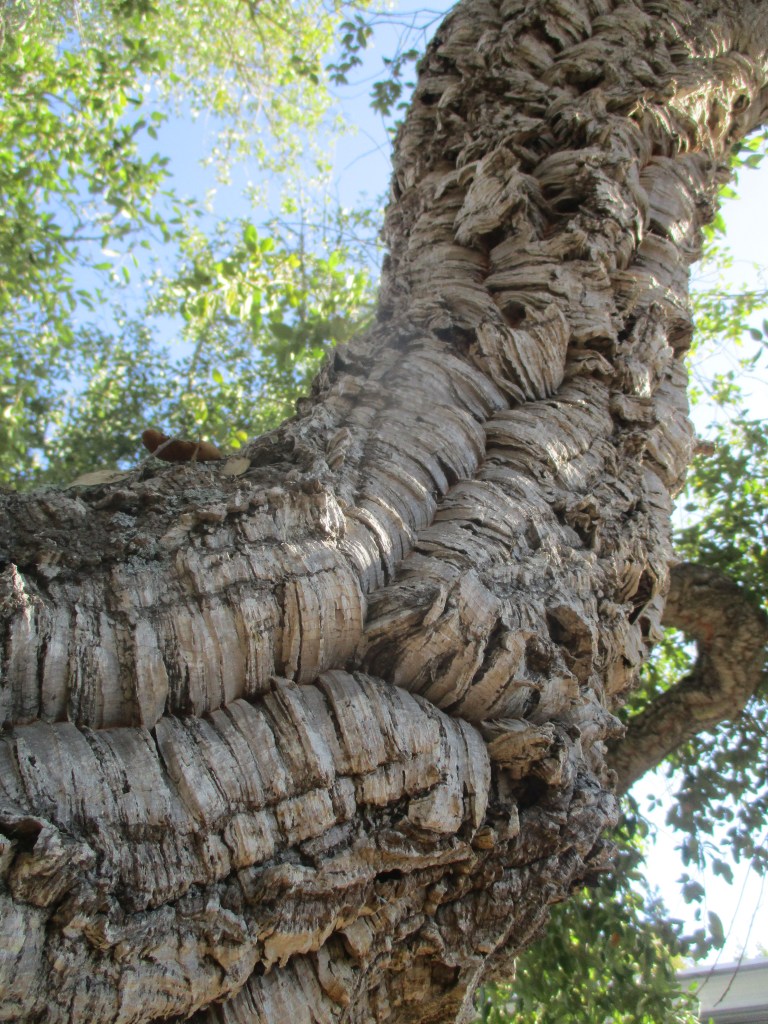
This is a tree that takes some time to impress. Bloom is uninteresting. Foliage is no more distinctive than that of coast live oak. Instead, the most spectacular characteristic of cork oak, Quercus suber, is the boldly striated and uniquely spongy texture of its mature bark. Such bark takes a few years to develop, but gets so thick that it seems significantly older.
As its name implies, cork oak had historically been the exclusive source of bark for corks and cork products. As modern and more practical materials diminished demand for such bark, cork oak became more popular as an evergreen shade tree. It is quite happy within the arid chaparral climates of California. In fact, it behaves much like native oak species.
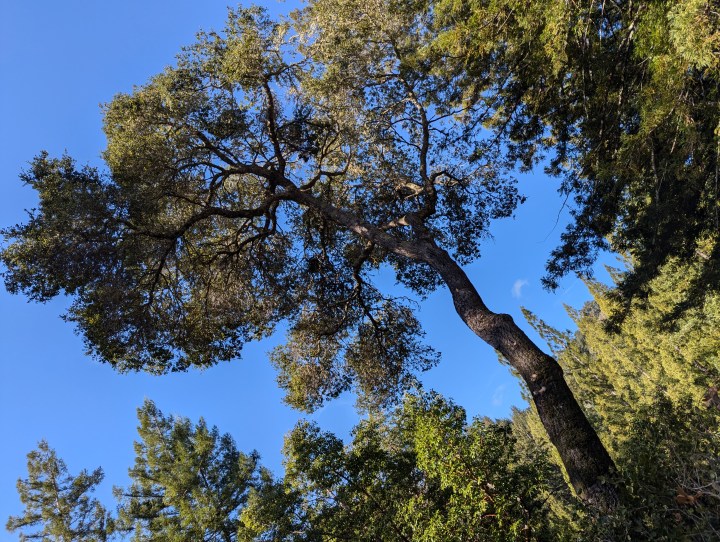
Mature cork oak trees generally stay less than forty feet tall, even if their trunks are wider than three feet with their unusually thick bark. Without excessive irrigation, their roots are notably complaisant. Low branches are more visibly sculptural than high branches. With pruning for adequate clearance though, trees with high branches are striking street trees. Foliar and floral debris is quite messy during spring bloom.



 Tony Tomeo