
If my articles start to seem somewhat deficient, it is all Brent’s fault. Really. I will need to be spending more time with GREEN; Greening Residential Environments Empowering Neighborhoods. It is a much more important project than what I am doing because it involves planting more street trees and trees in public places in Los Angeles, maintaining trees of the urban forest, and enforcement of tree preservation ordinances within Los Angeles. Brent has been very active with GREEN since we were in school, and it has really make a big difference in the parts of Los Angeles that have benefited from it.
I will need to be writing for the website and other social media outlets for GREEN, and consulting with others doing the same. To make matters more confusing, I will be working on yet ANOTHER projects later in January as well, but I can explain that a bit later.
When I started my writing here, it was initially intended as an outlet for my weekly gardening column. After a while I started recycling articles from last year as well. The space in between is filled in with my ‘elaborations’, which are supposed to be related to horticulture, but are sometimes about other funny but unrelated topics.
I hope to continue in such a manner than no one notices that I am also working on other projects. In fact, I believe that the other projects might be interesting topics here, which means that the different projects may actually compliment each other. We will find out as we go along. I will post updates about GREEN, which will soon be known as something else. I am sorry that the Facebook Page for GREEN has been deleted while we develop a new one. Otherwise, I would post a link to it.
 Right next door to my downtown planter box, (
 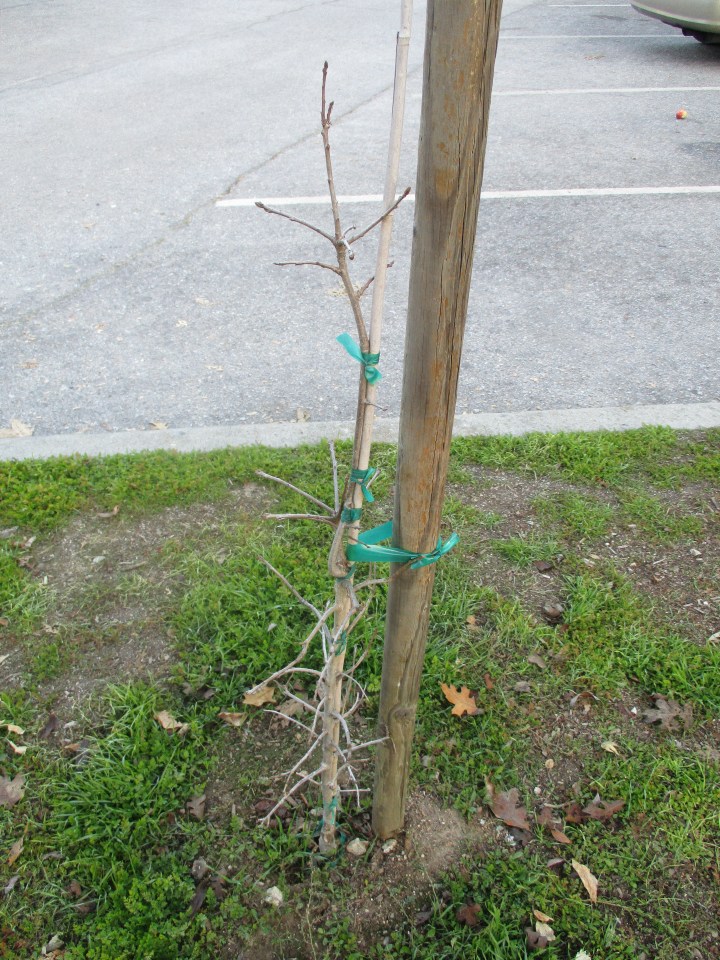 The sad little Scofield Tree in Felton Covered Bridge Park did not do much this year. (
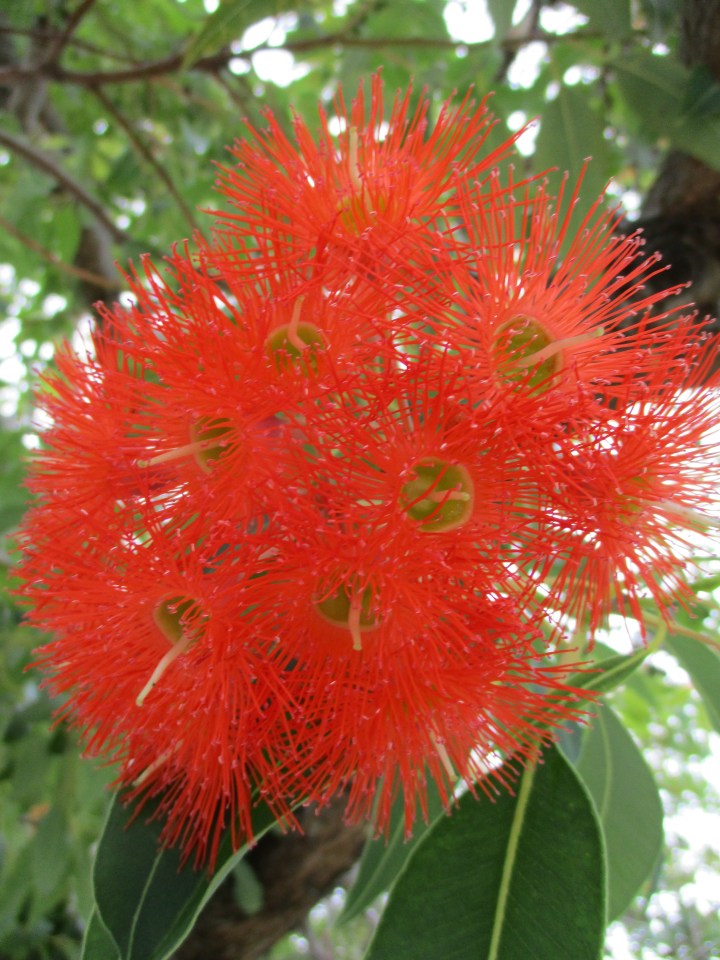 We all know about the bad reputation of eucalypti, especially the notorious blue gum. They are too big, too aggressive, too messy, too structurally deficient, and in groups, they are too combustible. However, there are several eucalypti that are not only appropriate for local home gardens, but because of their resiliency, drought tolerance and adaptability to the local environment, should be more popular than they are.
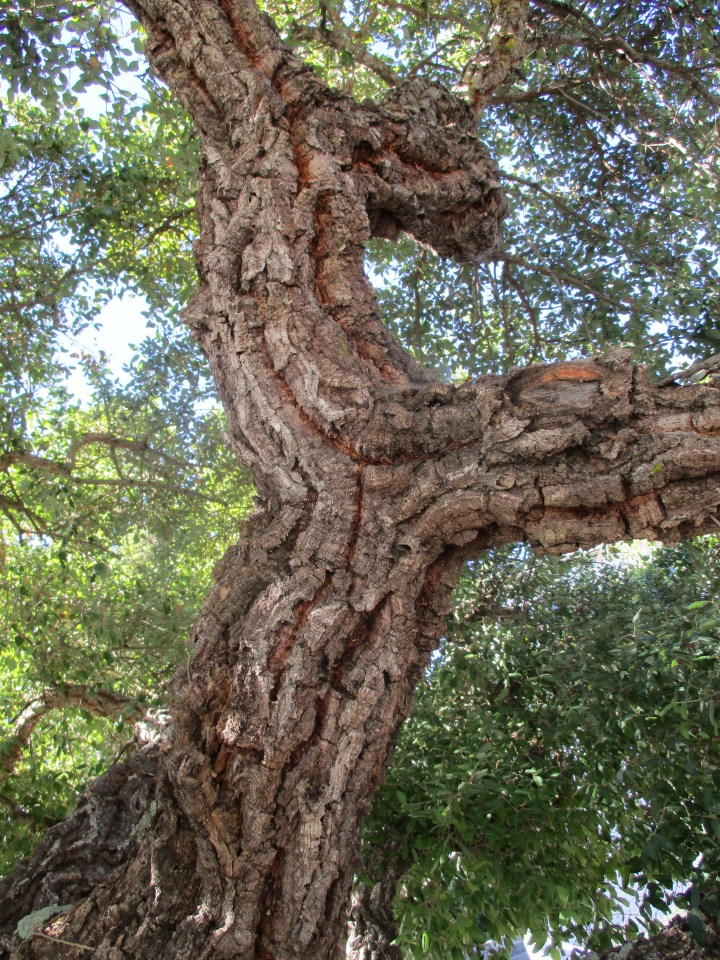 Like redwoods, the cork oak, Quercus suber, is a ‘pyrophyte’, which means that it survives forest fires that burn off competing vegetation. The trunks and main limbs are insulated with a very thick bark. Only the foliage and smaller stems burn off. After a fire, the upper limbs of cork oak regenerate new foliage while other less fortunate plants start over from their roots or seed at ground level.
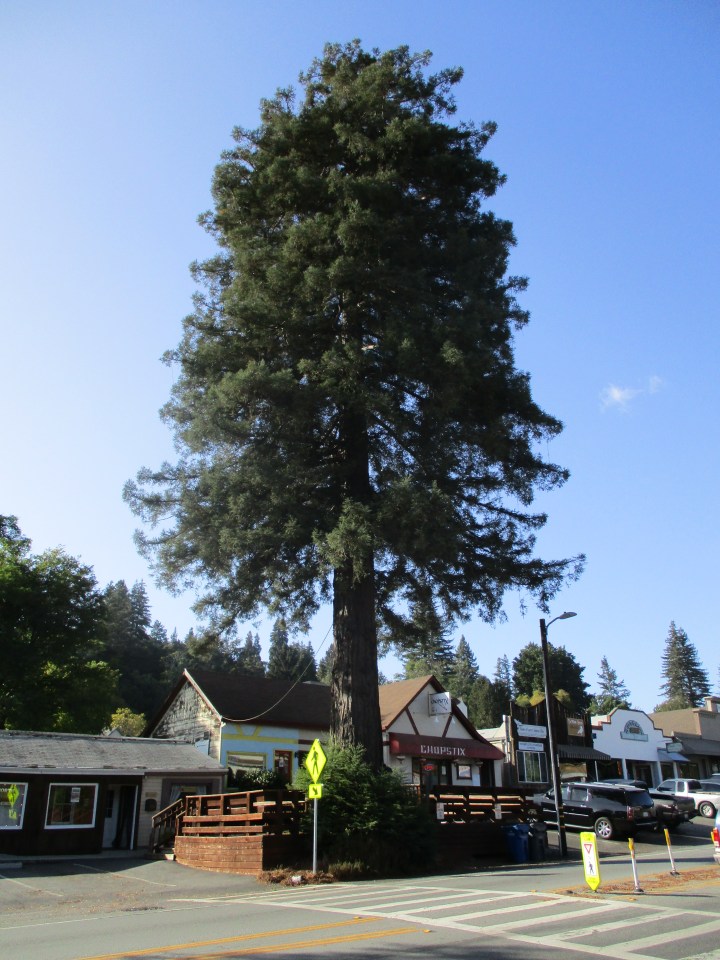 Trees get planted all the time. Apparently, nature does not do the job adequately. Trees get put into specific locations to provide shade, produce fruit, enhance a landscape, obscure a view, or for any of a vast number of reasons. It is amazing that they are as accommodating as they are. It is rather presumptuous for us to think that they actually want to live with us in our synthetic environments as much as we want to live with them.
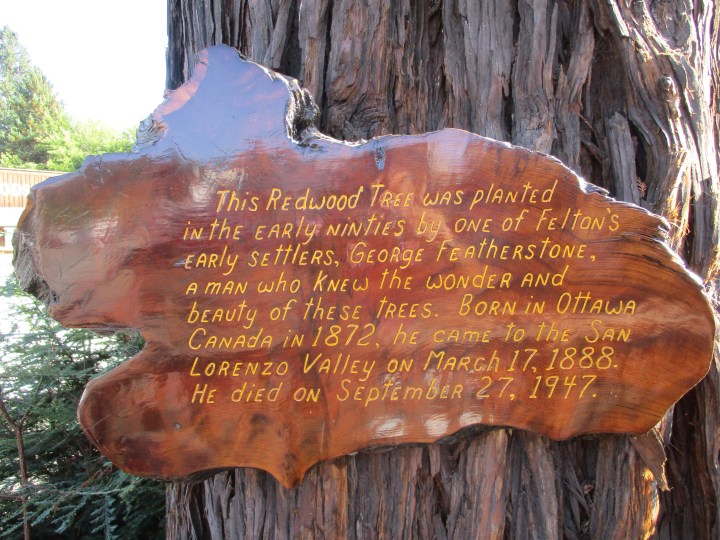 (‘ninties’ means the 1890s.) This Redwood Tree was planted in the early ninties by one of Felton’s early settlers, George Featherstone, a man who knew the wonder and beauty of these trees. Born in Ottawa, Canada in 1872, he came to the San Lorenzo Valley on March 17, 1888. He died on September 27, 1947.
 No other big tree has trunks as sculptural as those of the California sycamore, Platanus racemosa. They bend and groove so irregularly, seemingly without direction, that it is a wonder that old trees in the wild eventually get a hundred feet tall. Some trees have a few trunks. The mottled beige bark is quite striking both in the shade of the broad canopy, and while trees are bare in winter.
 Tony Tomeo