Succulents

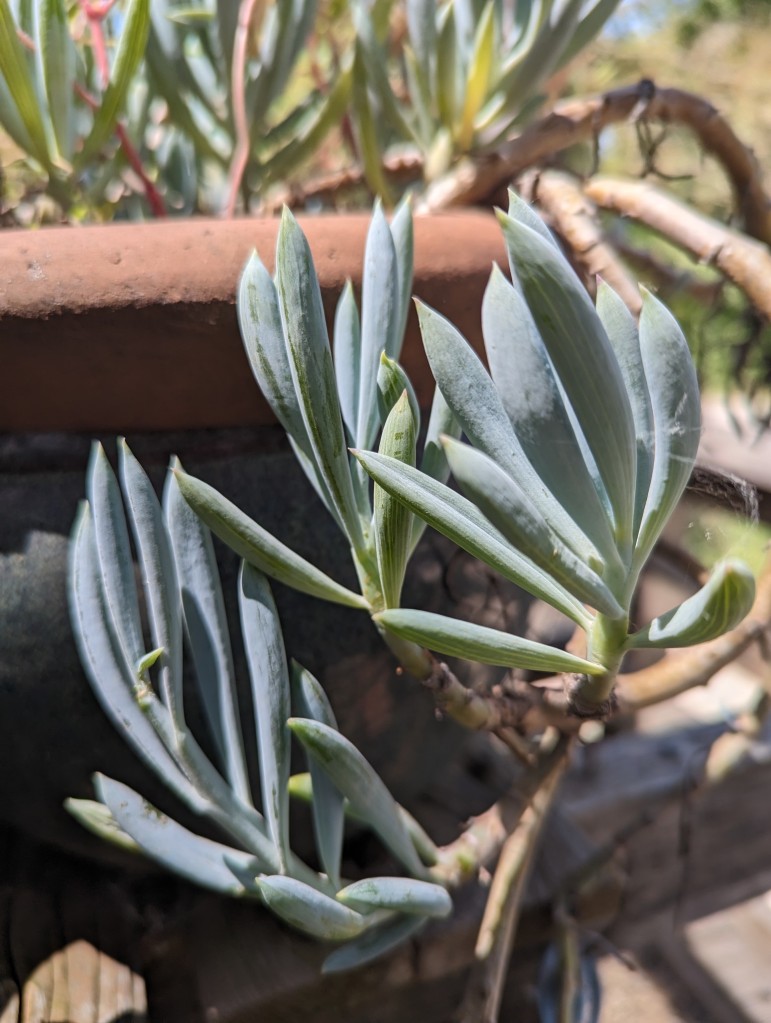
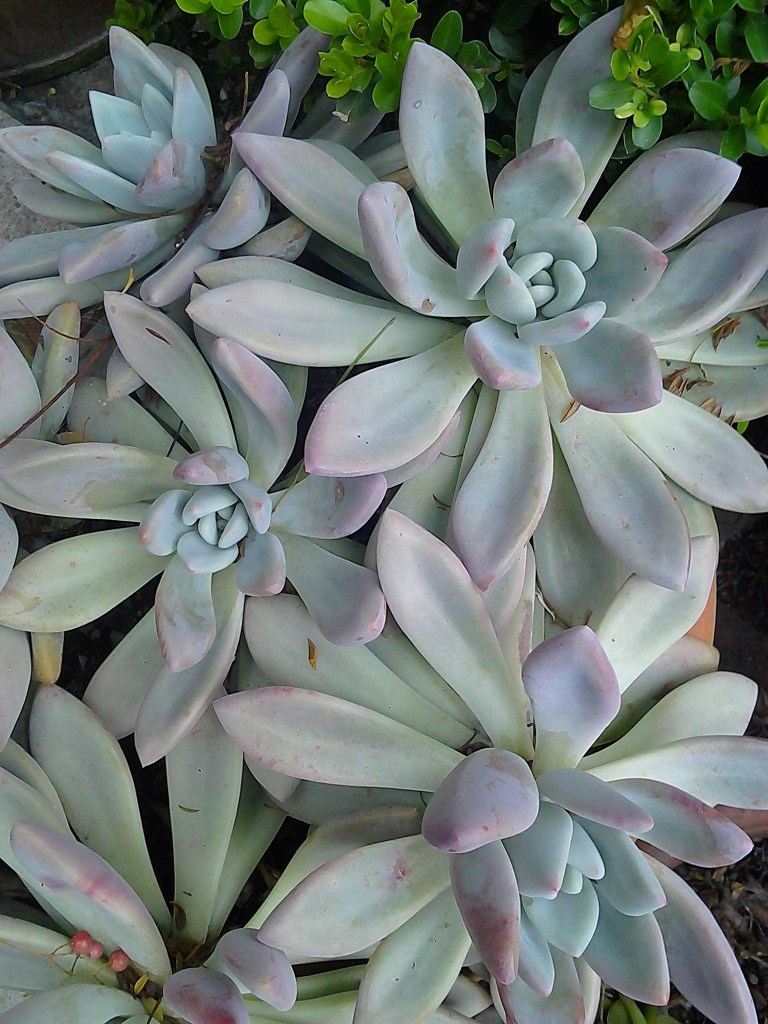
Succulents are remarkably diverse.

Among the many garden chores that I neglected so far this summer is the ‘processing’ of many of the bits and pieces of unusual succulent plants that I acquired from earlier volunteer work days at the Arizona Garden at Stanford. Volunteers are always welcome to take any of the debris that we generate. After everyone present took what they could, I could not bear to waste what was left; so I took more than I should. Cacti, agaves and yuccas cannot be recycled as green waste, so would otherwise have been disposed of.

I really wanted large canes of a particular unusual yucca, so processed them as large cuttings first. I only needed to cut away all but the foliage on top, stick them in the ground and keep them watered until roots grow. This particular desert yucca does not grow roots as efficiently as tropical yuccas do, though.

Meanwhile, many pieces of cacti, ice plant, and succulents that I can not even tell you the names of remain out in a pile in the driveway. However, as I was looking them over today, I noticed that they are not only alive, but actually seem to doing quite well. Some are even blooming!  

This is just too weird. There is no soil. There is no watering. Even if there were, there are no roots to exploit the resources that are necessary to keep plants alive. These bits and pieces of various succulents get only sunlight and warmth during the day. Apparently, this is all they need for now.

They know that it will eventually rain. When it does, they will develop new roots into the soil wherever they are. Since I do not intend to let them do this in my driveway, I will eventually get them into the garden, and water them in to hasten the rooting process. I will groom them and strip lower foliage from agaves and aloes, so that they look better than the debris that they are. They should actually grow slightly and look pretty good by autumn.   

There are so many different kinds of ‘succulent plants’ or ‘succulents’, that the definition is not always so clear. All cacti are succulents that are equipped with spines. Many relatives of poinsettia (euphorbs) have fleshy green stems just like cacti, so are also succulents. Some of these even look like cacti, with comparable spines. Aloes and agaves are succulents as well, with large fleshy leaves, some with very sharp leaf tips and teeth on their leaf margins. The list goes on, including sedums, sempervivums, echiverias, aeoniums, crassulas, lithops, ice plants and more.

Simply speaking, succulents store water in distended ‘succulent’ leaves, stems or even roots, in order to survive long dry seasons. Most happen to be remarkably easy to propagate from cuttings. Some can even be grown from relatively large cuttings. In the desert where water is a very limited commodity, many succulents defend themselves with spines or teeth.

Yuccas, which are related to aloes and agaves, are considered (by ‘some’) to be succulents as well, even though they lack fleshy leaves or stems. Some yuccas that form trunks and branches, particularly those that are from tropical or forest environments, and especially the common Yucca elephantipes, are just as easy to propagate from cuttings as other succulents are.

Volunteer Days at the Arizona Garden of Stanford

Green waste from the Arizona Garden is fair game for volunteers.

(This article is from 2010, so contains irrelevantly outdated information.)

Some gardens are native gardens. Some are wildflower gardens. Others are vegetable gardens, white gardens or rose gardens. There are really all sorts of gardens. Mine though is the only garden that I am aware that is described by some as a ‘felony garden’.

This less than appealing distinction originates from my habit of ‘recycling’ green waste from other gardens. From the bits and pieces of debris generated by normal maintenance, I like to propagate copies of plants that I like for my own garden. Sometimes, I get large volumes of material, such as clumps of New Zealand flax or African iris. Sometimes, I just get small bits of pelargonium or English ivy. Sometimes, the small bits are not exactly generated by maintenance.

On March 20, I really scored big! I procured a pick up full of large canes of a somewhat uncommon species of yucca, along with more than a wheelbarrow full of pieces of various cacti, agaves, aloes and succulents! I suppose that I should feel guilty; but I was helping to dispose of the green waste generated by the volunteers at the Arizona Garden at Stanford University.

The historic Arizona Garden could actually use the help of more volunteers during their Volunteer Days every third Saturday of each month. Most of us were pulling weeds last month, and will likely be pulling more this month. Although there is not always booty to be had, (and no one scores like I did!) volunteers are welcome to the debris they generate from any needed grooming and pruning.

The next Volunteer Days will be on April 17, May 15 and June 19. Volunteers can arrive at any time after 9:00 a.m., and should bring heavy gloves since almost everything in the Arizona Garden is equipped with nasty thorns or spines. Some who stay through noon like to bring bag lunches. New volunteers should contact Arizona Garden Coordinator, Christy Smith at 650 – 723 7459 or christy.smith@stanford.edu before attending a Volunteer Day to get any other necessary information and specific directions to access the Garden.

On April 18, the day after the next Volunteer Day at the Arizona Garden, the Going Native Garden Tour will be visiting more than 65 gardens throughout the Santa Clara Valley and the Peninsula from 10:00 a.m. to 4:00 p.m.. The gardens range from newly planted to established, from townhome lots to acre parcels, but all feature native plants. Some gardens feature talks about native plant gardening. A few gardens will have native plants available for purchase.

It is not possible to see all the gardens within this self guided tour, so guests can choose which gardens to visit. Admission is free, but limited; so early registration is recommended. Registration is required prior to noon on the day of the Tour. Registration can be arranged, and more information about the Going Native Garden Tour and about volunteering can be found at www.gngt.org.

Candelabra Tree

Candelabra tree is a big and strikingly weird succulent.

The weirdly sculptural succulent stems of candelabra tree, Euphorbia ingens, dark green but devoid of any real foliage, are striking in the right situation.  These stems resemble those of unrelated cactus, with longitudinal ridges topped with spines. Although botanically interesting, the minute greenish yellow flowers that bloom in autumn and winter on the ridges of the upper portions of the upper segments are not much to look at. Deep red seed capsules that turn purple as they ripen sometimes develop in milder climates after the flowers are gone, but are almost never seen locally.

Good exposure is preferred. Candelabra tree are better structured and more prominent standing alone away from other larger trees and shrubs. Cool winters and occasional frosts limit their height to not much more than fifteen feet; and unusually cold frost can actually kill big specimens back severely. However, in sheltered areas and milder climates, candelabra tree can get twice as tall. Soil should drain very well and get dry between watering. Regular watering can cause rot, particularly in dense or rich soil.

The main problem with candelabra tree is the remarkably caustic latex sap, which can be dangerous to children, chewing dogs or even those who need to prune the stems. Fortunately, candelabra tree needs very little attention, and only needs to be pruned where the stems get in the way or start to lean against fences or roofs. The caustic sap prevents insect problems.

Carpet Jade

Carpet jade resembles common jade plant.

As its common name suggests, it is a sprawling relative of common jade plant. Both are different species of the same genus. Carpet jade, Crassula nudicaulis var. platyphylla, grows only about six inches high. It sprawls slowly over the ground without getting much higher or lower. It roots where it sprawls, so can eventually develop significant colonies.

The evergreen foliage of carpet jade is a bit more dense than that of common jade plant. It is also a bit less glossy. Foliar margins blush a bit more through winter. Most popular cultivars become appealingly ruddy. Sun exposure enhances foliar color. However, frost can damage their exposed succulent leaves. Pale white winter bloom is unimpressive.

Carpet jade, like many succulents, is not very discriminating in regard to water or soil. It is likely to be more vigorous with regular irrigation. With less irrigation, it likely develops better ruddy foliar color. It provides appealing contrast to other small succulents with gray foliage. It performs well within pots, and may eventually cascade slightly over the edges.

Succulent Plants Exhibit Unique Foliage

Succulents provide unique texture and form.

All cacti are succulents. However, not all succulents are cacti. Actually, cacti are a very unique family. Their distinctive spines and thorns are very specialized leaves and stems. Such specialized leaves can not photosynthesize without green chlorophyll. Therefore, cacti rely on their succulent green trunks for photosynthesis. Their trunks work as foliage.

But of course, not all succulents are cacti. Other succulents have succulent leaves. Most also have succulent stems. Some, such as most agaves and some aloes, are spiny, but not like cacti are. They have real leaves that happen to be spiny. Yucca are supposedly succulent, likely because of their relation to agave. However, they lack succulent parts.

Furthermore, not all succulents are drought tolerant. Many are so only because they are naturally native to desert or chaparral climates. Many others are naturally native to less arid climates. Some that are native to tropical rainforests, like epiphyllum, crave regular watering. Many succulents thrive in harsh exposure. Some prefer a bit of cooling shade.

Succulents are generally very adaptable to container gardening. Ironically though, a few of the most familiar sorts are not as complaisant to containment. Several cacti and other desert species need more water while confined. They must compensate for their inability to disperse roots. However, frequent watering or even excessive rain might promote rot.

Agaves, including those of desert climates, happen to perform splendidly within big pots. In fact, some perform too splendidly. If they grow too big and heavy to move, they are as permanent as if in the ground. Their dangerously spiny foliage compounds the problem. Overgrown cacti are both very difficult to move, and likely to break apart in the process.

Fortunately, there are plenty of smaller, tamer and thornless succulents to choose from. They contribute a remarkable range of foliar form, texture and color to the garden. Some contribute colorful bloom. A few, such as aloes and agaves, produce sculptural bloom. Most succulents are naturally resistant to pathogens, and easy to propagate vegetatively. Rooted scraps are less expensive than nursery stock is.

Echeveria

There are so many different personalities of Echeveria! This one only slightly resembles the more familiar ‘hen and chicks’ types.

Some but not all of of the many succulent plants known as ‘hen and chicks’ are varieties of Echeveria. Likewise, some but certainly not all Echeveria are known as ‘hen and chicks’. Echeveria are so variable that many do not seem to be related, although all have dense rosettes of succulent leaves. Some have very narrow leaves like miniature yuccas. Others have warty broad leaves. Foliage can be simple green, yellowish, bluish, gray, bronze, bronzy purple or variegated. The edges and tips of leaves of many varieties are blushed with red or purple that is more colorful in winter, or with complete sun exposure. Most Echeveria will tolerate light shade. Propagation is very easy from division of pups, stem cuttings and even leaf cuttings.

There Is Variety In Succulents

It is difficult to believe that this stout trunk outfitted with sharp spines is a euphorb, related to leafier poinsettias.

Cacti have thick, fleshy stems outfitted with nasty spines instead of leaves. Agaves and related aloes have stout, fibrous stems that are mostly obscured by thick, fleshy leaves. (Only a few somewhat rare aloes develop bare trunks and stems.) What they have in common is that they all are succulent plants, collectively known as succulents.

There are all sorts of other succulents. Humongous saguaro cactus have hefty trunks and limbs. Diminutive impatiens (like busy Lizzie) are grown as annuals for their colorful and very abundant flowers. Many succulents have succulent stems. Many have succulent leaves. Some, like the common jade plant, have both succulent leaves and stems. Trailing ice plants, leafy begonias, and sculptural euphorbs (related to poinsettias) are all succulents.

Many succulents store water in their succulent parts because they live in dry climates. Because moisture is such a commodity where they live, cacti protect their succulent stems with sharp spines. Agave protect their leaves with sharp teeth. Euphorbs are equipped with caustic sap, and many also have spines like cactus have. Fortunately, most succulents are not so unfriendly.

Almost all succulents are remarkably easy to propagate from cuttings or by division. In the wild, pieces of prickly pear cactus that fall onto the ground will begin to develop roots through the rainy weather of autumn and winter, and be ready to grow into new plants by spring. In the home garden, cactus cuttings should be left out for a week or more so that the cut ends will ‘cauterize’ (Actually, they just dry out a bit.) and be less susceptible to rot once they get plugged into the ground or pots to grow roots. Alternatively, clumping cactus that develop multiple main stems from the base can be divided, although the spines make handling them difficult.

Most aloes and some agaves produce basal shoots known as pups, that can be split from the main plants to grow into new separate plants. Agaves that do not produce pups while young typically start to produce pups after a few (or many) years, as they mature enough to bloom. Many of the larger types produce an abundance of pups after bloom, since the main shoot dies as flowers deteriorate. If desired, one or more of the pups can be left in place or planted back to replace the parent plant.

Most other succulents are even easier to propagate. Small cuttings can be plugged wherever new plants are desired. Some can even be grown from leaf cuttings!

‘Angelina’ Stonecrop

‘Angelina’ is a bright chartreuse stonecrop.

Until the patent expires, unauthorized vegetative propagation (cloning) of ‘Angelina’ stonecrop, Sedum rupestre ‘Angelina’, is still illegal. However, it regularly flaunts its own unlawful proliferation wherever dislodged bits of stem can find anything to take root into. It can be just as happy to root into cracked concrete as in bare soil. Yet, it is a surprisingly complaisant small scale ground cover that cascades only several inches over stones, low retaining walls or the edges of planters.

Without getting more than four inches deep, stems root as they creep indefinitely but slowly along the ground. The bright yellowish evergreen foliage and bright yellow flowers that bloom about now contrast nicely with darker green or bronze foliage. Exposed foliage can get blushed with orange in winter. Shabby plants regenerate vigorously after getting pruned back. Pruning scraps sprinkled over bare soil and lightly mulched with finely textured compost will happily but illegally grow into more of the same. ‘Angelina’ stonecrop likes somewhat regular watering, but can survive with less.

Mexican Snowball

Mexican snowball is strikingly pallid blue.

The silly common name actually suits its plump rosettes of pale bluish succulent leaves. Mexican snowball, Echeveria elegans, forms small colonies that might resemble stashes of snowballs. Individual rosettes are circular, and a bit wider than tall. The widest are four inches or so across. The evergreen leaves are as neatly radial as scales of a pine cone.

Some may know Mexican snowball, and various other species of Echeveria and related Sempervivum, as hen and chicks. Big rosettes can produce so many small pups around their edges that they are reminiscent of mother hens surrounded by their huddled chicks. These pups are quite easy to separate for plugging into pots or elsewhere in the garden.

Mexican snowball is happiest in sunny situations with rather regular watering, but should tolerate a bit of shade and lapses of watering. For small trees in big pots, it can cover the surface of the potting media nicely. Pups plugged into crevices of stone walls might grow into clinging colonies. Tiny pink flowers with yellow tips bloom on wiry stems about now.

Fan Aloe

50610
Some aloes should have more fans.

most aloes are tough perennials that do not need much water. Unfortunately, they do not have many fans. Maybe that is why fan aloe, Aloe plicatilis, makes it’s own. The plumply succulent leaves are distichously arranged, which is a fancy way of saying that they are either to the left or to the right, flaring out to form foliar fans.

Individual leaves are just as distinctive as their arrangement is. They are not tapered and pointed like those of other aloes. Instead, they are about an inch and a half wide from end to end, with weirdly blunt tips. They get almost a foot long. The soft gray color contrasts nicely with coral flower spikes that bloom at the end of winter.

It grows slowly, but fan aloe is one of the few aloes that eventually grows into a big shrub with several sculptural trunks on a flaring base. In their native habitat in South Africa, old specimens grow as small trees more than ten feet tall. Branches that need to be pruned away can be rooted as cuttings after the cut ends dry out a bit.