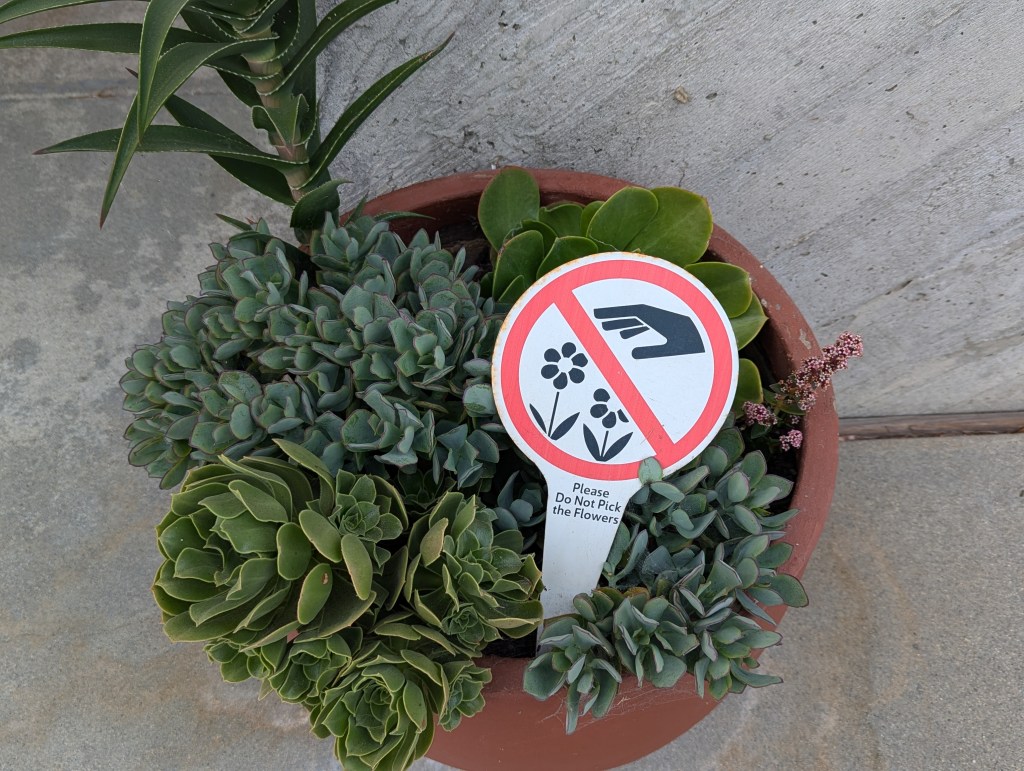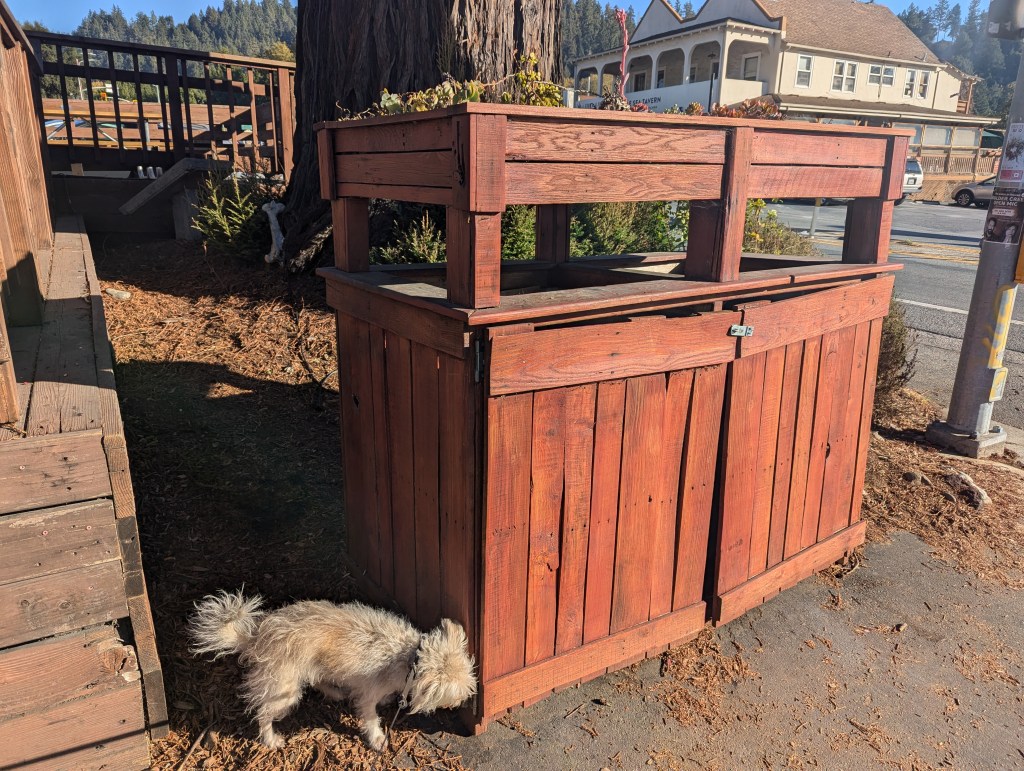
Please Do Not Pick the Flowers

Am I that predictable? How did whoever posted this sign know I would be here? I do not want their stupid flowers anyway. Besides, only that dinky twig of some random species that I can not identify is blooming on the far right. Is that all they got? What I really want, or more accurately, what I would want if I did not find them to be either uninteresting or redundant what is already in my garden, is stem bits of the succulents for propagation. I suppose that I am not the only one who might want that, which is why the sign, although slightly irrelevant to such desires, became necessary. Actually, I have direct experience with pilferage of bits of succulents from my small planter box downtown, so I am aware of why such signs might be useful. I would not install any such sign within my planter box because such a sign would be bigger and more prominent than any of the flowers that it would be intended to protect. If I were to grow more flowers, I would prefer those that are so abundant that no one would miss a few that might get pilfered. The most abundant flowers are also smaller than less abundant flowers, so they would not be as tempting to those who might want more impressive flowers. For example, the bearded iris within my downtown planter box blooms with only a few big and bold floral stalks. Not only are the flowers tempting and easily taken, but when they are taken, there are no more to replace them. Anyway, I do not actually mind if those who want copies of my succulent perennials take a few bits if only they do so properly. It may happen more often than I am aware of, but of course, I am not aware of it if otherwise useless bits are taken from below the visible growth, or where they should be pruned away anyway. That is how I justify what you likely know I will mention next. Yes, only about a hundred feet from this urn filled with succulents and the sign that requests that I refrain from doing as such, even if it does not mention the subject matter and procedure directly, I ‘borrowed’ a few bits of stem from the underside of a shabby specimen of what seems to be ‘Roman Red’ Salvia guaranitica that should eventually get pruned back for winter anyway.

Horridculture – Pilferage

Cuttings could have been taken more neatly than this.

Aeonium arboreum, tree houseleek and a few other succulents within my tiny downtown garden are very important to me. They are from the former garden of a friend who passed away years ago. They have performed very well for this particular application since their arrival. They are resilient and undemanding, and provide delightful foliar color and form. The darkest bronze cultivar of tree houseleek that I ever grew arrived with them, but over a few months, was stolen until none of it remained. As the first few cuttings grew enough to become prominent, they were either taken completely, or deprived of their upper foliar rosettes. Any remaining rooted but bare stems eventually succumbed as any subsequent foliar rosettes that they generated were also taken. The surviving succulents remain only because they are both less popular, and too numerous for complete depletion. Actually, I would not mind if those who find these succulents to be appealing sometimes take a few pieces. I merely find their lack of tact to be annoying. I expect them to know better than to take the last of something. Also, I expect that they should have enough sense to take bits from where they would not be missed, and to do so neatly, without leaving broken stubs. Quite a few stems are sometimes overgrown or extending awkwardly outside the planter box, so should be removed anyway. Many stems that are overwhelmed by upper growth could be removed without compromising collective visual appeal. That might actually be a common occurrence that I am not aware of because it is done properly. Stems of these succulents can be easily broken neatly at their unions, without leaving stubs, so pruning shears are not even necessary. Fortunately, these damaged tree houseleeks will recover like they and other succulents always do.

Gardening With Succulents

(This article is recycled from many years ago, so contains very outdated information.)

Many succulents are remarkably easy to propagate from cuttings.

Succulent plants that were so trendy during the 1970’s seem to be gaining popularity again. This is actually one of the few trends that I like to see, since succulents are such useful and practical plants in modern urban gardens. Although some cacti, agave and larger succulents become quite imposing, most other succulents are quite compact and proportionate to small garden spaces. Some can by happy in the partial shade of atriums and under eaves. Succulents generally do not need much attention, are remarkably easy to grow, and are even easier to propagate. Most do not need much water. 

‘Gardening with Succulents’, with master gardener Laura Balaoro and the Guadalupe River Park Conservancy, is a great program for experiencing the potential for succulents in containers and the garden. There will be several samples of container gardens to demonstrate some of the many possibilities for succulents, as well as their variety of textures and colors. Common pathogens, propagation methods, succulent that grow through winter, and succulents that are adaptable to partial shade will all be discussed. After a planting demonstration, there will be free cuttings for those who can not wait to add new succulents to their gardens.

‘Gardening with Succulents’ is only in a few days, from 10:00 a.m. to noon on September 11, so it is important to register right away by telephoning 298 7657 or online at www.grpg.org. If this program gets full to capacity first, there are many other interesting classes and programs described at the website for later. Admission is $15, or $10 for members of Friends of Guadalupe River Park and Gardens. ‘Gardening with Succulents’ will be at the Guadalupe River Park and Gardens Visitor and Education Center, which is located at 438 Coleman Avenue in San Jose.

Nearby in the San Jose Heritage Rose Garden, the last of the Rose Deadheading Blitzes will be from 5:00 to 7:30 p.m. on September 14, in order to remove spent blooms and promote more blooms before autumn. Volunteers should bring pruning shears and gloves, and wear closed-toe shoes; and of course, stay for ice cream afterward. (Loaner shears are available if necessary.) The San Jose Heritage Rose Garden is located on Taylor Street at Spring Street, just east of Coleman Avenue. Visit www.grpg.org or telephone 298 7657 for more information or to register.

Ice Plant

Other types of ice plant bloom with different colors.

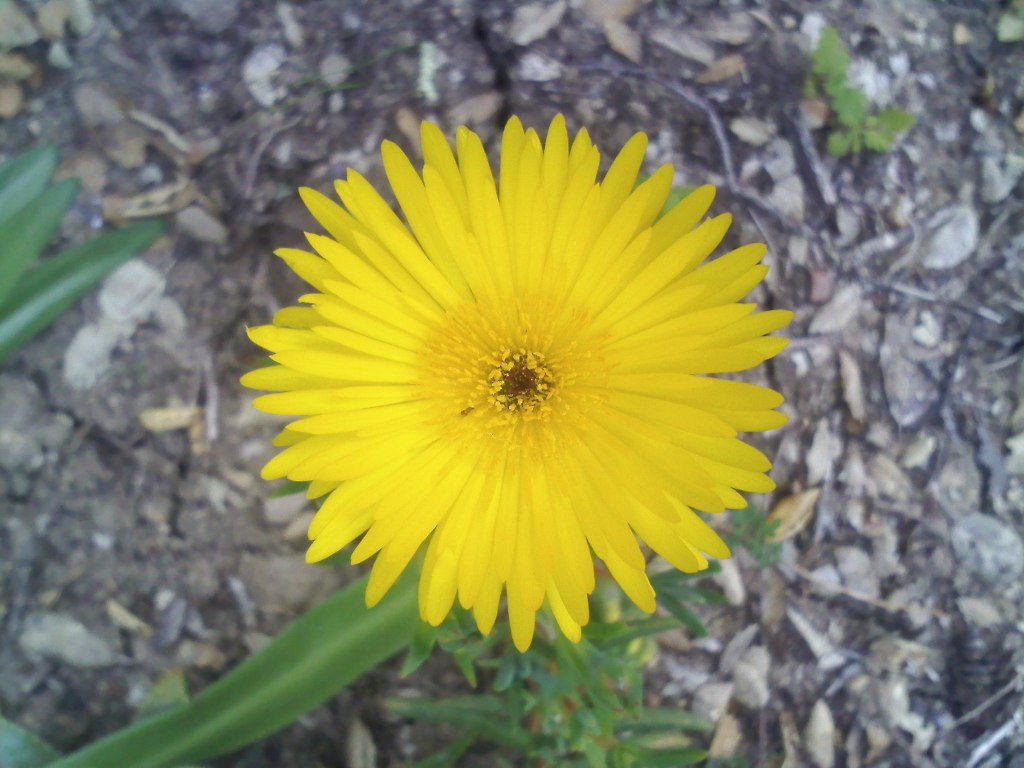
The bright orange, inch and a half wide flowers of Lampranthus aurantiacus, a type of ice plant, should bloom between winter and spring, but a few are brightening my garden right now. This bright yellow flower in the picture is that of the variety ‘Glaucus’, which I grew from a cutting last year. My single low mounding plant is about a foot wide now and will eventually spread to about two feet wide, and can get about a foot deep. Stems can root where they lay, forming new plants that will spread farther. To accelerate the spread, more plants are very easy to propagate from small cuttings. Lampranthus aurantiacus has narrow, inch long leaves, and a relatively shrubby basal branch structure.

Crassula tetragona

Crassula tetragona is more similar to related jade plant than it appears.

Although the narrow and pointed inch long leaves of Crassula tetragona (which lacks a common name) are not at all similar to the plump rounded leaves of the closely related but much more common jade plant, it is much more similar to jade plant than it appears to be. Both enjoy sunlight but will take a bit of shade. Both can be damaged by extreme exposure (reflected glare and heat), as well as the opposite extreme, frost. Their succulent stems are so easy to root as cuttings, that rather substantial pieces that may need to be pruned off can be stuck into the soil as instant new plants. Even leaves of these and various other specie of Crassula can be rooted as very small cuttings. Besides its distinctive foliage, Crassula tetragona differs from jade plant only because it is limited to about a foot and a half high and wide, and blooms with unremarkable white flowers instead of more prominent flower trusses.

Design and Implementation

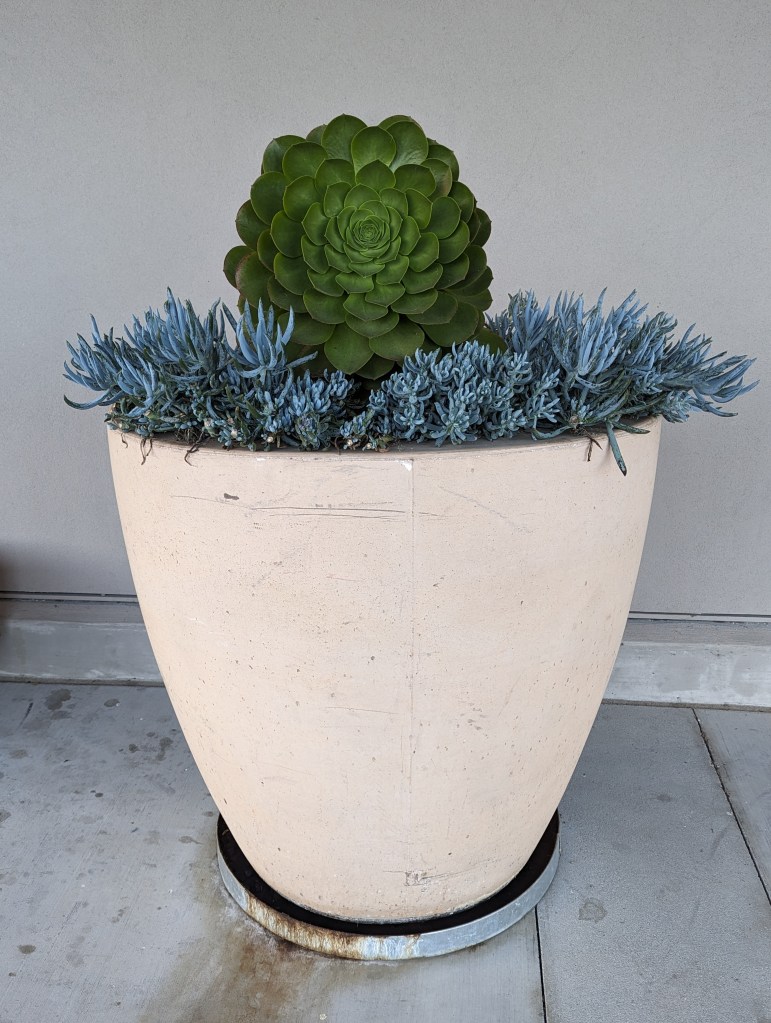
This exposed urn looks like a koala tummy.

This is so silly that I sort of like it. I mean, I found it to be sufficiently amusing to get a picture of it to send to Brent. It is a nice large urn, with an Aeonium arboreum that is a bit bolder than any of mine, and delightfully blue Senecio mandraliscae. It has nothing else going for it, but perhaps its simplicity is an asset. It might look junky if it contained any other well planned but comparably maintained material.

My only personal criticism of its design is that it is located on otherwise useful pavement, where pedestrian traffic must divert around it; but I am merely a horticulturist, not a landscape designer. For all I know, it could be there to intentionally soften the expansiveness of all that useful pavement, without occupying too much of it. I would also say that the urn should be outfitted with species that are more tolerant of the partial shade of its particular exposure, but obviously, these two simple species are reasonably happy there.

My more realistic criticism is of its implementation. Is it really too difficult for so-called maintenance ‘gardeners’ to maintain this as the landscape designer who designed it thought they should be able to? Must landscape designers design their landscapes with the expectation that their work will not be maintained as expected? Although it is delightfully silly, it might be more visually appealing if the Senecio mandraliscae cascaded a bit more over the edge. Alternatively, it could be confined to the upper surface of the urn if a third perennial were allowed to cascade somewhat over the edge; but again, I am no landscape designer. The urn is nice, but might be nicer with a bit of foliar color, form and texture over some of its exterior.

Candelabra Tree

Candelabra tree is a big and strikingly weird succulent.

The weirdly sculptural succulent stems of candelabra tree, Euphorbia ingens, dark green but devoid of any real foliage, are striking in the right situation.  These stems resemble those of unrelated cactus, with longitudinal ridges topped with spines. Although botanically interesting, the minute greenish yellow flowers that bloom in autumn and winter on the ridges of the upper portions of the upper segments are not much to look at. Deep red seed capsules that turn purple as they ripen sometimes develop in milder climates after the flowers are gone, but are almost never seen locally.

Good exposure is preferred. Candelabra tree are better structured and more prominent standing alone away from other larger trees and shrubs. Cool winters and occasional frosts limit their height to not much more than fifteen feet; and unusually cold frost can actually kill big specimens back severely. However, in sheltered areas and milder climates, candelabra tree can get twice as tall. Soil should drain very well and get dry between watering. Regular watering can cause rot, particularly in dense or rich soil.

The main problem with candelabra tree is the remarkably caustic latex sap, which can be dangerous to children, chewing dogs or even those who need to prune the stems. Fortunately, candelabra tree needs very little attention, and only needs to be pruned where the stems get in the way or start to lean against fences or roofs. The caustic sap prevents insect problems.

Sticks on Fire

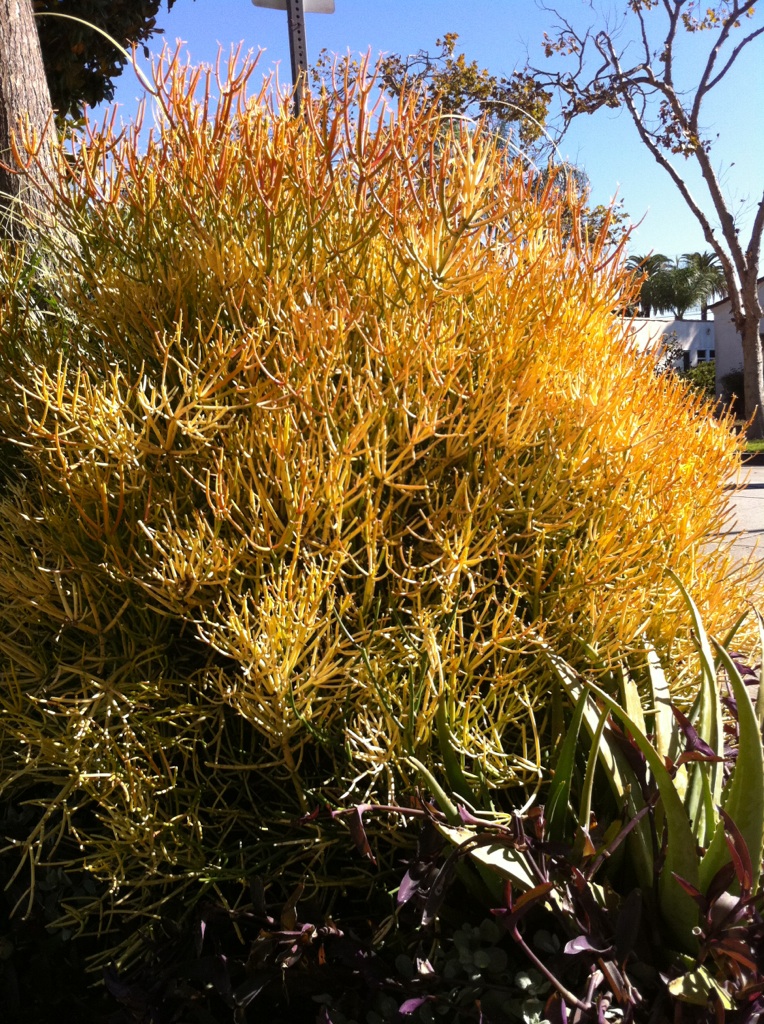
Sticks on fire is a more colorful version of pencil tree.

The old fashioned pencil tree, with leafless, succulent stems is a strikingly strange plant already. In mild climates of coastal Southern California, it can get quite large, nearly ten feet broad and twice as high. Sticks on Fire, Euphorbia tirucalli ‘Sticks on Fire’, stays less than half as large, but is even weirder because the stems are so oddly colored.

The inconspicuous leaves drop almost as soon as they develop, leaving distended fleshy stems that are either reddish or yellowish orange. Stems fade to softer yellow through summer, and then turn red in winter. Size and growth rate are limited by a lack of chlorophyll. Although related to poinsettia, the flowers of sticks on fire are not significant.

Sticks on fire prefers full sun exposure and warmth, but unfortunately needs protection from frost during winter. It can be happy under an eave on a south or west facing wall, or in a large tub that can be moved to shelter during winter. Plants in tubs are a bit more sensitive to rot if watered too frequently. The sap of sticks on fire is very caustic to skin and can be dangerous if it gets in the eyes.

Carpet Jade

Carpet jade resembles common jade plant.

As its common name suggests, it is a sprawling relative of common jade plant. Both are different species of the same genus. Carpet jade, Crassula nudicaulis var. platyphylla, grows only about six inches high. It sprawls slowly over the ground without getting much higher or lower. It roots where it sprawls, so can eventually develop significant colonies.

The evergreen foliage of carpet jade is a bit more dense than that of common jade plant. It is also a bit less glossy. Foliar margins blush a bit more through winter. Most popular cultivars become appealingly ruddy. Sun exposure enhances foliar color. However, frost can damage their exposed succulent leaves. Pale white winter bloom is unimpressive.

Carpet jade, like many succulents, is not very discriminating in regard to water or soil. It is likely to be more vigorous with regular irrigation. With less irrigation, it likely develops better ruddy foliar color. It provides appealing contrast to other small succulents with gray foliage. It performs well within pots, and may eventually cascade slightly over the edges.

Succulent Plants Exhibit Unique Foliage

Succulents provide unique texture and form.

All cacti are succulents. However, not all succulents are cacti. Actually, cacti are a very unique family. Their distinctive spines and thorns are very specialized leaves and stems. Such specialized leaves can not photosynthesize without green chlorophyll. Therefore, cacti rely on their succulent green trunks for photosynthesis. Their trunks work as foliage.

But of course, not all succulents are cacti. Other succulents have succulent leaves. Most also have succulent stems. Some, such as most agaves and some aloes, are spiny, but not like cacti are. They have real leaves that happen to be spiny. Yucca are supposedly succulent, likely because of their relation to agave. However, they lack succulent parts.

Furthermore, not all succulents are drought tolerant. Many are so only because they are naturally native to desert or chaparral climates. Many others are naturally native to less arid climates. Some that are native to tropical rainforests, like epiphyllum, crave regular watering. Many succulents thrive in harsh exposure. Some prefer a bit of cooling shade.

Succulents are generally very adaptable to container gardening. Ironically though, a few of the most familiar sorts are not as complaisant to containment. Several cacti and other desert species need more water while confined. They must compensate for their inability to disperse roots. However, frequent watering or even excessive rain might promote rot.

Agaves, including those of desert climates, happen to perform splendidly within big pots. In fact, some perform too splendidly. If they grow too big and heavy to move, they are as permanent as if in the ground. Their dangerously spiny foliage compounds the problem. Overgrown cacti are both very difficult to move, and likely to break apart in the process.

Fortunately, there are plenty of smaller, tamer and thornless succulents to choose from. They contribute a remarkable range of foliar form, texture and color to the garden. Some contribute colorful bloom. A few, such as aloes and agaves, produce sculptural bloom. Most succulents are naturally resistant to pathogens, and easy to propagate vegetatively. Rooted scraps are less expensive than nursery stock is.