The pinkish magenta of rock purslane bloom is almost obnoxiously bright.
In Santa Cruz and coastal areas down to Los Angeles and San Diego, rock purslane, Calandrinia spectabilis (grandiflora) has been popular for only a few years. It is still somewhat uncommon here in the Santa Clara Valley. Because of the ambiguity of its Latin species name, it is most commonly known simply by its genus name of Calandrinia.
Moderate watering is best. On the coast, rock purslane only needs water occasionally through the driest summer weather. It should recover readily from winter frost damage. Partial shade is not a problem, but may limit profusion of bloom. Harsh exposure or reflected glare can actually roast the tender succulent foliage.
From about now through autumn, limber, two foot tall stems suspend strikingly bright magenta flowers above the low, grayish evergreen foliage. The fragile leaves are neatly arranged in terminal rosettes. Foliage, stems, flower stalks and all parts are sensitive to traffic, and can even get broken by a cat sneaking through the garden. Broken bits and pieces of stem root very easily to make new plants, though.
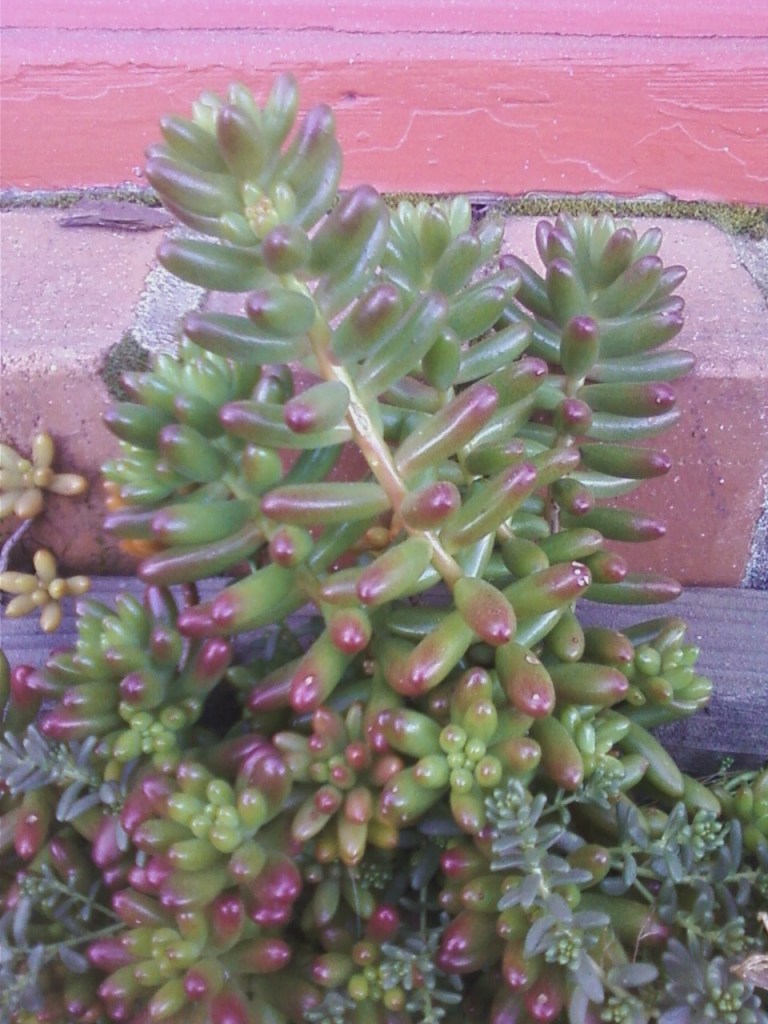
If it appears to be related to burrow’s tail, it is because pork & beans is the same genus.
The tender succulent foliage of pork and beans, Sedum rubrotinctum, is as squishy as it appears to be, so is safest where it will not be disturbed. Although it sprawls around without getting much deeper than six inches, it does not fill in reliably enough to be a real ground cover over a large area anyway. It can instead add color and texture in small doses between larger plants or stones. It is a nice addition to urns of mixed perennials, rock gardens and dish gardens. It propagates very easily from stem cuttings or even leaves that break off, so can be tucked into gaps in stone walls.
The plump three quarter inch long leaves resemble jelly beans more than pork and beans, since they are green where shaded. More exposed foliage is more bronzy red or brown, especially at the tips. Small clusters of tiny yellowish flowers are held above the foliage on reddish brown stems in spring.
Succulents that would not survive in alpine gardens where rock gardens were originally popularized are quite popular for rock gardens here.
Rock gardens, as they are known now, evolved from more traditional alpine gardens that were designed to display specimens of small plants found in the mountains of Europe. These plants were mostly compact and slow growing to be adapted to the harsh climates and rocky soils of higher elevations, but do not compete well with more aggressive plants. They consequently need their own space, and are quite happy surrounded by rock or gravel to insulate the surface of the soil and control weeds. Slight slopes, as well as the abundance of rock, enhance drainage to replicate mountainous conditions.
Compact plants from all over the world now find homes in rock gardens. The compact nature of rock garden makes them practical for small spaces, particularly where slopes make other gardening difficult. Sculptural, colorful or lichen covered rocks, as well as garden sculpture, can be as ornamental as the plants that surround them. Larger stones can substitute for low retaining walls.
Plants for rock gardens do not need to be from mountainous areas, but should be compact. They must also be appropriate to the particular microclimate. For example, small succulents and cacti want to be as exposed in a rock garden as they would be in a real landscape. Lily-of-the-valley shrub conversely prefers sheltered cooler spots.
Trees for rock gardens are generally very small. Pendulous (weeping) and dwarf Japanese maples are more desirable than those that eventually grow into mid sized trees. Dwarf forms of spruce, eastern hemlock, cedar, fir and false cypress all work well. There are also several dwarf pines to choose from, including dwarf cultivars of Scots, Japanese red, tanyosho, mugho, white and pinon pines.
Dwarf forms of cotoneaster, hebe, holly, rockrose, germander and Japanese barberry have become as popular in rock gardens as the more traditional small heathers and heaths. There are several compact junipers as well. Some rock gardens plants grow into small shrubbery. Others sprawl about as mats or dense ground cover.
Thrift (sea pink), campanula, snow-in-summer, fleabane, coral bells, plantain lily, evergreen candytuft, carpet bugle (Ajuga spp.), and small herbs like thyme and oregano are some of the more popular perennials for rock gardens. Mat forming penstemon, columbine, cranesbill, saxifrage, rockcress and dwarf types of dianthus and primrose are more difficult to obtain, but worth trying. There are of course many small succulents like aeonium, echeveria, stonecrop (sedum) and ice-plant.
Crocus, grape hyacinth, snowdrop and wild freesia are the only common bulbs that are well suited to rock gardens. Uncommon dwarf cyclamen (not Cyclamen persicum), small types of narcissus and diminutive iris that can sometimes be found by mail order catalogues, online, or occasionally in nurseries that stock unusual plants are actually more proportionate to rock gardens than they are in more typical types of gardens.
While away from work and home, and tending to errands downtown, I got these pictures from my downtown planter, which inadvertently became something of a Memorial.
1. Cuphea hyssopifolia, Mexican heather is not my favorite component of the downtown planter, but remains because it was installed by someone who was here prior to my time. A uniquely confined colony of montrebia that I will discuss on Wednesday also remains.
2. Senecio cineraria, dusty miller and the stonecrop below are from the garden of a now deceased client so can only be removed if a bit of it gets established in my home garden. It and the Mexican heather above are the only two of these six which are not succulents.
3. Sedum reflexum ‘Blue Spruce’ stonecrop is being displaced by the unidentified species of Aeonium below, but is also already established in my home garden. I expected it to be displaced eventually when I put it here several years ago. It is gratifying to see remnants.
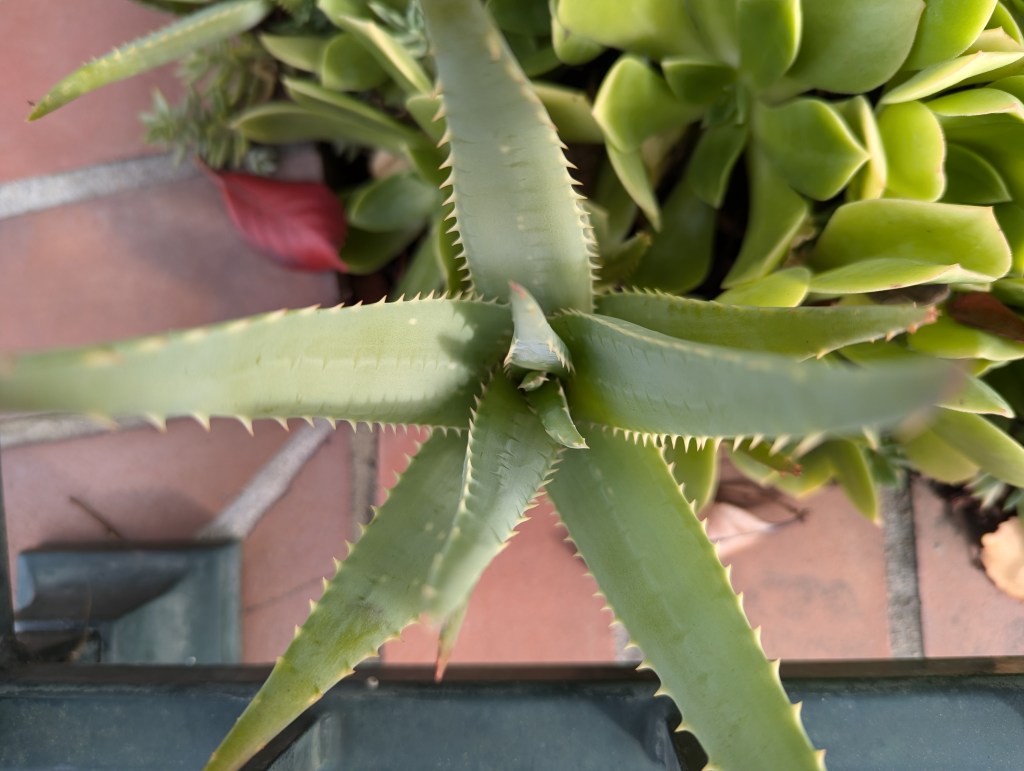
4. Aloe, as the Aeonium at the bottom of this list, is unidentified. It and both of the last six are from the garden of the deceased mother of a deceased friend who happened to be a direct descendant of Spanish explorers who were the first to arrive where Monterey is.
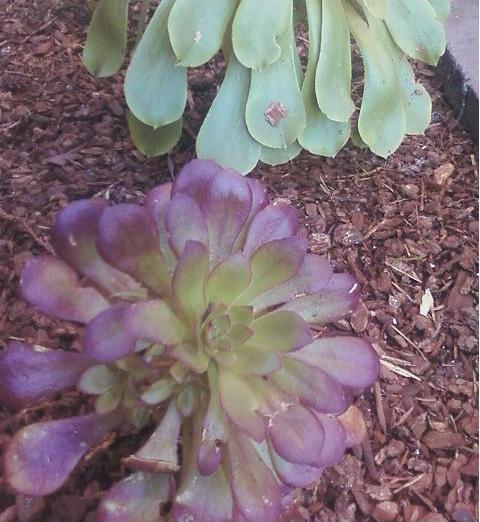
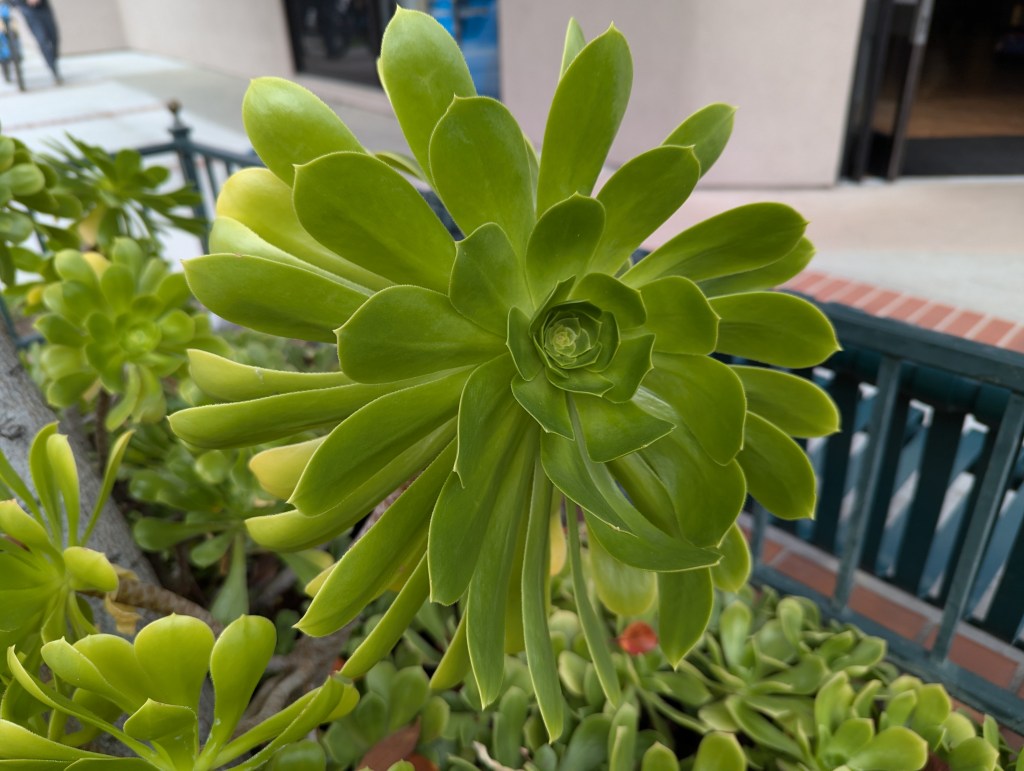
5. Aeonium arboreum, tree houseleek is the most striking vegetation within the planter, but is also occasionally disfigured by theft of its most sculptural stems. A darkly bronzed cultivar from the same special origin was taken piece by piece until none of it remained.
6. Aeonium is as unidentified as the Aloe above. It initially resembles the tree houseleek, also above, but remains low, dense and mounding. It is the most abundant vegetation of the planter, so was the primary culprit of the displacement of the stonecrop, also above.
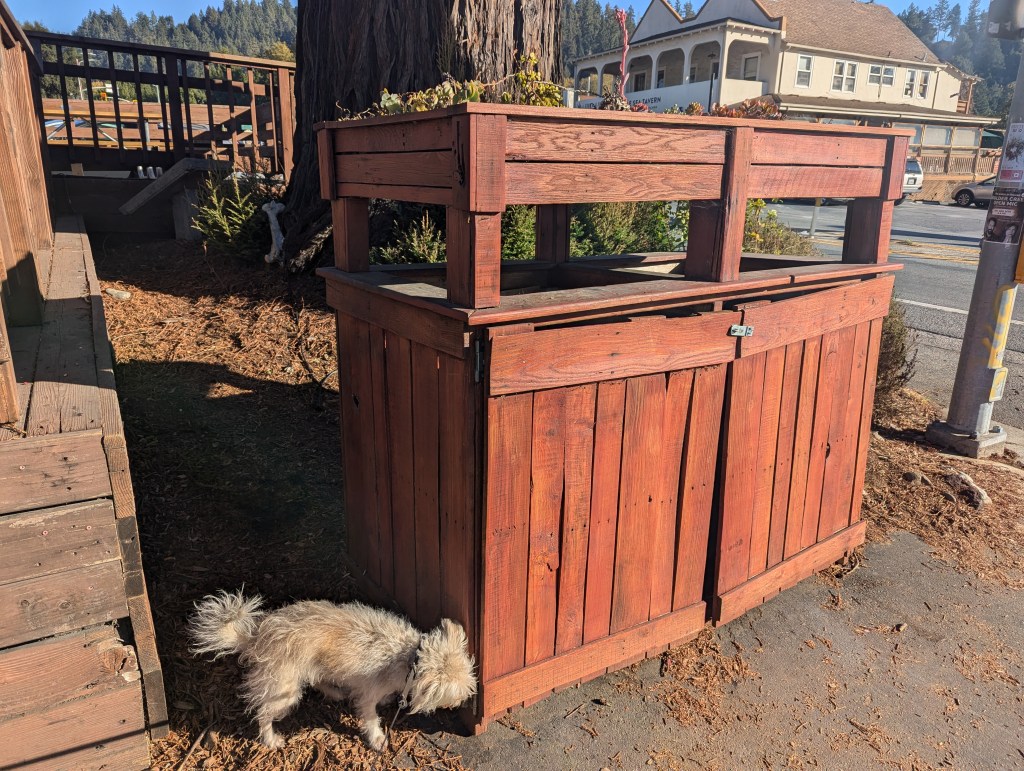
Public trash receptacles are a good concept. Without them, some of us would be more likely to litter. Contraptions such as this are most likely a good concept too, since they are somehow more visually appealing than exposed trash cans. Also, they are unlikely to fall over and spill as exposed trash cans sometimes do. Originally, one half of this receptacle was designated for trash, and the other half was designated for recyclables. This is another good concept, but was very unfortunately discontinued because it is so commonly ignored that someone must sort through less than efficiently sorted trash and recyclables. The only obvious component of this device that may not have been such a good concept is the planter box that hovers above it. Once outfitted with a nice collection of succulent perennials, it was left to survive as well as it can, which has not been very well. Succulents were likely selected for this particular application because they are supposedly ‘drought tolerant’. However, only some are drought tolerant, and only because they extend their roots as they must in order to find moisture, which they are unable to do while confined to this hovering planter box. Although they have been surviving, they have not been very happy about it. I suspect that someone must sometimes give them water, but these succulents want a bit more. Realistically, they would be happier in the ground behind the trash receptacle. There is certainly plenty of vacant space for them there, and they would be more visually appealing where they would actually be more visible than they are above average eye level. If some sort of vegetation is desirable above the trash receptacles, small shrubs or vines in the ground next to them would be happier than succulents above them. It would have been better to maintain the space that is already in need of maintenance than to add more.
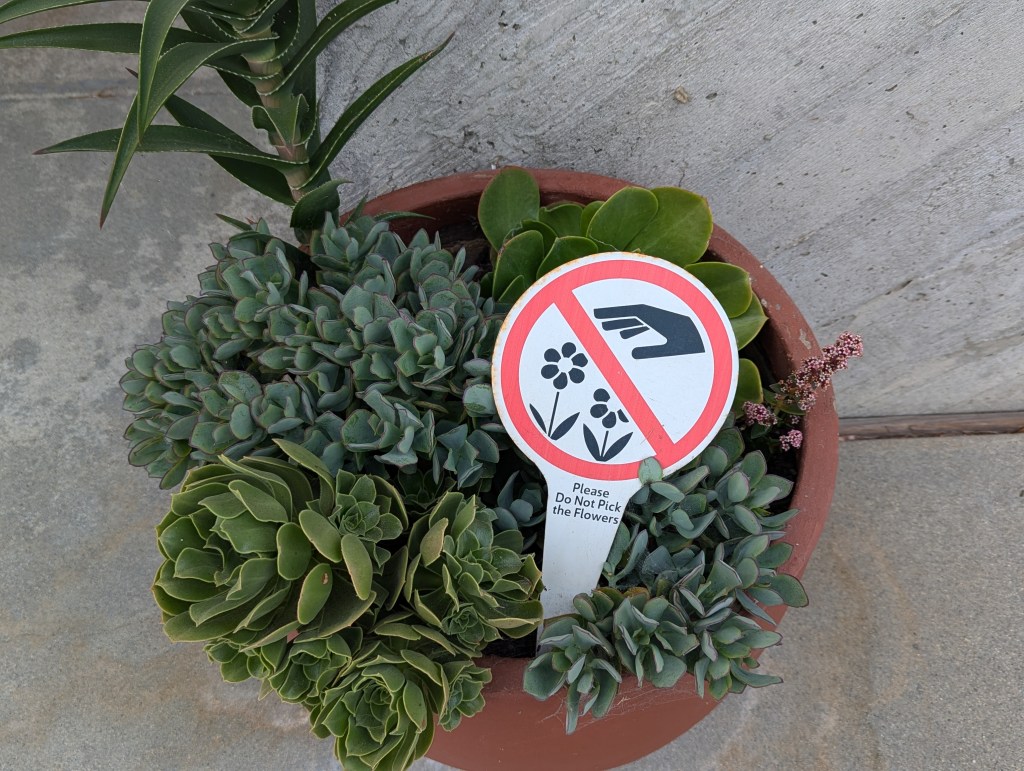
Am I that predictable? How did whoever posted this sign know I would be here? I do not want their stupid flowers anyway. Besides, only that dinky twig of some random species that I can not identify is blooming on the far right. Is that all they got? What I really want, or more accurately, what I would want if I did not find them to be either uninteresting or redundant what is already in my garden, is stem bits of the succulents for propagation. I suppose that I am not the only one who might want that, which is why the sign, although slightly irrelevant to such desires, became necessary. Actually, I have direct experience with pilferage of bits of succulents from my small planter box downtown, so I am aware of why such signs might be useful. I would not install any such sign within my planter box because such a sign would be bigger and more prominent than any of the flowers that it would be intended to protect. If I were to grow more flowers, I would prefer those that are so abundant that no one would miss a few that might get pilfered. The most abundant flowers are also smaller than less abundant flowers, so they would not be as tempting to those who might want more impressive flowers. For example, the bearded iris within my downtown planter box blooms with only a few big and bold floral stalks. Not only are the flowers tempting and easily taken, but when they are taken, there are no more to replace them. Anyway, I do not actually mind if those who want copies of my succulent perennials take a few bits if only they do so properly. It may happen more often than I am aware of, but of course, I am not aware of it if otherwise useless bits are taken from below the visible growth, or where they should be pruned away anyway. That is how I justify what you likely know I will mention next. Yes, only about a hundred feet from this urn filled with succulents and the sign that requests that I refrain from doing as such, even if it does not mention the subject matter and procedure directly, I ‘borrowed’ a few bits of stem from the underside of a shabby specimen of what seems to be ‘Roman Red’ Salvia guaranitica that should eventually get pruned back for winter anyway.
Cuttings could have been taken more neatly than this.
Aeonium arboreum, tree houseleek and a few other succulents within my tiny downtown garden are very important to me. They are from the former garden of a friend who passed away years ago. They have performed very well for this particular application since their arrival. They are resilient and undemanding, and provide delightful foliar color and form. The darkest bronze cultivar of tree houseleek that I ever grew arrived with them, but over a few months, was stolen until none of it remained. As the first few cuttings grew enough to become prominent, they were either taken completely, or deprived of their upper foliar rosettes. Any remaining rooted but bare stems eventually succumbed as any subsequent foliar rosettes that they generated were also taken. The surviving succulents remain only because they are both less popular, and too numerous for complete depletion. Actually, I would not mind if those who find these succulents to be appealing sometimes take a few pieces. I merely find their lack of tact to be annoying. I expect them to know better than to take the last of something. Also, I expect that they should have enough sense to take bits from where they would not be missed, and to do so neatly, without leaving broken stubs. Quite a few stems are sometimes overgrown or extending awkwardly outside the planter box, so should be removed anyway. Many stems that are overwhelmed by upper growth could be removed without compromising collective visual appeal. That might actually be a common occurrence that I am not aware of because it is done properly. Stems of these succulents can be easily broken neatly at their unions, without leaving stubs, so pruning shears are not even necessary. Fortunately, these damaged tree houseleeks will recover like they and other succulents always do.
(This article is recycled from many years ago, so contains very outdated information.)
Many succulents are remarkably easy to propagate from cuttings.
Succulent plants that were so trendy during the 1970’s seem to be gaining popularity again. This is actually one of the few trends that I like to see, since succulents are such useful and practical plants in modern urban gardens. Although some cacti, agave and larger succulents become quite imposing, most other succulents are quite compact and proportionate to small garden spaces. Some can by happy in the partial shade of atriums and under eaves. Succulents generally do not need much attention, are remarkably easy to grow, and are even easier to propagate. Most do not need much water.
‘Gardening with Succulents’, with master gardener Laura Balaoro and the Guadalupe River Park Conservancy, is a great program for experiencing the potential for succulents in containers and the garden. There will be several samples of container gardens to demonstrate some of the many possibilities for succulents, as well as their variety of textures and colors. Common pathogens, propagation methods, succulent that grow through winter, and succulents that are adaptable to partial shade will all be discussed. After a planting demonstration, there will be free cuttings for those who can not wait to add new succulents to their gardens.
‘Gardening with Succulents’ is only in a few days, from 10:00 a.m. to noon on September 11, so it is important to register right away by telephoning 298 7657 or online at www.grpg.org. If this program gets full to capacity first, there are many other interesting classes and programs described at the website for later. Admission is $15, or $10 for members of Friends of Guadalupe River Park and Gardens. ‘Gardening with Succulents’ will be at the Guadalupe River Park and Gardens Visitor and Education Center, which is located at 438 Coleman Avenue in San Jose.
Nearby in the San Jose Heritage Rose Garden, the last of the Rose Deadheading Blitzes will be from 5:00 to 7:30 p.m. on September 14, in order to remove spent blooms and promote more blooms before autumn. Volunteers should bring pruning shears and gloves, and wear closed-toe shoes; and of course, stay for ice cream afterward. (Loaner shears are available if necessary.) The San Jose Heritage Rose Garden is located on Taylor Street at Spring Street, just east of Coleman Avenue. Visit www.grpg.org or telephone 298 7657 for more information or to register.
Other types of ice plant bloom with different colors.
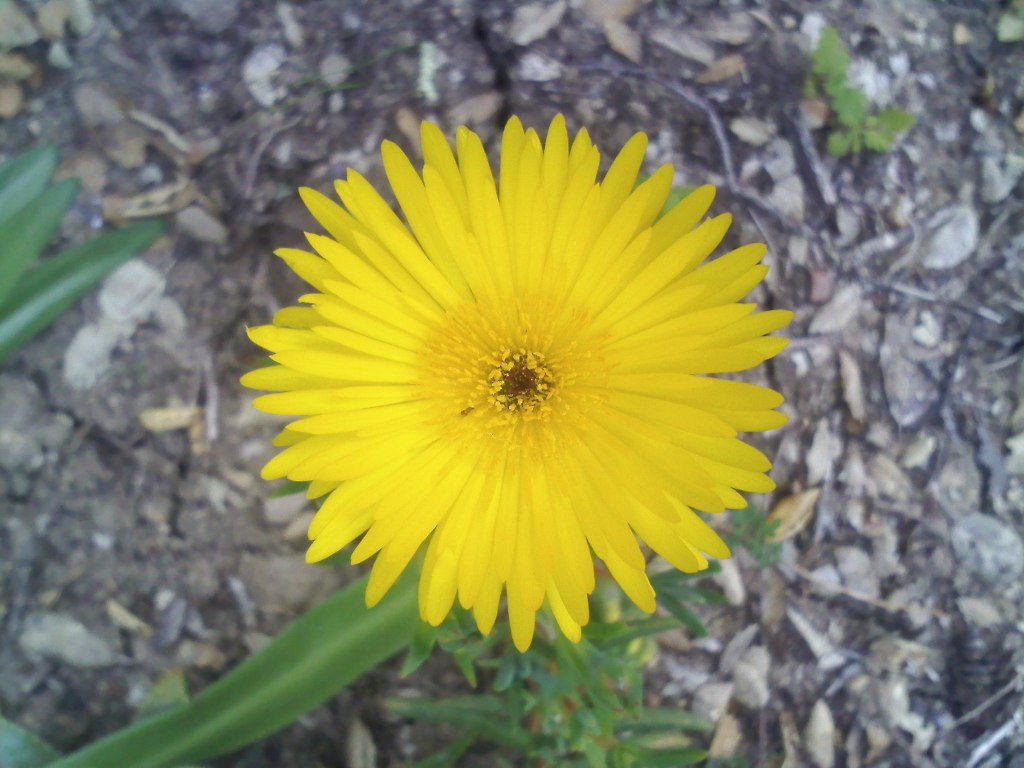
The bright orange, inch and a half wide flowers of Lampranthus aurantiacus, a type of ice plant, should bloom between winter and spring, but a few are brightening my garden right now. This bright yellow flower in the picture is that of the variety ‘Glaucus’, which I grew from a cutting last year. My single low mounding plant is about a foot wide now and will eventually spread to about two feet wide, and can get about a foot deep. Stems can root where they lay, forming new plants that will spread farther. To accelerate the spread, more plants are very easy to propagate from small cuttings. Lampranthus aurantiacus has narrow, inch long leaves, and a relatively shrubby basal branch structure.
Crassula tetragona is more similar to related jade plant than it appears.
Although the narrow and pointed inch long leaves of Crassula tetragona (which lacks a common name) are not at all similar to the plump rounded leaves of the closely related but much more common jade plant, it is much more similar to jade plant than it appears to be. Both enjoy sunlight but will take a bit of shade. Both can be damaged by extreme exposure (reflected glare and heat), as well as the opposite extreme, frost. Their succulent stems are so easy to root as cuttings, that rather substantial pieces that may need to be pruned off can be stuck into the soil as instant new plants. Even leaves of these and various other specie of Crassula can be rooted as very small cuttings. Besides its distinctive foliage, Crassula tetragona differs from jade plant only because it is limited to about a foot and a half high and wide, and blooms with unremarkable white flowers instead of more prominent flower trusses.