 It is pretty but pervasive. Actually, I do not really find scarlet pimpernel to be all that appealing, but this is how someone who reads my gardening column in the Santa Ynes Valley News describes it. Embarrassingly, she requested that I discuss scarlet pimpernel while it was more of a problem back on June 7, but I only recently read the message. By now, it is already dying back for autumn, and is completely deteriorated in dry and hot exposed areas. It will be back next spring, and will bloom with tiny peachy orange flowers so that it can throw tiny but ridiculously abundant seed by summer before anyone notices. Flowers can be other colors in other regions. The sprawling stems can spread more than a foot wide, and can get up to about ten inches high if sprawling over other weeds. The tiny and soft leaves are arranged in opposing pairs. Scarlet pimpernel may not seem like much of a threat now that it is deteriorating, but new seedlings will be profuse early next spring, and can compete with seedlings of more desirable plants.
Control of scarlet pimpernel is not easy. If application of herbicide is an option, it does not stick to the foliage of scarlet pimpernel very well, even with a wetting agent. Hoeing eliminated larger plants, but does not kill the seed that the larger plants have already tossed. Scarlet pimpernel starts throwing seed so early that it must be pulled as soon as it appears in very early spring. Like I said, it is not easy. The small plants are not even easy to see. The process must be repeated at least weekly for a while, just because some seedlings will emerge after the first batch is gone.
Fortunately, scarlet pimpernel is not very vigorous. If it comes up through mulch, only a few plants will survive, and they will be easy to pull. They do not compete with other more vigorous plants well either. Many simple ground covers will simply shade it out, although it can mingle with and ruin some of the finely textured ground covers like baby tears and thyme.
I am sorry that I do not have any more information about scarlet pimpernel than is commonly known. I am speaking primarily from experience, and my experience has not been as bad as with other more aggressive weeds. Scarlet pimpernel always seems to be around, but is not so much of a problem that I am too worried about annihilating it completely.
New Guinea Impatiens
 Good old fashioned busy Lizzie is hard to find nowadays, if it can be found at all. The nasty mildew that kills it so quickly might not be prevalent everywhere, but happens to be a serious problem where most of the bedding plant farms are located. Now, the formerly uncommon New Guinea impatiens, Impatiens X hawkeri, which is somehow resistant to the mildew, is becoming popular.
The two specie have distinct personalities though. Busy Lizzie dazzles with cheery cartoonish colors, and bloom profuse enough to almost obscure the light green foliage. New Guinea impatiens has bigger and bolder flowers of white, pink, red, magenta, lavender, purple, apricot and reddish orange, but does not try to hide its rich green, bronze, purplish bronze or gold variegated foliage.
New Guinea impatiens are more expensive, and are not available in cell packs like most other bedding plants are. They are most popular in four inch pots. They do well in pots and tolerate partial shade, but want rich soil and regular watering. Mature plants can get more than a foot wide, and might get as tall if crowded. Although grown as annuals, they can survive as short term perennials.
Busy Lizzie
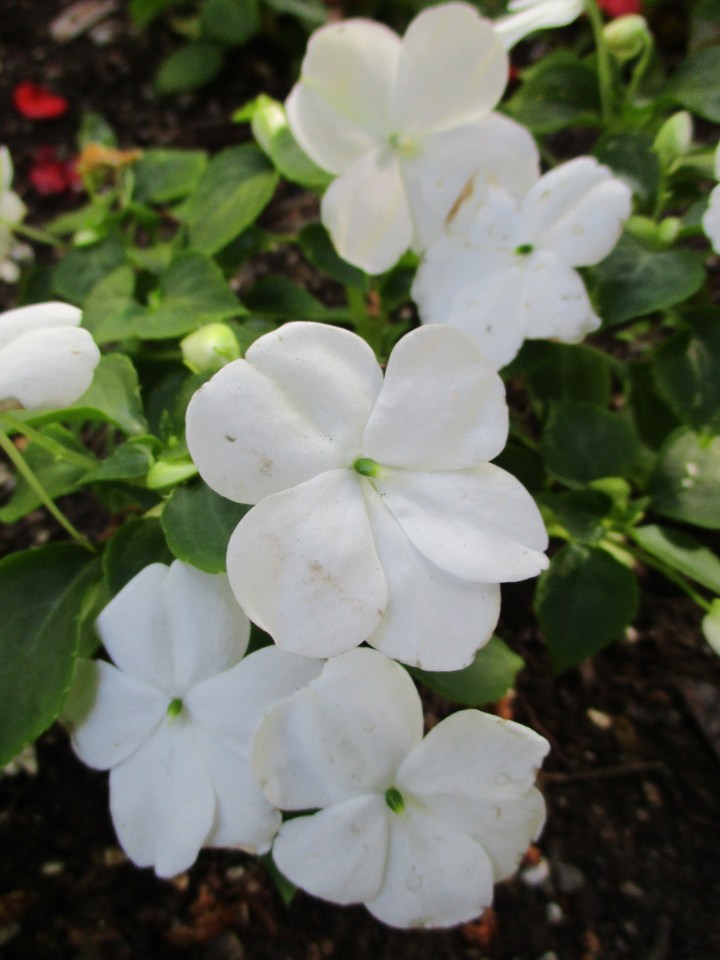 In only a few years, busy Lizzie, Impatiens walleriana, went from being one of the most popular warm season annuals to being unavailable in nurseries. It is now making a slight comeback. Most of those planted during their planting season last spring are now so profuse with bloom that their rich foliage is mostly obscured. Although they can be perennial, almost all get replaced in autumn.
The problem associated with their unavailability was that a type of downy mildew that is resistant to common fungicides had become a temporary epidemic among the growers who supply the plants. The disease is still out and about, so can still infect busy Lizzie, but is not such an epidemic after a few years of scarcity of host material for it to infest. Nonetheless, busy Lizzie is still risky.
Bloom is clear and cheery hues of pink, red, magenta, peachy orange, pale lavender and white. The five petaled flowers are about an inch or two in diameter. Leaves are a bit bigger than the flowers. Foliage and stems are succulent and very fragile, so will not tolerate traffic, and will die in winter if exposed to frost. The biggest plants can get almost two feet tall and three feet broad.
 Tony Tomeo