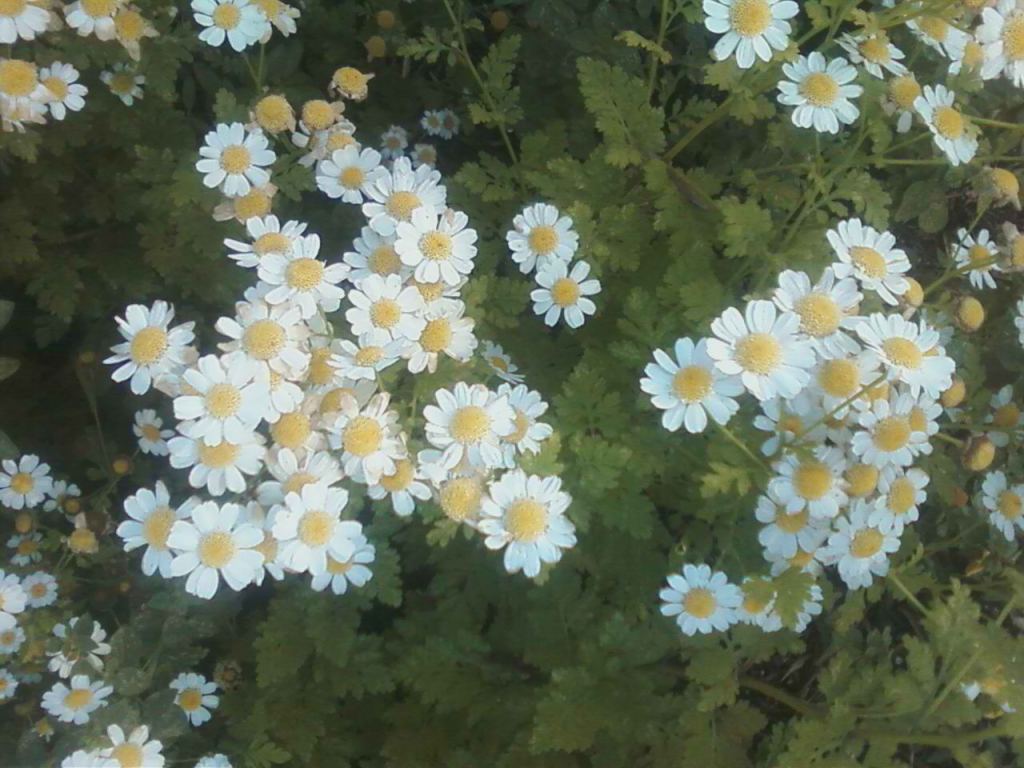
Once naturalized in the garden, chamomile, Matricaria recutita, can get to be too much of a good thing. Seed sown in at the end of winter or early in spring typically does very well in the first year. The new plants bloom abundantly by the middle of summer and eventually become rampant and sparse enough to get cut back by the end of the following winter. The largest and most productive plants can die at the end of their first year, but are only replaced by the formerly smaller plants that survive getting cut back through winter to get an early start the following spring. Self sown seed can fill in where last year’s plants do not, and can migrate into places where no one would have thought to plant them!
The finely divided, lacy foliage stands nearly two feet tall, and more than half as broad on somewhat floppy stems. The inch wide daisy flowers that are white around the edges of big yellow centers can be dried to make chamomile tea.
‘Snowball’, ‘Golden Ball’ and ‘White Stars’ are actually varieties of related Chrysanthemum parthenium that are sometimes sold as chamomile. Feverfew, chamaemelum nobile, stays dense and low, and can be a nice ground cover for small areas. I grew my favorite traditional chamomile (as well as feverfew) from seed from Renee’s Garden.
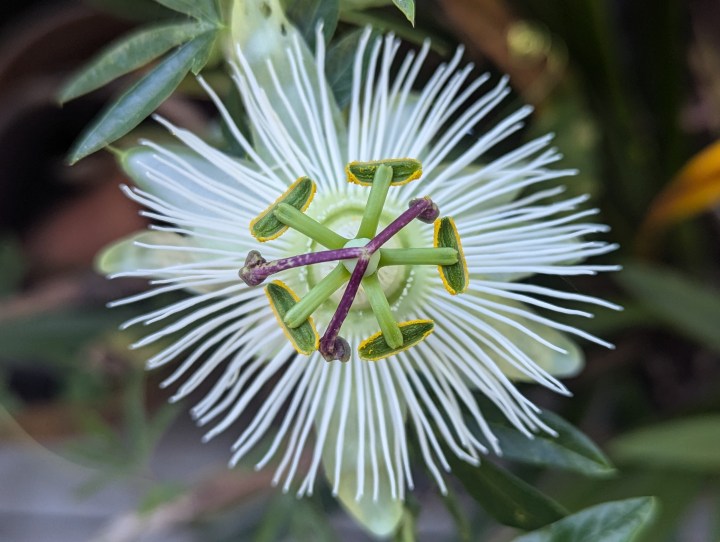
Even passion flower can make a nice, albeit colorless, tea.
When she was younger, my niece, who happens to be the most elegantly refined girl in Gilroy, enjoyed doing tea. She certainly had the technique, as well as two patient grandmothers, to indulge in this particular tradition properly. The only problem was caffeine.
She was such a young lady; and her Nana and Grandma refrained from the consumption of caffeine. Black tea, made from the fermented bud leaves of tea camellias, was not a good option. Even green tea, made from the same leaves but without fermentation, contains some degree of caffeine. Herbal teas were more practical, as well as appealing to the discriminating taste of a young lady of such impeccable refinement.
There are all sorts of herbal teas made from flowers, leaves and fruit that can be grown in home gardens. Mint, chamomile and lemon grass are perhaps the most well known. Peppermint, spearmint and the many other varieties of mint all have unique flavors. Lavender, particularly French lavender, and some of the many sages can be used to add a bit of their distinctive flavors, too.
Thinly sliced and dried ginger and licorice root make spicy teas that are also good remedies to a mildly upset stomach. However, flowering ginger is not as robust as herbal ginger is. Finely chopped dried berries, cherries, apricots and quince, as well as the rinds of lemons and oranges, add their fruity flavors. The extensive tea list at the White Raven in Felton features teas flavored with dried hibiscus flowers, pelargoniums and rose hips.
Experimenting with herbal tea is like cooking. Within reason, anything goes. Tea can even be made from the dried young shoots of Douglas fir! The only plants that can not be used as tea are those that are potentially toxic.
Tea can of course be enjoyed hot, cold, or even at ambient temperature. Herbal tea is almost always made from dried plant parts, but can be made from fresh parts as well. The various mints have different flavors if brewed from fresh bits taken directly from the garden instead of dried leaves. I actually like to add a few fresh leaves from rose scented geranium (pelargonium) to common sun tea made by leaving black tea to brew out in a jar in the sun.
While they are in season, I also like to add a thin slice of fresh quince, which is so strongly flavored that it is just as effective fresh as it is dried for sun tea or hot tea. Apples and crabapples are also nice, but with much milder, and perhaps even boring, flavor. I prefer to eat the apples and then drop the cores into tea. A Slice or two of richly flavored fig can be good in sweetened hot tea.
 Tony Tomeo