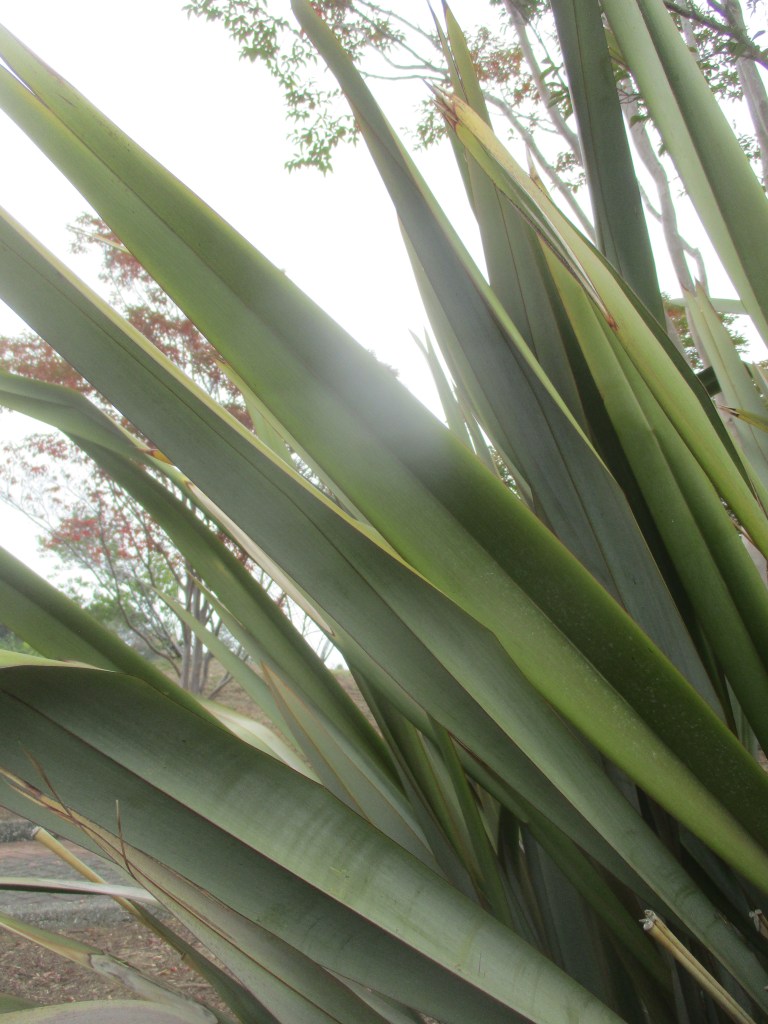
Simple old fashioned New Zealand flax, Phormium tenax, has been popular on the West Coast for as long as anyone can remember. Big specimens are prominent in old pictures of Victorian era gardens. The upright and olive drab foliage gets as high as ten feet, and as broad as fifteen feet. Bronzed and variegated cultivars stay somewhat more compact.
Modern cultivars of New Zealand flax might be Phormium colensoi, or hybrids of the two species. They are generally even more compact, with more colorful foliage. Foliage may be olive green, greenish yellow, brownish bronze, rich reddish bronze or striped with like colors. Some bronze sorts are striped with tan or pink. ‘Yellow Wave’ has floppier foliage.
New Zealand flax is a tough evergreen perennial. Its long and narrow leaves can be too fibrous to cut without scissors. These leaves grow as tall as they do from clumping basal rhizomes. Interestingly rigid floral stalks stand slightly higher than the foliage, with yellow or red bloom. After bloom, these floral stalks can be a delightful and bold dried cut flower, and work well with pampas grass bloom.
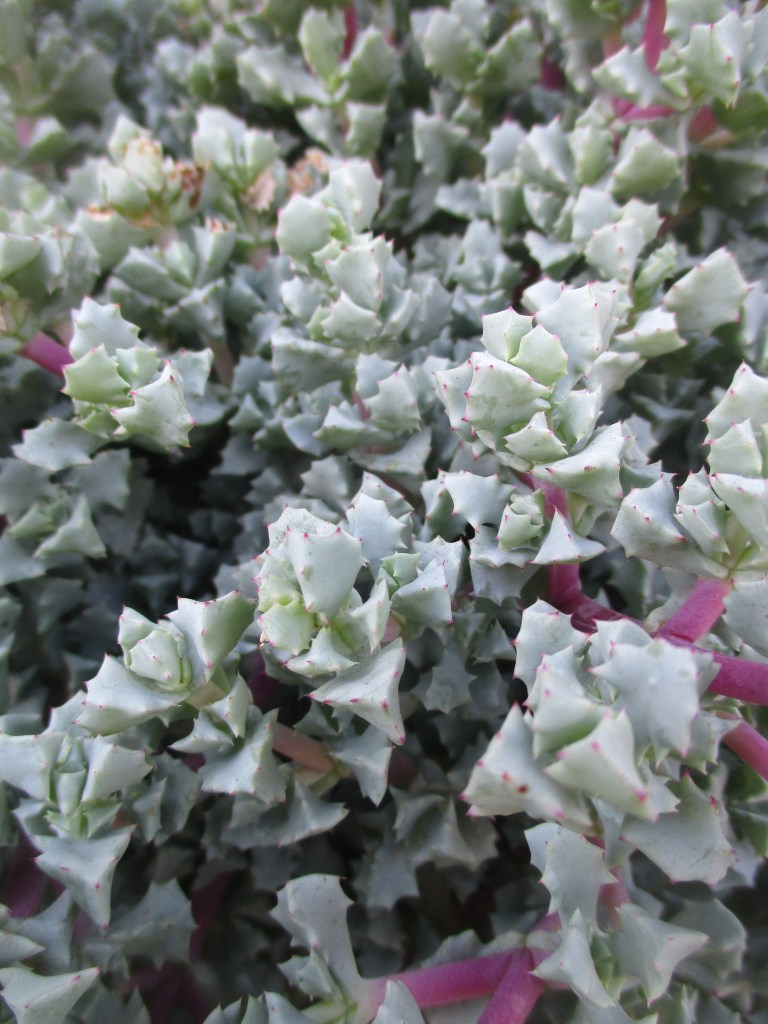
Lavender pink bloom in spring or early summer can be profuse in sunny situations. Individual flowers are like small daisies with yellow centers. They stay closed through most of the morning, then open by about noon. If the weather is conducive, they can be slightly fragrant. However, the evergreen foliage of pink iceplant, Oscularia deltoides, might be even more appealing than the bloom.
The plumply succulent leaves are a delightfully bluish hue of gray. With two sides and a flat upper surface, these leaves are triangular in cross section. Blunt foliar teeth provide a distinctive texture. Foliage is so dense that the relatively thin stems within are barely visible. Stems can blush with pink or purple. Bloom is better, and foliage is denser, with good exposure and occasional watering.
Mature growth gets at least half a foot deep, and can eventually get a foot deep. It slowly spreads about two or three feet wide. With age, outer stems develop roots where they lay on the soil, and spread even farther. New plants grow very easily from cutting. Pink iceplant cascades nicely from pots or over stone. It contrasts handsomely with richer or darker colors of other foliage or bloom.
Flowers provide color and texture. So does foliage. What is less often considered is that the bark of many trees and large shrubbery can be aesthetically appealing as well. Bark is usually thought of merely as something to cover up the trunks and limbs of the plants that provide all the colorful and textural flowers and foliage.
Coral bark Japanese maple and red twig dogwood (and yellow cultivars, which are selectively bred varieties) turn color as they defoliate for winter. However, the color is limited to the twigs and smaller stems. Red twig dogwood often gets cut back at the end of winter so that it will produce more twigs for the following winter. Mature stems and trunks are not as interesting.
Palms and yuccas do not actually have bark, but are still texturally interesting. Giant yucca trunks are weirdly sculptural. Mexican fan palm can be ‘shaven’ to expose lean trunks with a finely textured exterior, but are more often adorned with the intricately patterned thatch of old petiole bases (leaf stalks). Windmill palm is uniquely shaggy with coarse fiber.
Arbutus ‘Marina’ is a madrone that was developed for home gardens. It is compact and symmetrical, with finely textured flaking bark that reveals strikingly smooth cinnamon-colored bark beneath. Larger manzanitas can be pruned up to expose similar bark on a smaller scale. Smooth Arizona cypress looks much like other cypresses, but with strangely smooth bark on vigorous stems.
The bark of almost all eucalypti is interesting for one reason or another. Even the notorious blue gum, which gives other eucalypti a bad reputation, peels away in very long strips to reveal smooth bark that fades from green to pink to tan to gray before peeling away to start the process over again. Some eucalypti have blotched bark. Red ironbark has rich brown bark that is uniformly furrowed.
Lemon gum (eucalyptus) and various birches have strikingly white bark. Lemon gum bark is smooth. Birch bark peels away like paper. Because the trees are so slender, they can be planted in groups so that there are more trunks to display the distinctive bark. These are only a few of the many trees that can impress with mere bark.

 Tony Tomeo