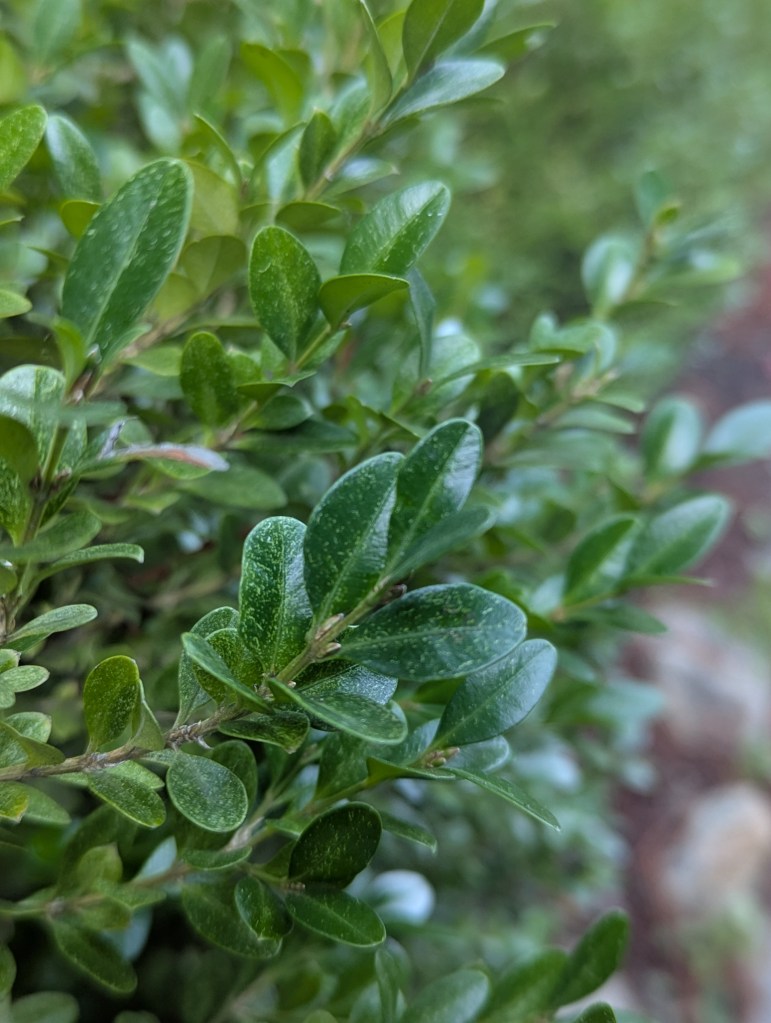
Japanese Boxwood

Japanese boxwood makes splendid compact hedges.

Formal boxwood hedges are traditional components of old rose gardens. They are short enough to not obscure the bloom of the roses. Yet, they are dense enough to obscure the less appealing bases of rose shrubs. English boxwood is more common where winter is cooler. Locally, Japanese boxwood, Buxus microphylla, has always been more popular.

Mature specimens generally stay less than three feet tall and wide. They can grow twice as large without pruning. Their glossy evergreen leaves are only about half an inch to an inch long. The foliar texture is quite dense, so is very conducive to formal shearing. Bark is light brown or gray, but is not often visible within such dense foliage. Roots are docile.

Old fashioned Japanese boxwood has somewhat yellowish green foliar color. It remains the most common cultivar within old gardens. Modern cultivars are notably darker green. At least one modern cultivar is even more compact and globular than the simple species. Another is fastigiate. ‘Borderline’ foliage is variegated with light yellow or white margins.

English ivy

A few cultivars of English ivy are variegated.

During the 1990’s, English ivy, Hedera helix, evolved beyond small scale ground cover and became popular for pseudo-‘topiary’. It is now commonly trained onto wire frames formed into spheres, cones and all sorts of shapes. English ivy is also a nice greenery to fill in between flowering annuals and perennials in mixed urns and planters, especially where it can cascade downward.

There are all sorts of cultivars (cultivated varieties) for all sorts of applications. ‘Hahn’s Self Branching’ English ivy is probably the most practical for ground cover, since it fills in so reliably and is somewhat tolerant of partial shade. ‘Needlepoint’ had darker and more finely textured foliage; but since it does not cover larger areas so efficiently, it is instead more commonly used as greenery with mixed annuals and perennials, or for pseudo-‘topiary’. All sorts of variegated English ivy, whether alone or as a component to mixed plantings, brightens slightly shaded spots. Variegation ranges from greenish white to yellow. Leaves can be lobed, ruffled, elongated, cleft or even nearly compound; but are generally two to three inches wide. Most have three to five ‘corners’.