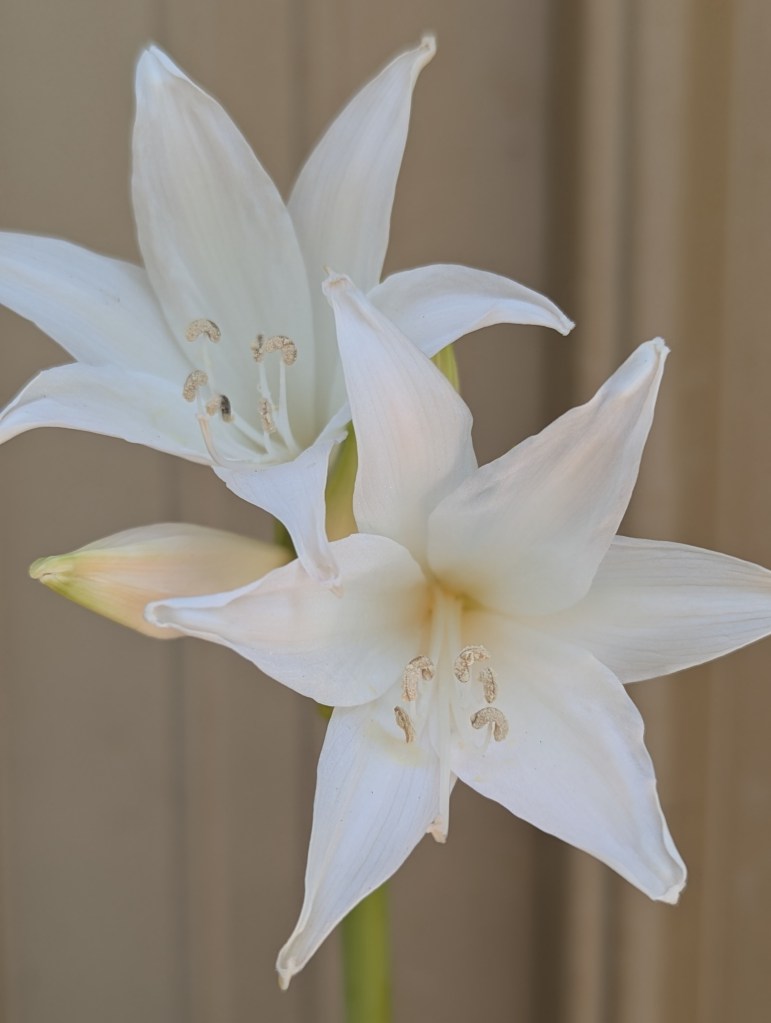
From scarcely exposed tops of seemingly dead bulbs, floral stalks unexpectedly appear. Foliage only appears after bloom finishes. This is why Amaryllis belladonna is known as naked lady. It blooms unfoliated. Various varieties of the same species bloom with about the same vivid pink color. White variants are very rare. Floral fragrance is mild but sweet.
Naked lady flowers are about two feet tall on simple brown or green stalks. Fleshy seeds that develop after bloom are viable only while fresh and plump. Foliage begins to appear by later summer, and grows more with autumn rain. It resembles foliage of lily of the Nile, but is more fragile, and shrivels by late spring. Then, bulbs lay dormant through summer.
Naked lady bulbs are impressively resilient, but also quite sensitive. If possible, the best time to relocate them is supposedly between bloom and foliation. However, relocation is likely easiest during complete summer dormancy. Unfortunately, though, such relocation can interfere with subsequent bloom. Naked lady needs full sun exposure to bloom well, but requires no water.
Like oleander and junipers, lemon bottlebrush, Callistemon citrinus, has become passe. It was a victim of its own practicality. It was so popular that it became overly common. Yet it is just as practical now as it was then. It is resilient enough to survive within medians of freeways with minimal irrigation. In less exposed situations, it might require no irrigation.
As a small tree, lemon bottlebrush can grow more than fifteen feet tall. With pruning from below, some grow about twenty feet tall with sculptural trunks. Their canopies eventually become messy though, and require aggressive pruning. Most lemon bottlebrush grow as big flowering shrubbery or high hedges. Shearing can compromise bloom if too frequent.
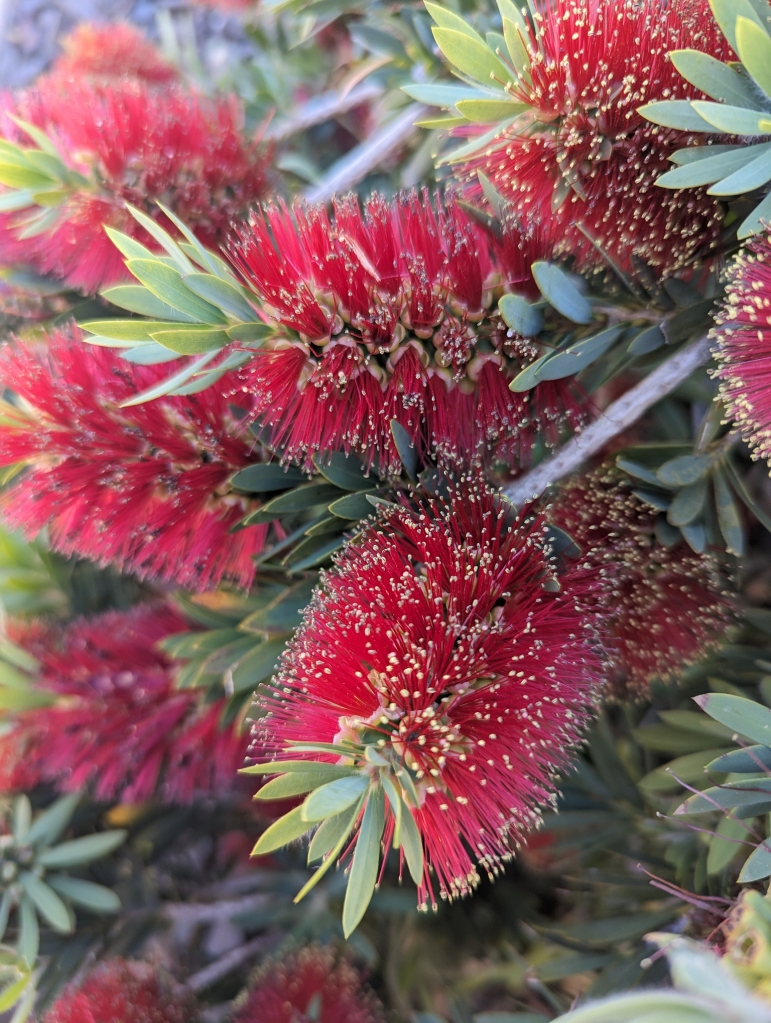
Bright red bloom should be most abundant for summer, but may be sporadic at any time. It is very popular with pollinators, including hummingbirds. Many small staminate flowers bloom in compact cylindrical trusses, like bottlebrushes. Each truss is about two or three inches long and nearly as wide. The aromatic and evergreen leaves are almost as long. Dark brown bark is handsomely shaggy and furrowed.
Orchid rockrose, as well as other rockrose, are remarkably resilient.
Out in the most remote islands in the vast parking lots of Westgate Mall, the three inch wide, bright pink flowers of orchid rockrose, Cistus X purpureus, defy the harsh exposure and sun baked soil. They begin to bloom somewhat abundantly about now after winter rains, and continue until the beginning of summer. Sporadic flowers can occasionally bloom out of season. The center of each flower looks like a starfish wearing a fuzzy sweater, because each of the five petals has a brownish red spot at the base, surrounding the bright yellow stamens.
Mature orchid rockrose plants are typically less than four feet tall and broad, with somewhat grayish green, aromatic foliage. Individual leaves are about one or two inches long. Older stems can be pruned out as they start to deteriorate and drop leaves, in order to promote new growth that lasts longer. Otherwise, plants look tired after a few years, and eventually die out. Orchid rockrose does not want much water once established, and can only tolerate frequent watering with good drainage.
Most modern silverberry is variegated with yellow or white.
Old fashioned silverberry, Elaeagnus pungens, has always been useful for large informal hedges and barriers in difficult locations. It may not be as refined or as bright green as other plants that are more commonly used for formal hedges; but it is more adaptable to harsh exposure, since it has no problem with heat and reflected glare.
If necessary, silverberry can be shorn like privets, but is at its best with only occasional selective pruning to keep it within bounds. Without pruning, it can grow to more than ten feet high and nearly as wide. Despite its slower growth at maturity, it grows faster and fills out quite efficiently while young.
All parts of silverberry are covered with slightly raspy and silvery or ‘rusty’ tomentum (fuzz – although it is not exactly ‘fuzzy’). The one to two and a half inch long leaves often have undulate margins. The less than abundant, half inch long brownish berries taste better than they look. Somewhat spiny vigorous stems efficiently deter intrusion. Trespassers that might get through them once will not try again.
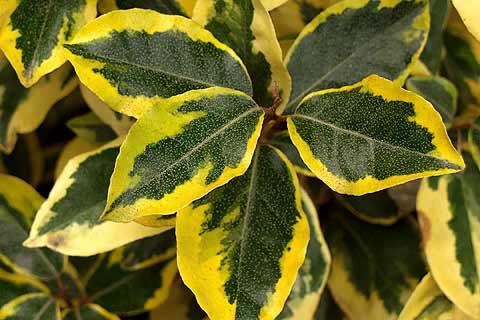
Modern cultivars (cultivated varieties) are neither as rugged as the straight species, nor as large, but have more colorful foliage. Leaves of ‘Variegata’, which is shown in the illustration, have lemony yellow or nearly white margins. ‘Marginata’ has brighter white leaf margins. ‘Maculata’ leaves are instead equipped with bright green margins around bright yellow centers. ‘Fruitlandii’ has larger silvery leaves.
Old fashioned lemon bottlebrush would be so practical, if only it did not get so bulky. It is impressively resilient. Although appreciative of occasional watering, it needs none once established. Phases of red bloom continue through warm spring and summer weather. A few sporadic blooms may continue throughout winter. Hummingbirds are very fond of it.
‘Little John’ bottlebrush, Callistemon viminalis ‘Little John’, is all that and less. It remains much more proportionate to compact home gardens. Growth is relatively slow and tame. Mature specimens may grow no bigger than three feet tall and five feet wide. They prefer to assume naturally mounding form without shearing. Any pruning should be quite minor.
More than compact form distinguishes ‘Little John’ bottlebrush from lemon bottlebrush. Its evergreen leaves are relatively small and slightly grayish. Their foliar texture is relatively tidy. Its lemony foliar aroma is relatively subdued and only evident if foliage is disturbed. The fuzzily staminate floral trusses are relatively small with relatively mellowed red color.
Yucca is a genus of about fifty species. However, any two can hybridize. They are more like fifty or so varieties of one species. They maintain distinction by blooming at different times or inhabiting different ranges. Mound lily, Yucca gloriosa, is one of these species. However, it is technically a perpetuating hybrid of Yucca filamentosa and Yucca aloifolia.
Mound lily develops symmetrical foliar rosettes that are only a few feet tall. Stout trunks that develop below can very slowly elevate these rosettes about eight feet. Elegantly tall floral stalks can stand as high as five feet higher. The stiff and evergreen leaves are one to two feet long, and about two inches wide. Their terminal foliar spines are very sharp.
The most popular cultivar of mound lily is variegated with creamy white stripes. Tristis is a variety with more flexible and arching foliage. It formerly classified as a distinct species of Yucca recurvifolia. All yuccas bloom with small, pendulous and creamy white flowers. Such flowers may exhibit a pale purplish or faint pale greenish blush.
Old fashioned New Zealand flax, Phormium tenax, is becoming increasingly uncommon. It is simply too big for compact modern gardens. Even without upright stems, its vertical and olive drab leaves can reach ten feet tall. They can flare outwardly as wide as fifteen feet. One cultivar is bronzed. Another is variegated. Both are somewhat more compact.
Most modern cultivars are either Phormium colensoi or hybrids of the two species. They are more compact and more colorful. ‘Jack Spratt’ grows only about a foot and a half tall, with chocolaty bronze foliage. ‘Yellow Wave’ gets about three or four feet tall with arching foliage with yellow stripes. Others are bronzed or striped with yellow, brown, red or pink.
New Zealand flax is remarkably resilient. The evergreen foliage is so very fibrous that it can be difficult to cut. Tough rhizomes that migrate where they are not wanted propagate easily by division. Some cultivars can revert by generating less colorful mutant growth. Since it is greener, such growth is more vigorous. It can overwhelm and displace more colorful foliage.
Since their development, freeways had been prettier with oleander, Nerium oleander. No other comparably resilient and undemanding shrubbery is as colorful. Harsh exposure of medians and interchanges was no problem. Oleander became less common through the 1990s only because of oleander scorch. Big contiguous colonies were most susceptible.
Oleander is as resilient as it has always been. It is less susceptible to oleander scorch if remote from other specimens. It performs best if it can grow wild without pruning. Pruning is not actually harmful, but can disrupt bloom. Frequent shearing eliminates most bloom. However, with pruning to remove lower growth, big shrubs can become nice small trees.
Bloom is white, pink or red. Pink ranges through bright cherry pink to pastel peachy pink. Pale yellow remains quite rare. Single flowers are most common. Double flowers are not rare though. A few cultivars provide mildly fragrant bloom, but also generate seed. Large oleander can grow as tall as fifteen feet. Dwarf cultivars may stay shorter than three feet. Oleander leaves resemble those of native bay laurel. All parts of oleander are notoriously poisonous.
Vegetation that survives within untended gardens is truly sustainable.
Sustainability is a good idea gone bad. It is so often used as a marketing gimmick by those who actually have the least to gain from it. Really, landscapers and gardeners would not have much business if landscapes really were sustainable and able to function without their help. The best landscapes probably compromise between being as sustainable as possible with a few more conventional but less sustainable features to make them functional.
For example, lawn happens to be among the least sustainable of landscape features. It needs ridiculous volumes of water and continual maintenance, typically with gasoline powered mowers. Many lawns are gluttons of fertilizer. Yet, almost all landscapes have lawn of some sort. Lawns are certainly justifiable for children and dogs.
The trick is to use lawn like rugs for the landscape instead of like wall to wall carpeting. If possible, it should not be an all purpose ground cover for whatever area is not landscaped with something else. It should cover only areas that will get used as lawn.
Bedding annuals are likewise far from sustainable. They need too much water and work, and get replaced seasonally. Even those that sometimes naturalize where a bit of water is available, like sweet alyssum, godetia and nasturtium, really do not perform quite like more pampered bedding plants do.
The best way to see sustainability in action is not in the pretty pictures in the brochures of landscape companies with something to sell, but in the worst of landscapes. Plants that survive in abandoned landscapes where lawns and bedding plants have died off are obviously more sustainable.
Bottlebrush, oleander and various junipers and yuccas may be stigmatized as ‘gas station’ plants, but earned that stigma by being so resilient and sustainable. The many types of cotoneaster, manzanita, wild lilac and rockrose are also worth investigating, (although wild lilac and rockrose do not live as long as the other shrubbery does.) Redwood, California laurel, strawberry tree, incense cedar and many types of eucalyptus, oak , cypress and acacia are among the more sustainable of trees.
Butterfly is like a more softly textured version of African iris, with pale pastel yellow bloom.
What was introduced as a seemingly fancier alternative to the common African iris is now almost as popular. Butterfly iris, Dietes bicolor (or Morea bicolor), is about as easy to grow, and nearly as resilient. Instead of white, the flowers are soft yellow with three prominent purplish brown spots with orange margins. The grassy evergreen leaves are a bit narrower and pliable.
Mature plants may get nearly three feet high and five feet wide. For those who do not mind digging and splitting apart the tough and densely matted rhizomes, large clumps are very conducive to propagation by division in autumn or winter. Deadheading (removal of stems that have finished blooming) promotes continued bloom and limits dispersion of seed that might otherwise grow new plants where they are not wanted. A bit of partial shade or minimal watering are probably nothing to worry about, but may inhibit bloom. Well exposed, well watered and well deadheaded butterfly iris should bloom from early spring until early winter.




 Tony Tomeo