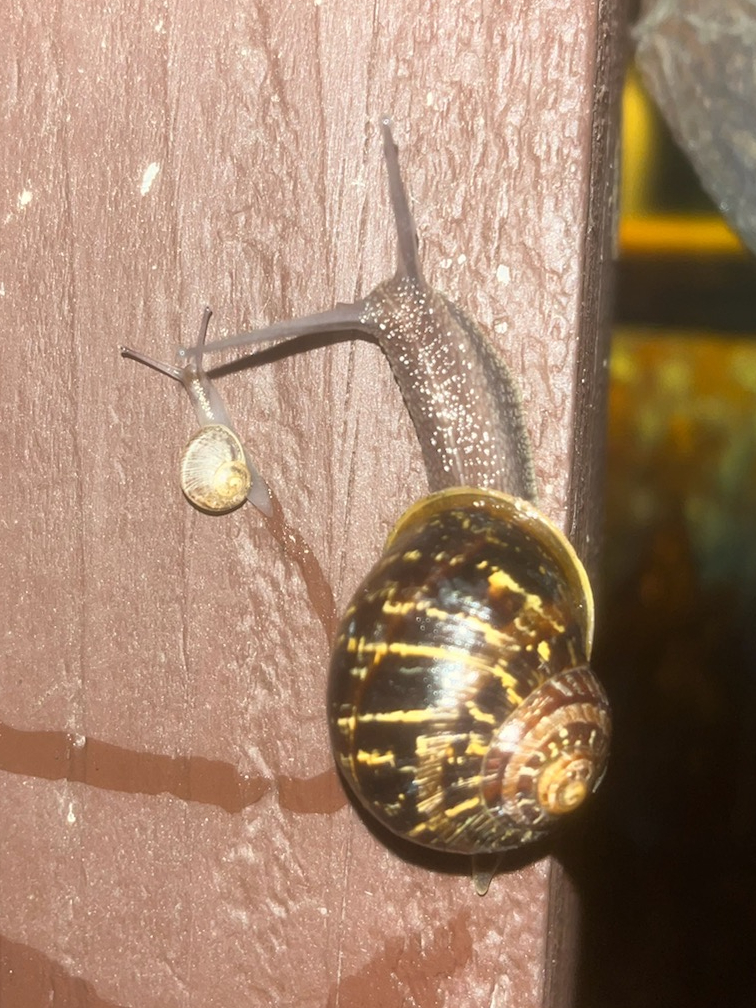
French hors d’oeuvres are somehow among the most bothersome of garden pests within California. They are voracious. They are very prolific. They are sneaky. They are more resilient to attempts to limit their damage than they had been in the past. Furthermore, attempts to limit their damage are less effective than they had been in the past.
Molluscicides, which are the pesticides that are formulated to be toxic to molluscs such as snails, are not nearly as toxic as they had formerly been. Years ago, they were so toxic that they had potential to be dangerous to cats, dogs, wildlife or children. They are safer for everyone now, including the molluscs that they should be toxic for. Some snails succumb after consuming such molluscicides, but some survive.
The progeny of snails who survive consumption of molluscicide are genetically more likely to also survive consumption of the same molluscicide than snails who did not survive to proliferate. Those who do not inherit such genetic resilience do not survive to proliferate. Consequently, each subsequent generation is more resistant to the particular molluscicide than its preceding generation. Although a different molluscicide would be more effective temporarily, a few snails survive it also, to proliferate and repeat the process. It is how they ‘develop resistance’.
Besides, many garden enthusiasts are hesitant to apply molluscicides because of how toxic such pesticides had been in the past, and how, regardless of how much safer they now are, they must still be toxic to some degree in order to be effective.
Lushly landscaped and generously irrigated home gardens are ideal habitats for snails. Vegetation within such landscapes is damp and sheltered, and provides an abundance of sustenance. Skunks, foxes, ducks and other wildlife that eat snails generally avoid or lack access to many urban home gardens. Opossums and raccoons are either uncommon, or more interested in eating fruits, vegetables, trash or dog and cat food.



 Tony Tomeo