V8

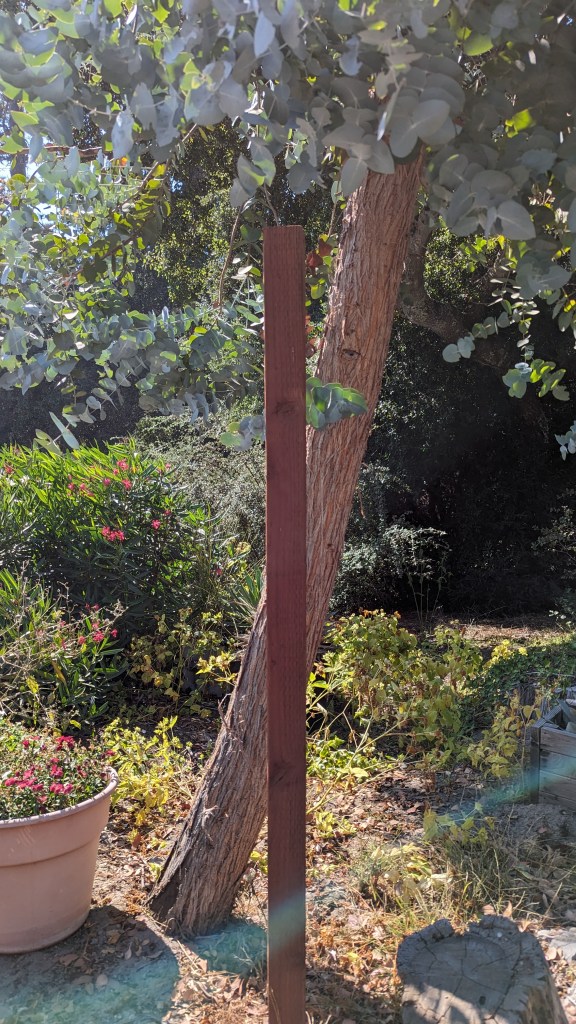
The vertical post demonstrates how much the tree trunk leans.

A few tree species should’ve had a V8. That includes more than a few individual trees. It applies to enough individuals of a species to indicate that the need is almost typical of the particular species.

The need for a V8 is derived from old advertisements for the V8 beverage that depicted those who were deficient in adequate consumption of V8 as leaning prominently. V8 is a juice beverage that is composed of juices of eight vegetables; tomatoes, carrots, celery, beets, parsley, lettuce, watercress and spinach. Hence, V8. It balances a diet so that those who consume it stand upright rather than lean.

In horticultural slang, the need for a V8 refers to a leaning trunk.

Any tree of any species has potential to develop a leaning trunk, and consequently appear to be in need of a V8. Some species innately develop leaning trunks though. No one seems to know why, but specimens of such species with vertical trunks are oddly uncommon or perhaps rare.

For example, so many ginkgo trees lean at such similar angles that, among some groups, their distinctive lean seems to be a normal characteristic of the species. It is variable though. Many individual trees that are isolated from others are quite vertical. So are some groups of street trees. However, many or most specimens of other groups of street trees lean at very similar angles, although in random directions.

Italian stone pines are more likely to lean, also at relatively similar angles, and also in random directions. Locally, vertical trunks are rare among this species. However, within their native range, vertical trunks are typical.

Argyle apple (eucalyptus) is almost comparable to Italian stone pine in regard to its typical need for a v8. I have seen a few with vertical trunks. I was determined for ours to be among them. I bound the trunk to keep it straight as it grew. I installed it with the trunk as vertical as the sign post next to it. When wind caused it to lean slightly while it was smaller than it is now, I pushed it back into position. Actually, I might have done that a few time. However, as it matured, it became more difficult to push back into position. Eventually, it refused to budge from its leaning position. Now, like most of the species, this specimen also seems to be in need of a V8.
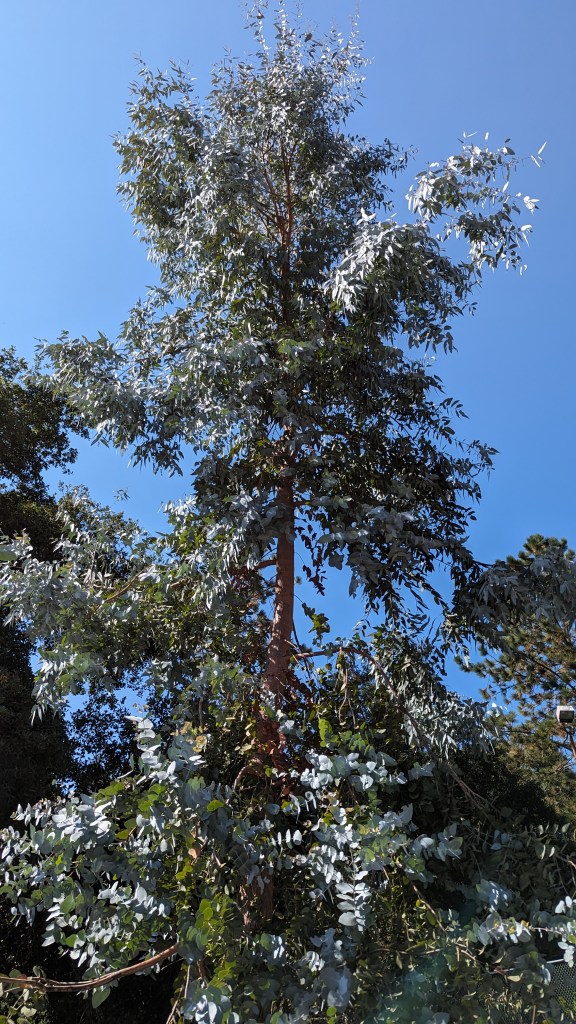
After the base of the trunk insisted on leaning, the upper portion of the trunk assumed vertical posture.

Some Trees Are All Bark

P00613-1
California sycamore bark is very distinctive.

Flowers provide color and texture. So does foliage. What is less often considered is that the bark of many trees and large shrubbery can be aesthetically appealing as well. Bark is usually thought of merely as something to cover up the trunks and limbs of the plants that provide all the colorful and textural flowers and foliage.

Coral bark Japanese maple and red twig dogwood (and yellow cultivars, which are  selectively bred varieties) turn color as they defoliate for winter. However, the color is limited to the twigs and smaller stems. Red twig dogwood often gets cut back at the end of winter so that it will produce more twigs for the following winter. Mature stems and trunks are not as interesting.

Palms and yuccas do not actually have bark, but are still texturally interesting. Giant yucca trunks are weirdly sculptural. Mexican fan palm can be  ‘shaven’ to expose lean trunks with a finely textured exterior, but are more often adorned with the intricately patterned thatch of old petiole bases (leaf stalks). Windmill palm is uniquely shaggy with coarse fiber.

Arbutus ‘Marina’ is a madrone that was developed for home gardens. It is compact and symmetrical, with finely textured flaking bark that reveals strikingly smooth cinnamon-colored bark beneath. Larger manzanitas can be pruned up to expose similar bark on a smaller scale. Smooth Arizona cypress looks much like other cypresses, but with strangely  smooth bark on vigorous stems.

The bark of almost all eucalypti is interesting for one reason or another. Even the notorious blue gum, which  gives other eucalypti a bad reputation, peels away in very long strips to reveal smooth bark that fades from green to pink to tan to gray before peeling away to start the process over again. Some eucalypti have blotched bark. Red ironbark has rich brown bark that is uniformly furrowed.

Lemon gum (eucalyptus) and various birches have strikingly white bark. Lemon gum bark is smooth. Birch bark peels away like paper. Because the trees are so slender, they can be planted in groups so that there are more trunks to display the distinctive bark. These are only a few of the many trees that can impress with mere bark.