Hard Hat

This is a harsh reminder.

This is why arborists wear hard hats. It is more than eight feet tall. I do not know how much of it extends into the wet sand. Nor do I know how much it weighs. It might have fallen from about twenty-five feet up. I do not know how far the pole saw that it was plucked down with was extended. Even with a hard hat, this would have been potentially very dangerous. I am glad that it is now on the ground, or will be when it falls over.

Nature is naturally hazardous. We try to make some of it safer. We can not eliminate all hazards though. Some, like this one before it fell, are not obviously hazardous. Some are not visible from the ground. As frequently as some hazards are eliminated, others are developing. Trees are always growing and shedding limbs that get shaded out. Old trees are always dying and deteriorating. It never ends.

The alder that dropped this necrotic limb took quite a beating when the creek flooded last winter. Water was higher than this broken limb now stands. Massive trunks of trees that fell upstream floated through here, battering any tree trunks that they encountered, including the trunk of the tree that dropped this limb, which is now at the edge of the water at its current depth. Such pummelling should have dislodged such decayed limbs. Perhaps this limb was not so decayed last winter, and therefore more firmly attached.

The intention of the minor tree work that was done in this area was merely to neaten the scenery a bit. Hazards such as this were not a consideration, since the trees appeared to be reasonably safe, and because they are located on the bank of a creek where no one else goes.

Horridculture – Hackers

How could anyone believe that this was appropriate?!

Of the many different types of horticultural professionals, the two most professional and educated are nurserymen and arborists. The two least professional and downright idiotic are maintenance gardeners and arborists. That means that some of the most professional and some of the least professional of horticultural professionals are arborists.

I have been very fortunate to have worded for some of the most professional, most educated and best arborists. However, much of my work as a consulting horticulturist and arborists involved damage that was caused by some of the least professional, least educated and worst of so-called arborists. They ruin the trees that their clients pay them to maintain or repair. It is infuriating.

Someone put a great deal of effort into destroying this formerly healthy tree.

This tree was formerly a nearly exemplary specimen of big cone pine, Pinus coulteri. It was impressively healthy and exhibited no indication of instability. Its only obvious problem was that it developed so many trunks that it would eventually develop structural deficiency. That will not likely be a problem now, since it will not likely survive long enough for such deficiency to develop. Even if it remains healthy enough to grow significantly, it will become too structurally deficient as a result of this recent damage to survive for long.

I can not imagine how anyone, arborist or not, could believe that this was a proper pruning technique. Nor can I imagine how anyone could have put so much effort into so blatantly destroying this formerly healthy tree. Seriously, this involved a lot of work! Every trunk, every major limb, and many minor limbs were cut. Some cuts were made at lateral branches, but many were not. It is not possible for the tree to compartmentalize all of the resulting pruning wounds, which will remain exposed to the weather until the tree succumbs to the resulting decay.

Recovery from such severe damage is impossible.

Arizona Cypress

Established Arizona cypress needs no irrigation.

Although not native, Arizona cypress, Hesperocyparis arizonica, behaves as if it is. It is native to deserts and chaparrals of Mexico, New Mexico and, of course, Arizona. Hence, new specimens only require irrigation until they disperse their roots. Afterwards, they are satisfied with seasonal rainfall. They are more resistant to pathogens than other cypress.

Most modern Arizona cypress cultivars are bluish gray with densely conical form. A few are yellowish, pendulous or columnar. ‘Blue Ice’ is a strikingly silvery bluish gray cultivar of smooth Arizona cypress. Most old Arizona cypress trees exhibit significant variation because they grew from seed. Some develop irregular form or more greenish drab color.

In the wild, Arizona cypress can grow taller than sixty feet. Locally, few get forty feet tall, particularly since modern trees are compact cultivars. Most stay less than twenty feet tall, and some stay about half as wide as they are tall. They work well as informal evergreen hedges. Smooth Arizona cypress exfoliates rough outer bark to expose smooth red inner bark. It is Hesperocyparis arizonica variety glabra.

Arboriculture Is Horticulture Of Trees

Many trees grow out of reach.

Recently wintry weather is a reminder that large trees require maintenance. Otherwise, some are likely to eventually drop limbs or blow over. Even some of the most stable and structurally sound trees benefit from maintenance. Otherwise, they can become shabby, overgrown or obtrusive. Such maintenance is what constitutes the basis of arboriculture.

Arboriculture is, most simply, the specialized horticulture of trees. Of course, it is not as simple as its definition. It is as complex as the diversity of the countless species of trees that it involves. In some gardens, particularly within rural regions, it may involve forestry. For small trees, such as citrus or Japanese maples, it may be comparable to gardening.

Garden enthusiasts are likely to maintain small trees within their gardens. Those who do not enjoy gardening may rely on maintenance gardeners to do so. Unfortunately though, very few maintenance gardeners are qualified for arboriculture. Many commonly damage or ruin trees by attempting to maintain them improperly. Arboriculture is very specialized!

Arborists are specialized horticulturists of trees who perform arboriculture. Most prefer to work with large trees that are beyond reach of garden enthusiasts. Many also work with small trees for those who do not enjoy gardening. Information about arborists is available at isa-arbor.com. This is the website of the International Society of Arboriculture, or ISA.

Garden enthusiasts who maintain their small trees may not be able to do so forever. Only a few of the smallest sorts of trees will never grow beyond their reach. Most trees that are manageable while young eventually mature. Taller types of palms grow too tall to groom within only a few years. It becomes more practical and much safer to rely on arborists.

Trees are the most substantial and permanent of vegetation within home gardens. They are not as temporary or disposable as annual bedding and vegetable plants. Some can survive for centuries. Within most municipalities nowadays, mature trees are protected by ordinance. Trees are commitments, which are certainly worthy of proper arboriculture.

‘Citriodora’ Monterey Cypress

This cultivar is also known as lemon cypress.

            Supposedly, ‘Citriodora’ Monterey cypress, Cupressus macrocarpa ‘Citriodora’, can get more than thirty feet tall and nearly as wide. Yet, it grows slowly enough to function like small trees or large shrubs. Even if it eventually gets a bit too large, it is much more conducive to occasional pruning than typical Monterey cypress is, and can even be artfully pruned into informal hedges. (However, nonselective shearing deprives if of its naturally appealing form.)

            With its lemon yellow foliage, ‘Citriodora’ Monterey cypress resembles golden arborvitae, but is even brighter yellow and has distinctive cypress-like branch structure. Its older foliage within eventually turns darker green to add depth and enhance the structure. ‘Citriodora’ Monterey cypress looks best locally if at least partially shaded by larger trees during the afternoon.

Blue Gum

Blue gum easily outgrows home gardens.

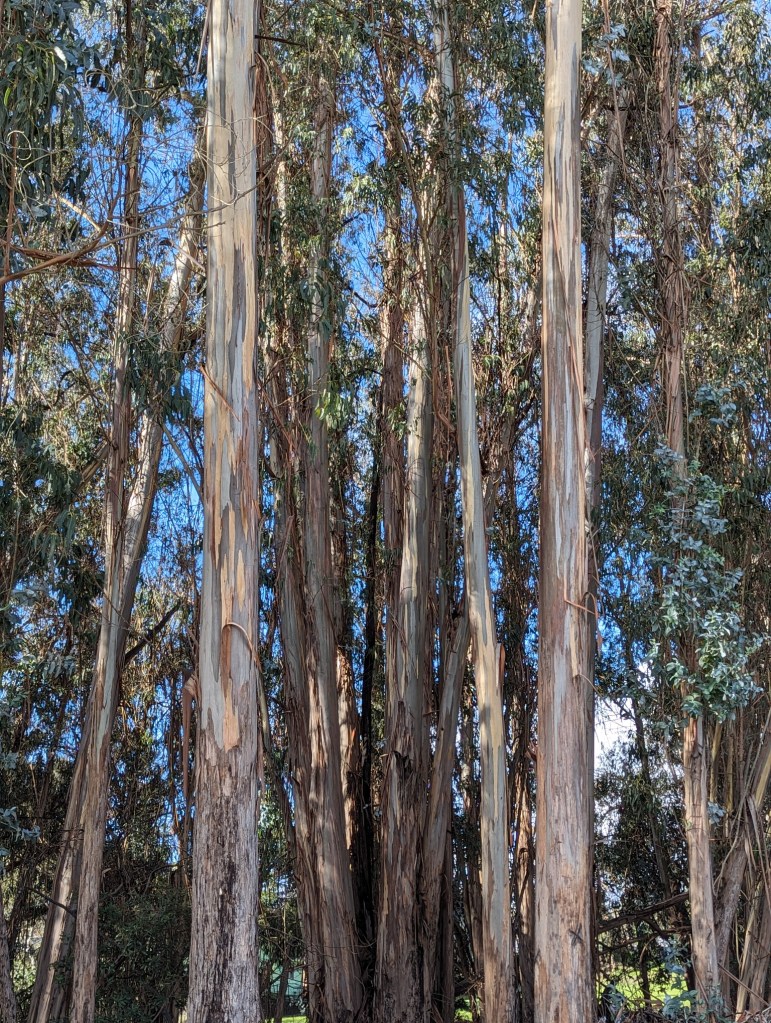
Almost no one adds blue gum, Eucalyptus globulus, to a landscape intentionally. Almost everyone who is familiar with it understands why. It is much too big and much too messy. Even where space is sufficient for it to mature, it is innately hazardous. It sheds big limbs from very high up. It often disperses its roots too shallowly to maintain adequate stability.

However, blue gum inhabits a few home gardens. Some were already there as gardens developed around them. Some grew from seed from nearby trees. Blue gum naturalizes in some regions. Mature trees are tall enough to share their shade, debris and seed with a few gardens. The copious debris inhibits weeds, but also inhibits desirable vegetation.

Blue gum in the wild is one of the tallest trees in the World. Naturalized trees commonly grow more than a hundred and fifty feet tall here. They stay shorter in windy situations. The tall and straight trunks constantly shed long strips of smooth tan bark. Fresher bark is tan, gray, greenish or even pinkish. The curved lanceolate leaves are quite aromatic. Ovoid juvenile leaves are bluish gray, and even more aromatic. Fuzzy staminate bloom is white.

Wind Is Messy And Hazardous

Trees lose limbs to strong wind.

Arborists become more popular after storms. That is when consequences of negligent tree maintenance become more apparent. Wind dislodges limbs and destabilizes whole trees. Unfortunately, the most diligent of tree maintenance can not prevent all damage. Trees and other vegetation are naturally vulnerable to frequently stormy winter weather.

Deciduous trees try to be less vulnerable to wind by defoliating prior to winter. Without foliage, they are less resistant to wind. In other words, they are more aerodynamic. Wind blows through them rather than against them. Some unfortunately defoliate slowly within the mild climate here. With such minor chill, some retain foliage until spring replacement.

For example, some sweetgum still retain much of their foliage. That is an advantage for the display of their autumn foliar color. It is a major disadvantage for their aerodynamics though. As a deciduous species, it does not expect to be so vulnerable to wind through wintry weather. What is worse is that sweetgum trees are innately structurally deficient.

Evergreen trees and other vegetation seem to be less concerned about wind. Actually, they merely employ different defensive tactics. Most cypress and some spruce are too dense and sturdy for wind to penetrate. Many pines develop sparse canopies that wind blows through. On the coast, coast live oak stays low and broad for wind to blow over.

Regardless of their efforts, trees of all sorts are vulnerable to damage from wind. Falling limbs or entire trees are very hazardous. Also, they can damage or destroy what they fall onto. That is why timely maintenance of trees is so very important. Any tree that becomes too hazardous to salvage necessitates removal. All trees eventually age and deteriorate.

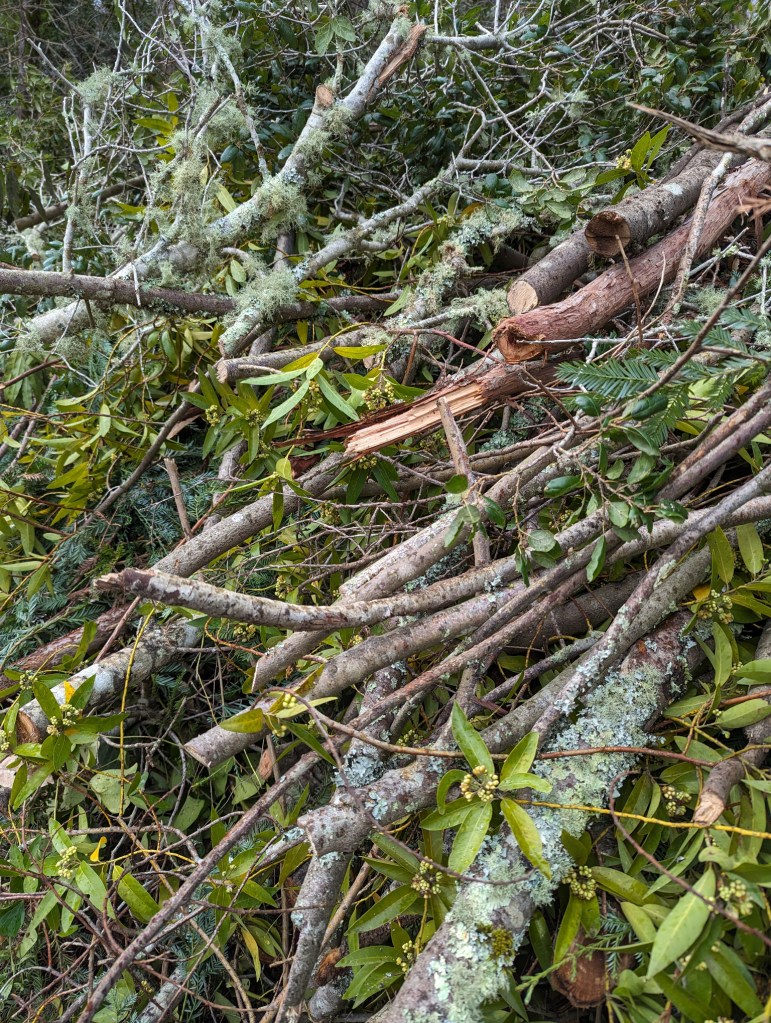
Also, all trees, as well as all other vegetation, are messy. Some are messier than others; and many get messier as a result of wind. Some of such mess clogs eavestroughs and downspouts when they are most helpful. Detritus fills curbside gutters also. Actually, it gets everywhere. Its removal will be easier between the windy storms that generate it.

Six on Saturday: Tree Circus

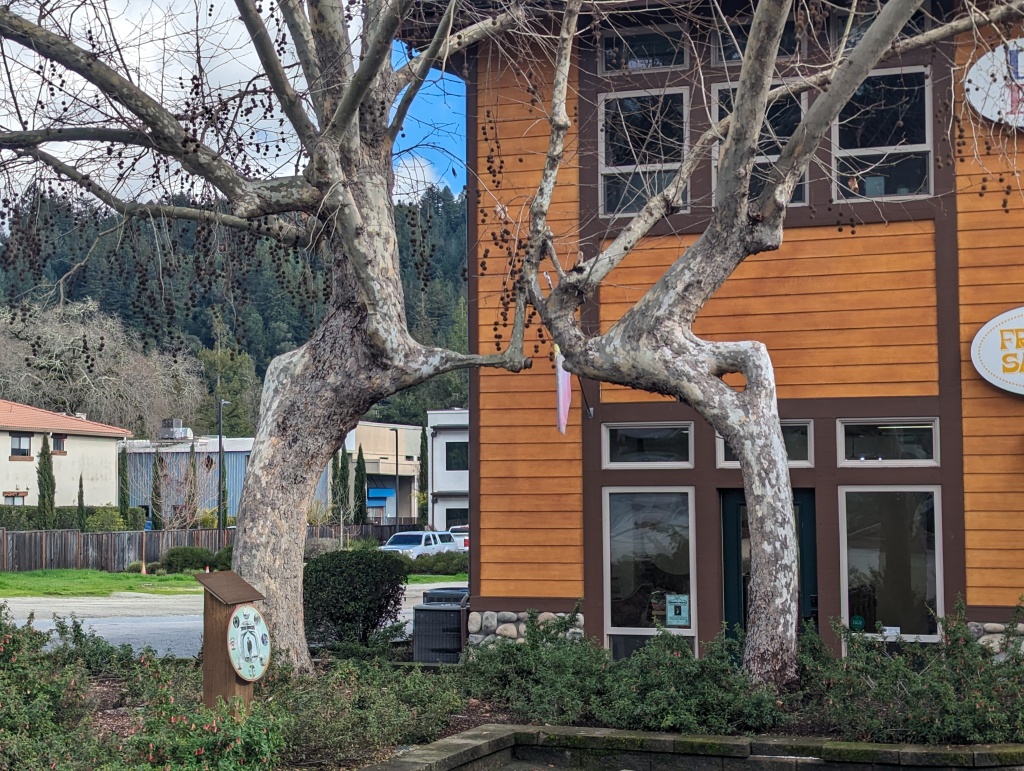
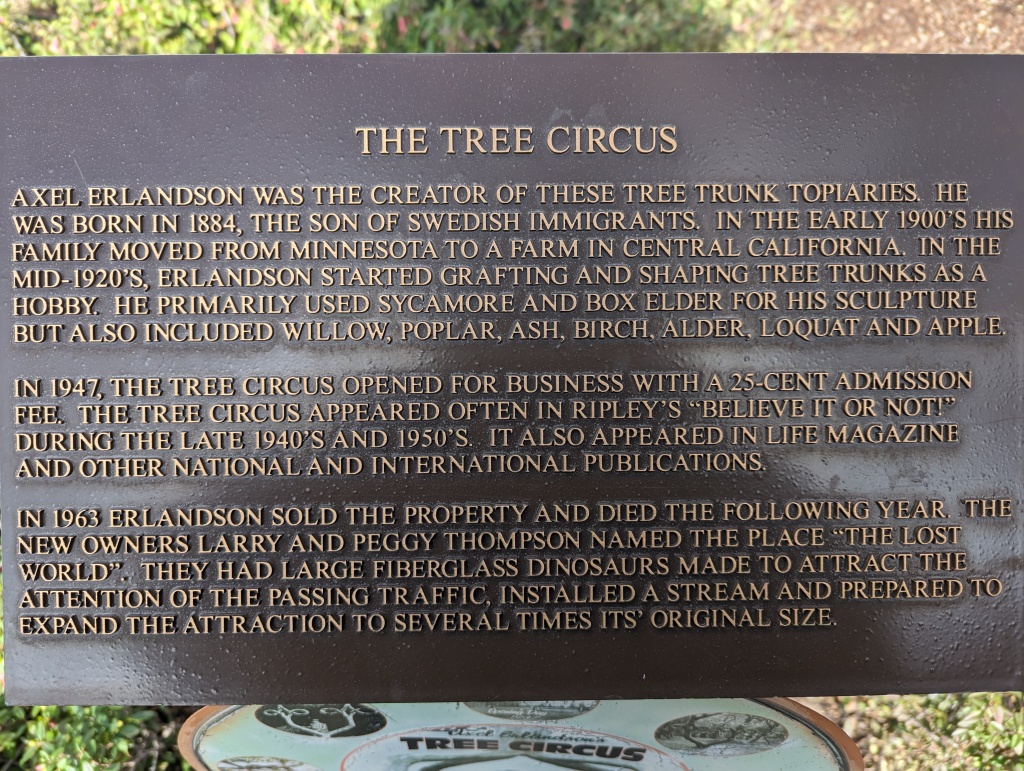
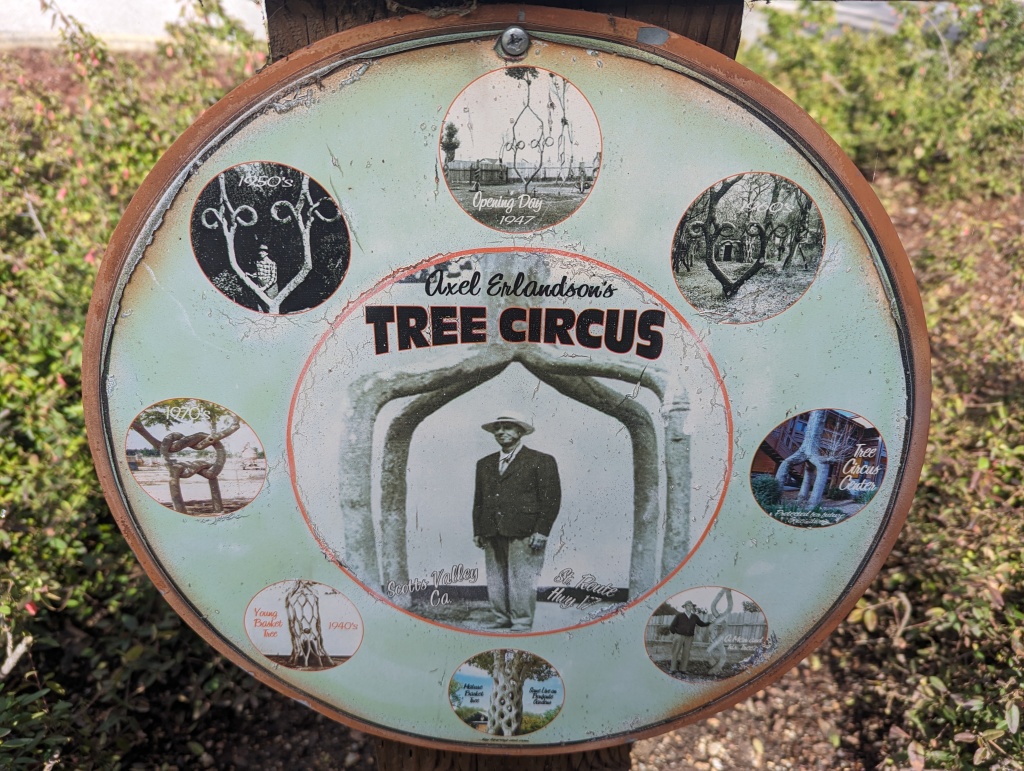
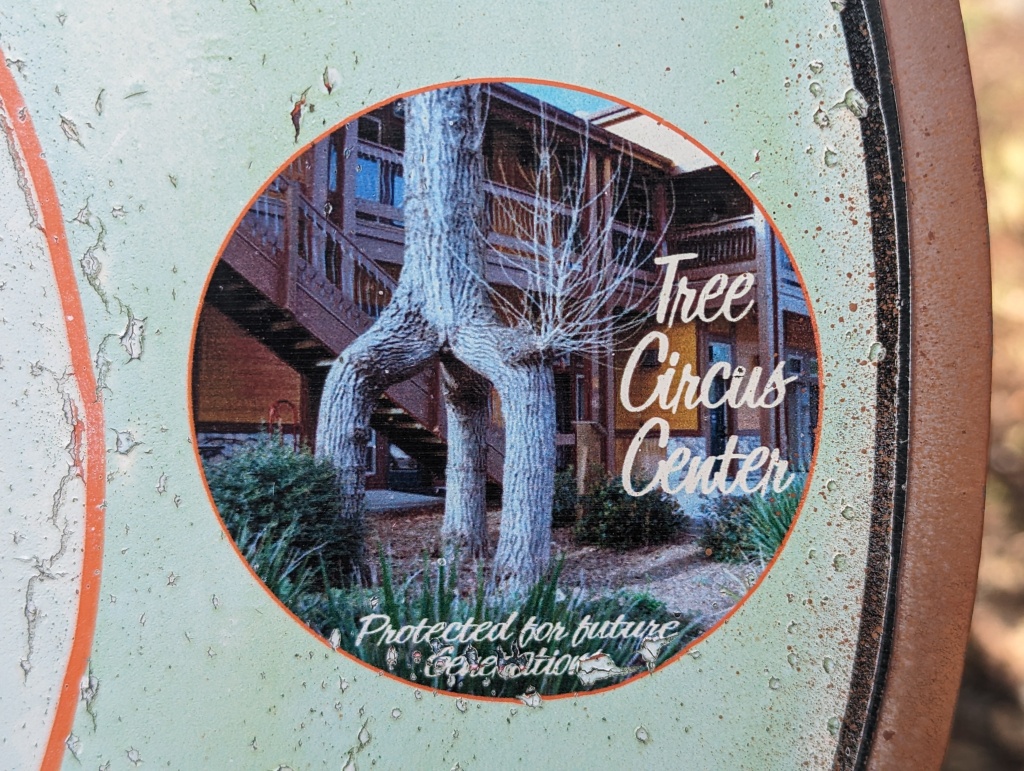
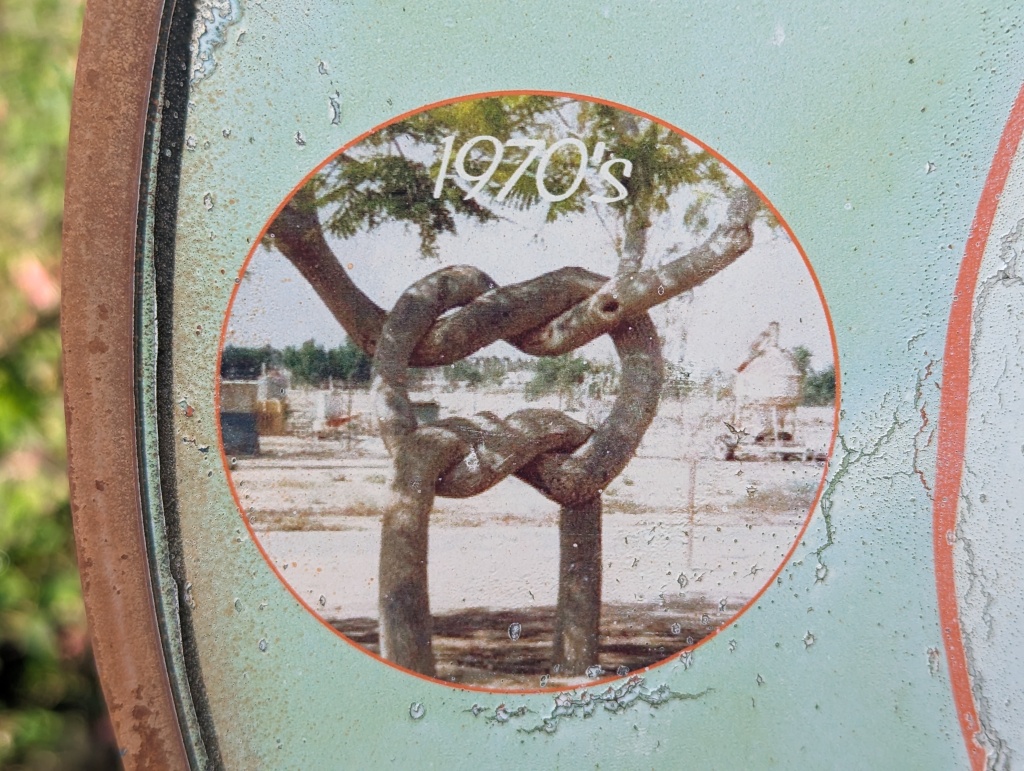
‘Crazy Great Ideas From Crazy Green Thumbs 6’ featured four sculptural tree specimens that had been relocated to Gilroy Gardens, which was formerly Bonfante Gardens, from the now defunct Lost World, which was formerly Tree Circus. While getting gasoline for Morgan in Scotts Valley, I stopped at the former site of Tree Circus for these six pictures. Not much remains to suggest that Tree Circus was ever there. Of these six pictures, only one shows real vegetation, which is a single London plane, Platanus X acerifolia, with a pair of trunks, which form an arch. (Incidentally, Crazy Green Thumbs sent me seed for poinciana and esperanza, which I featured for Six on Saturday almost two years earlier.)

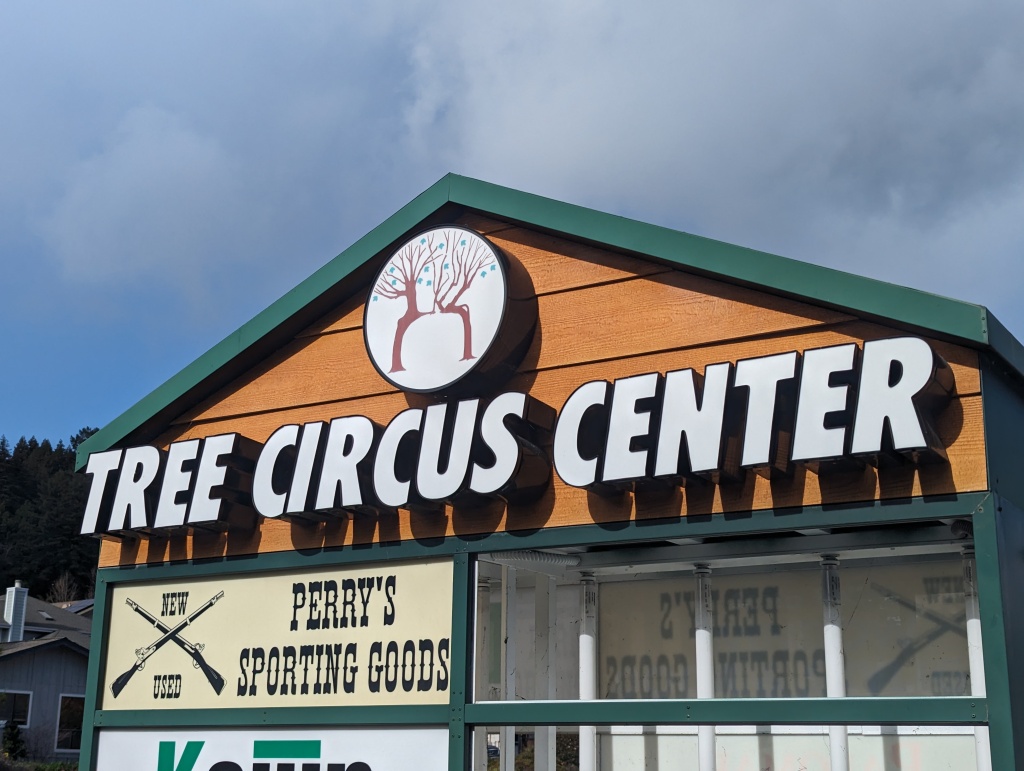
1. Tree Circus Center now occupies the former location of Tree Circus, and subsequently, the Lost World. Progress can be so trivializing. Notice the emblem at the top of this sign.

2. The emblem depicts this last tree of the Tree Circus, which was a pair of trees that got grafted together and separated and grafted together. Notice the plaques to the lower left.

3. This upper plaque very briefly explains the history of Tree Circus and the Lost World, although without mention of what happened afterwards. Notice the other plaque below.

4. This lower plaque features illustrations of a few of the many sculpted trees of the Tree Circus, although woefully weathered. Notice the illustrations to the far right and far left.

5. This illustration to the far right shows the only other tree of the Tree Circus to remain at the site, although it is now gone. Notice the caption, ‘Protected for future generations’.

6. This illustration to the far left shows one of the Tree Circus trees that was exhibited in the context of ‘Crazy Great Ideas From Crazy Green Thumbs 6’ by Crazy Green Thumbs.

This is the link for Six on Saturday, for anyone else who would like to participate: https://thepropagatorblog.wordpress.com/2017/09/18/six-on-saturday-a-participant-guide/

A Good Arborist Can Be Difficult To Find.

Some of the most avid garden enthusiasts need help with big trees.

            It was probably best that I was not here when it happened. Although, coming home to it was horrible nonetheless. This is the second major tragedy in my garden in only a few months. Last autumn, just before it could defoliate to be less susceptible to the wind, the most magnificent black oak in my garden was blown down. Now I find that the weather has again flaunted its ominous power by claiming the innocent life of the most glorious Douglas fir, and desecrating the shattered remains in the cold mud.

            How can this be?! I am an arborist! I am supposed to protect trees from such demise! Sadly, the truth is that the fir has been deteriorating for a long time before we became acquainted. There was nothing that I could have done for it. If the tree had been located where it could have been hazardous to anyone in the area, it would have needed to be removed.

            Hazardous trees innately become much more hazardous in stormy weather. Rain loosens their anchorage by softening the soil. Wind can either destabilize trees, or break their limbs away. Ideally, it is best to give trees the attention they need before the weather gets unpleasant. Realistically though, we do not often think about it while the weather is not so threatening.

            Now that the weather is reminding us of how important it is to take care of our trees, we should be certain to do so properly. Large trees may require procedures that we are unable to perform. When it becomes necessary to procure the services of tree maintenance professionals, it is imperative to find qualified arborists. (Arborists are horticulturists of trees.)

            Unfortunately, the arboricultural (tree maintenance) industries are infested with unqualified ‘hackers’ who can inflict serious damage. Real arborists are about as specialized as physicians are. Getting anyone else to assess trees is about a sensible as getting a cardiologist to do brain surgery. 

            Arborists inspect trees to identify hazards such as instability and structural deficiency, and then prescribe corrective procedures. Not everyone involved with the crew that performs any necessary procedures is a ‘certified’ arborist. The crew should though be directed by what an arborist prescribes. Sometimes, trees are found to be too hazardous to be salvaged, and will need to be removed.

            The website of the International Society of Arboriculture (ISA) at www.isaarbor.com is an excellent resource for finding local certified arborists. This site also features articles that explain in more detail than I did why it is so important to ‘hire an arborist’, as well as many other relevant topics. Perhaps just as importantly, it demonstrates how serious arborists are about arboriculture.

California Sycamore

California sycamore develops massively gnarly trunks.

The tallest, largest and oldest trees of the World are all native to California. So are the rarest pine, rarest fir and largest oak. California sycamore, Platanus racemosa, is loyal to this tradition of distinction. Although not the tallest sycamore, it might be the grandest. It develops gnarly and sculpturally irregular form. Some develop multiple massive trunks.

Because of its scale, California sycamore is uncommonly available from nurseries. It is simply not proportionate to home gardens or even big landscapes. Most old specimens are older than the landscapes around them. They are somewhat adaptable to landscape irrigation. However, increased moisture increases potential for spontaneous limb failure.

California sycamore can grow a hundred feet tall with bulky trunks and limbs. Old trees may exhibit scars from shedding limbs throughout their long lifespans. The mottled bark is gray and tan, and roughens only slowly with age. The deciduous foliage of such large trees is very copious through a long defoliation. Foliar tomentum (fuzz) is quite irritating.