California Black Oak

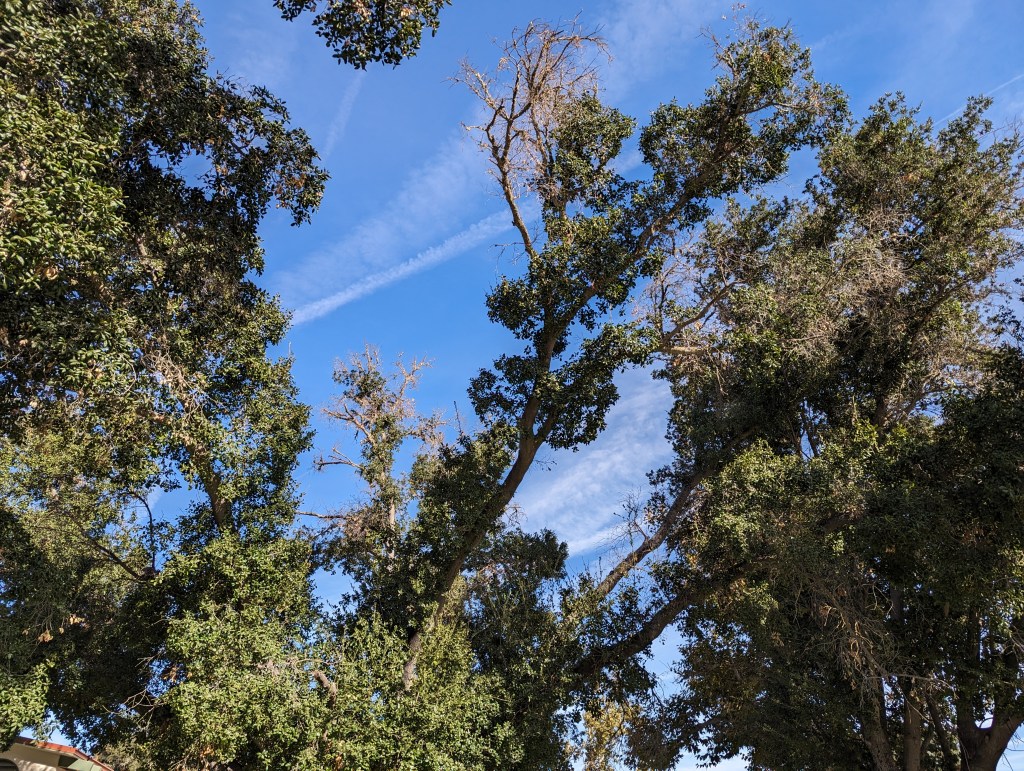
California black oak defoliates through autumn.

Only a few counties within California lack native California black oak, Quercus kelloggii. Yet, it is not prominent where it is native locally. It generally inhabits mixed forests within the Coastal Ranges. It is rare among home gardens, and rarely available from nurseries. Within the Sierra Nevada, it is common enough to be harvestable as a hardwood timber.

With good exposure, mature California black oaks may get no taller than thirty feet. They can get twice as tall where they must compete with tall trees. The largest trees are higher than a hundred feet. Their elegantly upright trunks are generally less bulky than those of other oaks. Few are more than four feet wide. Gray bark darkens and roughens with age.

The deciduous foliage of California black oak is almost brownish drab green. It becomes brownish yellow prior to defoliation. Cooler weather enhances brighter yellow or orange color, but also accelerates defoliation. Foliage can linger into winter with milder weather. The handsomely lobed leaves are about four inches long, and bigger on vigorous stems. The docile roots are vulnerable to rot with frequent watering.

Horridculture – Bay

Umbellularia californica is NOT Laurus nobilis.

Bay grows wild here. It is native. It is also known as bay tree, laurel, bay laurel, spice tree, pepperwood, myrtlewood, Pacific myrtle, Oregon myrtle and California bay. All these different common names demonstrate why simple botanical nomenclature is useful. In that regard, this native bay is Umbellularia californica.

Bay is also native to the Mediterranean region. Of course, it is a different species, Laurus nobilis. Like the bay that is native here, it is also known as bay tree, laurel and bay laurel. Furthermore, it is known as Grecian bay, true laurel and sweet bay, although it is not at all sweet.

Laurus nobilis is a common culinary herb though. Umbellularia californica is not. That does not mean that Umbellularia californica can not be useful as such. It merely means that it is not commonly used as such, and is very different from the bay that genuinely is. Some of us here in California and southwestern Oregon actually do sometimes find culinary applications for it.

Umbellularia california has a much more pungent and stronger flavor than Laurus nobilis. Although it has potential to be useful for similar applications, it is by no means a substitute, and should certainly not be used in comparable proportions. Most of us who use it are aware of the differences, and know how to use it, generally quite sparingly.

The problem is that fresh foliage of Umbellularia californica is sometimes available as culinary bay from supermarkets, and is typically labeled as sweet bay, true laurel or Grecian bay. This is no problem for those of us who recognize it, but we would not purchase it from a market while we can get it for free from the wild. Those who purchase it likely do so because they believe that it is genuine Laurus nobilis.

Horridculture – New Lawn for Old Trees

These mature oaks can not adapt to the irrigation that the new lawn requires.

Californian climates are impressively diverse. However, most climates here are chaparral or desert climates, or similar to such climates. That means that almost all rain occurs during the rainy winter season, and that almost no rain occurs during the dry summer season. Vegetation that is native to California is very familiar with the climates here. Therefore, it does not expect rain during summer. This should be obvious.

Some native species can adapt to irrigation during summer. Some may grow faster than they normally would without irrigation, but compromise their natural life span in the process. This is acceptable within some landscapes. Many riparian species are not bothered by irrigation.

However, some species adapt less efficiently. Some do not adapt at all. Some that can adapt while young can not do so while mature. Oaks are a common example of this.

These coast live oaks with a few blue oaks were installed as shade trees within a formerly minimalistic landscape that did not include turf. They were happy with annual rainfall for half a century or so. Then, this generously irrigated lawn was installed around them. They can not adapt to the frequent irritation that the lawn requires. Their roots are succumbing to decay, so will eventually be unable to sustain their foliar canopies. As they deteriorate, decay may eventually compromise their structural integrity and stability. Dieback is already evident within their upper canopies, with lower watersprouts attempting to compensate.

I suspect that the trees will be removed before they deteriorate enough to become hazardous. I also suspect that new trees will systematically replace them prior to their systematic removal. Their eventual demise is likely an acceptable loss, and perhaps expected. Turf with adapted shade trees is likely more important within this particular situation than preservation of these middle aged oaks.

Dieback is evident within the upper canopy. Watersprouts are evident with the lower canopy.

Big Leaf Maple

The sugaring maple of the West!

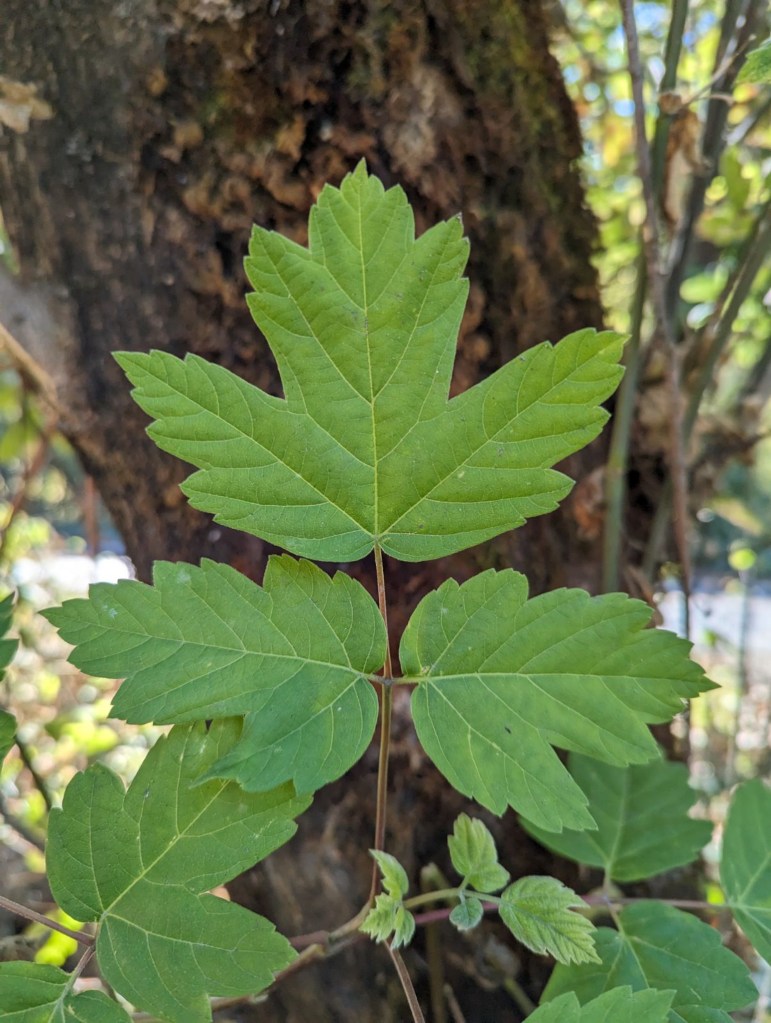
Maple sugar production has not always been exclusive to northeastern North America. In fact, it is not exclusive to sugar maple. Big leaf maple, Acer macrophyllum, also provides maple sugar in British Columbia. It is native from the southern extremity of Alaska to San Diego County. Most of its range is generally coastal but also includes the Sierra Nevada.

Bigleaf maple is one of merely two native maples here. It is more common within riparian ecosystems and at higher elevations. However, it is rare among home gardens because it is so vigorous and grand. Its aggressive roots eventually buttress, and are likely to ruin lawns and pavement. Autumn defoliation of big trees releases big volumes of big leaves.

Bigleaf maple can grow almost fifty feet tall and wide within sunny suburban landscapes. It can grow a hundred feet taller where it competes for sunshine within coastal forests! Its palmately lobed leaves are typically wider than six inches. They can be twice as wide on vigorous stems. Foliage turns yellow for autumn. Seedlings might be annoyingly prolific. Local climate is unfortunately not conducive to practical sugar collection and refinement.

Wood Still Warms Many Homes

Trees recycle quite naturally into fuel.

Fireplaces and wood stoves are not completely obsolete. They are merely less common than they were years ago. Modern building codes prohibit them within new construction. For some that incur damage from earthquakes, removal is more practical than repair. Not many people use fireplaces and wood stoves nowadays anyway. Nonetheless, a few do.

Sources of firewood have also changed. Displacement of orchards and forests by urban developments had been reliable sources. Such orchards are now gone. Forests are now farther away, and protected from harvest. Instead, most wood fuel is now obtainable from the tree service industry. Scrap from tree maintenance and removal converts to firewood.

Unlike uniform firewood from former orchards, scrap wood is variable. Orchards produce only one type of firewood from their unvaried trees. Firewood from forests involves only a few species that may remain separate for sale. Scrap wood can include any species that a particular tree service encounters. Except for larger volumes, separation is impractical.

The tree service industry provides less firewood than displaced orchards and forests did. However, nowadays, less firewood is necessary. There are many more homes here than years ago, but very few consume wood for heat. Residents who choose to burn firewood are now generally less selective. Yet, some might separate mixed firewoods accordingly.

Tree services prefer to leave firewood where it lands. They charge for removal of excess firewood. They typically cut logs to firewood lengths, but do not split them. Neighbors are therefore sometimes pleased to share wood from removed trees. Tree services sell wood that they must remove, after splitting and seasoning it. They typically charge for delivery.

Firewood for this winter must have seasoned by now. Most types should have sufficiently seasoned if cut and split before last spring. Fresh firewood can not season so late during increasingly cool and damp weather. Scrap from winter pruning can become firewood for next winter. Palms and other monocots do not produce actual wood that burns efficiently.

Box Elder

Box elder leaves are pinnately compound.

Leaves of three, leave it be, unless one can see that it is a box elder tree, Acer negundo. This is the most common of the North American maples. It is native to all American states except for only Alaska and Hawaii. Yet, it is also unique as the only maple with pinnately compound leaves. Typical leaves have three leaflets, but might have as many as seven. A few rare maples have palmately compound leaves.

Although common in the wild, box elder is rare within refined landscapes. It grows fast to about forty feet tall, but does not live for much more than fifty years. It typically develops a few plump trunks with casually irregular form. Unfortunately though, such form becomes structurally deficient with age. Autumn foliar color is unremarkable yellow or brown here.

However, a few garden cultivars display distinctly colorful foliage for spring. ‘Flamingo’ is the most popular cultivar. Pink variegation of new spring growth fades to white. ‘Auratum’ displays bright yellow new growth. ‘Violaceum’ displays smoky blushed new foliage with purplish red floral tassels. After pollarding, such cultivars are more compact and colorful, but lack floral tassels.

Ginkgo

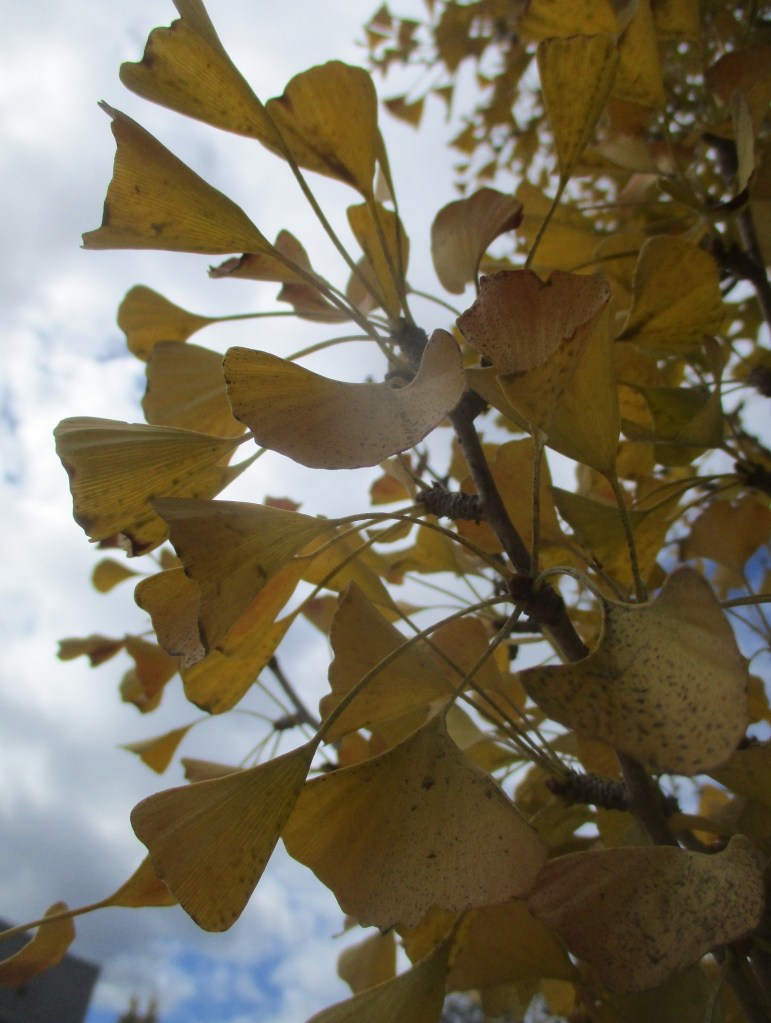
Ginkgo tree develops brilliant yellow color.

Minimal chill is sufficient for ginkgo, Ginkgo biloba, to develop brilliant yellow foliar color. Mild weather actually enhances retention of foliage after it colors. Colder weather or frost accelerates efficient defoliation. Although less messy, it ruins the spectacular display too soon. Autumn foliar color is monochromatically yellow, but is the best yellow of autumn.

Some old ginkgo trees produce messy fruit with objectionable aroma. This characteristic limited their practicality and popularity. Modern cultivars, though, are male and therefore fruitless. Female cultivars are very rarely available, and mostly only by online purchase. Their fruit and the nuts within are edible. However, only mature trees can be productive.

Ginkgo trees grow somewhat slowly, but can eventually get taller than fifty feet. Modern cultivars are rather slender and perhaps lanky while young. They retain their elegantly irregular structure as they broaden with maturity. Leaves are about two or three inches long. Their venation radiates outward from their petioles, like fishtails, with paired lobes.

King Palm

King palm prefers frostless climates of Southern California.

Where it grows wild in rain forests of eastern Australia, the piccabeen or bangalow palm, Archontophoenix cunninghamiana, is a strikingly elegant tree that gets to about fifty feet tall on a clean, slender trunk. The six to ten foot long feather fronds (pinnate leaves) form a light but distinctive canopy about ten to fifteen feet broad. Smooth green petioles (leaf stalks) encase the upper few feet of crownshaft, eventually peeling away cleanly to reveal the smooth trunk as it grows below. A juvenile king palm does not bloom, but eventually flaunts adulthood with softly pendulous ‘graduation’ tassels of profuse but tiny purple tinged white flowers.

Locally, this palm is known more commonly as the king palm, and does best as a large houseplant or where it is protected from frost. Outdoors, it seem to be happiest close to the San Francisco Bay where it is somewhat insulated by all the water, but can unfortunately get smacked about by the wind there. A mature tree is somewhat more tolerant to frost than a young tree is, but can be damaged or even killed if it gets cold enough.

King palm fortunately does well in the partial shade of larger adjacent trees or buildings that might shelter it from frost. However, it can not be pruned down for clearance from higher trees, ceilings or any other overhead obstruction (including utility cables), so should be planted where it has plenty of room to grow vertically, or where no one will mind it getting removed when it gets too tall after many years.

Unlike most other palms, king palm does not transplant easily when mature. It has no problem getting planted from a pot to a larger tub or planter, or into the ground. Once in the ground though, it is there to stay.

Canary Island Date Palm

Canary Island date palm is the boldest of the common palms here.

The biggest and boldest of the common palms is the Canary Island date palm, Phoenix canariensis, which can get more than sixty feet tall and nearly forty feet wide, with a full canopy of gracefully arching deep green fronds. A young tree actually spends the first many years as a shrubby plant while the base of the trunk develops. Fronds get longer and spread broader every year until the trunk gets big enough to elongate. Vertical growth then accelerates somewhat, but the canopy gets no broader.

Most trees are female, eventually producing ornately orange but messy clusters of inedible dates. Male trees eventually get a bit taller, but are not quite as graceful and bloom with unimpressive dusty tan flowers.

Old deteriorating fronds need to be pruned away close to the trunk. Petiole bases of the most recently removed fronds are often carved into ‘pineapples’ to leave a bit of support directly below the canopy. Removed fronds leave a distinctive pattern on the trunk.

Palms Are A Californian Tradition

Mexican fan palm might still be the most common palm here, but is not native.

Only a few of the  many different palms that can be grown locally are actually common. The Canary island date palm and the Mexican fan palm, which had historically been the most common palms, have unfortunately given palms a bad reputation. Both get too large for small gardens, and need costly maintenance when they grow out of reach.

Since the late 1980s, the formerly uncommon queen palm has become the most common palm. Although it too eventually grows beyond reach, it is still more proportionate to home gardens while young. It has a relatively narrow trunk that is partially ‘self-cleaning’ (which means that old fronds, or leaves, often fall off or can be easily peeled off).

The windmill palm and the Mediterranean fan palm, although no more common now than a century ago, are two of the better palms for home gardens, since they do not get too large, and are somewhat easy to maintain. The Mediterranean fan palm has several sculptural trunks that curve out randomly from the base. Sharp teeth on their petioles make pruning a challenge, but not impossible.

The windmill palm has a straight solitary trunk that is distinctively hairy where old fronds get pruned away. It eventually grows out of reach, but takes many years to do so. By that time, many people allow beards of old fronds to accumulate on the trunks overhead instead of bothering to keep them pruned.

The desert fan palm, which is the only palm that is native to California, is very similar to the Mexican fan palm, but is about twice as stout and half as tall, with a fluffier canopy. Because it grows slower and stays smaller, it would be a better palm for urban gardens, except that it does not like to be watered regularly when mature. It really prefers warmer and drier climates.

Pindo palm and Mexican blue palm would also be great palms for urban gardens, but grow rather slowly before getting big enough to get noticed. In some climates, pindo palm produces strange and messy, but sweet and tasty fruit. Mexican blue palm is one of the most resilient palms, and blooms with really cool long floral tassels that a can drag on the ground from short trees.

‘Feather’ palms, like Canary Island date palm, queen palm and pindo palm, have pinnate (and generally compound) leaves, with small leaflets arranged on solitary midribs. Their fronds must be removed as they deteriorate.

‘Fan’ palms, like Mexican fan palm, Desert fan palm and windmill palm, have palmate leaves, centered around the distal termini of solitary petioles. These are most often pruned away, leaving distinctive patterns of petiole bases, but can alternatively be left to accumulate into thick beards of thatch.

Mexican fan palms are sometimes ‘shaven’ of their petiole bases to expose elegant lean trunks, although the procedure is intensive and expensive. Desert fan palms and some Mexican fan palms drop their own beards naturally.