Canary Island date palm is the boldest of the common palms here.
The biggest and boldest of the common palms is the Canary Island date palm, Phoenix canariensis, which can get more than sixty feet tall and nearly forty feet wide, with a full canopy of gracefully arching deep green fronds. A young tree actually spends the first many years as a shrubby plant while the base of the trunk develops. Fronds get longer and spread broader every year until the trunk gets big enough to elongate. Vertical growth then accelerates somewhat, but the canopy gets no broader.
Most trees are female, eventually producing ornately orange but messy clusters of inedible dates. Male trees eventually get a bit taller, but are not quite as graceful and bloom with unimpressive dusty tan flowers.
Old deteriorating fronds need to be pruned away close to the trunk. Petiole bases of the most recently removed fronds are often carved into ‘pineapples’ to leave a bit of support directly below the canopy. Removed fronds leave a distinctive pattern on the trunk.
Mexican fan palm might still be the most common palm here, but is not native.
Only a few of the many different palms that can be grown locally are actually common. The Canary island date palm and the Mexican fan palm, which had historically been the most common palms, have unfortunately given palms a bad reputation. Both get too large for small gardens, and need costly maintenance when they grow out of reach.
Since the late 1980s, the formerly uncommon queen palm has become the most common palm. Although it too eventually grows beyond reach, it is still more proportionate to home gardens while young. It has a relatively narrow trunk that is partially ‘self-cleaning’ (which means that old fronds, or leaves, often fall off or can be easily peeled off).
The windmill palm and the Mediterranean fan palm, although no more common now than a century ago, are two of the better palms for home gardens, since they do not get too large, and are somewhat easy to maintain. The Mediterranean fan palm has several sculptural trunks that curve out randomly from the base. Sharp teeth on their petioles make pruning a challenge, but not impossible.
The windmill palm has a straight solitary trunk that is distinctively hairy where old fronds get pruned away. It eventually grows out of reach, but takes many years to do so. By that time, many people allow beards of old fronds to accumulate on the trunks overhead instead of bothering to keep them pruned.
The desert fan palm, which is the only palm that is native to California, is very similar to the Mexican fan palm, but is about twice as stout and half as tall, with a fluffier canopy. Because it grows slower and stays smaller, it would be a better palm for urban gardens, except that it does not like to be watered regularly when mature. It really prefers warmer and drier climates.
Pindo palm and Mexican blue palm would also be great palms for urban gardens, but grow rather slowly before getting big enough to get noticed. In some climates, pindo palm produces strange and messy, but sweet and tasty fruit. Mexican blue palm is one of the most resilient palms, and blooms with really cool long floral tassels that a can drag on the ground from short trees.
‘Feather’ palms, like Canary Island date palm, queen palm and pindo palm, have pinnate (and generally compound) leaves, with small leaflets arranged on solitary midribs. Their fronds must be removed as they deteriorate.
‘Fan’ palms, like Mexican fan palm, Desert fan palm and windmill palm, have palmate leaves, centered around the distal termini of solitary petioles. These are most often pruned away, leaving distinctive patterns of petiole bases, but can alternatively be left to accumulate into thick beards of thatch.
Mexican fan palms are sometimes ‘shaven’ of their petiole bases to expose elegant lean trunks, although the procedure is intensive and expensive. Desert fan palms and some Mexican fan palms drop their own beards naturally.
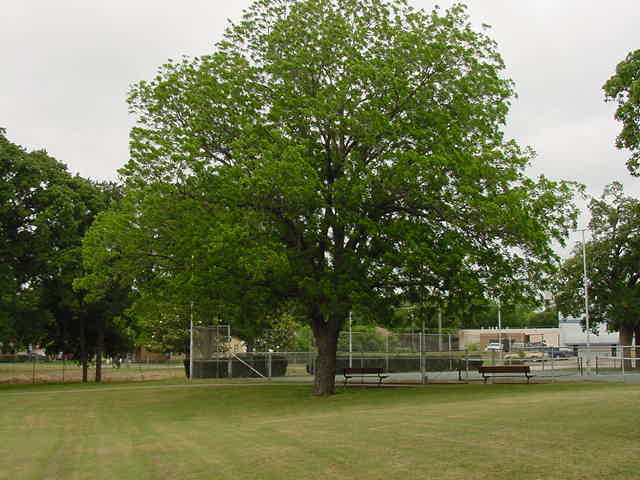
Texas selected a distinctive state tree; the pecan, Carya illinoensis. It is happy in the south and middle mid-west, where naturally grows about seventy feet tall. It can get almost as large here, so is best in big spaces. Summers are a bit too mild for reliable nut production in autumn, but single trees can sometimes make plenty. Two different trees (to pollinate each other) can actually be quite productive, although not quite as well flavored as in warmer climates. The pinnately compound leaves have about eleven individual leaflets that are about five or six inches long. Shade is not too dark.
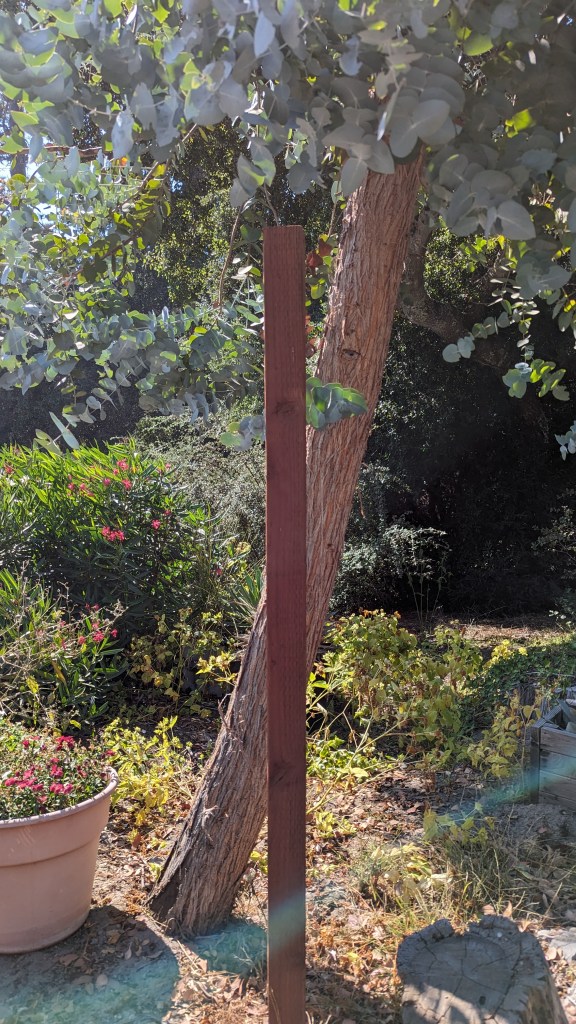
The vertical post demonstrates how much the tree trunk leans.
A few tree species should’ve had a V8. That includes more than a few individual trees. It applies to enough individuals of a species to indicate that the need is almost typical of the particular species.
The need for a V8 is derived from old advertisements for the V8 beverage that depicted those who were deficient in adequate consumption of V8 as leaning prominently. V8 is a juice beverage that is composed of juices of eight vegetables; tomatoes, carrots, celery, beets, parsley, lettuce, watercress and spinach. Hence, V8. It balances a diet so that those who consume it stand upright rather than lean.
In horticultural slang, the need for a V8 refers to a leaning trunk.
Any tree of any species has potential to develop a leaning trunk, and consequently appear to be in need of a V8. Some species innately develop leaning trunks though. No one seems to know why, but specimens of such species with vertical trunks are oddly uncommon or perhaps rare.
For example, so many ginkgo trees lean at such similar angles that, among some groups, their distinctive lean seems to be a normal characteristic of the species. It is variable though. Many individual trees that are isolated from others are quite vertical. So are some groups of street trees. However, many or most specimens of other groups of street trees lean at very similar angles, although in random directions.
Italian stone pines are more likely to lean, also at relatively similar angles, and also in random directions. Locally, vertical trunks are rare among this species. However, within their native range, vertical trunks are typical.
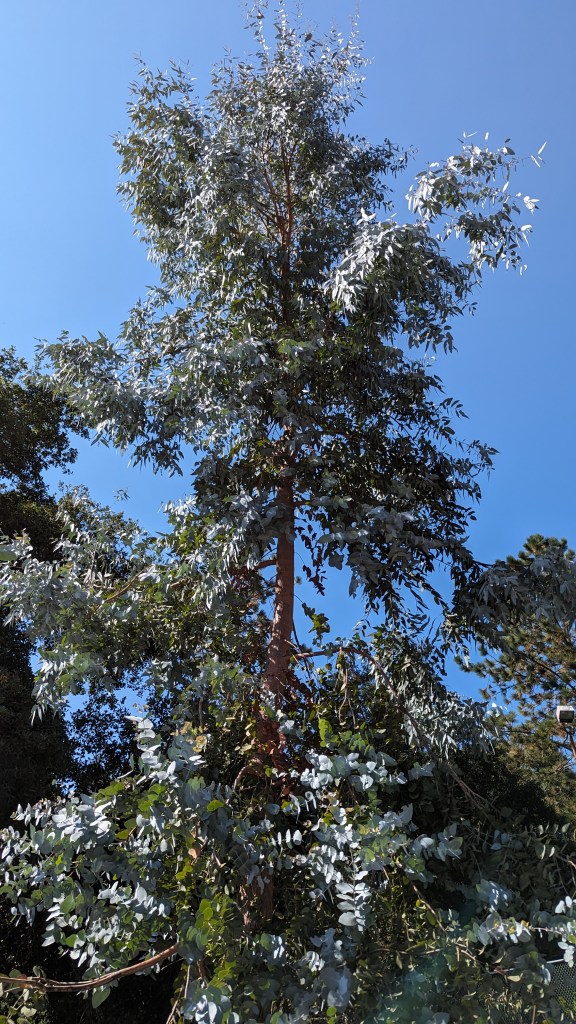
Argyle apple (eucalyptus) is almost comparable to Italian stone pine in regard to its typical need for a v8. I have seen a few with vertical trunks. I was determined for ours to be among them. I bound the trunk to keep it straight as it grew. I installed it with the trunk as vertical as the sign post next to it. When wind caused it to lean slightly while it was smaller than it is now, I pushed it back into position. Actually, I might have done that a few time. However, as it matured, it became more difficult to push back into position. Eventually, it refused to budge from its leaning position. Now, like most of the species, this specimen also seems to be in need of a V8.
After the base of the trunk insisted on leaning, the upper portion of the trunk assumed vertical posture.
Mexican fan palm is the most familiar palm of California.
It does not take long for Mexican fan palm, Washingtonia robusta, to get too big for most of the spaces it so often self sows its abundant seed into. The attractive lush foliage looks innocent enough, although the long petioles (leaf stalks) have nasty teeth. As trees get tall enough to get out of the way, they also get too big to manage, eventually reaching a hundred feet tall on elegantly curving trunks. No matter how tall they get though, their canopies always stay about eight feet wide. The problem is that the maintenance of such tall and aggressive trees can be costly.
Beards of old leaves can be allowed to accumulate on the trunks, but are combustible and can get infested with rats. Old leaves are more often pruned off, leaving a distinctive pattern of petiole bases. Old leaves can alternatively be ‘shaven’ to expose elegant bare trunks.
Red gum eucalyptus is notably drought tolerant. Apparently, it can also temporarily tolerate saturation.
Although not quite as aggressive, sloppy, big or structurally deficient as the notorious blue-gum eucalyptus, the red-gum eucalyptus, Eucalyptus camadulensis, is one of the ‘other’ eucalyptus that give eucalyptus a bad reputation. It is realistically too big and messy for refined urban gardens, and can be combustible if overgrown or too abundant. It is consequently probably not available in nurseries, despite being one of the most common species of eucalyptus (second only to blue-gum) in California. Red-gum eucalyptus has the advantage of being one of the most resilient large scale trees for unrefined or semi-wild landscapes, and works well where it has space to grow in many of the local county parks.
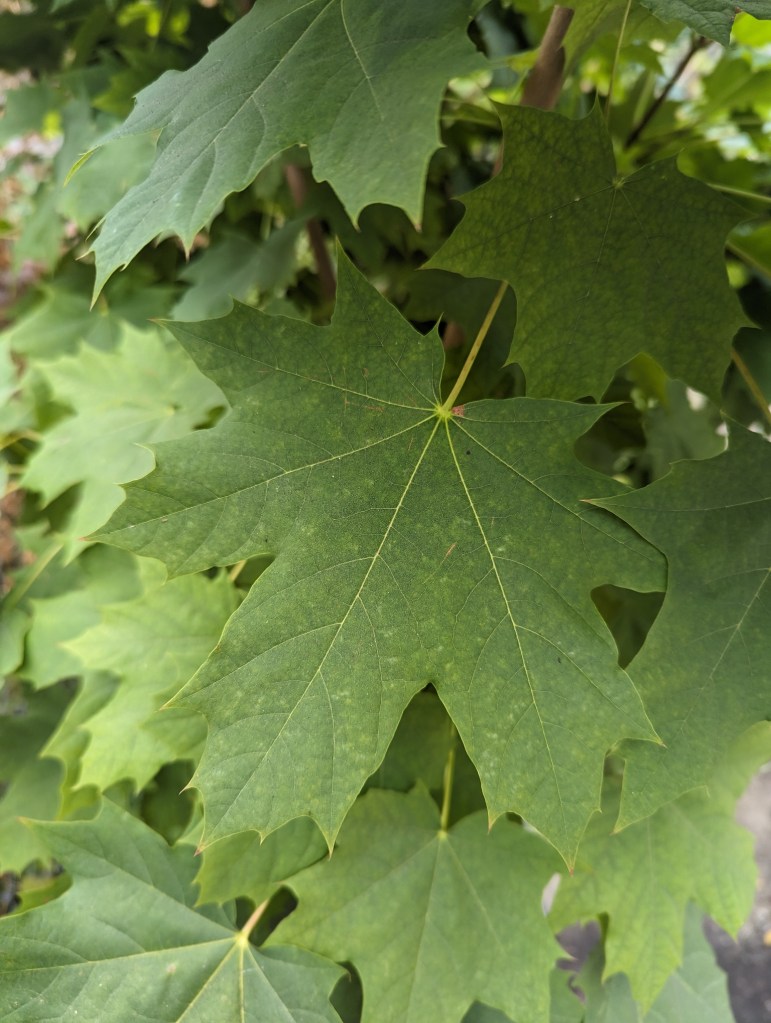
The botanical name of Norway maple, Acer platanoides, means ‘maple like a sycamore’. It resembles Platanus X acerifolia, which means ‘sycamore with maple foliage’. Platanus X acerifolia is London plane (‘sycamore’), which serves similar purposes. Norway maple lacks the irritating foliar tomentum of London plane. It has more aggressive roots though.
Norway maple was likely never a fad, but was common as a street tree during the 1950s. It naturalized as in invasive exotic species in parts of the Pacific Northwest. It is not such a nuisance locally. Most domestic trees are sterile or almost sterile cultivars. If their roots were more complaisant, they could have been ideal street trees. Their shade is splendid.
‘Schwedleri’, with bronzed foliage, was likely the most popular cultivar originally. Modern cultivars are darker bronze, golden, variegated or simple green. Their deciduous foliage is not so impressive for autumn though. It turns somewhat brownish yellow. The palmate leaves are about five to nine inches wide. Defoliation is efficient. Refoliation is quite late. Not many Norway maples get more than forty feet tall within the mild climates here.
This picture is from my Six on Saturday post for this morning.
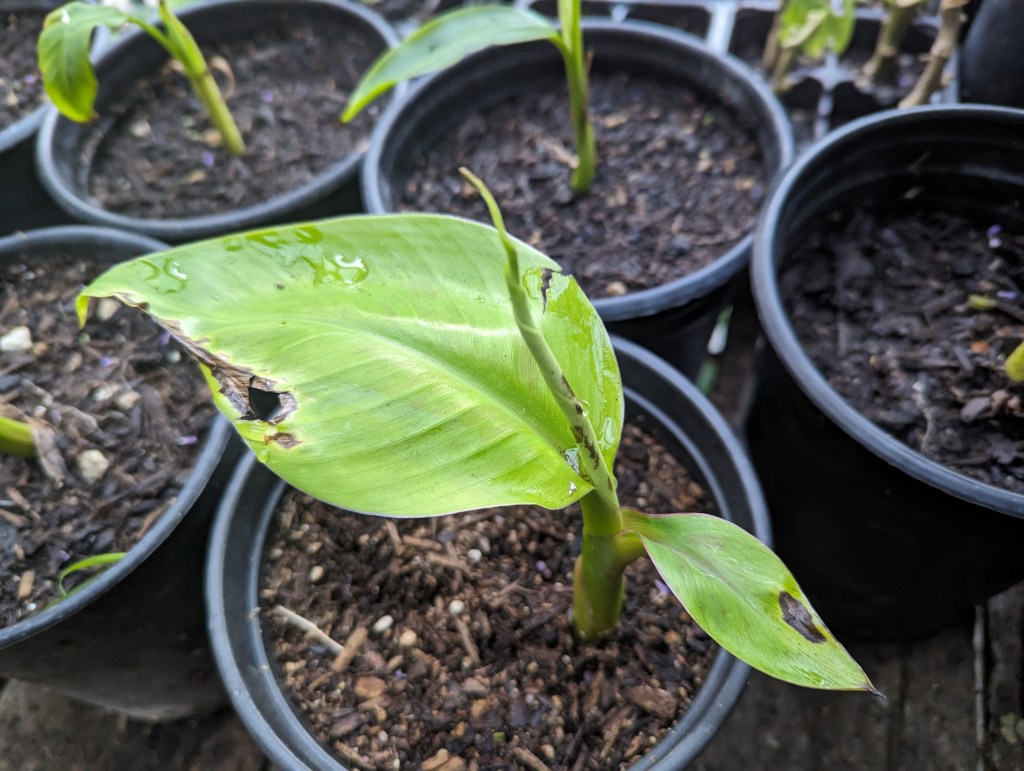
Its name is so minimalistic and blunt in the language of the indigenous people who are most familiar with it. Others might know it as the giant highland banana. It seems to me that most of us who find it to be of interest know it by its botanical name of Musa ingens.
Oem, or giant highland banana, or Musa ingens, is native to the tropical montane forests of New Guinea. Because it is endemic to high elevations, it does not perform so well in the sort of continually hot and humid tropical climates that most other species of banana enjoy. It actually prefers the weather to get somewhat cool at night. Therefore, it is more likely to be happier here than in Southern Florida, Hawaii or coastal San Diego County.
Not many horticultural enthusiasts grow it anyway. Actually, I do not know of anyone else who grows it. I have seen only a few comments online regarding germination of the very rare and expensive seed. Furthermore, no one seems to be successful with germination. This particular species does not generate pups as readily as other species of the genus, and even if it did, there are no established specimens from which to procure such pups.
However, its lack of popularity is less likely a result of its rarity and difficulty to propagate, but more likely because of its massive scale. In the wild, oem can grow to a hundred feet tall! It may be limited to about half as tall within cultivation, and without competition from other tall trees, but that is nonetheless a potential to get fifty feet tall! That may not seem like much relative to other trees, particularly the redwoods that are more than a hundred feet tall, with potential to get three times as tall. The concern is that banana trees are not actually trees. They are merely humongous perennials. Their pseudostems do not grow for very long before they begin to deteriorate and collapse. Pseudostems of smaller sorts may complete the process within two years, but are easily removed afterwards. Fifty foot tall pseudostems take significantly more time to mature and then deteriorate, but are not so easily removed from refined landscapes. Arborists can not climb them to cut them into sections. They require space to fall harmlessly. They are full of water, so are very heavy.
Now, oem lives here. It is merely a single dinky pup, but grows very efficiently. I have no idea of what to do with it. It can likely stay canned through this year, but may need to go into the ground next year. Not only does it need plenty of space, but it does not conform to the styles of any of the landscapes here. Consequently, it might eventually inhabit my home garden, regardless of its awkward appearance. This will likely get very interesting.
Property management pays landscape service companies to maintain their landscapes for them. It is expensive. It is certainly fiscally adequate to justify the expectation that this sort of damage would not occur within the landscapes that property management pays landscape service companies to maintain. Now that it did occur, it should be remedied as efficiently as possible by the landscape service company that is justifiably expected to both prevent such damage, and remedy such damage if it occurs. This should not be a complicated concept.
Realistically, this is likely not as egregious as it seems to be. Automated irrigation was likely disabled through the rainy season last winter. It might have been enabled a bit too late into the dry season that began last spring. Hey, it happens. The upper stems of the subject succumbed to desiccation, likely as a result of warm and arid weather. Now that the automated irrigation has been restored, the subject is now attempting to recover from the damage by generating healthy and vigorous new growth relatively low within its canopy. Upper necrosis might remain only because the gardeners are prohibited by their insurance to perform any tasks above a particular height, even with a pole pruner instead of a ladder, and the necrosis is simply too high for them to engage. That task must instead, and perhaps more appropriately, be performed by an arborist. However, the arborist who typically maintains the trees at this particular property would need to charge an expensive minimal fee for this relatively minimal task. It would be more feasible to postpone the task until there is a need for more substantial arboricultural work. The arborist could remove necrosis from this subject within a few minutes, and without charging extra, while at the site to maintain many other larger trees.
Trees of all sorts are among the most important features of most gardens, and are also the most substantial. Yet, in the end, whether they get too big, too crowded, too hazardous or simply succumb to old age, they eventually need to be removed.
Getting rid of the brush (foliage and smaller limbs) of smaller trees is generally not much of a problem, especially where greenwaste can be left at the curb for recycling. Larger limbs and trunks can be cut and split into firewood. The brush and wood of trees that are so large that they need to be removed by professionals typically gets taken away be the same professionals. The most difficult parts to remove though, are the stumps.
Professional tree services typically offer the option of stump grinding. This works well for the most obtrusive stumps that are accessible. Other stumps get left either because they are inaccessible, or because of the expense of grinding.
Stumps that are within ground cover or shrubbery often get obscured by the surrounding vegetation, and are never seen again. Others are not so easy to hide. Many refuse to die for several years, and may even try to grow back as new trees.
Coastal redwoods (but not giant redwoods), poplars, willows, privets, sycamores and camphors are notoriously difficult to kill. Their stumps can continue to sprout for years. Shoots that emerge away from the stump can certainly be left to grow into new trees if they happen to be where they will not soon become problematic. (Shoots that emerge directly from cut stumps will likely lack structural integrity.)
To kill stubborn stumps, shoots must be removed as they appear. Eventually, the stumps and roots below the ground exhaust all resources and die. Of course this sounds simple, but may take years to kill redwood stumps. Leaving shoots to grow prolongs the process by allowing replenishment of resources. A stump from a camphor tree that I cut down in about 1988 but did not regularly remove the shoots from lingered for about twenty years before finally succumbing in about 2008!
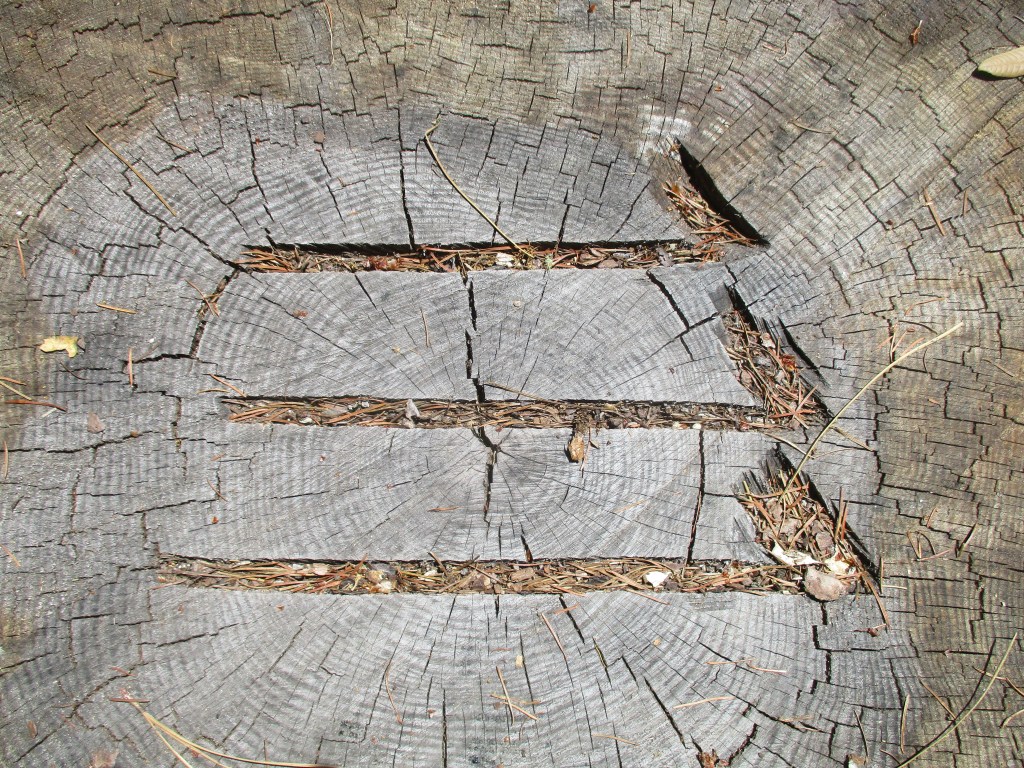
Once stumps die, they rot faster if buried or at least covered with other plant material. Less stubborn stumps that are not likely to sprout again, like those of pines, cypresses, cedars, birches and (solitary trunked) palms, can be buried or concealed immediately. Stumps that are not cut low to the ground are not so easy to conceal, but should still rot faster if covered with ivy. I prefer to plant either freshly divided lily-of-the-Nile shoots or geranium cuttings around the bases of stumps, because they obscure the stumps and also promote rot as they get watered and disperse roots into the decaying wood. They can be removed, if desired, as the stumps deteriorate.




 Tony Tomeo