Palm Trees Are Specialized Trees

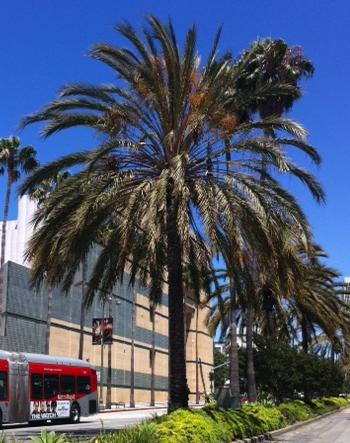
Many palms have palmate leaf form.

A tree is a woody perennial plant with a single tall trunk and branches. Banana trees and tree ferns lack both branches and wood. Arboriform yuccas develop branches but are not woody. Palm trees are no better. Some develop a few trunks but without branches. Doum palms that develop branches are extremely rare in California. No palm is actually woody.

Palms are trees only because of their size and form. In other words, most are big and tall. The most compact of palms are no smaller than Japanese maples, which are also trees. Realistically though, palms are merely large to very large perennials. They are monocots like grass, bamboo or cordyline. Some horticulturists classify them as herbaceous trees.

Only California fan palm is native to California, and only to remote desert oases. All other palms are exotic. Spanish Missionaries imported date palms to produce dates within arid regions. Only a few other palms were similarly utilitarian. The majority are desirable only for their distinctive form, texture and evergreen foliage. They are genuinely ornamentals.

All palms are evergreen. Fan palms produce rounded palmate leaves on sturdy petioles. Feather palms produce elongated pinnately compound leaves on sturdy rachises. Many fan palms also produce wicked teeth on their petioles. Many feather palms also produce dangerously sharp spines on the bases of their rachises. Even lush palms can be mean.

Not many palms get big enough to provide much shade. Many types are shady in groups though. Without branches, palms are not conducive to containment or redirection. Some eventually grow tall enough to shade neighboring gardens instead. Unfortunately, palms that encroach too closely to high voltage cables require removal. They do not go around.

Palm trunks do not widen as their canopies grow higher above. Palms with plump trunks grow at ground level for several years before they can launch. Their single terminal buds must first grow as wide as their mature trunks will ever get. Their foliar canopies likewise grow no broader than they were when they launched. They only grow higher. Most large palms develop distended basal adventitious roots that can get quite wide, though.

Black Walnut

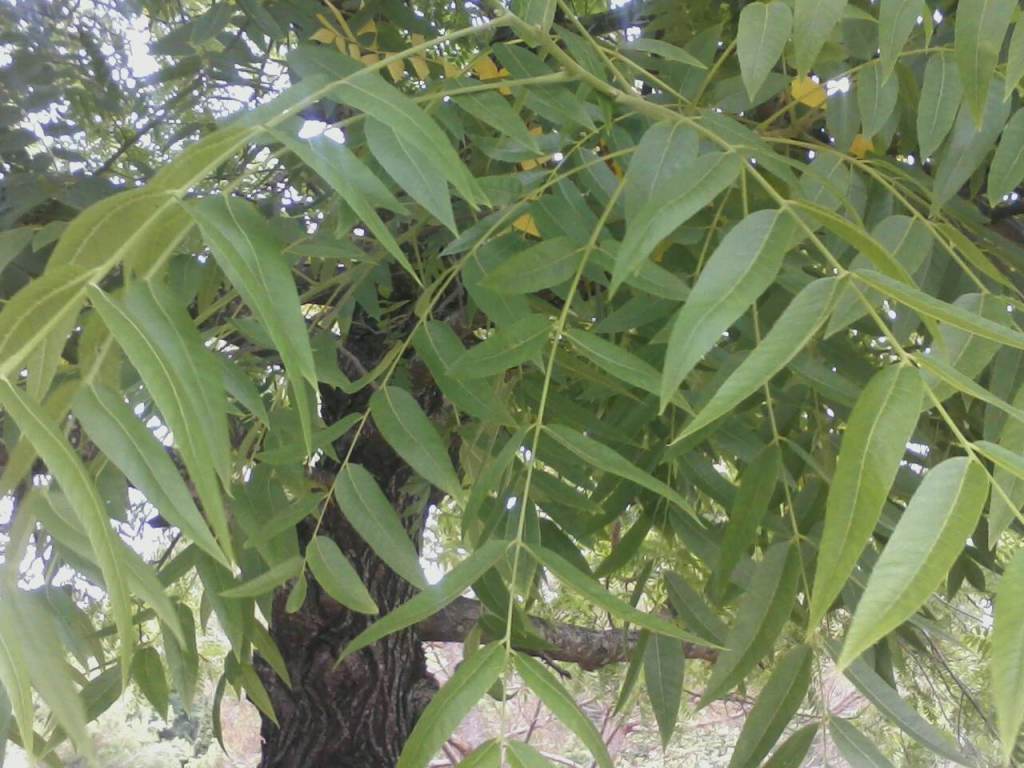
Most black walnuts were not planted intentionally, but grew from the roots of old English walnut trees.

Although native, most local black walnut trees, Juglans hinsdii, are secondary growth from the rootstock of what were once grafted English walnuts, or descendents of such trees. (English walnut trees are grafted onto black walnut understock.) However, the massive old trees that flank the old Monterey Highway south of San Jose were planted as large shade trees nearly a century ago. They are now about sixty feet tall, with lofty broad canopies. Their foot long leaves are pinnately compound, with about eleven to nineteen slightly dentate leaflets that are about three or four inches long. The hard nuts and thick husks are far too messy for refined gardens.

Date Palm

Many relocated mature date palms were recycled from date orchards.

It seems that recycled large date palms, Phoenix dactylifera, became trendy in the past few decades while vast date orchards around Las Vegas were displaced by urban sprawl. They are stately trees with airy but bold rounded canopies between twenty and thirty feet wide. Mature trees are more than fifty feet tall on single trunks. Varieties with multiple trunks are shorter and rare. The ten to twenty foot long leaves are pinnately compound with folded foot long leaflets, and nasty basal spines.

Each date palm tree is either male or female (dioecious). Orchards are almost exclusive to fruiting female trees with only a few male trees grown separately for their pollen, which gets applied manually. Without male pollinators, recycled formerly productive female trees are fruitless, and therefore not messy.

Date palms may have been in cultivation for nine thousand years! The Judean date palm was grown from seed that was lost in storage for two thousand years, which (until recently) was the oldest known viable seed!

China Doll

Most big China doll trees were formerly docile houseplants.

It is hard to believe that the original variety of the familiar China doll, Radermachera sinica, that grows so slowly to reach an eight foot high ceiling as a houseplant, can actually grow into a substantial fifty foot tall tree with a three foot wide trunk, where protected from frost. Modern varieties with more billowy foliage take even longer to reach the ceiling, and do not go much higher. The finely textured and very glossy foliage is bipinnately compound, which means that each of the half to two foot long leaves are divided into smaller leaflets, which are also divided into even smaller leaflets that are about an inch or so long. Trusses of tubular white flowers that resemble big catalpa flowers are almost never seen among houseplants or modern varieties, but are quite showy on big old trees.

Colorado Blue Spruce

Colorado blue spruce is densely evergreen.

Most trees behave very differently in cultivation than in the wild. Colorado blue spruce, Picea pungens, is naturally a grand tree. It slowly but surely grows almost a hundred feet tall in the Rocky Mountains. Locally, if not competing with taller trees, it rarely gets as tall as thirty feet. Mild winter weather does not stimulate much more than necessary growth.

Furthermore, most home garden Colorado blue spruce are densely compact cultivars. Most are plumply conical. A few are quite rounded or globular. They function more as big shrubbery than trees. They are less conducive to major pruning than shrubbery though. Removal of low limbs for clearance compromises their strict but naturally elegant form.

Foliar color is as appealing as form and foliar texture. Obviously, Colorado blue spruce should be blue. Some are a bit more silvery or grayish. Trees that grow from seed tend to be greener and a bit less dense than cultivars. Such seedlings are sometimes available online. The stiff and prickly needles of Colorado blue spruce are only about an inch long.

Trees Naturally Dominate Their Gardens

Oaks slowly become grand and sculptural.

Trees are generally the most significant living components within a home garden. Even treeless gardens benefit from nearby trees. Some old redwoods contain more wood than the homes that they shade. Some old oaks inhabited their gardens centuries before their gardens did. With few exceptions, nothing in a garden is as big or permanent as a tree.

Japanese maples, citrus trees and other small trees can be among the exceptions. They might be smaller than some of the shrubbery they share their gardens with. Papayas and other herbaceous trees can also be exceptions. Some live for only a few brief years. The definition of what a tree is can be vague. Variable interpretations complicate this matter.

A tree is a woody perennial plant with a single tall trunk and branches. However, banana trees develop several unbranched herbaceous trunks. Palms and tree ferns are neither woody nor branched. Arboriform yuccas are no woodier than palms. Many trees develop many trunks. Banyans use roots as trunks. This definition does not even describe ‘tall’.

Ultimately, the characteristics of a tree are more important than its definition. Shade trees near homes should be deciduous to let warm sunshine through in winter. Evergreens are better for obscuring unwanted scenery throughout the year. Evergreens are messier than most deciduous vegetation though. Their shedding is not so limited to distinct seasons.

Fruit trees are some of the most misunderstood inhabitants of home gardens. Not many grow big enough to function as shade trees. Fruit is difficult to harvest from those that do. Almost all require intensive and specialized pruning and maintenance. Few get it. Most eventually succumb to neglect. Citrus and avocados are some of the least demanding.

Palms, whether or not they qualify as a type of tree, are also misunderstood. They lack branches, so are not conducive to pruning away from utility cables. Their single terminal buds grow only upward. Removal is the only option for palms that encroach too closely to high voltage cables. Even the best palms need grooming from professional arborists. Most quickly grow beyond reach from the ground or even a ladder, and are dangerous to climb.

Fruitless Mulberry

Fruitless mulberry is conducive to pollarding.

Even though silk never became a major commodity in North America, it indirectly made an impression on American gardening. The tree that was developed to most efficiently feed silkworms is now among the most popular of shade trees. The fruitless mulberry, Morus alba, wastes no resources producing fruit while providing only abundant foliage, which is the only sustenance for silkworms.

Young trees grow at a good rate to nearly thirty feet tall, and can eventually reach fifty feet. They are often pollarded (pruned severely back to the same burly ‘knuckles’ every winter), which causes them to regenerate stems at an alarming rate during summer. Shoots from mature pollarded knuckles have no problem reaching fifteen feet in all directions! Mulberries incidentally have the distinction of the fastest motion known to the plant kingdom, because they launch their pollen at more than half the speed of sound!

The serrate leaves are quite variable. Those of vigorous young shoots of pollarded trees are mostly about six inches long with rounded wide lobes, but can be nearly a foot long! They turn bright yellow and typically fall neatly from the tree within a limited time in autumn, facilitating raking. Leaves on slower growing stems of lightly pruned mature trees are mostly unlobed and less than six inches long. They begin to fall earlier in autumn and linger over a longer time, sometimes with slightly subdued autumn color.

Stakes And Binding For Trees

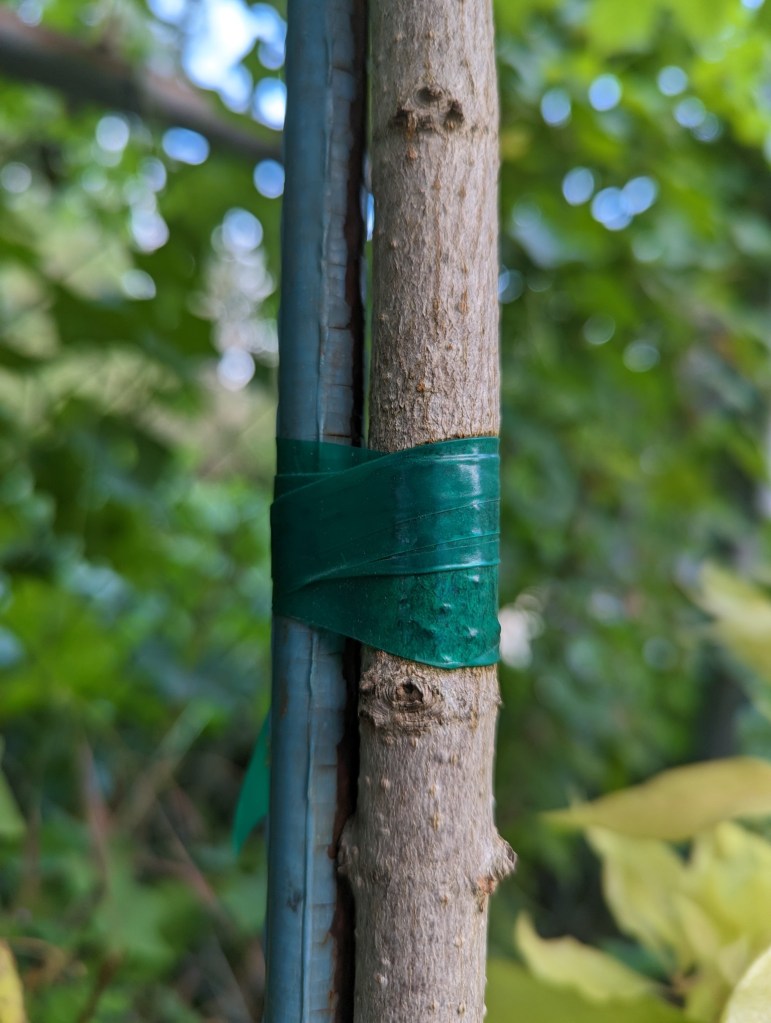
Binding merely straightens developing tree trunks.

Few trees that inhabit home gardens begin their residency as nature intended them to. Most are exotic, from other ecosystems, regions and climates. Almost all initially grew in nurseries, with their roots confined to cans of soilless media. Most rely on pruning and binding to develop straight and tall trunks. In the garden, most rely on stakes for stability.

Nursery stakes are different from landscape stakes. They support the developing trunks of young trees as they grow in nurseries. They can do the same for very young trees that grow directly into home gardens. Such stakes do not stabilize trees. Within confinement of nursery cans, they can not extend into the soil below. They guide trunk development.

Some young trees with very limber trunks rely on constrictive binding to nursery stakes. Most trees need only loose binding. Ideally, binding should be as loose as possible, and is only temporary. Trunks that move with wind are less reliant on support as they mature. Once straight trunks develop, temporary nursery stakes should no longer be necessary.

Landscape stakes stabilize new trees after installation into a garden. Most of such trees lack stability while their roots are initially very confined. Root dispersion stabilizes trees as they mature. Landscape stakes are only temporary during this process. They should not be so constraining that trees rely on them for support. They must be sturdy though.

As important as it is for many trees, staking can interfere with trunk development. It limits motion from wind that stimulates trunk expansion and root dispersion. Timely removal of stakes when no longer needed promotes healthier development. Yet, some very limber trees may briefly need both nursery and landscape stakes. Timing of removal is critical.

Small trees may need only a single landscape stake after installation. Larger trees may need a pair of stakes. Some stout trees may need no stake at all. Ties that loosely attach trees to stakes should cross over between the trees and stakes. This forms a figure eight pattern that limits abrasion between trees and stakes. Short nails can hold ties in place.

Arborists Are Horticulturists Of Trees

Arborists work with the big trees.

Landscapers and gardeners are only the two most familiar of horticultural professionals. There are also landscape designers, horticulturists, greenskeepers and various nurserymen, just to name a few. Each of the many distinct horticultural professionals works within a specific horticultural industry; like each of the many different types of physicians works within a specific medical industry, even though many might work together in the same hospital.

Arborists are the horticultural professionals, or even horticultural ‘physicians’, who work specifically with trees. In fact, they had historically been known as ‘tree surgeons’  because they perform what might be considered to be surgery on trees. After nurserymen grow trees in nurseries, and landscapers install trees in landscapes, arborists take over to care for the same trees like gardeners take care of landscapes below the trees.

Arboriculture, or the horticulture of trees practiced by arborists, is important because trees are so different from other plants in the landscape. Obviously, trees are larger than anything else. Structural problems or instability can have devastating consequences, not only to the affected trees, but also to anything around them that might be damaged by falling limbs or even entire trees. Some trees are large enough, or even have limbs that are large enough to crush an entire home.

Arborists who are certified by the International Society of Arboriculture, or ISA, have passed an examination of their arboricultural expertise, and maintain their certification by attendance to educational seminars, workshops and other relevant ISA approved events. Certified arborists are the most qualified to assess the health, stability and structural integrity of trees, and prescribe any necessary arboricultural procedures. Such matters should not be trusted to other horticultural professionals who specialize in other aspects of horticulture.

The website of the ISA at www.isaarbor.com is the best resource for finding certified arborists and the tree service businesses that they are affiliated with. Arborists can be found within particular regions by city or ZIP code, or directly by name. The website also features all sorts of information about trees that is useful to anyone who lives with them or wants to add more to the landscape.

Of course, there is more to gardening than trees. For those who missed reading about it already, it is nearly time for the most locally grown of horticultural events. Spring in Guadalupe Gardens will be April 28, from 10:00 a.m. to 3:30 p.m., in the Guadalupe River Park and Gardens between Taylor Street and Coleman Avenue in San Jose. More information can be found online at www.grpg.org or by telephoning 298 7657.

Coast Live Oak

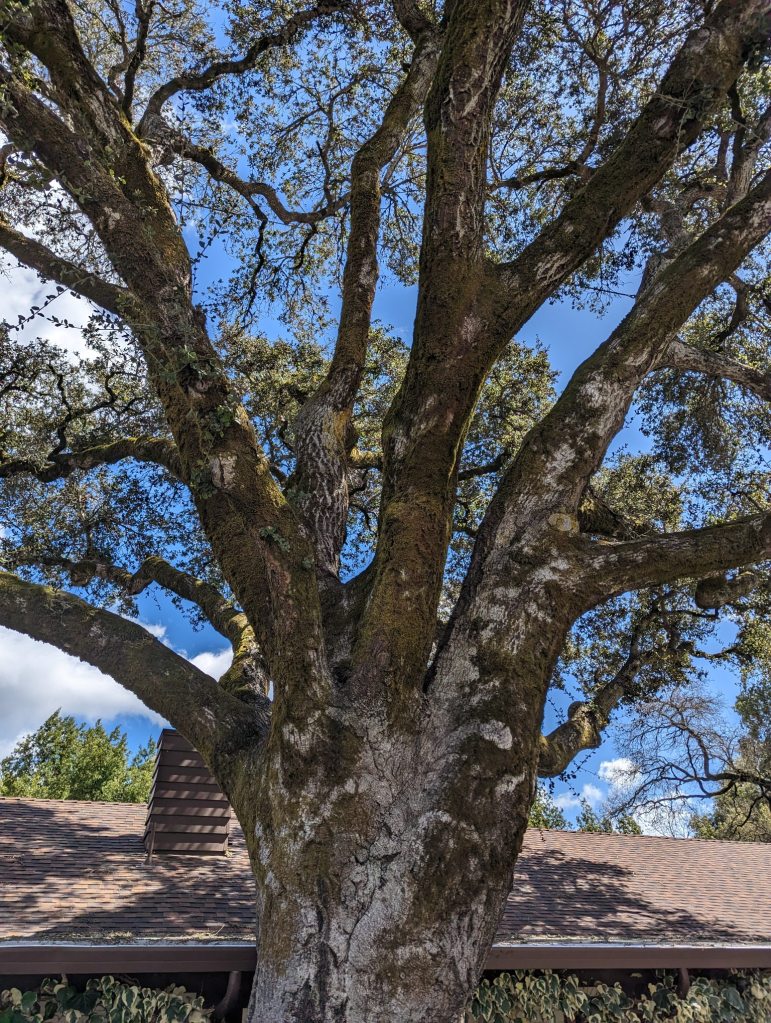
Coast live oak can get massive!

Valley oak and coast live oak are the two most magnificent oaks of California. Valley oak likely receives more notoriety. It stands taller, and defoliates to expose its sculptural form through winter. Coast live oak, Quercus agrifolia, is almost as grand within its evergreen foliage. It can grow as tall and broad as seventy-five feet, with trunks wider than ten feet.

Coast live oak is notably variable in the wild. Exposed and solitary trees can grow bigger and older than grove trees. They can live for many centuries, and hang their canopies to the ground. Grove trees may not live half as long, and tend to shed shaded lower growth. Solitary trees are likely to survive fire. Grove trees within forests are less likely to survive.

Coast live oak is more appealing in the wild than within home gardens. Regularly messy debris is mildly herbicidal to some delicate plants below. It also stains hardscapes. Trees that matured without irrigation are very susceptible to rot with new irrigation. Landscapes around such trees must therefore demand very little. Roots are very sensitive to damage.