During the summer, the native white alder, Alnus rhombifolia, is a nice shade tree that looks bigger than it really is. By late winter, the bare deciduous canopy has an appealingly picturesque silhouette. This time of year is actually when white alder is typically less appealing, with dead foliage that provides no interesting fall color, but lingers until knocked down by rain or late frost. Yet, even now, it sometimes surprises with these funny looking floral structures that are interesting both in the early winter landscape, and with cut flowers.
In past decades, white alder was an ´expendable’ tree that was put into landscapes for quick gratification while slower but more desirable trees matured. By the time the desirable trees matured, the alders were removed to make more space for the desirables. This technique was practical because, like many fast growing trees, alders do not live very long, so start to deteriorate after about twenty five years anyway. However, alders often live longer than expected.
Mature alders are usually less than fifty feet tall where they are well exposed. They can get at least twice as tall where shaded by other trees or big buildings. Their plump trunks with mostly smooth silvery gray bark make them seem larger than they really are though. Too much water promotes buttressed roots which can displace pavement.
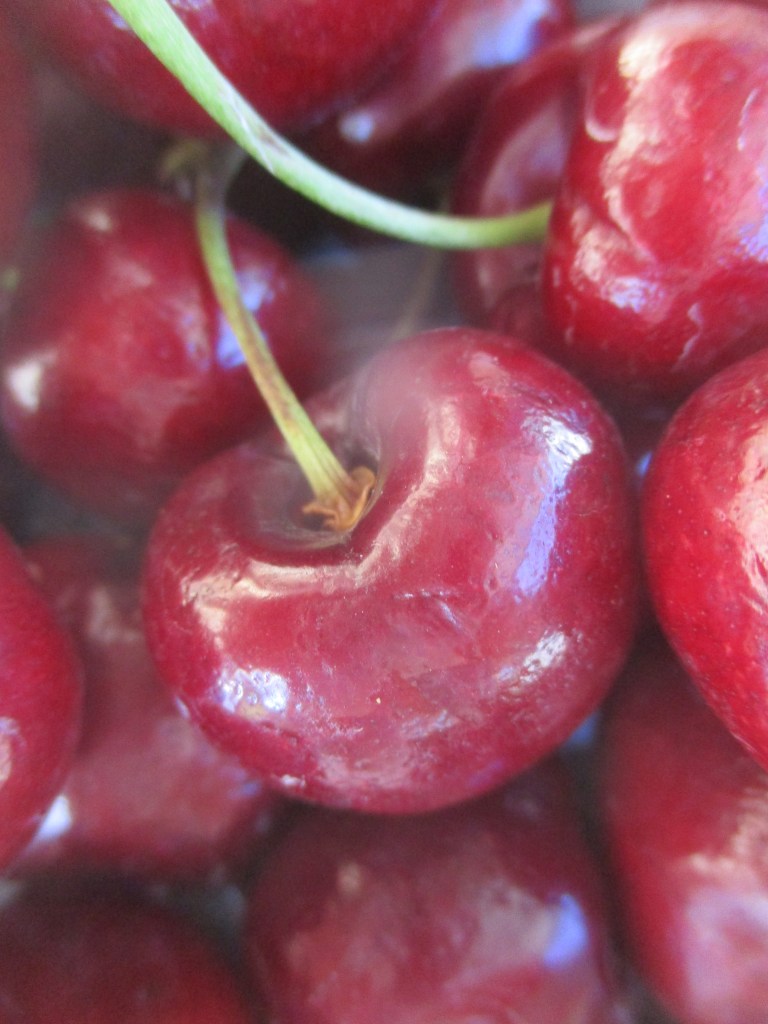
Cherry, Prunus avium, is one of the more popular fruits of summer. However, winter is the season for planting new trees and pruning mature trees. Pruning is comparable to that of other stone fruits, but to a lesser degree. Their sweet fruits are typically less than an inch and a half wide, so are relatively lightweight. Docile trees may not need annual pruning.
Home garden trees with dwarfing rootstocks should grow no taller than about fifteen feet. Some stay less than ten feet tall. Orchard trees with standard rootstock grow significantly taller. Wild or feral trees can grow forty feet tall, with their fruit beyond reach. Old cultivars mostly require another compatible cultivar for pollination. Some modern cultivars do not.
Cherry fruits are mostly rich deep red, but can be dark blackish red or pale orangish pink. Early spring bloom is brief but profuse and splendidly clear white. Three to four inch long leaves that are deep green through summer become bright yellow or golden yellow prior to defoliation during autumn. Even the silvery young bark of some cultivars is appealing.
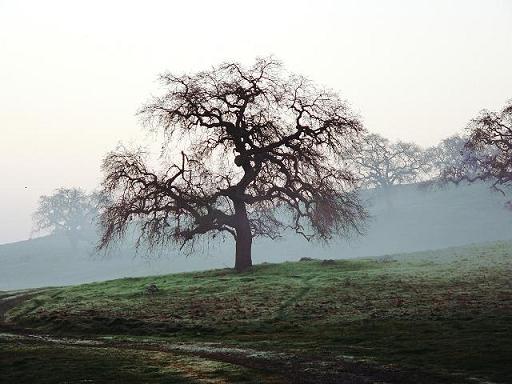
‘Foggy Oak Morning’ by Karen Asherah, is another example of the local scenery that I miss while not taking a bus or walking. I drove past this scene for years on my way to work outside of San Martin without ever bothering to take a look at it. This happy tree is a native valley oak, Quercus lobata, like those that had been common throughout the Santa Clara Valley until only about two centuries ago. It is not exactly the sort of shade tree that everyone wants in a compact suburban garden, but is grand enough for large spaces like parks.
Mature specimens may not seem to get as tall as oaks in the Appalachian Mountains, but are actually the largest oaks in North America, and live more than five centuries. The tallest trees are mostly less than seventy feet tall, but can get taller. Trunks of the oldest trees are commonly six feet wide or wider. The distinctively and uniformly furrowed bark is as classically ‘oakish’ as the rounded prominent lobes of the deciduous leaves, and the sculpturally irregular branch structure. Odd stem galls, commonly known as ‘oak apples’, are home to the larvae of tiny wasps that rely on valley oaks for everything they need. Incidentally, Paso Robles, or ‘El Paso de los Robles’ is named for the valley oaks in the area, which Spanish immigrants thought resembled the ‘robles’, the European oaks that inhabit Spain.
More information about ‘Foggy Oak Morning’ can be found at the website of Karen Asherah at karenasherah.com.
Small coniferous trees do not stay small for long.
One of the problems with driving my favorite vehicles that were old long before I learned to drive them is that I spend considerable time waiting for a bus or walking. The cool thing about that is that I get to seem so much scenery that I would otherwise drive past. While waiting nearly an hour for a bus at the Cavallero Bus Terminal in Scott’s Valley, I went across the street to see the landscape of the somewhat new Post Office, which has actually been there for many years now.
The landscape is a bit sparse in front (I think because of architectural modifications after the landscape was designed), so was outfitted with recycled live Christmas trees. Although none of these particular trees seem happy in the local climate or sandy soil, I had wanted to get better acquainted with them for some time. They are an odd assortment of spruce and fir that are rare here.
The more typical concern with the more common live Christmas trees is not that they are not well suited to local climates and soils, but that they actually do too well and grow much larger than expected. Except for the small rosemary, holly and English ivy ‘trees’, most coniferous evergreen live Christmas trees are young pines that get remarkably large; and some waste no time doing it! The most common live Christmas trees are Italian stone pines, which happen to be the two very large and broad trees in Blaney Plaza in downtown Saratoga!
Canary Island pines, which had been more common than they are now, do not get quite as broad, but do get very tall and messy. Years ago, Aleppo, Eldarica and Monterey pines all took their turns being popular live Christmas trees. Each of them grows large enough to require significant garden space.
This is of course not a problem for the few live Christmas trees that happen to get planted where they have plenty of space. However, those that get planted where they do not have room to grow can cause serious problems. Because they seem so cute and innocent while they are young, and are so often expected to stay cute and innocent, many often get planted dangerously close to houses, where they can displace porches, walkways and even foundations! Large pines, particularly Italian stone pines, are also too messy and potentially combustible (if not pruned and groomed regularly) to be too close to houses.
Sadly, large pines do not like to stay in containers too long. They can be pruned for a few years, but eventually get congested roots. (Bonsai techniques of root pruning can maintain even the largest types of pines in containers indefinitely, but not many of us know these techniques.) Small pines, like Austrian black, Japanese black and Scott’s pine (which has no relation to Scott’s Valley), as well as other small coniferous evergreens, like certain junipers, can stay in containers much longer, but these are the sort that are small enough to get planted in the garden, so do not necessarily need to stay in containers anyway.
If space is not sufficient, pines and other live Christmas trees that eventually get too large really should be given to friends and neighbors who have space to accommodate them. Fortunately, most do not require much attention once they get established after two years or so.
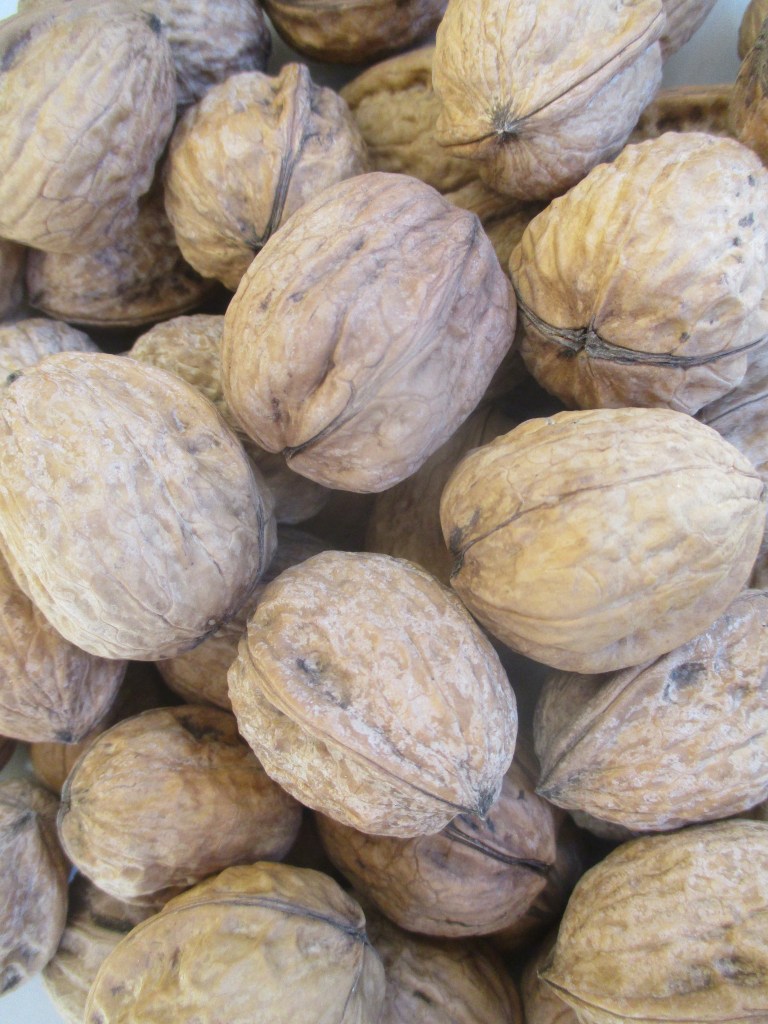
It has been in cultivation for several thousands of years. Throughout that time, it escaped cultivation to naturalize in many regions between the Balkans and the Himalayas. It most likely originated from a much smaller natural range within Persia. An interesting certainty of its dubious original range is that English walnut, Juglans regia, is not actually English.
English walnut likely arrived at Spanish Missions of California prior to 1800. It became a major agricultural commodity of both the Sacramento Valley and the San Joaquin Valley. A few old trees survive within urban areas that were formerly orchards of the Santa Clara Valley. Newer trees are unfortunately rare within home gardens because they get messy.
English walnut trees rarely grow more than forty feet high and wide here. Their abundant foliar, floral and fruit debris is toxic to young plants though, and stains hardscapes. Each type of debris sheds during a different season. Squirrels might claim most or all nuts, but drop shredded hulls. The deciduous and pinnately compound leaves can be a foot long.
This specimen would be a challenge for an arborist.
(This article is recycled from a decade ago.)
Pasadena sustained the worst of the damage caused by the strongest Santa Ana Winds in three decades. Huge piles of debris from broken trees are much more than can be removed any time soon. Falling debris and trees damaged many roofs, cars and anything else that happened to get in the way.
Other towns and neighborhoods throughout the area, particularly those at the base of mountains, also sustained major damage. At the same time, severe winds ravaged the San Francisco and Monterey Bay Areas as well, particularly in the Santa Cruz Mountains and the hills of the East Bay.
Some of the damage caused by wind in urban areas might have been less disastrous if trees had gotten the respect and attention that they deserve. Some trees develop structural deficiencies that need to be corrected by pruning, either to eliminate the problems, or at least to decrease the strain exerted onto the structurally deficient parts. A few trees that become unstable as they mature may likewise need to be pruned or even removed.
It is not always possible to prune trees to remove all structural deficiencies without damaging the affected trees more, or causing more structural problems to develop. For example, major pruning to remove all parts that may get blown down by wind, such as pollarding or ‘topping’, may seem to be effective for the short term, but actually stimulates the development of vigorous secondary growth or watersprouts that are disproportionately heavy and even more likely to tear off from the older limbs.
Structural pruning more often involves thorough reduction of weight and wind resistance. Weight of foliage and stems directly applies leverage against unions where smaller stems are attached to the larger stems from which they originate. Wind resistance adds more leverage as foliage gets blown about by wind. Thinning obviously removes significant weight, and also decreases wind resistance to allow wind to blow though the affected canopies.
Besides helping to compensate for structural deficiency, structural pruning is also beneficial to potentially unstable trees for the same reasons. However, unstable trees typically need even more reduction of weight and wind resistance. Some of the most unstable trees and those that are deteriorating need to be removed because their instability cannot be accommodated.
During winter, while deciduous trees are bare, evergreen trees are more susceptible to wind damage, obviously because they retain their weight and wind resistance through winter while the weather is the most severe. Unstable trees become even more destabilized as rain softens the soil. Regardless of the potential for susceptibility to wind damage, this would be a good time of year to get any needed tree maintenance done, prior to any more windy and rainy winter weather.
Arborists certified by the International Society of Arboriculture are the most qualified to identify potential structural problems or instability, and to prescribe corrective procedures. A list of certified arborists can be found at the website of the International Society of Arboriculture at http://www.isaarbor.com.
In the wild, Atlas cedar can get almost a hundred feet tall. Bluish gray or rarely yellowish cultivars which are popular for home gardens are generally more compact. Perhaps they could get as grand as wild trees after a few centuries. Weeping blue Atlas cedar, Cedrus atlantica ‘Glauca Pendula’ is an strange one. It can barely stand fifteen feet tall and wide.
The trunks and limbs of weeping blue Atlas cedar are initially so pliant that they sag onto the ground without support. New stems try to grow upward, and may do so for a few feet, or may hang downward after achieving only a few inches of height. Trunks need binding for either straight or serpentine form. They lignify slowly as they mature and gain caliper.
Weeping blue Atlas cedar requires commitment. Indiscriminate pruning or shearing ruins the naturally sculptural form. Such pendulous growth necessitates meticulous grooming, although it may not be necessary very often within spacious situations. Expanding trunks eventually absorb the curves of serpentine form. Low stems can sprawl over the ground.
Christmas trees grow on farms. They are an agricultural commodity. Their unnatural and intensive cultivation is no asset to any associated natural ecosystem. Their harvest does not deprive ecosystems of natural components. Live Christmas trees are at least equally as unnatural. Their cultivation involves more synthetic materials and unnatural irrigation.
There should be no shame associated with the procurement of cut Christmas trees. They are merely cut foliage that is significantly more substantial than that which accompanies cut flowers. Furthermore, live Christmas trees are not an ecologically responsible option. They are merely potted plants that can be difficult to accommodate within home gardens.
That certainly should not invalidate the appeal and potential practicality of live Christmas trees. With proper maintenance, other potted plants, such as houseplants, can grow and perform for many years. Since live Christmas trees are coniferous species that get rather large, they demand more attention. All are not necessarily totally unmanageable though.
Some compact conifers, such as dwarf Alberta spruce and compact cultivars of Colorado blue spruce, can remain within pots for many years. They need either larger pots as they grow, or occasional root trimming if they stay within their same pots for a few years. Their roots outgrow pots as slowly as their canopies grow. They also require diligent watering.
Unfortunately, the most common of decorated live Christmas trees that are available from supermarkets are also the most problematic. Most are either Canary Island pine or Italian stone pine, which grow surprisingly large for such seemingly innocent small evergreens. They very often go into compact gardens, where their bulky roots displace infrastructure, such as pavement and turf grass.
Contrary to popular belief, planting live Christmas trees in the wild after Christmas is not a practical option. Because their roots were confined to pots, they rely on irrigation while they disperse roots into the ground. They can not survive without irrigation after the rainy season. Besides, trees that are not native could be detrimental to the native ecosystems.
Although very rare here, bald cypress is prominent enough in the South to be the state tree of Louisiana.
There are very few coniferous (cone bearing) trees that are deciduous; and because most prefer cooler winters, very few are ever seen in local gardens. The bald cypress, Taxodium distichum, happens to be one of the few deciduous coniferous trees that really could be more popular than it is, since it seems to be right at home in mild climates. It is native to coastal riparian regions from Maryland to Florida to eastern Texas, and up the Mississippi and Ohio Rivers as far as Indiana.
The soft foliage resembles that of coastal redwood, but is more finely textured. It is still mostly light green, but will soon be turning paper bag brown before trees go bare. The tiny individual leaves are shaped like flat pine needles, and are not much more than half an inch long. The ruddy or grayish brown bark is finely shaggy.
In the wild, mature bald cypress trees can get more than a hundred feet tall with trunks more than five feet wide. Some of the largest trees have buttressed trunks as wide as fifteen feet! Trees in swamps develop distended growth from their roots known as ‘knees’, which can stand several feet tall! Fortunately, bald cypress rarely get half as tall or develop such massive trunks locally.
Bald cypress is one of the few deciduous conifers; so the finely textured light green foliage will soon be gone.
With such densely foliated low limbs reaching the ground, Colorado blue spruce functions as much as large shrubbery as a small tree.
Colorado and Utah share the same stately state tree; the Colorado blue spruce, Picea pungens, which is native to the Rocky Mountains between Arizona, New Mexico and southern Idaho. Colorado blue spruce are stoutly conical trees that grow slowly to eventually get more than seventy five feet tall. Where they need to compete with other trees in forests, the biggest are nearly twice as tall with trunks nearly five feet wide. However, because they grow so slowly, and do not get much bigger then they need to, well exposed trees stay proportionate to home gardens for many decades. Many shrubby compact cultivars actually stay less than ten feet tall. Foliage can be grayish green to silvery pale blue. The stiff and sharply pointed needles are about three quarters to an inch and a quarter long, and densely set on relatively rigid stems.
The elegant silvery blue foliage of the Colorado blue spruce is striking either in front of or behind darker evergreen foliage, like that of redwoods or junipers. These stout and densely foliated trees make any garden look a bit more woodsy.




 Tony Tomeo