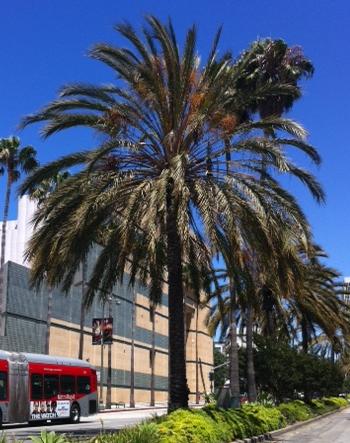
There is no such thing as a perfect tree. All trees have foliage that one way or another, eventually falls to the ground. All trees have roots that might try to displace something that gets in their way. Many trees are messy in bloom. Some make messy fruit. Except for palms, all trees have branches that can be broken by wind. Just about any tree can be blown over if the wind is strong enough.
This is why the selection of trees that are appropriate to each particular application is so important. Finding trees that provide enough shade, obscure an unwanted view, or perform any specific function is one thing. Finding trees that behave while performing their assigned tasks is something else. There are always compromises. A certain degree of bad behavior will likely be tolerated.
Street trees for a parkstrip between the curb and sidewalk can be the most challenging trees to select. There are so many variables to consider. Many neighborhoods have saved us the trouble of selection by prescribing a specific tree, or maybe limiting the choices to only a few species, whether or not they are actually appropriate. Otherwise, we are on our own, to select whatever we like.
Microtrees might seem like good choices. They do not get big enough to damage a sidewalk, or make much mess. These are trees like crape myrtle, purple leaf plum and photinia (in tree form). These trees can be proportionate to narrow streets, but really do not shade much more than a single parking space. Because they are so low, they need serious pruning for adequate clearance.
Mid-sized and bigger trees like Chinese pistache, honeylocust maidenhair tree and some of the modern hybrid elms certainly cause more problems, but might be worth the bother. They shade curbside parking and part of the front yard nicely. Like small trees, they need to be pruned for clearance, especially over the roadway, but they eventually grow up high enough to be out of the way.
It seems that trees that exhibit some of the better characteristics for street trees are deficient in other ways. Australian willow has very complaisant roots, and is very resilient, but also branches low, and is not much to look at. Fern pine and several oaks are excellent street trees for decades, but eventually get big. Root barriers will delay, but not prevent roots from damaging sidewalks.
 There are certain disadvantages to gardening in such a perfect climate. We can not grow things that require significant chilling in winter. Nor can we grow things that require prolonged heat in summer. Seasons change so gently that it is easy to get behind schedule. It is already late summer, whether it seems like it or not. What we do not do in the garden is as important as what we do.
 Tony Tomeo