Horridculture – Aberraculture

Totem of aberrative arboriculture

“Aberraculture” is no more a real word than “horridculture” is. Just as “horridculture” is like a contraction of “horrid” and “culture” that seems to describe horrid horticulture without actually doing so, “Aberraculture” is like a contraction of “aberrative” and “culture” that seems to describe aberrative arboriculture without actually doing so. Perhaps the illustration above provides a better explanation. I suspect this happened because the entire canopy of this particular Quercus agrifolia, coast live oak, extended over the fence and the driveway within the fence from which it needed to be pruned for clearance. However, because of the fence at the edge of the driveway, the trunk could not be cut completely to the ground. Whoever did this lacked access through a nearby gate. The dinky limb and stubbed limb at the top of this severed trunk seem to be a pathetic attempt to cut back to a lateral limb, as if it somehow makes this a proper cut. If this trunk had remained, it would have generated rampant growth that would extend in all directions, including back over the driveway that necessitated this procedure. It is gone now, and the stump should be dead. Because this was on a property where I work, I did not want anyone to see it there. I have no idea who did it, since it was done for an adjacent property, and whoever made arrangements for it did not want to trouble us with it. I only noticed because the adjacent property happens to be a bank that I do business with. I probably should occasionally inspect such fenclines for potential problems before something like this happens again. They are easy to neglect because, although close to some landscapes outside, they are so far from the trees and refined landscapes that we maintain within.

Does cutting back to a lateral limb somehow make this a proper cut?!

Western Red Cedar

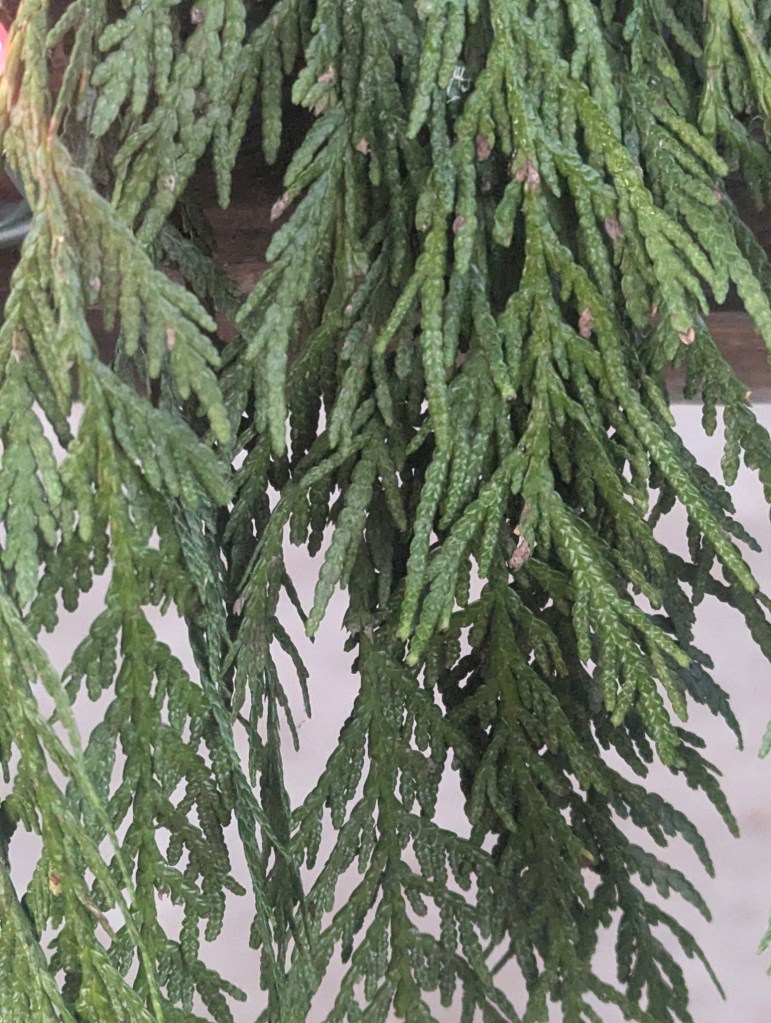
Western red cedar makes nice garland.

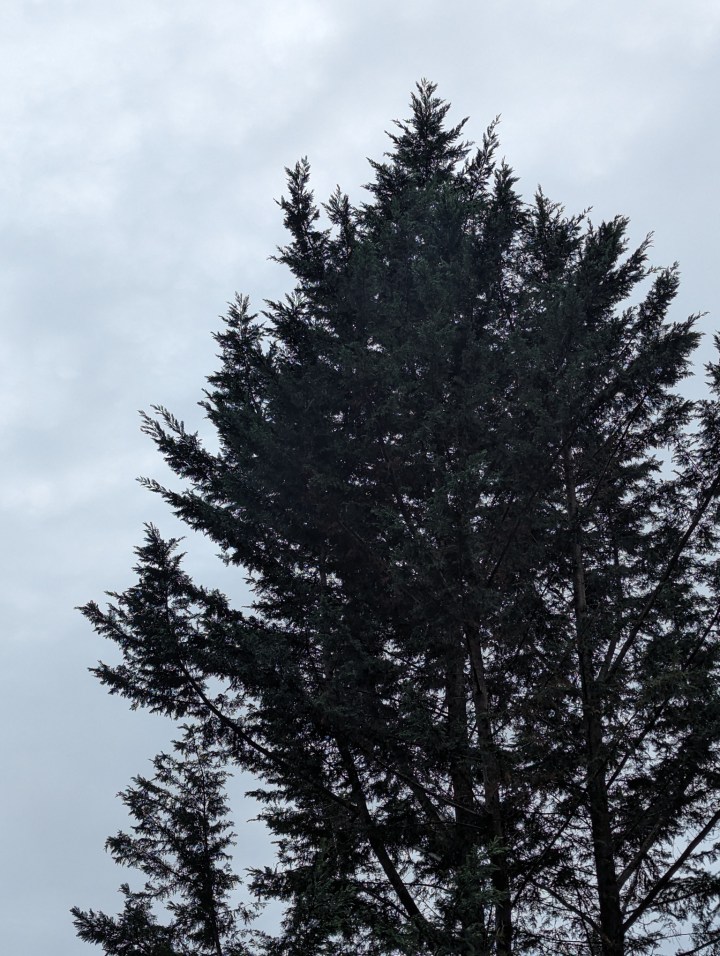
This coniferous evergreen is more appealing as seasonal foliar decor than it is practical. Western red cedar, Thuja plicata, is the most common component of Christmas garlands. Also, it is very popular for wreaths of mixed evergreens. It is the same genus as common arborvitaes. However, this particular species is notably rare among local home gardens.

Western red cedar is native to the Pacific Northwest. Its range extends south to the north coast of California, and east to western Montana. It therefore does not adapt efficiently to the arid warmth of local chaparral climates. Even with generous irrigation, its foliage can be vulnerable to desiccation. The healthiest specimens here are within coastal climates.

Like some other trees within its native range, western red cedar typically grows very big. It can easily reach a hundred and fifty feet tall, and can grow taller than two hundred feet. Although it does not grow as fast as redwood, it eventually needs about as much space. Western red cedar, here, is appropriate only for large landscapes within coastal climates. It is too obtrusive for compact home gardens.

Confluence

There are too many bridges to count here. Several roads and trails, and a historic narrow gauge railroad cross over two creeks and two streams within a relatively confined area. This particular suspension bridge is for a hiking trail that crosses over Zayante Creek at the downstream edge of its confluence with Bean Creek. Bean Creek, which is to the upper right in the picture below, flows through the farm on the outskirts of Scotts Valley. Zayante Creek, which is to the left in the picture below, flows through my neighborhood on the outskirts of Los Gatos. Ferndell Creek, which is just a stream from a nearby spring, also flows into this same confluence, but is not visible to the right of the picture below.

All of these creeks and streams sustain even more diverse ecosystems than those of the redwood forests above, and the chaparral pine forests a bit father above. Redwoods grow like weeds here. The redwood in the picture below is what is known as a ‘virgin’ because it was not harvested for lumber when most others were clear cut harvested to sustain development of the San Francisco Bay Area, and to rebuild San Francisco after the Great Earthquake and Fire in 1906. It was most likely rejected because it was too small to bother with at the time. Only a century later, it is massive! The cables that are now embedded into its bark formerly supported an older suspension that the newer bridge replaced many years ago. Although redwoods are not necessarily a riparian species, and can actually be resilient to drought, they do enjoy this abundance of moisture. The many other trees that inhabit these ecosystems with them grow very tall to compete for sunlight, and in some situations are excluded by their dense growth.

Horridculture – Deferred Road Maintenance

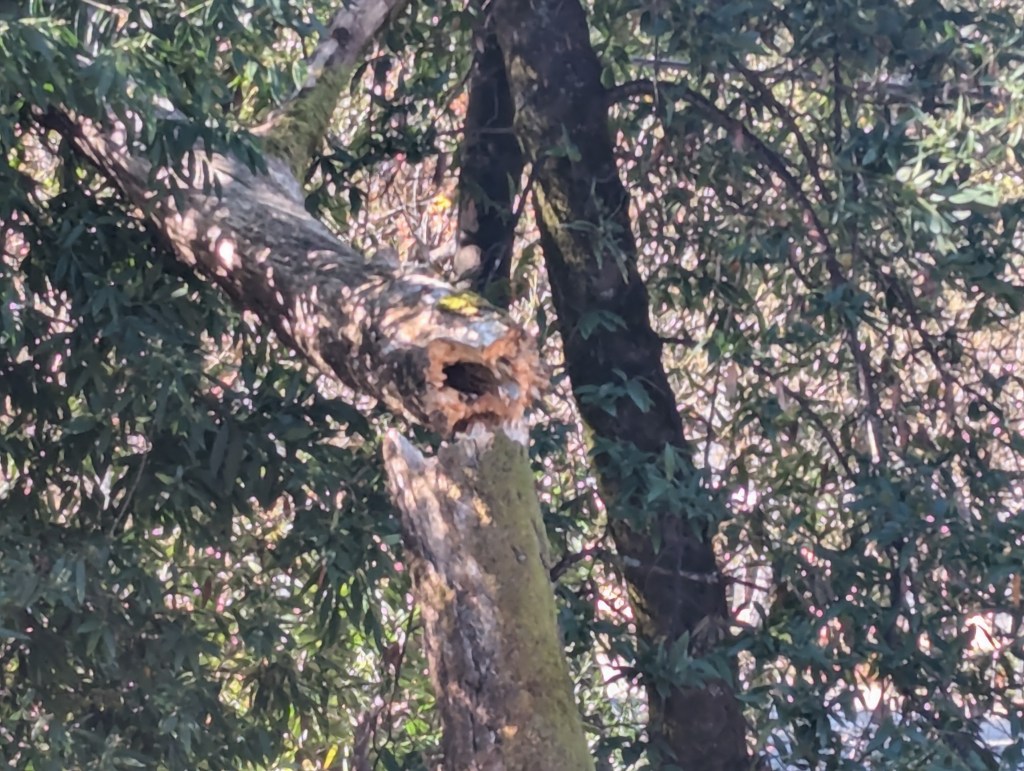
It is not on the road yet, but will be soon. This box elder has been deteriorating for several years. Only a few viable watersprouts remain within about ten feet of the ground. All limbs above are gone, leaving only this decomposing trunk. Several more similarly deteriorating trunks, with more or even less of their associated canopies remaining, are barely standing nearby. Most succumbed to an unidentified pathogen a few years ago. Some were dead prior to that. This one is special because such a significant portion of its upper trunk has broken off, and now remains suspended by the unbroken portion of the same trunk and the collective canopy of adjacent bay trees. This would not be such a concern if this broken portion of the trunk was not suspended so closely to the busy road below. (The picture above shows where the trunk broke. The picture below shows its proximity to the road below.) I suspect that when the broken portion of trunk eventually falls through the canopy of bay trees, the heavier basal end will fall first, and guide the lighter upper portion to land closer to the base of the remaining trunk, and safely away from the road, but I can not be certain until it actually happens. Those who maintain the road will not remove the broken portion of trunk until this does not actually happen, and the debris instead falls into the road. I can do nothing about it because I can not direct how the broken portion of trunk will fall once it is dislodged, and the traffic on the road is nearly constant during the day. It would be safer with a crew to stop traffic while the trunk is removed, and even better if they remove all of the several decaying trunks.

Western Cottonwood

Western cottonwood is better in the wild than within refined gardens.

The brilliantly clear yellow autumn color of Western cottonwood, Populus fremontii, is best in the higher elevations and inland areas of its extensive range, which spreads from the coast of California to the Rocky Mountains and as far south as Mexico. Although it thrives in local riparian areas, particularly Coyote Creek and Guadalupe River, mild temperatures in both summer and winter do not allow it to get as colorful as it does in Nevada. It is almost never planted intentionally, but has a sneaky way of sometimes growing from seed in well watered gardens.

The bad news is that Western cottonwood grows big, fast and aggressively. The shallow roots displace pavement, compete with other desirable plants and damage septic and drainage systems. Large trees produce an abundance of annoyingly fuzzy seeds that adhere to anything. After causing so much damage, Western cottonwoods survive only a few decades, leaving big deteriorating carcasses that need to be removed before collapsing. Consequently, Western cottonwood is really suitable only for large open areas or in the wild.

Mature trees can be more than fifty feet tall and more than half as broad. Their somewhat thick leaves are almost triangular, with paired angular lobes on the sides and blunt tips. ‘Nevada’ is a male cultivar that does not produce fuzzy seeds.

Six on Saturday: Away Again

It is a long story. To be brief, Rhody and I are again far away from work and home, near Phoenix in Arizona, without time to write.

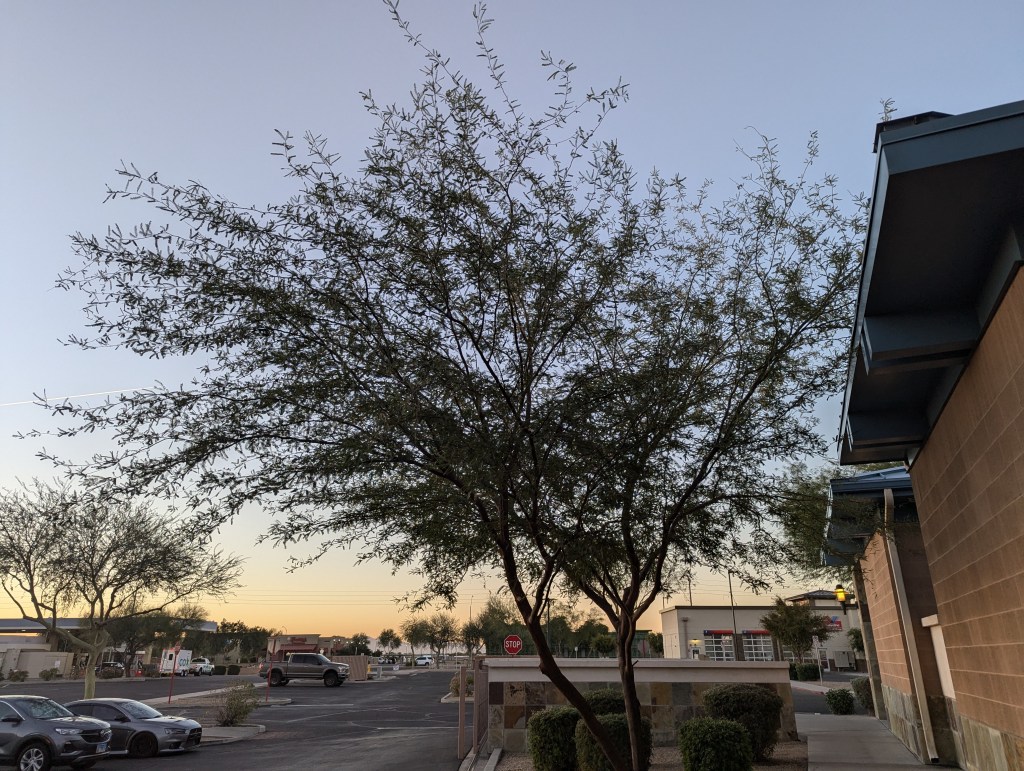
1. Prosopis velutina, velvet mesquite is supposedly the most common mesquite here and is also native. It develops sculptural form, but only light shade, which seems to me to be substandard for such a warm climate. Perhaps it is common because it is undemanding.

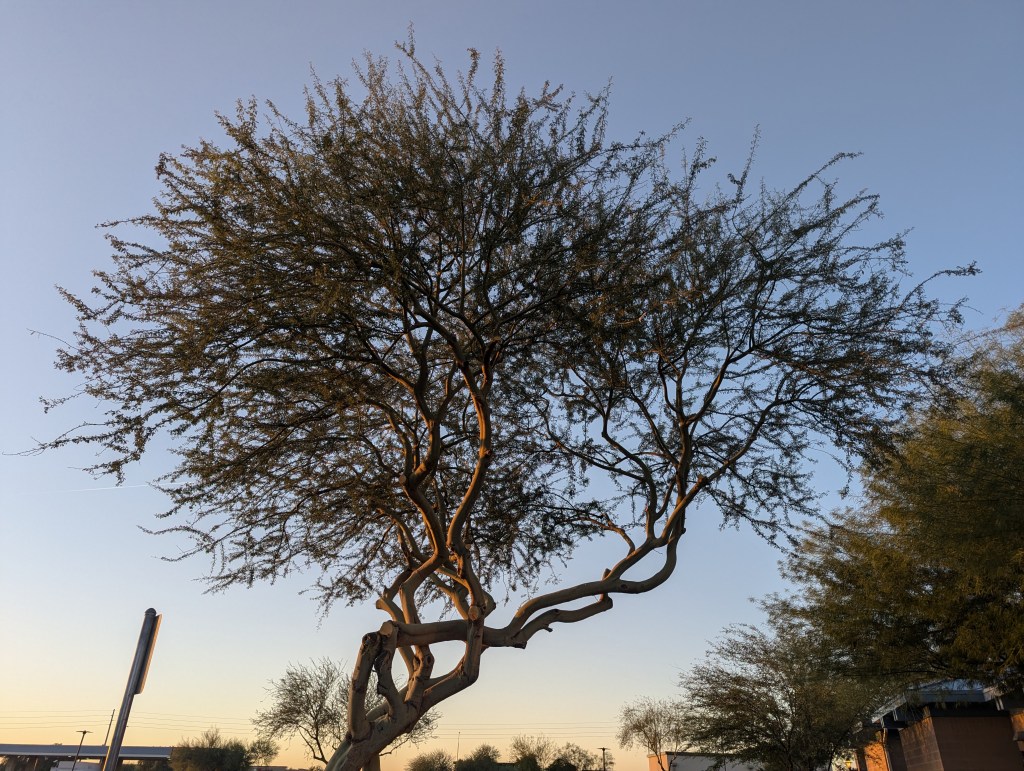
2. Parkinsonia florida, blue palo verde is also native like velvet mesquite, but is only one of the two most common palo verdes here. Foothill palo verde is the other. Both develop sculptural form and light shade, also like velvet mesquite, and are a bit more sculptural.

3. Lantana montevidensis, trailing lantana is the same common type that I occasionally work with at home, but seems to be happier and more colorful here, even while shorn as these weirdly compact globs, and humiliatingly deprived of its naturally sprawling form.

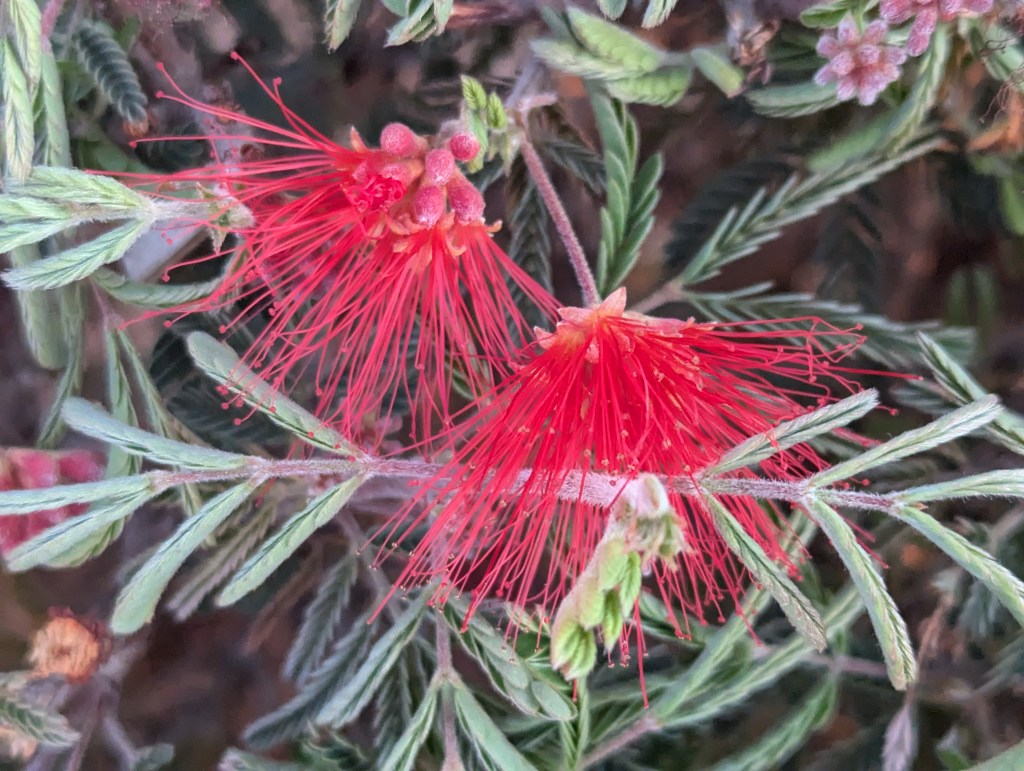
4. Calliandra californica, Baja fairy duster seems to be more prevalent here than it is in California. Of course, Baja California is a very big and very diverse region to the south of the State of California that I am familiar with. I suspect that this is a hybrid or a cultivar.

5. Leucophyllum frutescens, Texas sage, like so much of the flowering shrubbery here, is shorn too abusively to bloom as well as it likely should. Its silvery gray foliar color is also compromised. I can not even guess what its natural form or branch structure should be.

6. Rhody is so tolerant of my interest in unfamiliar vegetation. His only interaction with it involves just ‘claiming’ it. I absconded with a handful of seed pods and three seedlings of velvet mesquite, and a seedlings of Baja fairy duster (which will get a different name).

This is the link for Six on Saturday, for anyone else who would like to participate: https://thepropagatorblog.wordpress.com/2017/09/18/six-on-saturday-a-participant-guide/

Chinese Elm

Chinese elm is sculptural and textural.

Dutch elm disease became a serious problem for American elms in the 1930s. However, it did not reach California until half a century or so later. Chinese elm, Ulmus parvifolia, is not very susceptible to the disease, but is a vector. In other words, it can survive infection to share it with other species of elm. Consequently, it became unavailable by the 1980s.

Some mature specimens of formerly common Chinese elm still inhabit older landscapes. Younger specimens in newer landscapes are mostly ‘Drake’ Chinese elm. They are a bit more upright, with more symmetrical form. More importantly, they are not vectors of Dutch elm disease. Other cultivars that are also resistant are rarely available at local nurseries.

Classic and formerly common Chinese elm can eventually grow more than fifty feet high. Some can grow thirty feet wide to shade an entire urban front lawn. Some cultivars might grow nearly as high, but are generally not quite as broad. Their blotchy gray and tan bark adorns curvaceous limbs. Their small deciduous leaves are not very colorful for autumn. They can be copious, messy and quite tedious to rake.

Horridculture – Headless

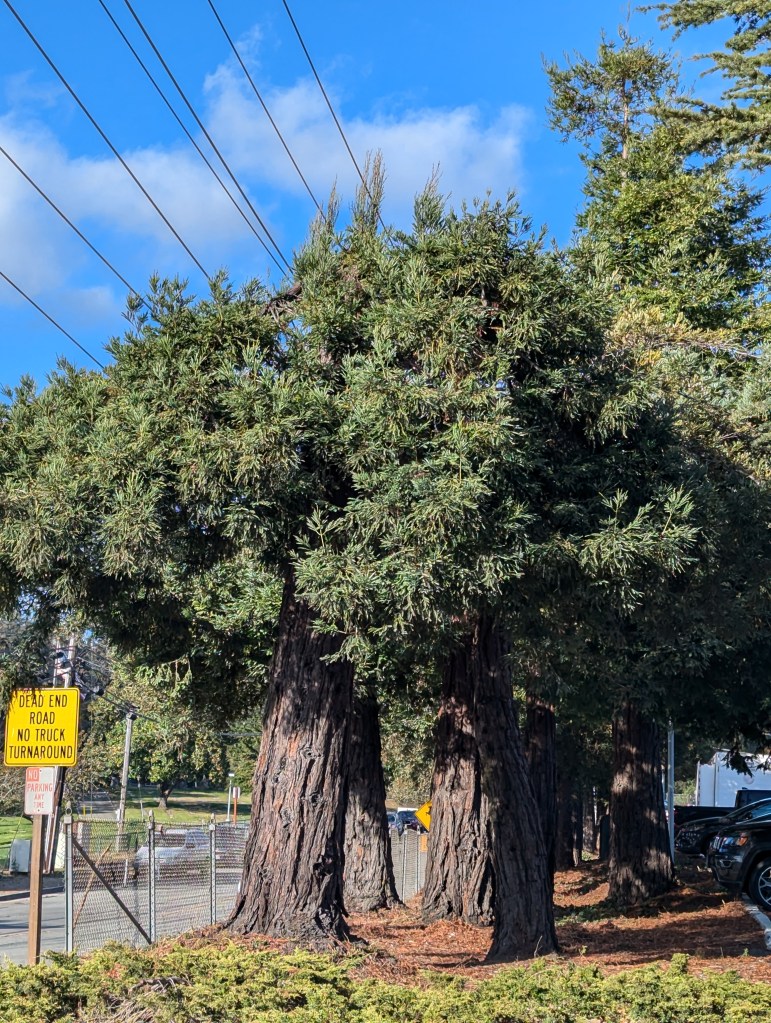
Appropriately, this picture was taken on Halloween. The ‘DEAD END’ sign and cemetery beyond, which are visible to the lower left of the picture, were also coincidental. The several headless redwood trees are the primary topic. Obviously, they were decapitated because of the electrical cables above. Otherwise, redwoods with such healthily plump trunks would be rather tall by now. After all, coastal redwoods are the tallest trees in the World. Unfortunately for them and those who are now appalled by their disfigurement, reliable and safe electrical service is more of a priority than poorly situated trees. It is no fault of the trees. Nor should this atrocity be blamed on those who executed it. Their only better option would be complete removal of the subjects, and perhaps replacement with smaller trees that will not grow tall enough to get too close to the electrical cables above. Maintenance of clearance of the vigorously upright redwoods from the cables above is a chronic problem that must be morally challenging for the arborist who must perform the necessary procedures. However, removal of several such significant trees would be very objectionable to the Community, which is very likely why these trees remain, regardless of their severe and irreparable disfigurement. Application for permits for their removal requires posting of such intentions on the trunks of the subject trees, to which neighbors would very likely protest. None of this would be such a problem now if only trees that are more appropriate to this particular situation were installed instead! Did the landscape designer who designed this landscape even visit the site during the design process, or was it all done on paper in a remote studio? Why did those who installed these trees not foresee this problem and modify the landscape plan and species selection accordingly?

Blue Atlas Cedar

Blue Atlas cedar creates distinctive silhouettes.

No other coniferous tree develops such distinctively irregular form. Very few exhibit such distinctively steely grayish blue foliar color. Blue Atlas cedar, Cedrus atlantica ‘Glauca’ is no simple shade tree. It is a striking trophy tree that is worthy of prominent display within grand landscapes. It is ideal for traffic circles, without other trees to obscure its boldness.

Blue Atlas cedar is also sufficiently resilient for traffic circles and other difficult situations. Arid warmth, even if enhanced by pavement, roofs or walls, should be no problem. Once established, blue Atlas cedar does not crave much irrigation. It should be able to survive with none. Excessively frequent or copious irrigation is more likely to become a problem.

Blue Atlas cedar can grow a hundred feet tall in the wild within its native range. It should not grow much more than half as tall with good exposure within landscapes. Trunks may slowly grow to almost six feet wide. Canopies can eventually grow wider than thirty feet. ‘Glauca Pendula’ is weeping blue Atlas cedar, which is smaller but even more exquisite. ‘Aurea’ with gold tips, is very rare.

Taking Sides

This is what taking sides looks like. The right side was taken completely off, leaving only the left. The view from the other side would show that the left side was taken completely off, leaving only the right. It is not such a good picture because it is difficult to distinguish the extent of the damage from what is going on in the background. Realistically though, a better picture would be even worse, since the extent of the damage would be more obvious. The justification for such damage here is more obvious, since, obviously, this is a bad situation, with no room for balanced growth. Although survival is possible, this is not what nature intended. Natural growth should be an asset, and efficiently directed to where it can be useful, which would most likely be much more balanced than this. Incidentally, this is a coastal redwood, which is the Official State Tree of California. This sort of pruning would be just as damaging to Western hemlock, Douglas fir or blue spruce. For that matter, it would be just as damaging to longleaf pine, Western white pine or Ponderosa pine. Ultimately, it is bad technique for any tree in any situation.