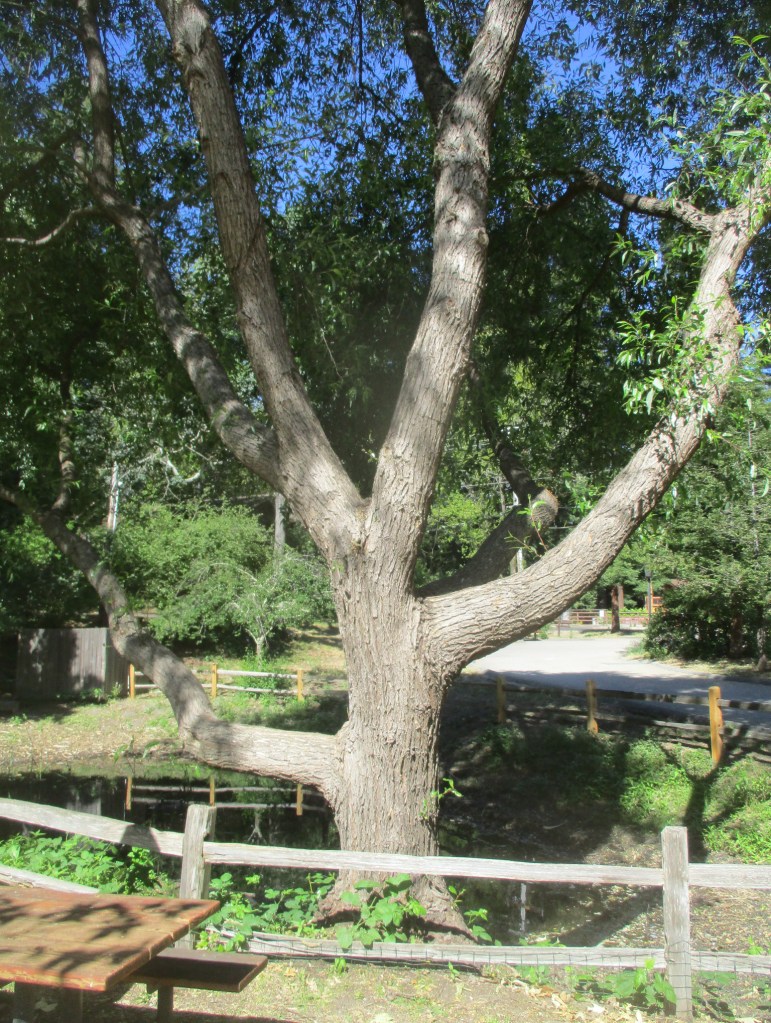
Platanus, or sycamore, supposedly derives its botanical name from the Greek word “platys”, which means “broad”, and describes its wide leaves. However, some believe that its name was derived from “Plato”, who lectured about philosophy within the shade of a sycamore grove, rather than an olive orchard, outside of Athens. The Tree of Hippocrates, is an individual Platanus orientalis that was planted centuries ago, supposedly where Hippocrates lectured about medicine under a much older tree of the same species. Trees grown from cuttings and seed from the Tree of Hippocrates have been shared with medical institutions, schools and libraries all over the World. One seedling was planted at Dominican Hospital in Santa Cruz in 1968. Until only the last few years, it had been pollarded in an exemplary manner, which left no twigs for me to get cuttings from during winter. Only last summer, a gardener left me a few twigs, which I plugged as early cuttings. Of course, most succumbed to summer warmth. Some of the survivors did not root through winter. Now, though, there are four surviving rooted cuttings! So, we have four copies of a seedling of the second Tree of Hippocrates! Does that count for anything?
Many dwarf plants are very practical. The many different dwarf cultivars (cultivated varieties) of false cypress that are grown for their interesting forms, textures and foliar colors are much more proportionate to home gardens than similar specie in the wild, which are big enough to get harvested for timber. Oranges are easier to reach on dwarf trees than on standard trees, which get as big as shade trees.
However, not all plants should be bred to be dwarfs. Dwarf Southern magnolias certainly have their appeal for tight spots, but do not make as much shade as larger trees do. Compact cultivars of crape myrtles (although not actually dwarfs) take too much time to grow above truck traffic to be practical as street trees.
Many classic annuals and perennials are likewise bred to be too compact to be as practical as they were in the past. Annie of Annie’s Annuals in Richmond refers to this all too common practice as ‘boinkification’. It makes many blooming plants more marketable and resilient to shipping and installation, but deprives them of their natural form and elegance.
Short annuals and perennials certainly have their place. Lobelia, sweet alyssum, dwarf marigolds and petunias are fine along walkways and in pots with other larger plants. They also work well as bedding plants for a profusion of color. Yet, there is all too often too much of a good thing. Some flower beds are simply so big and plain, that it would be just as colorful to paint an area orange instead of planting so many marigolds.
Taller flowering annuals like nicotiana (flowering tobacco), cosmos and zinnias add depth behind lower growing annuals. Dahlias are perennials that can accomplish the same thing. Some of the older and less common varieties of familiar bedding plants that have not been so boinkified also work well. There are even petunias that can get two feet tall and wide! These taller plants also provide cut flowers; which is something that boinky plants are not so good at.
Boinkification also compromises fragrance and aroma. Bedding dianthus have almost no fragrance at all; unlike the old fashioned dianthus and carnations that had such distinctive spicy fragrance. Modern zonal geraniums are more colorful than classic varieties, but their foliage is not quite as aromatic.
Not only does increased foliar density of boinky plants promote the proliferation of many diseases and pests; but the genetic violations necessary for boinkification interfere with resistance to diseases and pests!
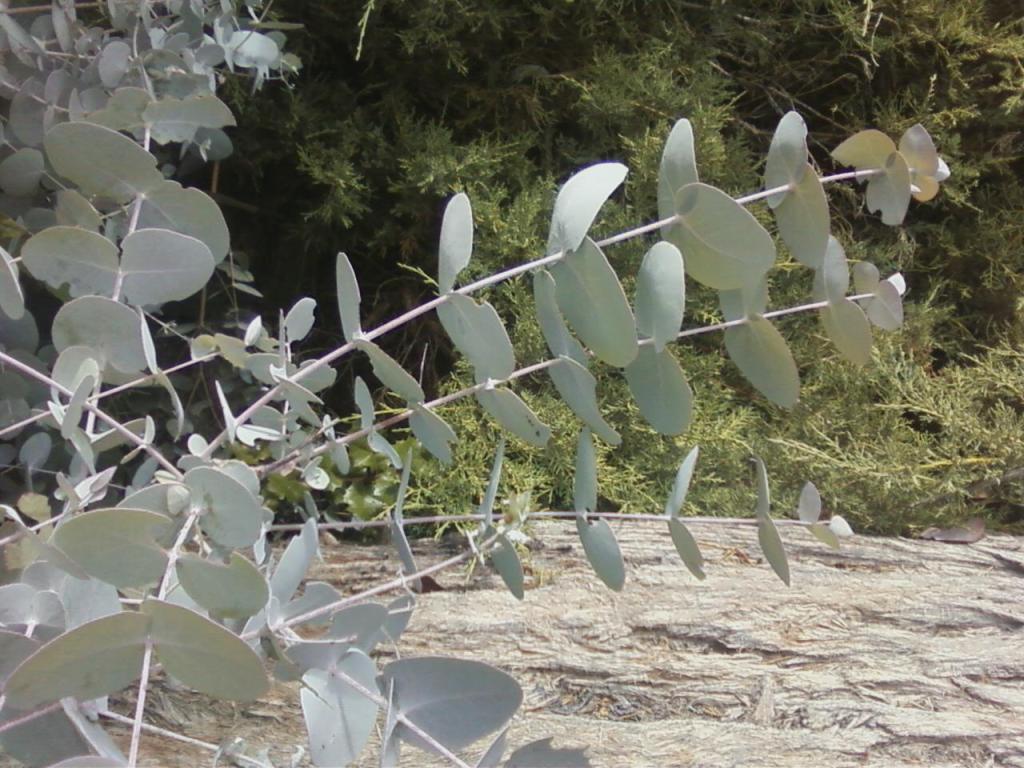
Silver mountain gum needs no irrigation once established.
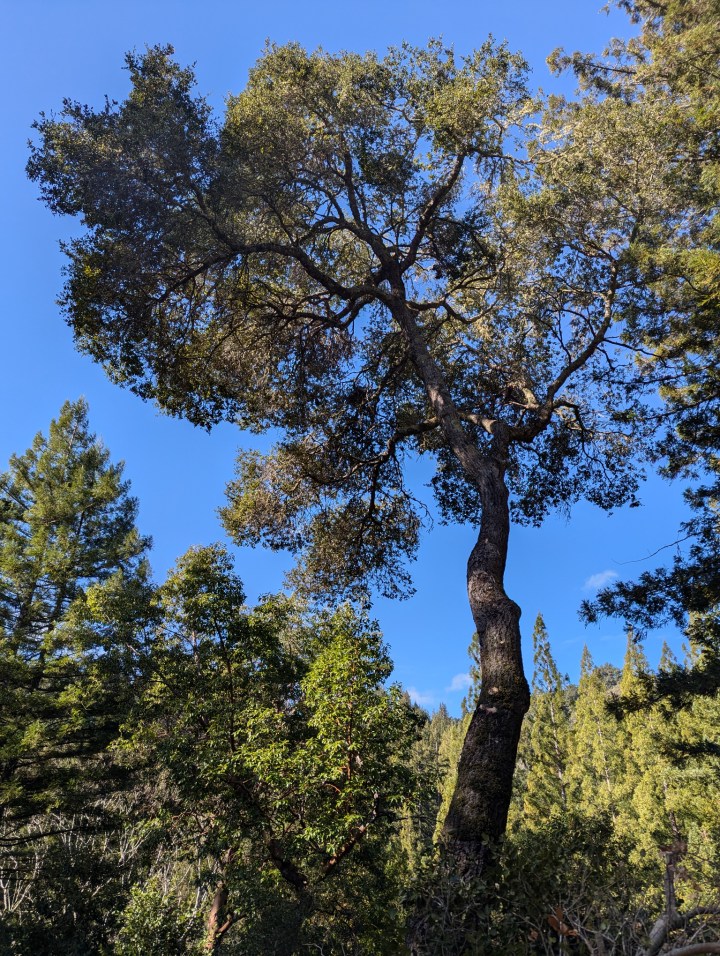
The bulky trunk and limbs, and shaggy bark of silver mountain gum, Eucalyptus pulverulenta, seem like they should be associated with a more imposing tree. Mature specimens are rarely more than twenty five feet tall. Those that try to get taller often fall over or break apart because they are unable to support their own weight, particularly if watered too generously. Aggressive pruning in spring and summer limits size, and also promotes an abundance of silvery juvenile foliage, which is popular as cut foliage.
Juvenile leaves are round and sessile (without petioles or stalks), and arranged in strict four-ranked formation. (Each pair of opposite leaves alternates with similar but perpendicular pairs.) Adult foliage is almost lanceolate (lance shaped) and not quite as silvery. Small, white, staminate flowers (without obvious petals) bloom between leaves from autumn through winter. Young stems have peeling bark.
Like almost all eucalypti, silver mountain gum gets established most efficiently and grows best if planted while small. They are actually best grown from seed, which can sometimes be obtained online. The next best option, which is actually least common, is #1 (1 gallon) trees. #5 (5 gallon) trees are typically the smallest trees available. Larger trees are likely to have problems dispersing their roots. Once established, silver mountain gum needs no fertilizer or watering.
“Cedar” is a common name of a few species of a few genera that are not actually cedars. Western red cedar is an arborvitae. Eastern red cedar is a juniper. Deodar cedar, Cedrus deodara, happens to be one of only three real cedars. Atlas cedar and cedar of Lebanon are the other two. Cultivars of Atlas cedar are uncommon. Cedar of Lebanon is very rare.
Although too big for compact gardens, deodar cedar is one of the more popular conifers. It performs splendidly within local climates and soils, as if it is right at home. Mature trees can survive without irrigation. Roots are generally complaisant, and disperse too deeply to displace pavement. However, deodar cedar can grow fifty feet tall and thirty feet wide.
Deodar cedar mostly develop casually conical form. Some develop multiple trunks or big limbs that eventually curve upward like trunks. Otherwise, limbs tend to droop somewhat at their tips. Glaucous grayish needle leaves are about an inch or two long. Most occur in terminal clusters of short spur stems. Some develop singly on elongated vigorous stems. Foliar debris has an herbicidal effect on the ground below.
Pavement necessitates trees with complaisant roots.
Trees of substantial size are not as popular as they had been among old home gardens. Modern landscapes of bigger homes on smaller parcels can not accommodate as many. Clearance from various infrastructure is now more of a concern than shade. Within many modern urban gardens, most available space is in front. Such is the realm of street trees.
This is not because of a lack of obstacles, such as infrastructure that requires clearance. It is more because such obstacles are closer to the ground with more open space above. Many street trees must actually be more adaptable to certain constraints than other trees. Selection of such trees, if allowable by their municipalities, necessitates diligent scrutiny.
Street trees are, most simply, trees between curbs and sidewalks. Some inhabit medians while others are adjacent to curbside sidewalks. Many municipalities prescribe particular trees for particular situations. Anyone who is uncertain of such limitations should inquire. Many municipalities permit property owners to install any trees they prefer, or none at all.
For those who can select street trees, such trees must be appropriate to their application. They must grow high enough to not obstruct sidewalks or roadways. Both sidewalks and roadways require minimal clearances. So do street signs, streetlamps and traffic signals. However, street trees should not grow too large for the confined spaces that they inhabit.
This includes their roots. Aggressive roots of willows, poplars and sweetgum are likely to displace pavement. Oaks, although too big for confined situations, are more docile. Their roots are less likely to displace adjacent infrastructures. Crape myrtle has become overly common because it is too small to cause damage. It does not make much shade, though.
Crape myrtle might also get rather messy, which is another consideration for street trees. It drops flowers during summer, and can get infested with scale, which exude honeydew. Magnolias drop flowers that can be a slipping hazard. Whether deciduous or evergreen, street trees should be reasonably tidy. Over roads, they should not need much attention.
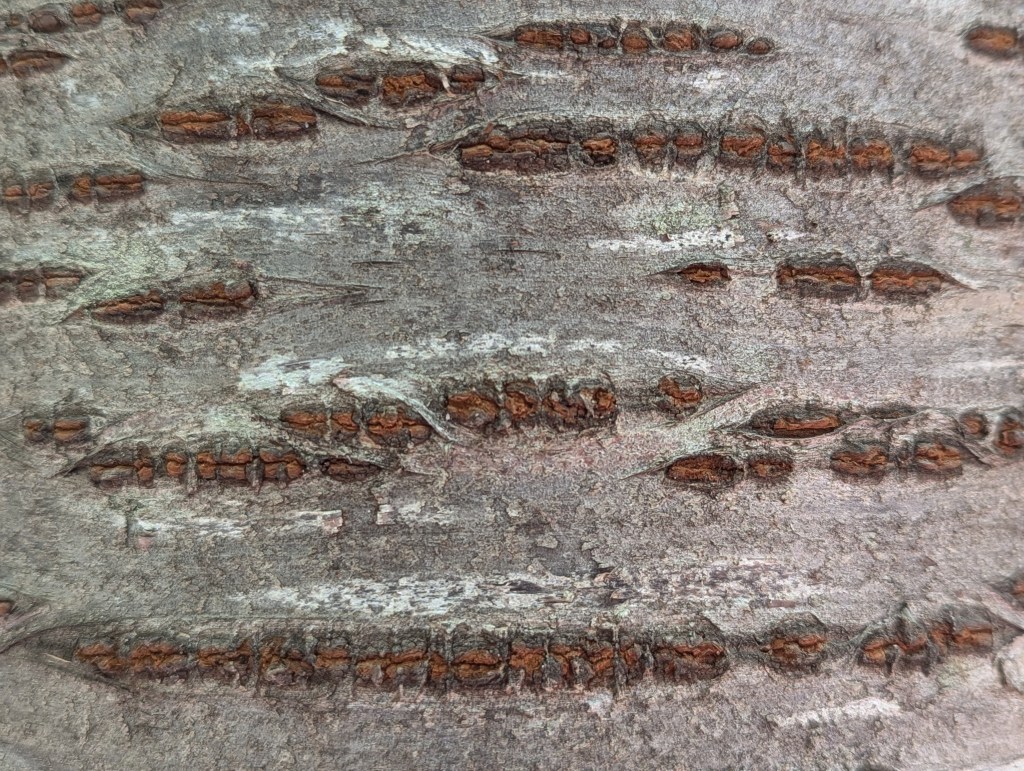
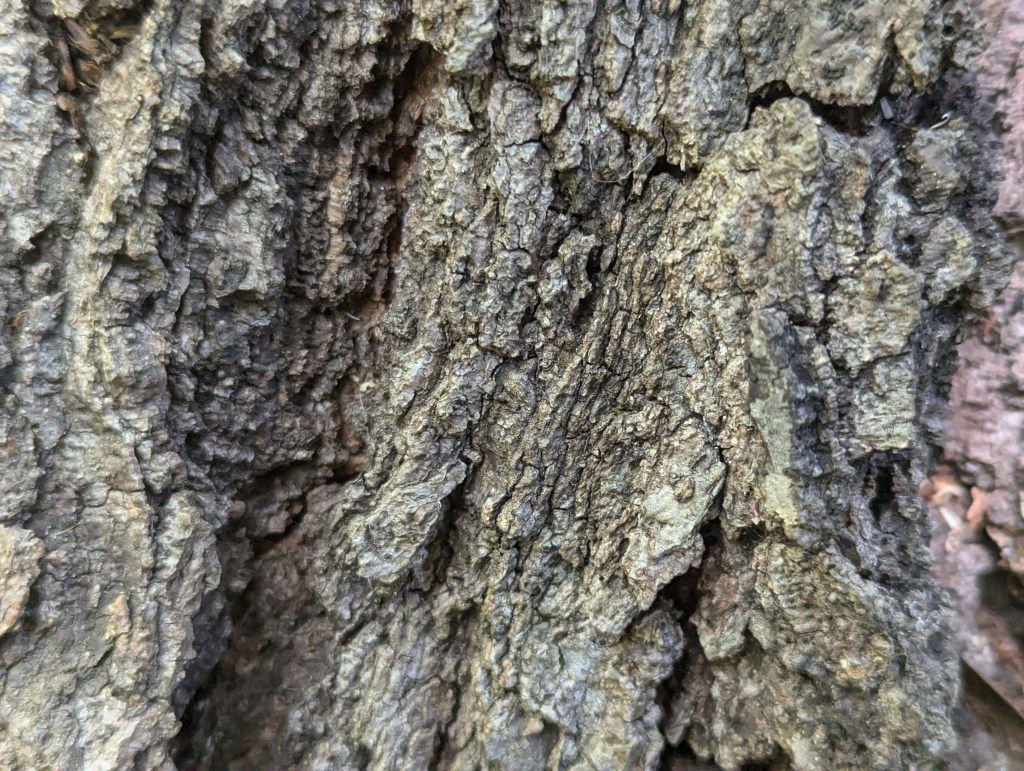
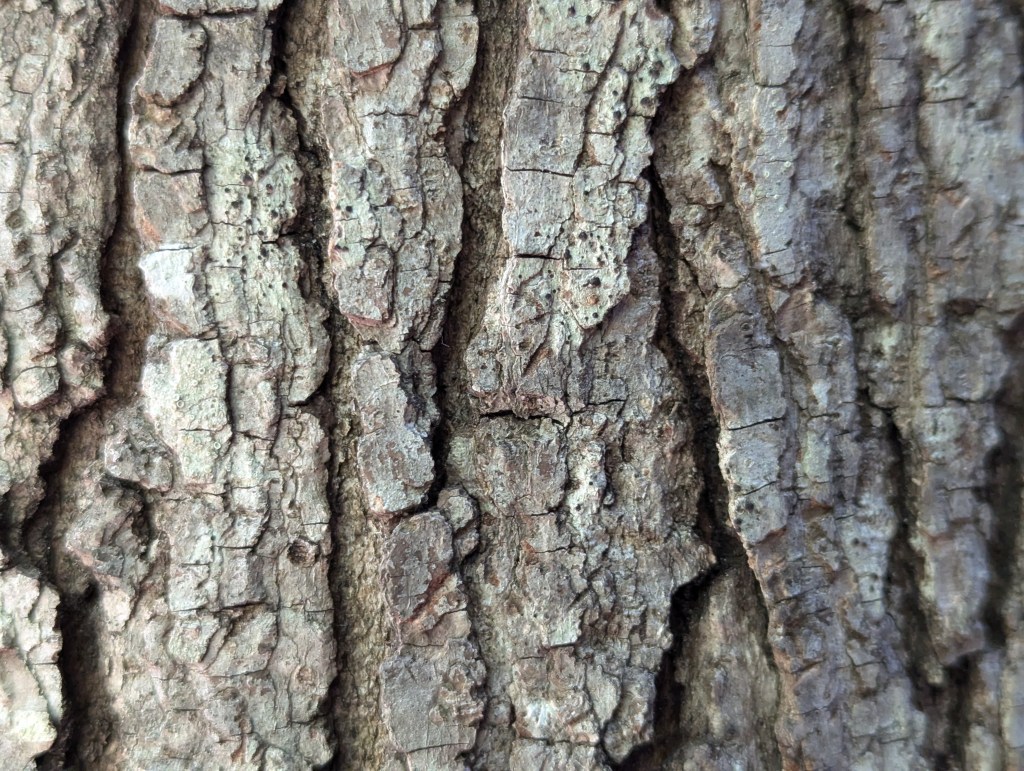
Bark was actually not Rhody’s suggestion. It was simply a convenient theme while it was difficult for me to get out to take other pictures. These are six trees that I worked around yesterday. I could recycle this theme for native species.
1. Sequoia sempervirens, coastal redwood is the Official State Tree of California, and the tallest tree species in the World. Although native, this particular specimen was grown in a nursery, and is the cultivar ‘Soquel’. It was installed into its landscape likely after 1989.
2. Metasequoia glyptostroboides, dawn redwood is the only of three species of redwood that is not native to California. It is also the only deciduous redwood. Sequoia gigantea, giant redwood, is also represented by a young tree, but I did not get a picture of its bark.
3. Prunus serrulata, flowering cherry seems to be the cultivar ‘Kwanzan’. Perhaps shade from surrounding redwoods, birches, sweetgums and dogwoods interfere with its bloom profusion. Individual flowers are a bit smaller than they should be for typical ‘Kwanzan’.
4. Betula pendula, European white birch has distinctly white bark, but also exhibits dark brown or black furrowed bark at the bases of large trunks. I tried to take pictures of both for contrast, but the white bark seemed too gray. I could have gotten both in one picture.
5. Liquidambar styraciflua, sweetgum bark goes through different phases as it matures. Young twigs initially exhibit smooth bark. Then, their smooth bark develops corky wings that grow as the stems grow. Somehow, mature bark shows no evidence of former wings.
6. Cornus florida, flowering dogwood is supposedly easy to identify by its ruff bark. I do not get it, though. Of these Six, only flowering cherry has more finely textured bark. This particular tree does not bloom so well, but produces spectacular foliar color for autumn.
Like the many different kinds of physicians who work in a hospital, there are many different kinds of horticultural professionals who specialize in particular disciplines. Although too commonly considered to be ‘landscapers’, and even though many do not work directly with landscapes, there are nurserymen, gardeners, landscape architects, horticulturists and arborists, to name a few.
Arborists specialize in the horticulture of trees. Only a few decades ago, arborists were known as tree surgeons, since they perform surgery on trees. Of all the horticultural physicians that attend to concerns in the landscape, arborists and their associated technicians are the most qualified to properly maintain trees.
Expecting a gardener to maintain large mature trees is like expecting a pediatrician to perform major surgery. Even the most proficient and educated gardeners are too specialized with maintaining other plant material in the garden to also be specialized with arboriculture, or the horticulture of trees.
Arborists who are certified by the International Society of Arboriculture, or ISA, have successfully passed and examination of their arboricultural aptitude. Certification must be maintained by attendance to educational seminars, workshops and other relevant events approved by the ISA.
The website of the International Society of Arboriculture, or ISA, at www.isaarbor.com, is the best resource for finding certified arborists and the tree service establishments that they are affiliated with. Arborists can be found within particular regions by city or ZIP code, or identified directly by name or certification number.
The ‘Public Outreach’ category at the ISA website features links to www.TreesAreGood.org, and ‘Why hire an arborist?’, as well as a few other links for consumers. After all, the website exists not only for professionals, but also to help consumers find professionals and to make responsible decisions about their trees, from the time they get planted, throughout their lifetime, and until they get old and eventually need to be removed.
The www.TreesAreGood.org link has all sorts of information about trees and their maintenance. There are many and various articles about the benefits of trees, the value of trees, tree selection, planting new trees, proper pruning techniques, insects and diseases, tree hazards, why topping hurts trees, and even an article about palms. Incidentally, the Fun Facts link mentions that the tallest tree is the coastal redwood, the biggest tree is the giant redwood, and oldest tree is the bristlecone pine, all of which are native to California.
Trees are of course the most substantial components of a landscape. Some will be around for years. Some will be around for more than a century!
Not many arborists or horticulturists are fond of the unremarkable but very popular London plane tree, Platanus X acerifolia. It soon gets too large for many of the tight situations it gets planted in, more than thirty feet broad and more than forty feet tall. Although it is among the most common of street trees, it can produce aggressive buttressed roots that displace sidewalks and curbs. Fuzz (tomentum) from the leaves is irritating to the skin or if inhaled.
Older trees that were planted prior to the development of disease resistant varieties are very susceptible to anthracnose and mildew, and are likely to infect other susceptible plants. Infected trees often get their foliage late in spring (after earlier new foliage shrivels and falls), or defoliate by late summer. Otherwise, the slightly raspy eight inch wide leaves seem sickly as they turn grungy yellowish brown in autumn.
Landscapers use London plane trees too commonly merely because they are so reliable. They tolerate most soils, smog, severe exposure (such as reflected glare from pavement) and a bit too much watering. Modern varieties are not quite as susceptible to disease. ‘Yarwood’ has large rounded leaves that are resistant to mildew. ‘Bloodgood’ is less susceptible to anthracnose. ‘Columbia’ is less susceptible to both diseases.
Large limbs and trunks with mottled gray and tan bark are rather sculptural while bare through winter. London plane happens to be conducive to annual pollarding, which makes the limbs even more sculpturally gnarly, and produces more vigorous growth with larger leaves that are less susceptible to disease.
Trees are the most significant components of the landscapes that they inhabit. They get larger than all other plants, and live for decades or centuries. Because inappropriate trees have such potential to cause such serious problems, and can be so difficult and expensive to remove, it is important to select trees that are appropriate to each particular application.
Size and form of trees when they mature are important considerations. Crape myrtles are small to midsized trees that fit nicely into tight spots, but are too dinky to be good street trees. London plane trees are more proportionate as street trees, but eventually displace sidewalks and curbs with their aggressive buttressed roots. Chinese elms can be good street trees, but need to be pruned regularly to maintain clearance. Red maples are a better choice because they get large enough without getting too big, have complaisant roots, and are easily pruned for adequate clearance.
Other features in the area can limit tree selection. Poplars and willows have aggressive roots that invade septic systems or old unsealed iron or terra cotta sewer pipes. Queen palms eventually reach utility cables, but can not be pruned to go around them. Any good shade tree can provide too much shade over solar panels. Partial shade from large trees or structures is a problem for most other trees, but is actually preferred by a few ‘understory’ trees like vine maples, Japanese maples and dogwoods.
Trees that are expected to provide shade through summer should probably be deciduous, like red oaks or silk trees, to allow warming sunlight through during winter, particularly close to the home. However, trees that should obscure unwanted views should be evergreen, like Southern magnolias or arborvitaes.
Some trees that need more attention than others are only appropriate where they will get the attention they need. Mexican fan palms are easy to care for while young, but eventually grow out of reach and need to be groomed by professional arborists. Of course, every tree is limited to particular climates. Various ficus trees that are common in nurseries in San Diego will not survive even a mild frost, which is why they are not available in San Jose.
Actually, this does not even qualify as pollarding. It looks as if this tree, which was one of a few similarly damaged Acacia melanoxylon, black acacia trees, was in the process of being removed when the crew who was removing it left for the day. It would not have been so bad if they had returned to remove it and the others completely. They did not. This was the finished product. It and the others were almost twenty feet tall in this condition. They were about twice as tall prior. This sort of hack job is what gives pollarding a very bad reputation. It also demonstrates why proper pollarding should not be so vilified that arborists do not learn how to do it. Very obviously, this is not proper. Because they could not be salvaged, all of these trees were cut down a few days after I got this picture.
Pollarding can be done for a variety of reasons, and has been done for centuries in various cultures. It is still respected technique in many or most cultures. It stimulates vigorous growth that can be fodder for some types of livestock, including silkworms who consume the vigorous foliage of pollarded white mulberry trees. It can prevent some trees from producing troublesome pollen or fruit, such as old orchard olive trees that were retained as homes and their respective gardens were constructed around them. It can enhance autumn foliar color for some types of deciduous trees, such as the old Schwedler maples that were formerly common as street trees in San Jose. It stimulates growth of vigorous cane stems that are useful for basketry, fences, trellises or kindling. Locally though, it is considered to be as egregious as the technique pictured above, which is why no one here learns about it.