Palms take commitment. Some of the most popular grow too big for their situations. Most grow so tall that only arborists can maintain them. None are conducive to pruning to limit their natural height. Individual palm trunks rely on their single terminal buds, which grow only upward. Diversion is not an option for any palm that encroach into electrical cables.
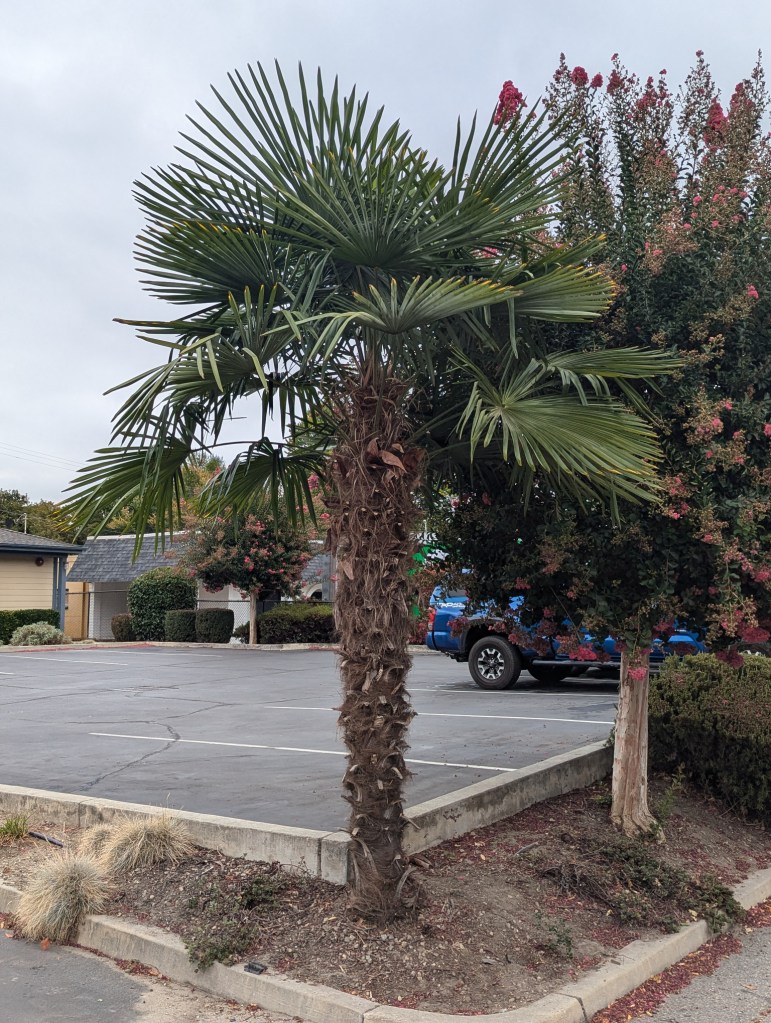
Windmill palm, Trachycarpus fortunei, is one of the more complaisant of palms. It can not grow around utility cables, but otherwise does not grow obtrusively big. Young trees can grow fast to fifteen feet tall, but then grow slowly to double their height. Only a few elderly trees grow as tall as forty feet. Their foliar canopies are generally less than ten feet wide.
Trunks of windmill palms are distinctively shaggy. Pruning dead fronds as closely to their trunk as possible promotes a neater appearance. Because growth decelerates with age, trunk shag is typically wider higher up. Trunks are about half a foot wide, but seem twice as wide since they are so shaggy. Gathering seed from pollinated female trees is simple.
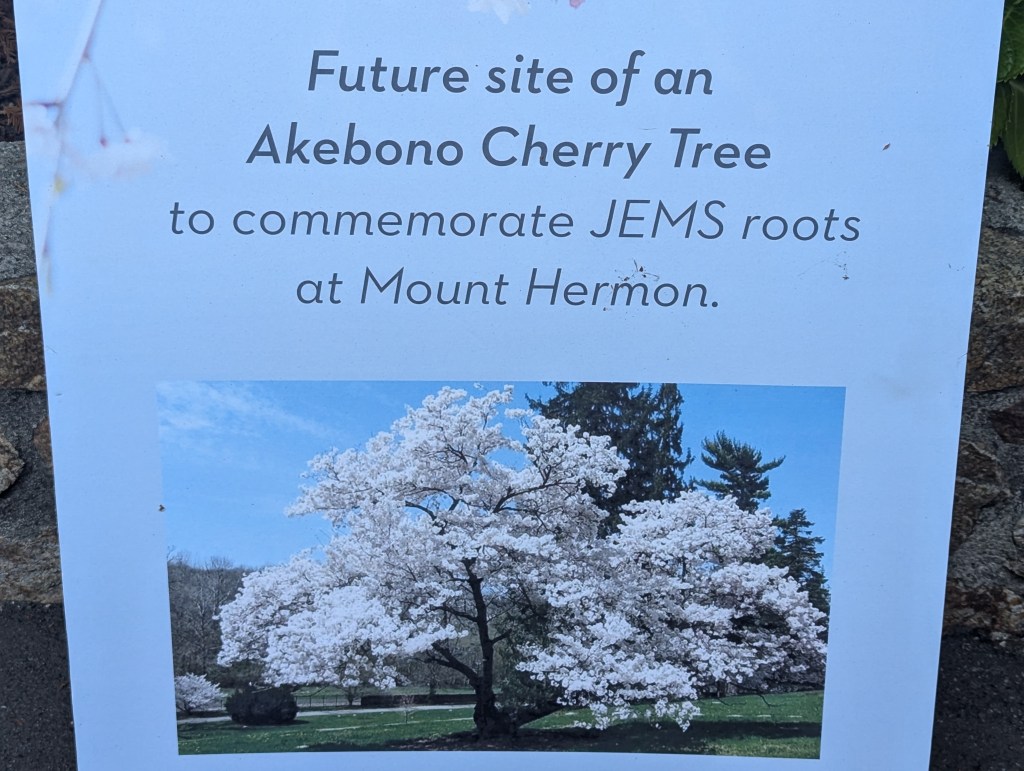
Yoshino is such an elegant name! It is the middle name of one of my nieces. A few of the flowering cherry trees here are very likely cultivars of Yoshino flowering cherry. Another recently arrived. It is a Commemorative Tree from the Japanese Evangelical Missionary Society, which we know simply as ‘JEMS’, for three quarters of a century of involvement with Mount Hermon Christian Conference Center. Its cultivar name is ‘Akebono’. We do not install many trees here, and we are more concerned with cutting trees down, but this tree is very special. It is situated very prominently on the central Mall at Mount Hermon where its spring bloom will be spectacular. It already seems to be a venerable Historical Tree that lacks only age. Now that it is here, it will acquire that eventually.
1. The Japanese Evangelical Missionary Society, or JEMS commemorated three quarters of a century of involvement with Mount Hermon with this gift of a flowering cherry tree.
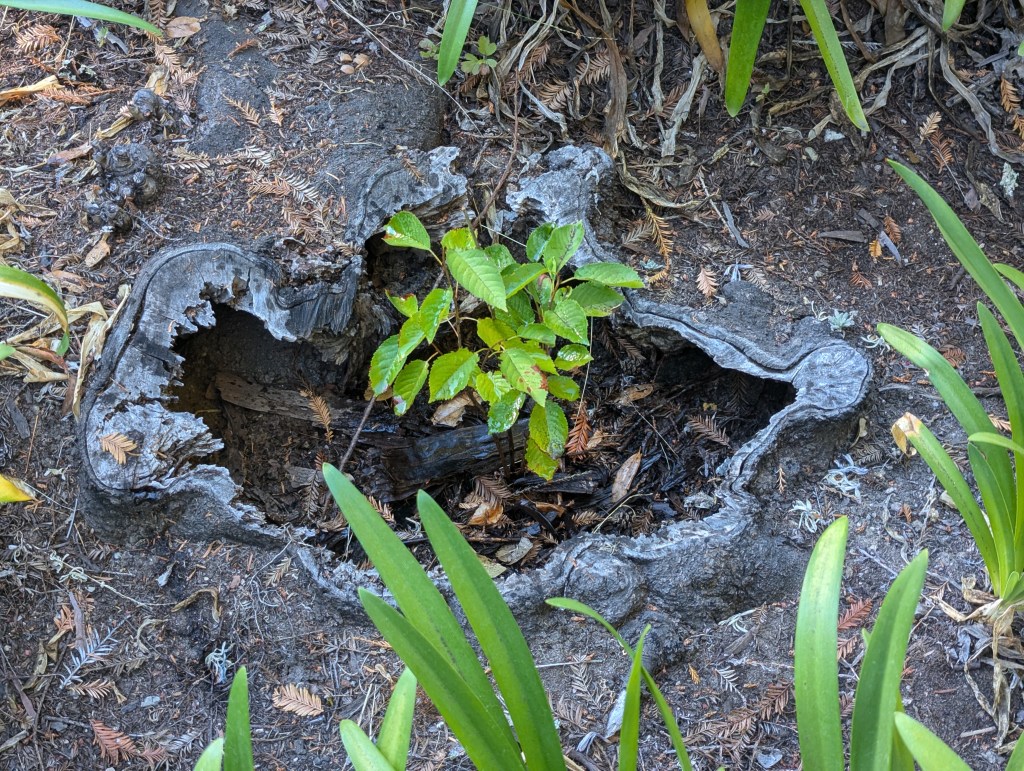
2. Unfortunately though, the pair of tiny flowering cherry trees that I installed to replace a very deteriorated and elderly pair of the same is already obsolete before it got to grow.
3. This pair of tiny flowering cherry trees grew from suckers from the original ungrafted pair, so are genetically identical, and are installed within the stumps of the original pair.
4. The new Commemorative Flowering Cherry Tree is much more prominent and better situated than the original pair, which was there prior to some of the adjacent pavement.
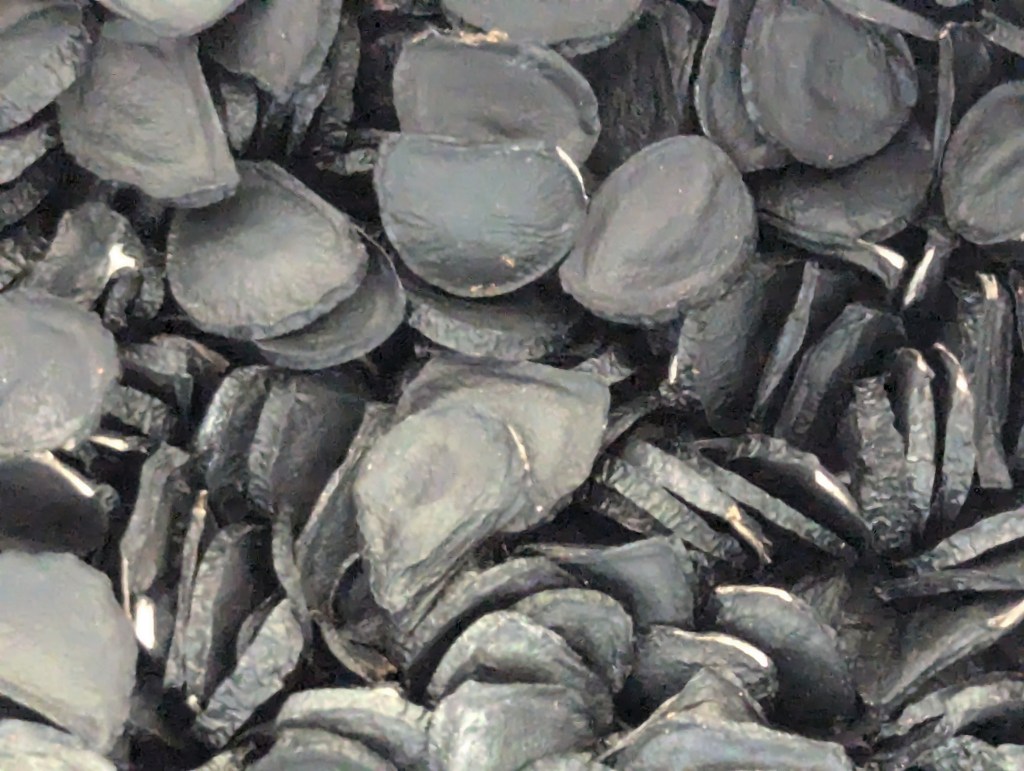
5. In other news, seedpods from (Hespero)Yucca whipplei, chaparral yucca, supposedly without its specialized pollinator, generated quite a few of what seems to be viable seed.
6. Also, Hedychium gardnerianum, kahili ginger that bloomed prematurely for the first several days of August is blooming again and more appropriately for the end of summer.
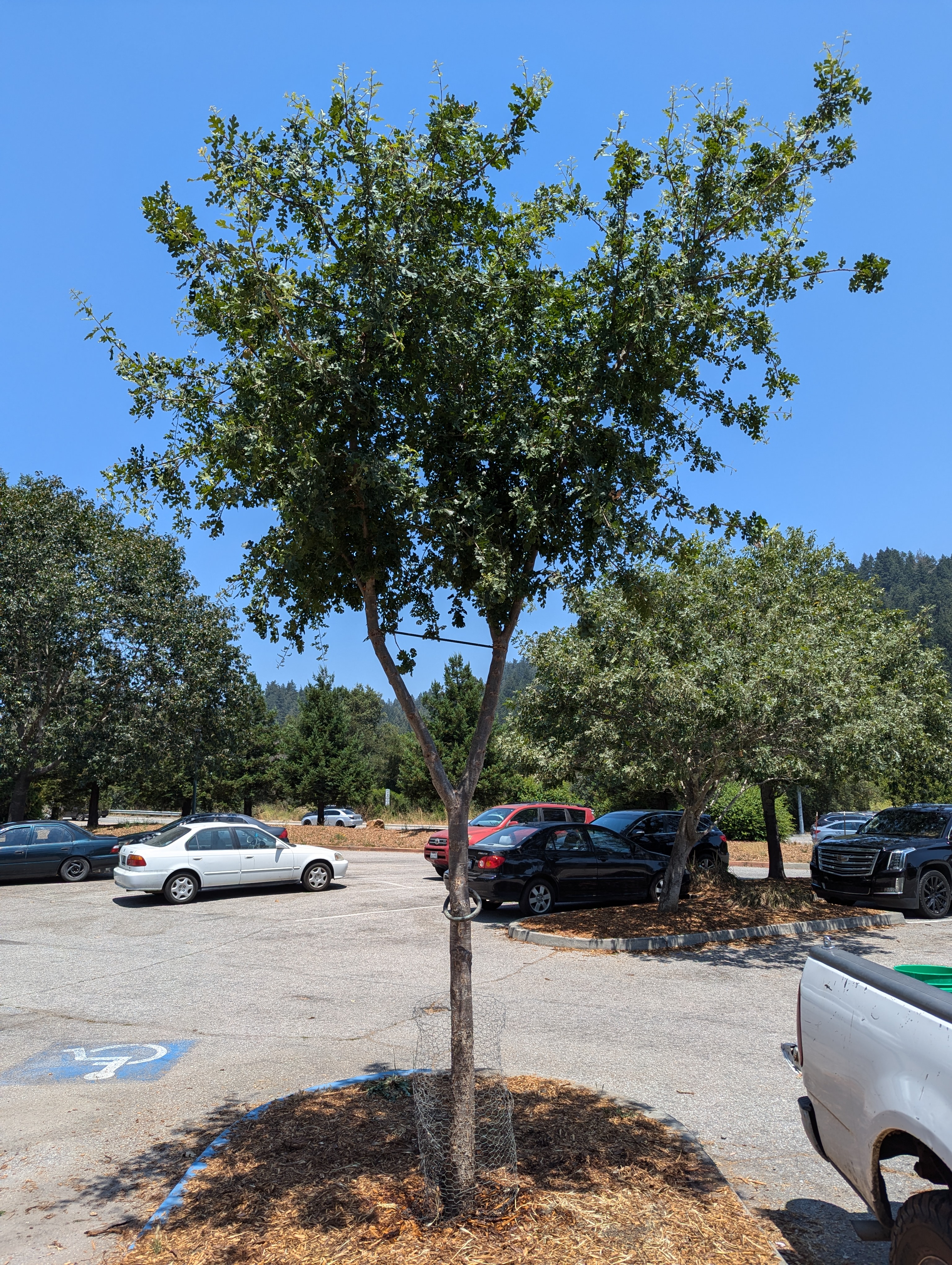
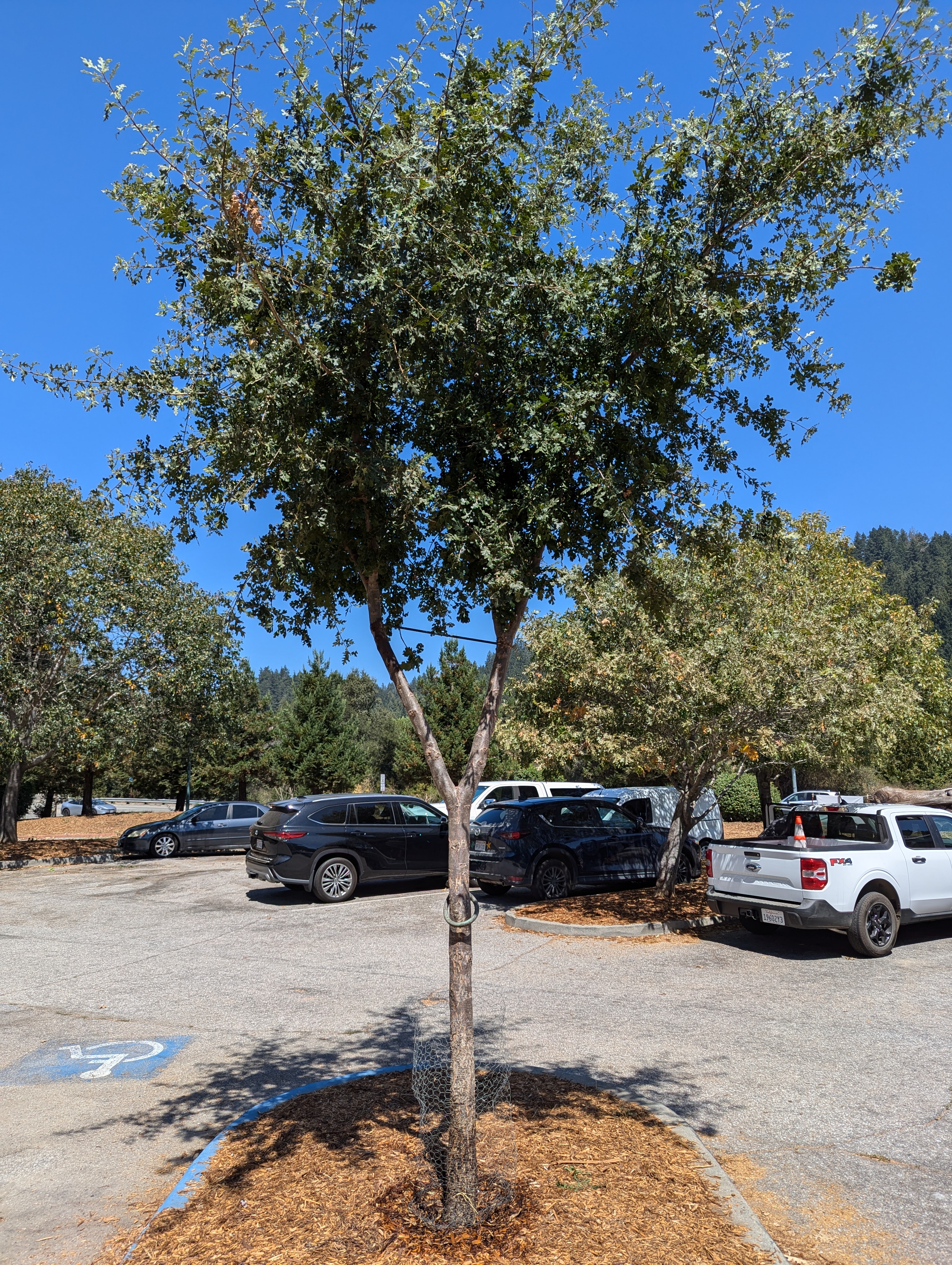
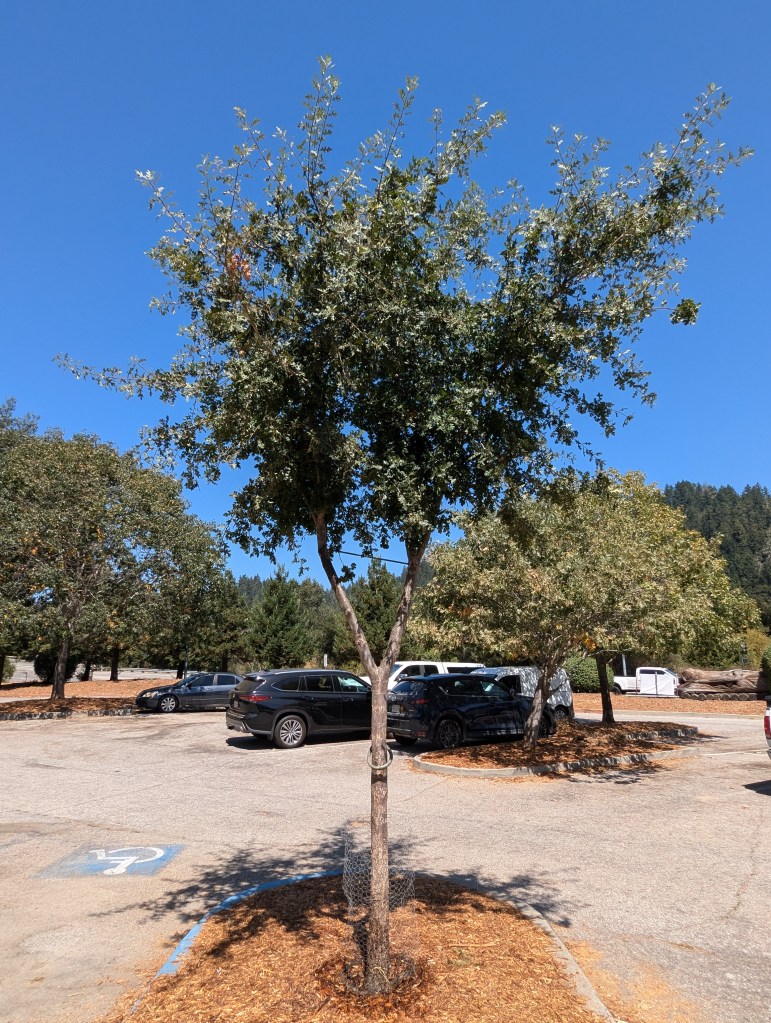
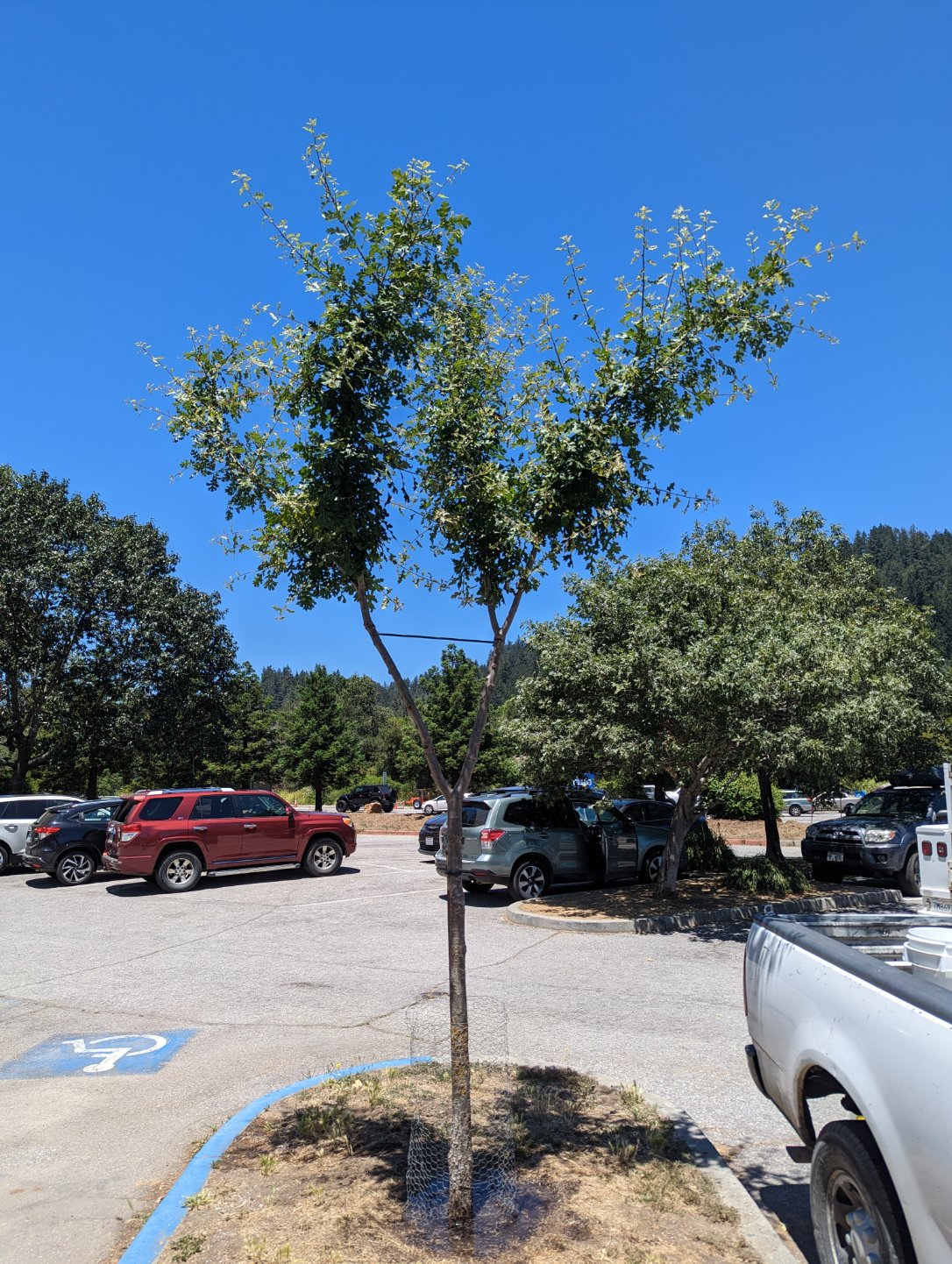
What a difference seven weeks can make! Updates regarding the Memorial Tree in Felton Covered Bridge Park are typically posted annually about the twelfth of July. Growth is obvious after a year. I did not expect it to be so obvious after less than two months between the twelfth of July and the thirtieth of August. I suppose that I should not be surprised. Even after most growth occurs through spring, some growth continues through late summer, and perhaps as late as the beginning of autumn, immediately prior to the slow initiation of dormancy for winter. Specimens of this species, valley oak, Quercus lobata, are innately vigorous and grow faster and more vertically while young. Growth decelerates and redirects itself laterally as trees mature and age. Otherwise, if they continued to grow as vigorously as they do while young, they would collapse from their own weight before they get to be as old as elderly trees get. Some live for more than six centuries, so their technique is obviously effective. Four nearby California black oaks, Quercus kelloggii, are not likely to get to be five centuries old, and are more likely to live for only one or two centuries. Unfortunately, two of them are not in comparably exemplary condition. One must be pruned for removal of major necrosis, and direction of new growth. Another requires major structure pruning. All four should be pruned for clearance above the surrounding parking lot. Perhaps I should be more concerned with these four California black oaks now that the Memorial Tree will need nothing for quite a while. Perhaps I should investigate the condition of the Monterey cypress Memorial Trees within the nearby Memorial Grove, which are growing well enough that surrounding box elders should be pruned away to relinquish more space for them.
Planting trees often involves staking. Until they disperse new roots, many new trees rely on stakes for stabilization. Their stability is limited by the initial confinement of their roots. Nursery stakes and their associated binding provide different support. They merely direct straight trunk growth. In a home garden, nursery stakes subordinate to landscape stakes.
This process is different for different trees. Small palm trees need no staking at all, either in nurseries or home gardens. Spruce trees are too stout to need support after they grow beyond their nursery stakes. Camphor trees may need both types of stakes concurrently. Landscape stakes maintain their stability as nursery stakes maintain their trunk integrity.
Typically though, landscape stakes completely replace nursery stakes of most trees. For adequate stability, they must extend into undisturbed soil below excavated soil. For most trees with bare trunks, such staking should reach lower limbs. Some trees need only one stake. Some, particularly those with large canopies, may need a pair of opposing stakes.
Straps that attach trees to their landscape stakes need proper installation also. They are more durable than nursery binding, but must not be too restrictive. They should only hold trees upright without interfering with their natural development. Straps should be as high as practical on their respective stakes. Additional ties may be needed to prevent bowing.
Some old fashioned straps are strips of old tires with bailing wire at each end. Others are simple bailing wire through bits of old hose. Modern straps are more refined and diverse to facilitate staking for diverse subjects. They should cross over between the stakes and the trees they support to limit abrasion. Short nails may attach them firmly to their stakes.
Staking should be as unobtrusive as possible. Trunks that can move somewhat freely in mild wind are studier than those that can not. Binding for trees that initially require it with staking should be as loose as practical. Incremental loosening might be safer for weakly limber trunks. Without loosening, tight binding might harmfully constrict trunk expansion.
The Memorial Tree is becoming a productive member of its ecosystem!
Every year, there is less to write about regarding the Memorial Tree in Felton Covered Bridge Park. That is because every year, it becomes more independent. It no longer needs structure pruning for clearance above the surrounding parking lot. It no longer benefits from supplemental irrigation. The mesh around the base of the trunk really should be removed. So should the truss between the two lowest main limbs. The stake remains merely as a precaution for strong winds, but is likely completely unnecessary. It can be removed after defoliation next winter. The trunk is quite sturdy. Growth is quite vigorous. The branch structure seems to be rather awkward, but such structure is normal for such young specimens of this particular species, and is very unlikely to compromise structural integrity as the tree matures. The canopy is slightly asymmetrical, but not problematically so. The crew who maintains the park replenishes the mulch within the parking lot island around the tree more regularly than they had in the past, and cuts weeds when necessary. They are very protective of this tree, so pull weeds between the trunk and the surrounding mesh rather than get too close to the trunk with their weed whackers. Recently, a neighbor pulled weeds before weed whacking became necessary. Although oaks can technically bloom and produce acorns after only about five years, almost all delay bloom until they are about twenty years old, and some wait until they are twice as old. A lack of bloom this early is therefore normal. The development of two oak apples was a surprise though. Apparently, an oak apple gall moth considers this tree to be mature enough to sustain its eggs. It is as if this little Memorial Tree is already growing up to become a productive member of its ecosystem!
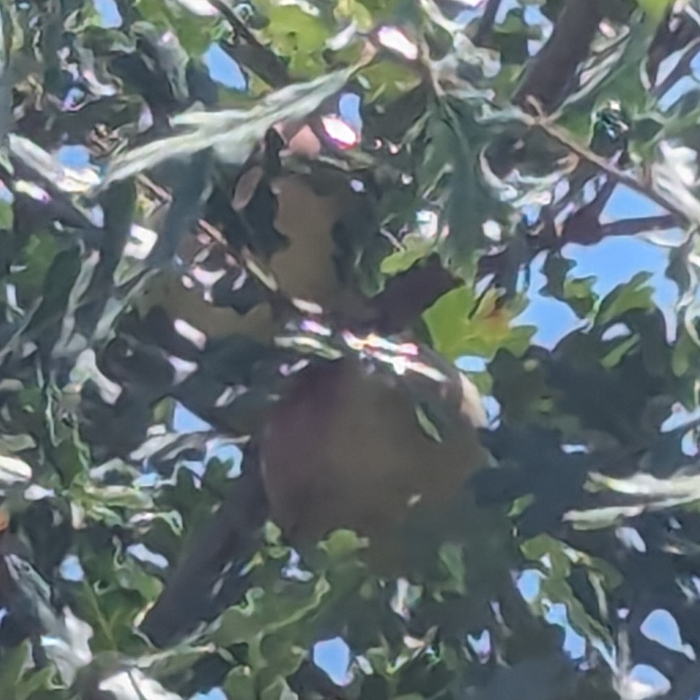
From the ground, I could not get a good picture of these first oak apples.
Electrical cables are hazardous! There is no need to elaborate. That is why high voltage electrical cables are either subterranean or aerial. Subterranean electrical cables remain safely out of reach underground. Aerial electrical cables remain safely out of reach about thirty feet above ground. However, electricity is always dangerous regardless of location.
Excavation can inadvertently expose subterranean electrical cables. Pruning large trees can similarly involve minimal proximity to aerial electrical cables. Home gardening rarely involves such deep excavation. However, it commonly involves arboriculture, or pruning, of big trees. When it does, the most eager of garden enthusiasts must know their limits.
Clearance pruning eliminates obstructive vegetation. Ideally, it prevents it from becoming obstructive before it does so. It is useful for roadways, walkways and chimneys, and also protects roofs from damage. Yet, it sometimes necessitates the service of professionals. For example, pruning trees over major roadways is likely too hazardous for anyone else.
Pruning trees over high voltage electrical cables is even more hazardous. However, it is also necessary. That is why electrical service providers employ professionals to perform such tasks. Unfortunately, proper arboricultural technique is not a priority. Reliability and safety of electrical service are. It is efficient, but can severely damage any involved trees.
What is worse is that such damage is also dangerously close to utility cables. Corrective procedures also require the services of specialized arborists. Utility service providers do not assume any associated expenses. Removal might be more practical than salvage for the most severely mutilated trees. Salvage of decapitated palm tree trunks is impossible.
Selection of appropriate trees can limit such problems in the future. With few exceptions, palms are inappropriate within aerial utility easements. Almost all grow only upward with solitary terminal buds. Conversely, some large shrubbery is conducive to pruning to stay lower than cables. So are a few compact trees. Several stay lower than cables naturally.
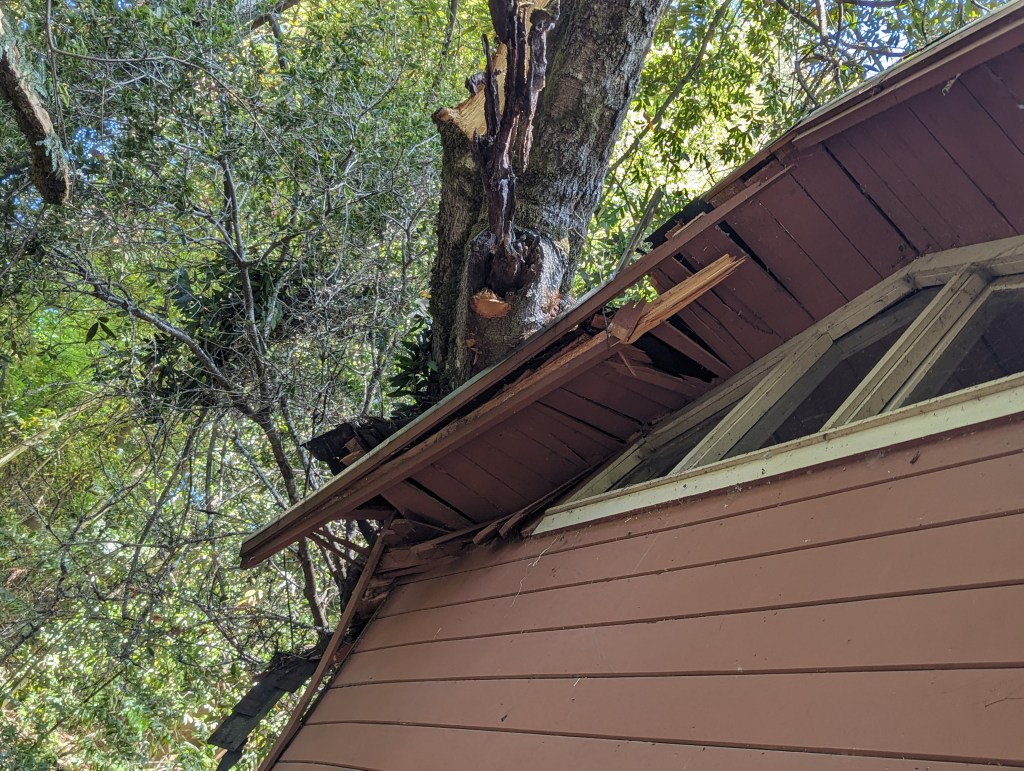
What goes up must come down. This elderly and deteriorated Shreve oak may have taken more than a century to go up, and then suddenly came down within only a few seconds. Unfortunately, it was not at all graceful about doing so, as it landed on this unoccupied cabin and a nearby bay tree. The cabin can be repaired. The bay tree needed to be removed with the fallen Shreve oak. Nature is messy like that. Some might say that it is also inconsiderate. Regardless, it can be difficult to live and work with. Most of our landscapes are adjacent to natural ecosystems. All are dominated by big natural trees, including coastal redwood, which is the tallest species of tree in the World. Even if none of the big trees are directly within some of the landscapes, some of such trees are big enough to drop debris or limbs within landscapes that are significant distances away; or worse, they can fall into the landscapes. As much as we try to limit such risks, nature, besides being messy and potentially inconsiderate, is also generally unpredictable. However, one of only a few aspects of nature that is always reliably predictable is gravity.
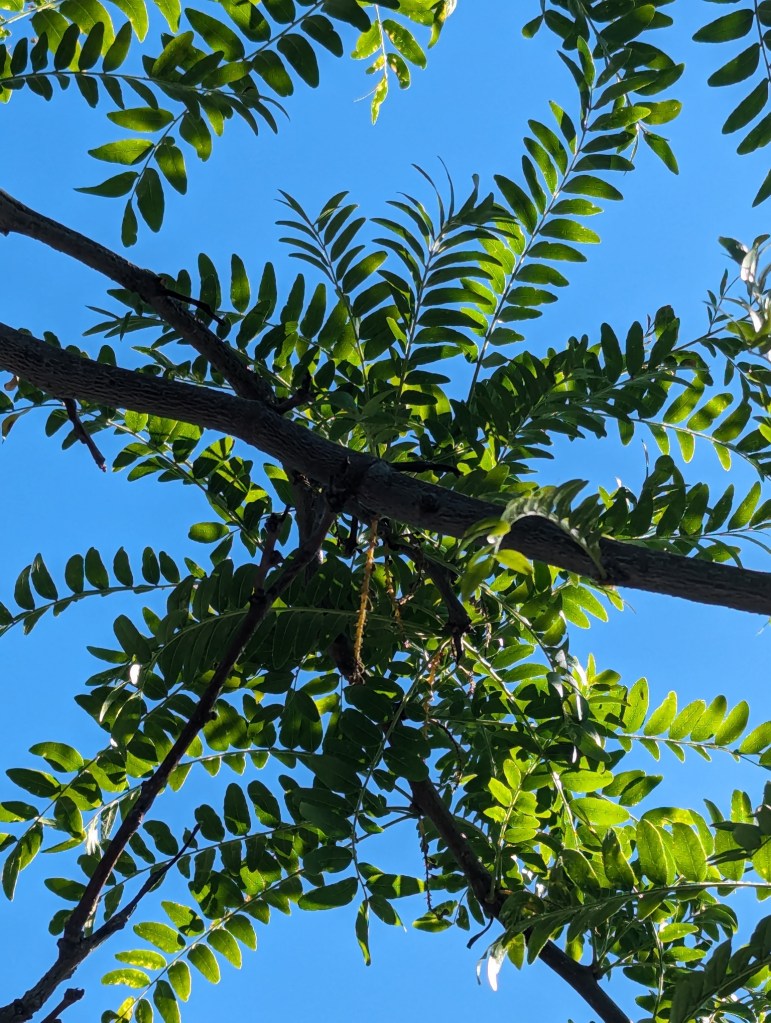
Within its native range, wild thorny honey locust, Gleditsia triacanthos, is a nasty tree! Its wicked thorns are typically as long as four inches but can be twice as long. Some branch into many thorns or thick clusters of thorns. Thickets of many trees can be impenetrable. Female trees produce a messy abundance of brown pods that are about half a foot long.
Fortunately, its cultivars are much more docile. Most are exclusively male, so produce no pods. Old fashioned cultivars that might produce pods as they mature are now rare. More importantly, cultivars are thornless. That is why their common name is now honey locust rather than thorny honey locust. They are as remarkably resilient as the simpler species.
Most cultivars of honey locust grow no taller or wider than fifty feet here. Some grow only half as tall. Some of the more popular cultivars are brightly yellowish green for spring. At least one is ruddy bronze for spring. The finely textured foliage provides dappled shade. Leaves are pinnately and bipinnately compound, and turn yellow for autumn defoliation. Individual leaflets are less than an inch long, so can be difficult to rake.
Pruning techniques are very diverse to serve various purposes. Dormant pruning during winter concentrates resources for spring or summer growth. Hedging or shearing merely contains growth. Thinning or grooming removes superfluous growth to enhance sunlight diffusion. Clearance pruning directs new growth that might otherwise become obtrusive.
There are too many distinct pruning techniques to mention. Some, such as shearing and thinning, are mutually exclusive. Shearing actually initiates the sort of congested growth that thinning eliminates. Techniques such as dormant pruning and clearance pruning are mutually compatible. After all, almost all pruning is less stressful with winter dormancy.
Clearance pruning merely becomes a concern now as spring growth becomes obtrusive. Much of the worst require professional assistance. Only arboricultural professionals can safely prune trees away from high voltage cables. Such cables are extremely hazardous! Utility services generally try to arrange such procedures before major problems develop.
However, arboricultural professionals are necessary for other clearance pruning as well. Many trees are simply too large or hazardous for anyone but professionals. Some extend over roadways that need clearance for the largest of trucks. Some extend over chimneys that could ignite vegetation that gets too close. Many simply extend beyond a safe reach.
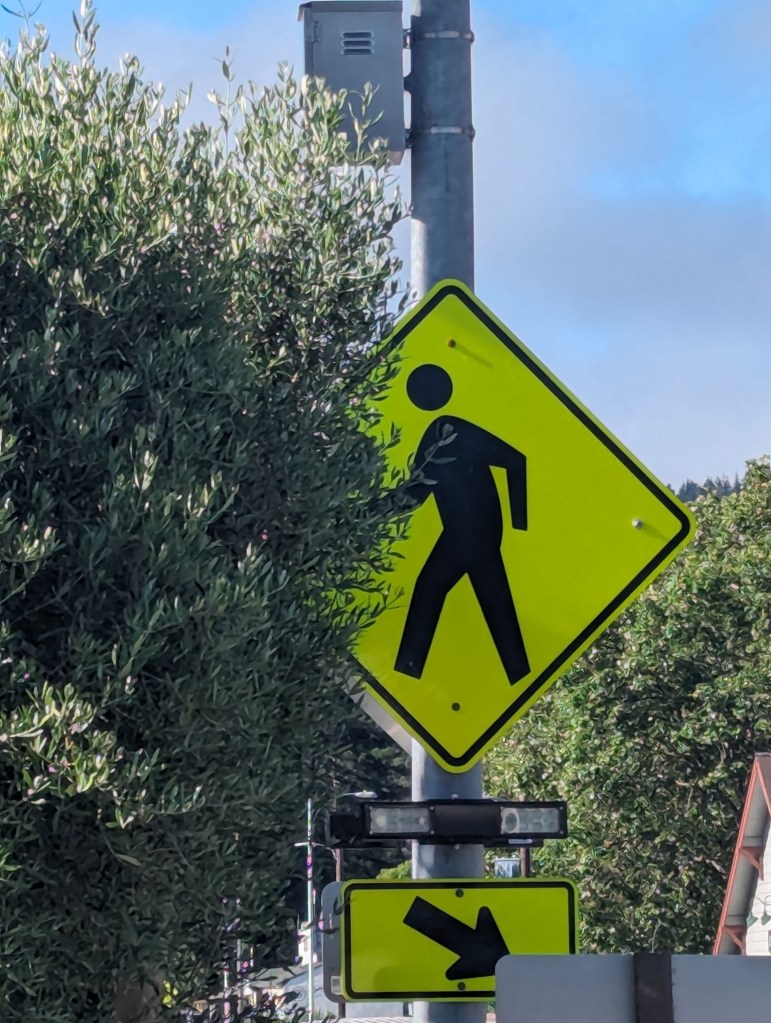
Street trees seem to require the most clearance pruning. They must be a specified height over any roadway, as well as over any sidewalk. Also, they must not obstruct street signs or views for cars backing out of driveways. Ideally, their interference with light from street lamps should be minimal. Vegetation that is closer to buildings presents other concerns.
Besides chimneys and exhaust vents, roofs also need clearance. Stems and foliage are abrasive as they move in any wind. They collect debris that causes rot and clogs gutters. Furthermore, walkways and navigable areas are more efficient with adequate clearance. Clearance pruning should direct growth away from any obstruction, rather than contain it.
Carob eventually develops gnarly branch structure.
John the Baptist survived in the Wilderness of Judah by eating locusts and honey. These locusts could have been large orthopteran insects, such as grasshoppers. However, they were more likely fruits of locust trees, such as carob, Ceratonia siliqua. Both possibilities are both nutritious and kosher. The insects got their name from resemblance to the fruit.
That was almost two millennia ago, and more than seven thousand miles away. Carob is much more popular than grasshoppers here and now. Unfortunately though, within home gardens, the fruit is more of a mess than an asset. Male trees are not messy like females, but produce objectionable floral fragrance. Monoecious trees are both messy and stinky.
Mature trees develop broad canopies that are generally less than thirty feet high. Trunks and main limbs eventually become sculpturally gnarly. Densely evergreen foliage is very shady. Pinnately compound leaves are olive drab, glossy and four to seven inches long. Female orchard cultivars should be fruitless without a pollinator, but are rarely available. Besides, it is impossible to know if a male tree is within pollination range.






 Tony Tomeo