 Most of the familiar vines really are exploitative bullies. They shade the same trees and shrubs that they climb for support. Some will even strangle and kill those who make it possible to get where they want to be. If they do not find trees or shrubs to victimize, they are likely to climb walls and ruin the paint, stucco or siding. Their aggressive nature can be a problem in landscape situations.
Fortunately, there are several vines that are not so aggressive or destructive, such as mandevilla, lilac vine, star jasmine and Carolina jessamine. Other vines that are even more complaisant are light duty perennials and annuals that might grow like weeds while the weather is warm, but then do not have enough time to grow too big or do much damage before they die back through winter.
If flashy color is not important, vining vegetable plants such as pole beans, cucumbers and peas, can cover fences very nicely. On flat fence surfaces, such vines will climb string strung in a vertical zigzag pattern between a horizontal row of protruding nails at the top, and another similar row at the bottom. Unsightly cyclone fences are even better, but will need be harvested from both sides.
Although it is too late to sow beans and cucumbers, a new phase of peas can be sown in mid summer for production in autumn. Fragrant and subtly colorful sweet peas, which are grown for their flowers rather than as vegetable plants, take considerably more effort here. They get started in autumn for the following spring. Trailing nasturtium can get sown at any time, for summer or winter.
As the name implies, perennial pea is a perennial that can get almost rampant, but dies back by autumn.
Passion fruit vine can either be a perennial that dies back to the ground in winter, only to regenerate the following spring, or a somewhat woody vine with wiry stems that survive for several years. Those that retain their vines through winter can get cumbersomely big, or can alternatively be cut back severely late in winter, to behave almost like more docile types that die back for the winter.

 Pink, red or white are the only choices. There happens to be a darker shade of red. Yellow throats are more conspicuous in white flowers. Otherwise, there is not much variation of color amongst the various mandevillas. The flowers are very similar in both color and form to those of related oleander, but are larger. Some are as wide as three inches. Small flowers can have pointed petals.
 Like Ginger and MaryAnn, choosing between the flashier hybrids of clematis and the anemone clematis, Clematis montana, might not be so easy. The fancier hybrids have the bigger, bolder and richly colored flowers that the genus is known for. Anemone clematis has smaller and more subdued flowers in soft pastel hues, but is more prolific, more vigorous, and blooms for nearly a month.
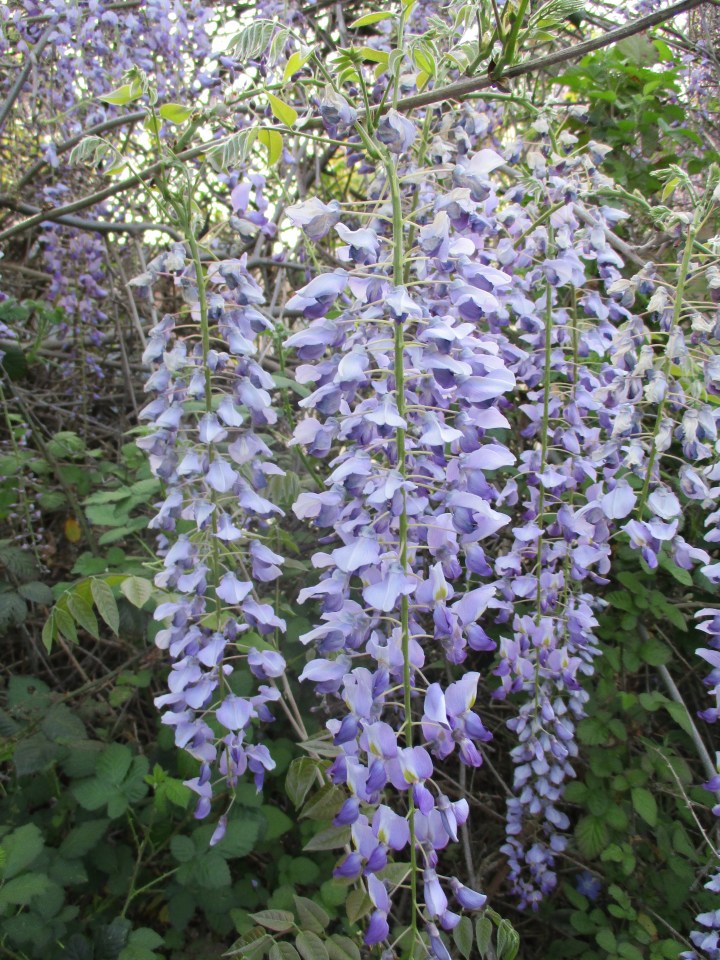 Anyone can plant a grapevine. With a bit of work, almost anyone can make a grapevine grow. Most who put forth the effort can figure out how to prune and cultivate a grapevine. Yet, grapevines so often get very out of control. They easily escape confinement, overwhelm nearby plants, climb into trees and overburden their trellises or arbors. It is easy to forget how aggressive they can be.
 There are so many different specie involved with the extensive breeding of the modern cultivars of clematis that they are not even assigned full Latin names. They are simply known as ‘clematis’ (without a specie name), with a respective cultivar name. Clematis X jackmanii is the oldest known hybrid, so the name is often applied to other hybrids, whether or not they are actually related.
