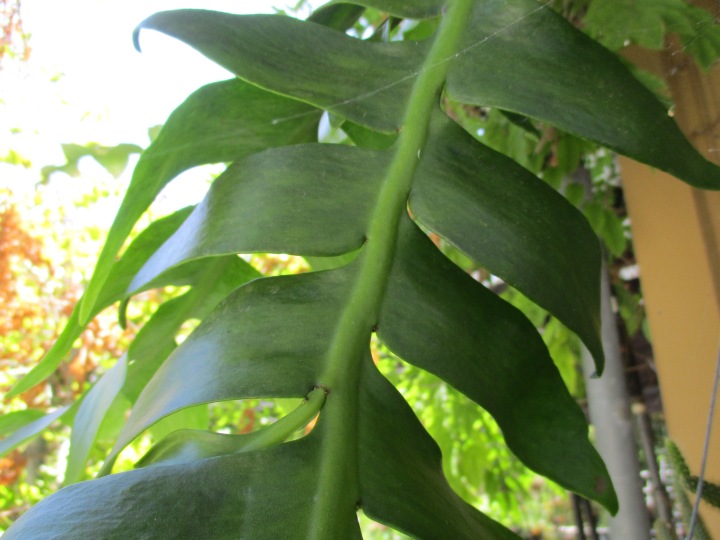
 Plants can inhabit nearly every climate on Earth. They live in hot and dry deserts, cold arctic regions, rainforests and just about everywhere in between. Plants seem to have it all figured out. Some even know how to live in our homes as houseplants, although they probably did not plan it that way. Most houseplants are tropical plants that are naturally endemic to tropical ecosystems.
It is actually their tropical heritage that makes them more comfortable in our homes. Tropical climates tend to be conducive to proliferation of all kinds of plants. Those that want to live there must be competitive. Trees compete by growing faster and taller than other trees. Vines compete by climbing the trees. Understory plants that live under taller plants compete by needing less sunlight.
It is these understory plants that do not mind the shade of our homes. Even those that like bright ambient light might never expect to get direct sun exposure. The various ficus trees that might naturally grow tall enough to reach the top of a forest canopy in the wild are still understory plants while young. Because they know how to use resources efficiently, tropical plants do well in pots.
However, these advantages are not so useful out in the garden. Tolerance to partial shade also means that some tropical understory plants need to be sheltered. If too exposed, foliage can get roasted by sunlight or arid wind. (Most tropical climates are more humid than local climates are.) Complaisant roots do not disperse well enough to sustain lush foliage without regular watering.
Ironically, roots of the various ficus trees are very aggressive because they to not disperse deeply, but instead spread out at the surface of the soil where they grow into exposed root buttresses.
The most familiar weakness of tropical plants is their susceptibility to frost. Even though it does not get very cold here, it gets cool enough in winter to offend plants that would never experience cool weather in the wild. Actual frost can severely damage foliage, and can even kill some tropical plants.
 What an unflattering name for such striking tropical foliage! The pointed and strap-shaped evergreen leaves of mother-in-law’s tongue, Sansevieria trifasciata, stand vertically, about two or three feet tall. They are rather rigid, and seem to be plastic with a glossy finish. Almost all modern varieties are variegated with silvery gray, white, cream or yellow stripes or banding. Dwarf varieties stay shorter, with flared foliage.
 Everyone is from somewhere. Not everyone is fortunate enough to be from California. Most of the various plants in our gardens, even if grown locally, are descendants of plants that were collected from all over the world. Most houseplants are from tropical regions. They perform well as houseplants primarily because they tolerate the sort of partial shade that they would get as understory plants in dense tropical forests.
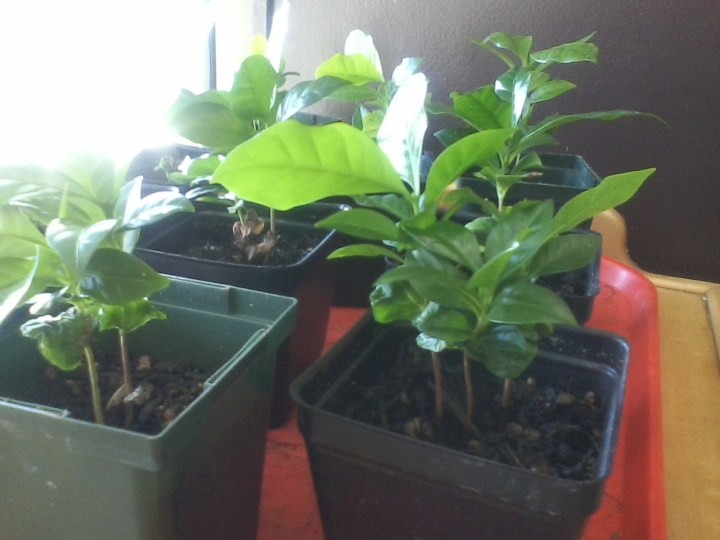 There are certain things that we expect to find in a coffee shoppe. Mainly, we expect to find . . . coffee. Yes, coffee, . . . duh. We can get all sorts of coffee beverages; hot, chilled, steamed, infused with things that have no business going into coffee. They have all sorts of cool sounding but strangely irrelevant Italian names that white people enjoy telling people of Italian descent how to pronounce. Yes, my name is Tony Tomeo; and I don’t want twenty cups of coffee with bread. Well, besides the coffee beverages, there are plenty of coffee beans; all sorts of roasts. I do not know of any coffee shoppe that grows any of the beans that it sells, but there is nice coffee shoppe in Felton, The Mountain Roasting Company, that grows coffee trees.
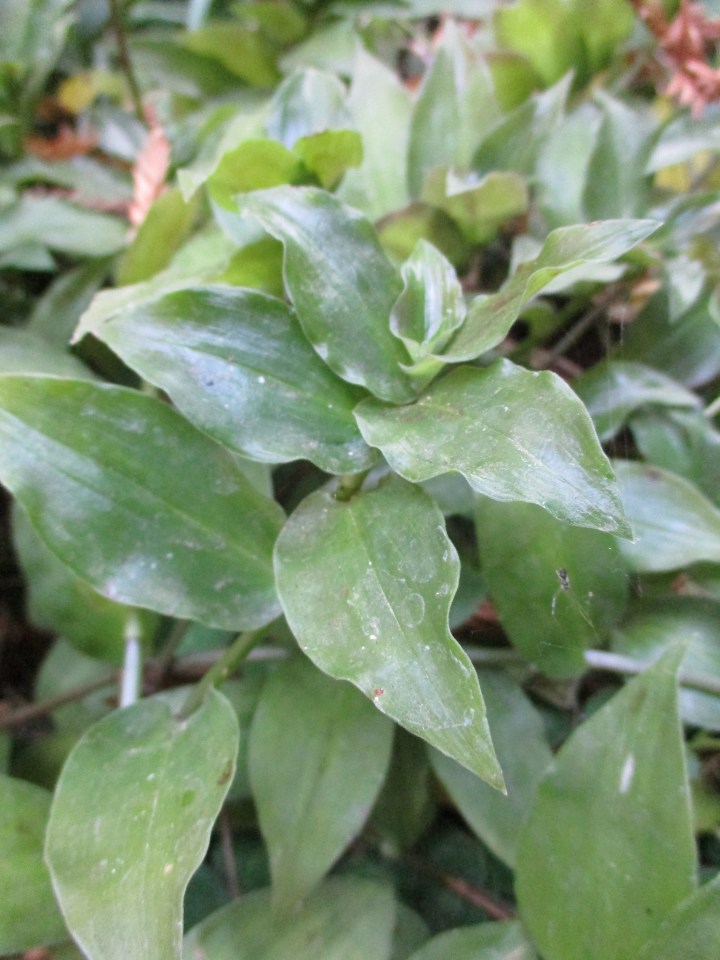 It could not have survived out in the desert for forty years. Wandering Jew, Tradescantia fluminensis, would have desiccated before its first summer. Well watered gardens are a completely different situation. Wandering Jew can become invasive and mix with other more desirable ground covers, only to die back and turn dark brown through winter. It starts over the following spring.
 Philodendrons, dracaenas, ferns, palms or any sort of tropical foliage inside our homes only create an illusion of closeness to nature. Naturally, these plants live in very different climates, mostly thousands of miles away. Not only do they have no business in our homes; they have no business on the North American Continent. Some can live in the garden, but only with unnatural watering.
 Tony Tomeo