Bark Up The Right Tree

Bark can contribute color and texture.

Autumn foliar color does not seem to last long enough. As it dissipates, though, it reveals silhouettes of bare deciduous trees. Some are delightfully sculptural, with strikingly pale bark on their trunks and stems. Others develop distinctively reddish twigs. Some display interesting bark textures or patterns. Color, texture and patterns are remarkably variable.

Of course, for most species, bark does not change much throughout the year. It becomes more prominent now merely because defoliation increases its exposure. In fact, some of the most distinctive bark belongs to evergreen species. Some belongs to flowering trees, fruiting trees or arboriform shrubbery. The sources are as variable as the characteristics.

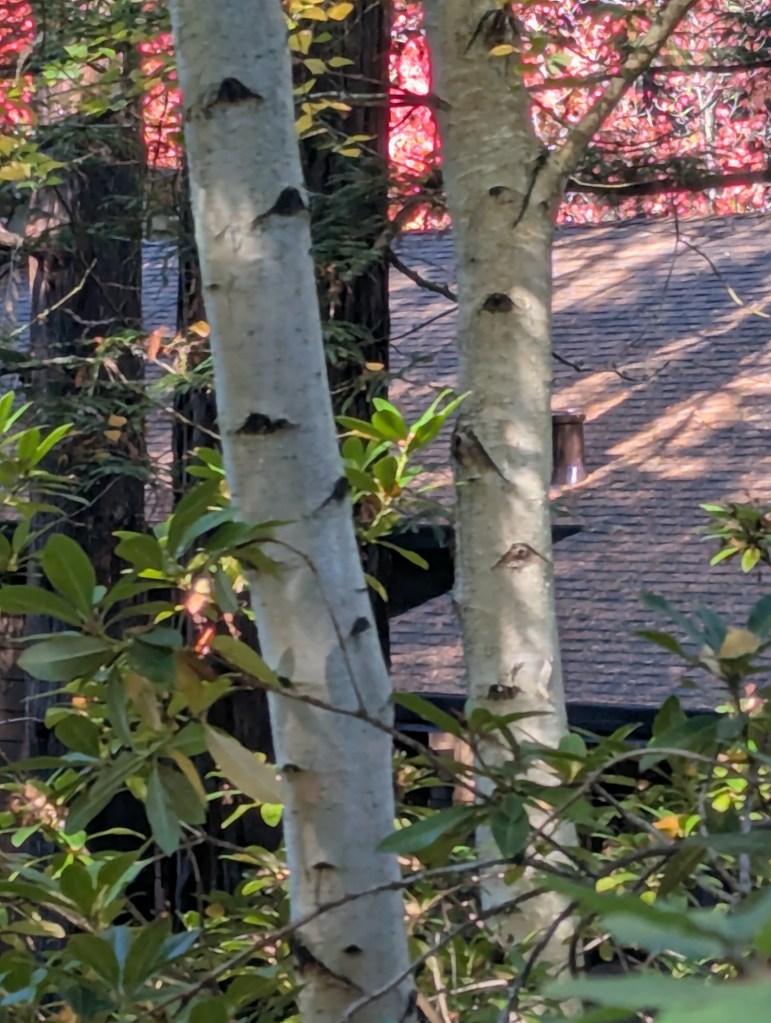
European white birch is likely the most familiar tree with white bark. Jacquemontii birch is even whiter. California sycamore is a massive tree with mottled light gray and tan bark. Crape myrtle, which is more proportionate to home gardens, is more mottled. Some elms exhibit elegant tan trunks and limbs. European beech trunks develop metallic gray color.

Melaleucas are evergreen trees with distinctively shaggy trunks. Eucalyptus are likewise evergreen, but generally with pale and smooth trunks. Lemon gum is particularly tall and elegant. However, red ironbark eucalyptus has dark and notably rough trunks and limbs. ‘Marina’ madrone develops smooth trunks and limbs with brown and cinnamon red color.

Coral bark Japanese maple and osier dogwood display colorful bark differently. Theirs is on small twigs rather than trunks and main limbs. Color actually develops in response to autumn chill and defoliation. Coral bark Japanese maple develops, pinkish orange color. Osier dogwood is more brownish red, although some cultivars are orangish or yellowish.

Trees that exhibit distinctive bark are subject to the same constraints as all other trees. In other words, they must be appropriate to their particular landscapes. California sycamore for example, is much too large for compact urban gardens. Osier dogwood can grow as a thicket without intensive maintenance. Any new tree or shrubbery should be sustainable.
Binding For Straighter Tree Trunks

Proper binding promotes straight trunk growth.

Staking is not quite the same as binding with stakes. It is more for the benefit of the roots than the trunks, which is what binding is for. Staking should support new trees only while such trees disperse roots for adequate stability. As trees do so, stakes become obsolete. Actually, stakes that remain for too long may be detrimental to healthy tree development.

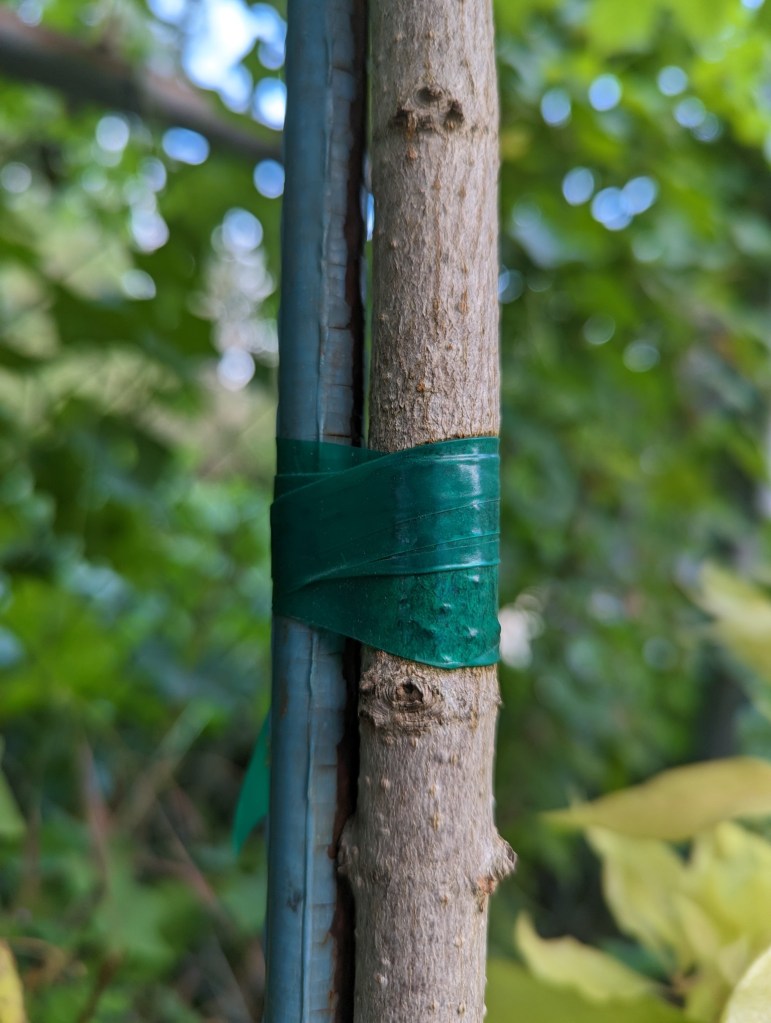
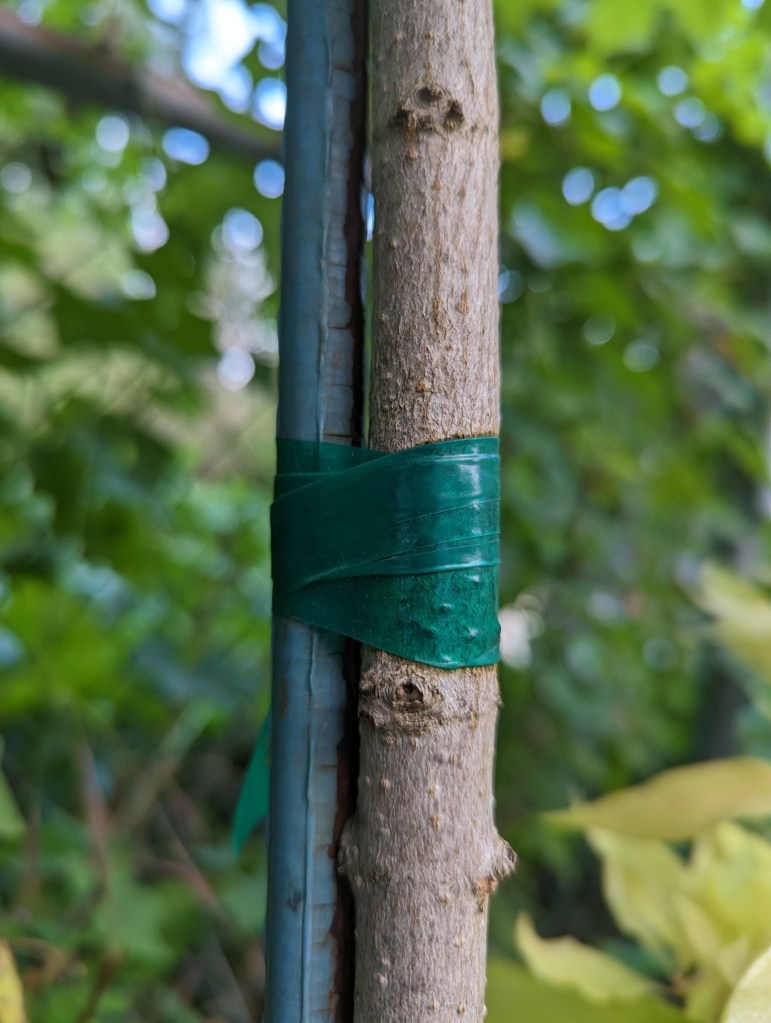
Binding with stakes promotes straight trunk growth. It is particularly practical for trees that naturally develop crooked or multiple trunks. It is a technique that is quite common within nurseries, although not home gardens. However, many trees retain binding stakes when they arrive from nurseries. For a while after planting, some continue to benefit from them.

However, binding may be more detrimental than staking if it remains for too long. Trunks that become reliant on any sort of supportive stake remain weak or limber. Also, tape that binds trunks to stakes can become constrictive as trunks grow. It is important to remove it before it begins to interfere with trunk expansion. Looser tape can be useful if necessary.

For example, California pepper tree naturally develops a few irregular and limber trunks. To produce trees with single and straight trunks, nurserymen bind single trunks to stakes. They then prune out other trunks and low limbs until main trunks attain an optimal height. Because they are still limber, trees remain bound to their stakes while available for sale.

However, such stakes provide only support for trunks. They do nothing for stability while trees disperse roots into their new gardens. Additional staking with heftier stakes may be necessary for that. Such stakes must extend into undisturbed soil below the roots of such new trees. If possible, it is better to merely replace binding stakes with supportive stakes.

The next best option is to replace tape that binds young trunks to stakes with looser tape. This maintains the straight form of such trunks without inhibiting their growth. Supportive stakes, in addition to binding stakes, maintain their upright posture. Most trees need only supportive stakes, realistically. A few trees, especially new palms, need no stakes at all.

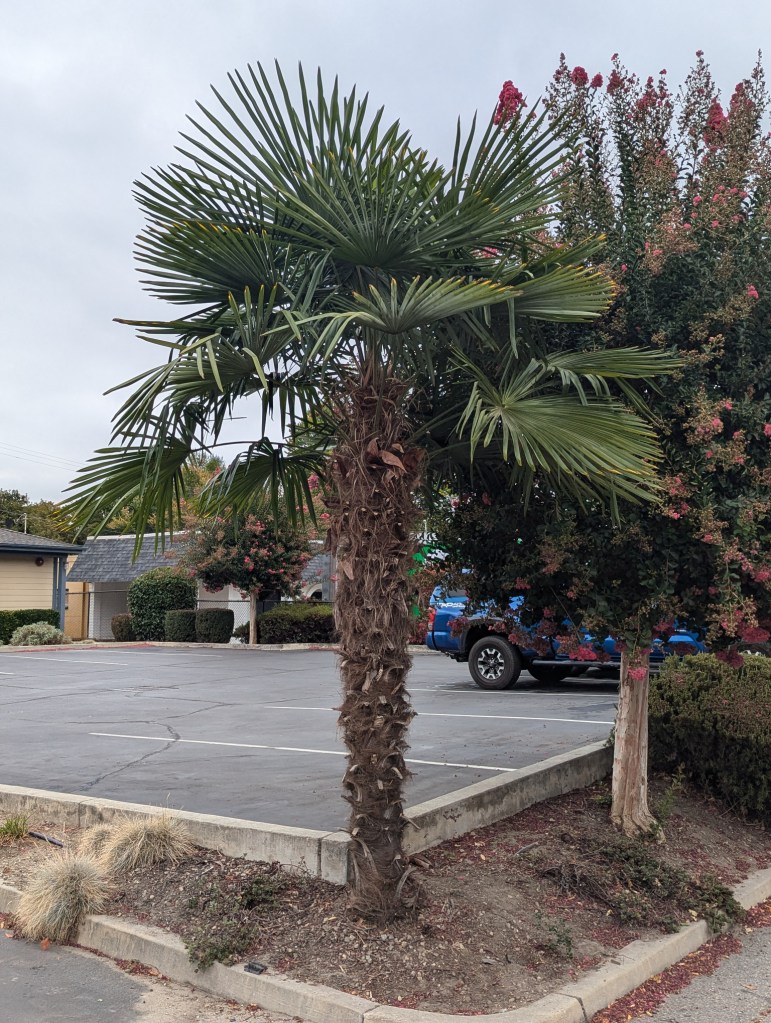
Windmill Palm

Windmill palm can disperse copious seed.

Palms take commitment. Some of the most popular grow too big for their situations. Most grow so tall that only arborists can maintain them. None are conducive to pruning to limit their natural height. Individual palm trunks rely on their single terminal buds, which grow only upward. Diversion is not an option for any palm that encroach into electrical cables.

Windmill palm, Trachycarpus fortunei, is one of the more complaisant of palms. It can not grow around utility cables, but otherwise does not grow obtrusively big. Young trees can grow fast to fifteen feet tall, but then grow slowly to double their height. Only a few elderly trees grow as tall as forty feet. Their foliar canopies are generally less than ten feet wide.

Trunks of windmill palms are distinctively shaggy. Pruning dead fronds as closely to their trunk as possible promotes a neater appearance. Because growth decelerates with age, trunk shag is typically wider higher up. Trunks are about half a foot wide, but seem twice as wide since they are so shaggy. Gathering seed from pollinated female trees is simple.

Sculpture

Eucalyptus citriodora – lemon gum

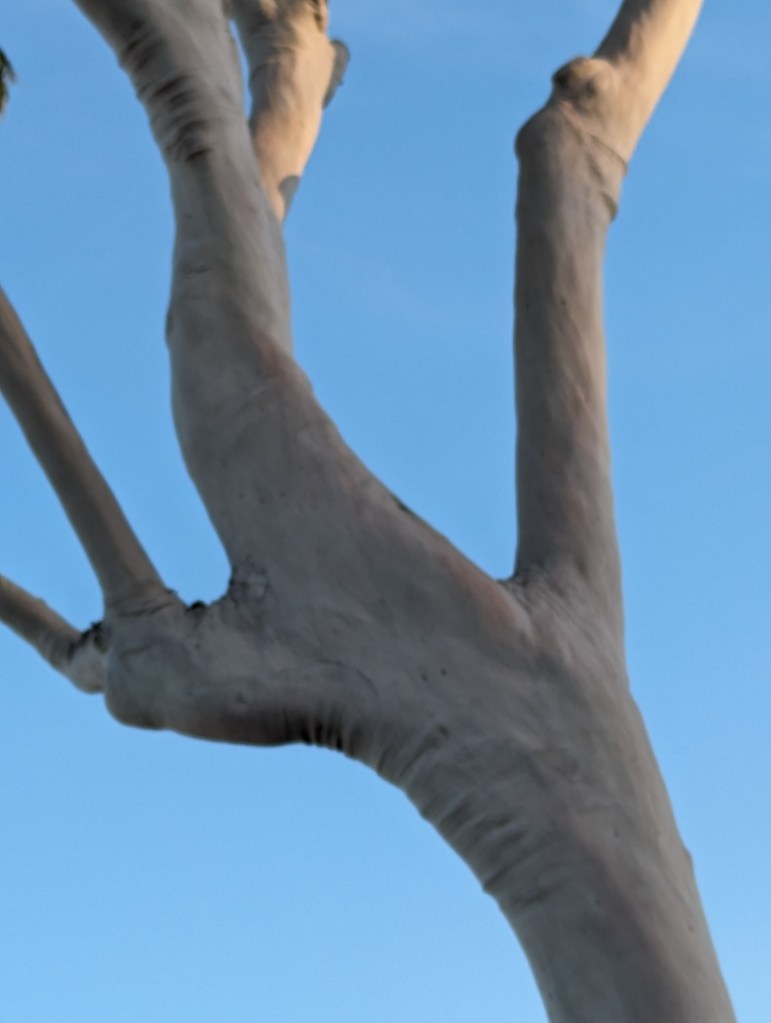
Eucalyptus citriodora, lemon gum, is one of several species that I miss from the more southern portion of the Central Coast and Southern California. San Luis Obispo, where Brent and I studied horticulture at Cal Poly, and where I learned to appreciate this particular species, is technically within the same climate zone as Los Gatos. Nonetheless, many species that are popular in Southern California are more popular there than here, perhaps because of the proximity to Southern California. I got this picture on the inland edge of Highway 101 in Carpinteria on the return trip from Los Angeles. It demonstrates how sculptural the elegantly slender, smooth and pallid trunks and limbs of lemon gum are. The airy foliage is delightfully aromatic, but is too high to reach among trees that are sufficiently mature to be so sculptural. A few other eucalypti are similarly but distinctly sculptural. Some develop heftier trunks and limbs. Some develop blotched or uniformly coarse bark. Also, several other genera, such as coast live oak, camphor and ‘Marina’ madrone, develop sculptural form. Such form should be more of a consideration for modern landscape design, as it was until about the late 1970s, when trees like European white birch and the last of the complaisant eucalypti slowly became passe. It is actually gratifying to notice that a few daring horticulturists are experimenting with some of the smaller species of eucalypti that could have become popular years ago, as well as a few that had not yet been introduced. Where lemon gum might eventually grow too large, smaller species, such as Eucalyptus caesia, gungurru, might be more proportionate. Of the more than seven hundred species of Eucalyptus available, more than a few must be appropriate to refined home gardens, and more than a few of such are likely sculptural.

Mexican Fan Palm

Mexican fan palm is the most familiar palm of California.

It does not take long for Mexican fan palm, Washingtonia robusta, to get too big for most of the spaces it so often self sows its abundant seed into. The attractive lush foliage looks innocent enough, although the long petioles (leaf stalks) have nasty teeth. As trees get tall enough to get out of the way, they also get too big to manage, eventually reaching a hundred feet tall on elegantly curving trunks. No matter how tall they get though, their canopies always stay about eight feet wide. The problem is that the maintenance of such tall and aggressive trees can be costly.

Beards of old leaves can be allowed to accumulate on the trunks, but are combustible and can get infested with rats. Old leaves are more often pruned off, leaving a distinctive pattern of petiole bases. Old leaves can alternatively be ‘shaven’ to expose elegant bare trunks.

Stakes And Binding For Trees

Binding merely straightens developing tree trunks.

Few trees that inhabit home gardens begin their residency as nature intended them to. Most are exotic, from other ecosystems, regions and climates. Almost all initially grew in nurseries, with their roots confined to cans of soilless media. Most rely on pruning and binding to develop straight and tall trunks. In the garden, most rely on stakes for stability.

Nursery stakes are different from landscape stakes. They support the developing trunks of young trees as they grow in nurseries. They can do the same for very young trees that grow directly into home gardens. Such stakes do not stabilize trees. Within confinement of nursery cans, they can not extend into the soil below. They guide trunk development.

Some young trees with very limber trunks rely on constrictive binding to nursery stakes. Most trees need only loose binding. Ideally, binding should be as loose as possible, and is only temporary. Trunks that move with wind are less reliant on support as they mature. Once straight trunks develop, temporary nursery stakes should no longer be necessary.

Landscape stakes stabilize new trees after installation into a garden. Most of such trees lack stability while their roots are initially very confined. Root dispersion stabilizes trees as they mature. Landscape stakes are only temporary during this process. They should not be so constraining that trees rely on them for support. They must be sturdy though.

As important as it is for many trees, staking can interfere with trunk development. It limits motion from wind that stimulates trunk expansion and root dispersion. Timely removal of stakes when no longer needed promotes healthier development. Yet, some very limber trees may briefly need both nursery and landscape stakes. Timing of removal is critical.

Small trees may need only a single landscape stake after installation. Larger trees may need a pair of stakes. Some stout trees may need no stake at all. Ties that loosely attach trees to stakes should cross over between the trees and stakes. This forms a figure eight pattern that limits abrasion between trees and stakes. Short nails can hold ties in place.

Some Plants Impress With Bark

P80805Lemon eucalyptus, ‘Marina’ madrone, cork oak and all sorts of melaleuca trees are known more for their interesting bark than for their foliage or flowers. It helps that their distinctive trunks and branch structures are ideal for displaying their unique bark. Color and texture of bark is remarkably variable, and tends to get noticed more in winter while blooms and foliage are lacking.

Bark of sycamores, birches, elms and crape myrtles that had been so handsome throughout the year is more visible now that it is not partially obscured or shaded by the deciduous foliage that is associated with it. Trunks and limbs of European white and Jacquemontii birches are strikingly white. ‘Natchez’ crape myrtle has distinctively blotched bark, (although the white flowers are pale.)

Because of their other assets, English walnuts, figs and saucer magnolias are not often grown for their bark. Nonetheless, their pale gray bark shows off their stocky bare branch structure nicely, especially in front of an evergreen backdrop of redwoods or pines. The smooth metallic gray bark of European beech is much more subdued, but is what makes big old trees so distinguished.

A few deciduous trees and shrubs get more colorful as winter weather gets cooler. Instead of white or pale gray, their bark turns brighter yellow, orange or red. Some plants, like sticks-of-fire, do not need much cool weather to develop good color. Others get more colorful in colder climates, and contrast spectacularly to a snowy landscape. Locally, they should be well exposed to chill.

As the name suggests, the coral bark Japanese maple (‘Sango Kaku’) develops pinkish orange bark. It can get ruddier in colder climates, but may get yellowish here. Unlike other Japanese maples that get pruned to display their delicate foliage and branch structure, the coral bark Japanese maple sometimes gets pruned more aggressively to promote more colorful twiggy growth.

Osier dogwood is a shrubby dogwood that lacks colorful bloom, but compensates with ruddy brown, brownish orange or pale yellow bark in winter. (Dogwood bark . . . There is a pun there somewhere.) Because it lacks colorful bloom, it can be pruned aggressively after winter. Older canes that do not color as well can be pruned to the ground as they get replaced by new canes.