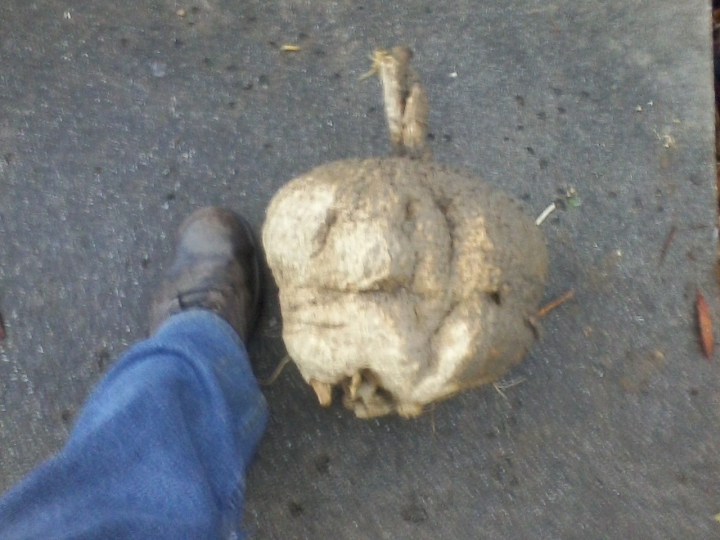
 What is it?!?
Is it alive?
Was it alive?
Is it moving?
Should we roll it back into the river?
Can we eat it? Someone actually asked that.
It really is as big and ugly as it looks. That is a size 11 boot next to it to demonstrate how big it is. We can not eat it. There is no need to put it back into the river. It is not moving. It was alive, and still is. It is the distended tuberous root of a wild cucumber, of the genus Marah, which is also known as ‘manroot’ because of how big it can get. That stub protruding from the top (toward the top of the picture) is the remnant of a stem. A few thin roots protrude from the lower half, with thicker root stubs at the bottom.
This picture was taken last winter after the San Lorenzo River flooded and then receded. There has not been enough rain this year to wash more than leaves and a few pinecones downriver.
If this tuberous root had not been unearthed and scoured clean by floodwater, it would have been actively growing through winter. The surprisingly thin and wiry vines appear in autumn and climb with tendrils over shrubbery and small trees. The palmately lobed leaves are rather fragile, and tear easily. Loose clusters of small pale white flowers are followed by weirdly spiny round fruit that ripens from light green to greenish yellow. Each fruit is about the size of a golf ball, and contains a few big seeds. As the weather gets warm in summer, the vines die completely to the ground, leaving the drying fruit dangling from whatever the vines grew onto earlier.
Why can’t the river bring us something useful?
 Tony Tomeo