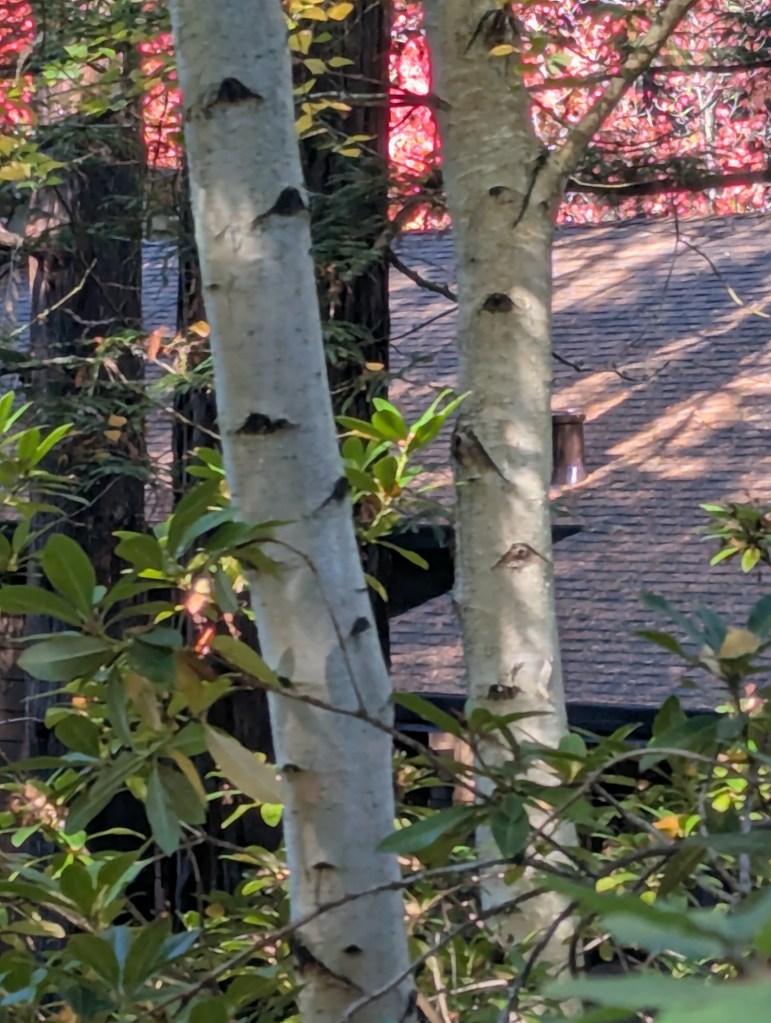
Autumn foliar color does not seem to last long enough. As it dissipates, though, it reveals silhouettes of bare deciduous trees. Some are delightfully sculptural, with strikingly pale bark on their trunks and stems. Others develop distinctively reddish twigs. Some display interesting bark textures or patterns. Color, texture and patterns are remarkably variable.
Of course, for most species, bark does not change much throughout the year. It becomes more prominent now merely because defoliation increases its exposure. In fact, some of the most distinctive bark belongs to evergreen species. Some belongs to flowering trees, fruiting trees or arboriform shrubbery. The sources are as variable as the characteristics.
European white birch is likely the most familiar tree with white bark. Jacquemontii birch is even whiter. California sycamore is a massive tree with mottled light gray and tan bark. Crape myrtle, which is more proportionate to home gardens, is more mottled. Some elms exhibit elegant tan trunks and limbs. European beech trunks develop metallic gray color.
Melaleucas are evergreen trees with distinctively shaggy trunks. Eucalyptus are likewise evergreen, but generally with pale and smooth trunks. Lemon gum is particularly tall and elegant. However, red ironbark eucalyptus has dark and notably rough trunks and limbs. ‘Marina’ madrone develops smooth trunks and limbs with brown and cinnamon red color.
Coral bark Japanese maple and osier dogwood display colorful bark differently. Theirs is on small twigs rather than trunks and main limbs. Color actually develops in response to autumn chill and defoliation. Coral bark Japanese maple develops, pinkish orange color. Osier dogwood is more brownish red, although some cultivars are orangish or yellowish.
Trees that exhibit distinctive bark are subject to the same constraints as all other trees. In other words, they must be appropriate to their particular landscapes. California sycamore for example, is much too large for compact urban gardens. Osier dogwood can grow as a thicket without intensive maintenance. Any new tree or shrubbery should be sustainable.
 Tony Tomeo