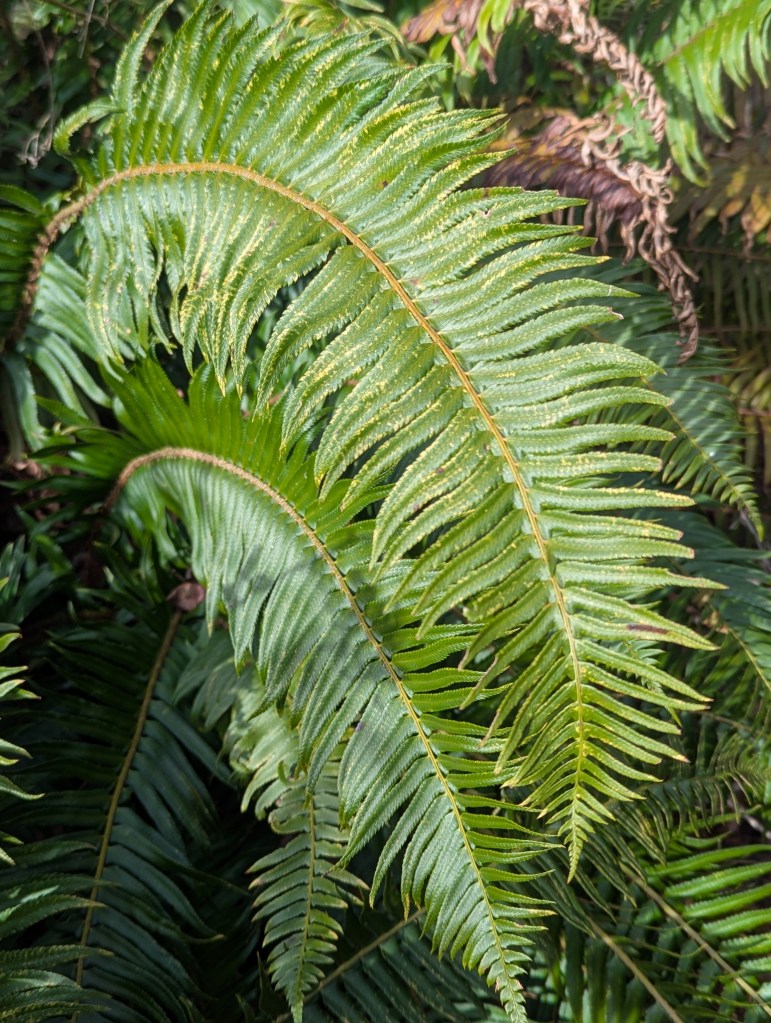
Of the native ferns, Western sword fern, Polystichum munitum, is the most common. Yet, it can be difficult to cultivate outside of its native range. Regional symbiotic soil microbes might be what limit its adaptability beyond its range. Locally in the wild, it prefers riparian situations. Within home gardens, established specimens are impressively undemanding.
As an understory species, Western sword fern should probably prefer partial shade. Yet, it can perform as well with full sun exposure. Although it appreciates organically rich soil, it can be satisfied with soil of inferior quality. New or relocated specimens need frequent irrigation as they disperse roots. Monthly irrigation can suffice for established specimens.
Western sword fern grows about two or three feet tall, but can get taller in partial shade. It might be twice as wide. The evergreen foliage is dark forest green. Individual leaves are pinnately compound and arching. New leaves mostly obscure old leaves that deteriorate after their first or second year. Shabby specimens regenerate well after getting cut back.
Ferns are an odd bunch within home gardens. They lack floral color and fragrance. They produce no fruit or vegetables. The few that are deciduous lack autumn foliar color here. With very few exceptions, they provide no shade. There is quite a bit that they do not do. Yet, they are notably popular for their lush foliage, intricate textures and distinctive forms.
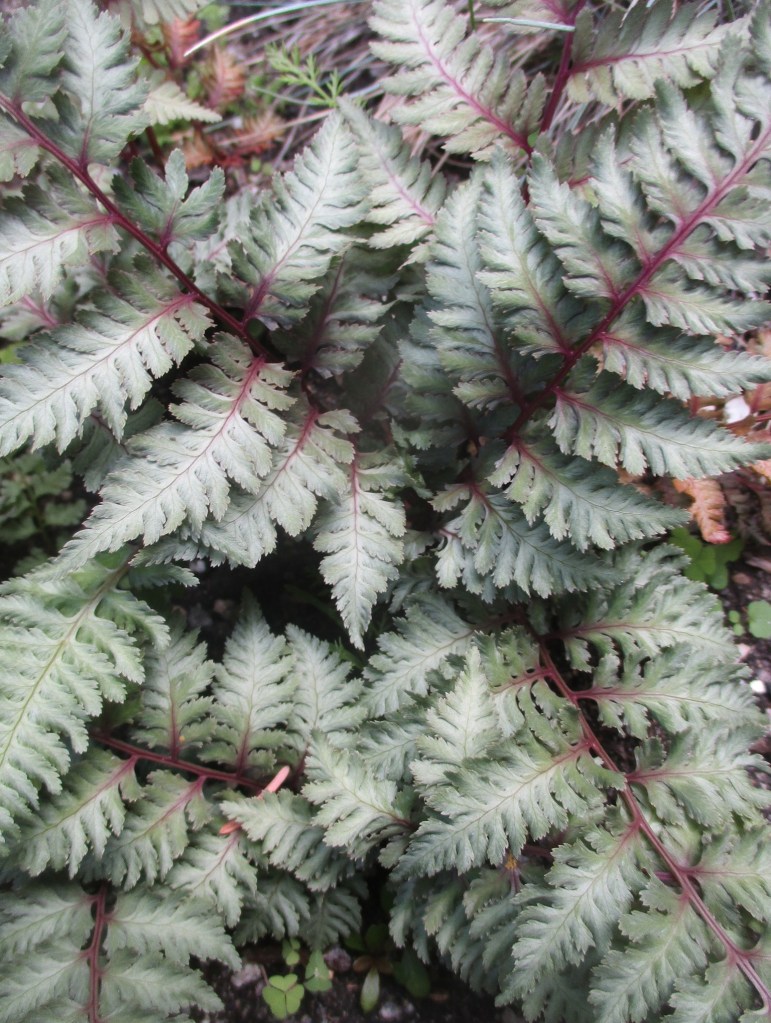
Almost all ferns are a rich deep green. Some are vibrantly lighter green. A few are silvery gray or exhibit intricate silvery patterns. Most exhibit lacy textures. Several are finer than most. Several develop relatively coarse textures. Bird’s nest fern has large but undivided and glossy fronds. Holly fern exhibits coarse texture of fronds that resemble holly foliage.
Most ferns that are popular here are evergreen foliar perennials. They are therefore tidier with occasional grooming to remove deteriorating old foliage. Some extend new foliage above old foliage as the old foliage lies down. Some regenerate lushly after the removal of all their foliage prior to their growing seasons. Deciduous ferns are uncommon locally.
Ferns do not develop stems or trunks like some other vegetation does. They sprawl over the ground with fleshy rhizomes. Tree ferns grow upward only by extending roots into the deteriorating rhizomes below. Such roots are quite strong and wiry, and form what seem to be trunks. Fern roots are rather fibrous. Fern rhizomes grow in length but not diameter.
Because of their fibrous roots, ferns are complaisant to confinement within pots. Several are splendid houseplants. Boston fern is an old fashioned but familiar example. Rabbit’s foot fern, maidenhair fern and bird’s nest fern are also popular as houseplants. Staghorn ferns are weirdly epiphytic. They can grow outside on vertical boards rather than in pots.
Most popular ferns are understory species. That means that, within their natural habitats, they live in the shade of larger vegetation. It also means that, within home gardens, most tolerate partial shade. A few actually prefer it. Most ferns also prefer systematic irrigation. Although, native Western sword fern tolerates both partial shade and lapses of irrigation.
Even for some understory species, shade can inhibit bloom. For Hosta, that would not be much of a problem. Its late summer bloom is merely an added bonus to its lushly colorful foliage. Actually, the foliage is more appealing without its tall floral spikes. Such bloom is prettier in a vase anyway. The hanging white or lavender flowers are an inch or two long.
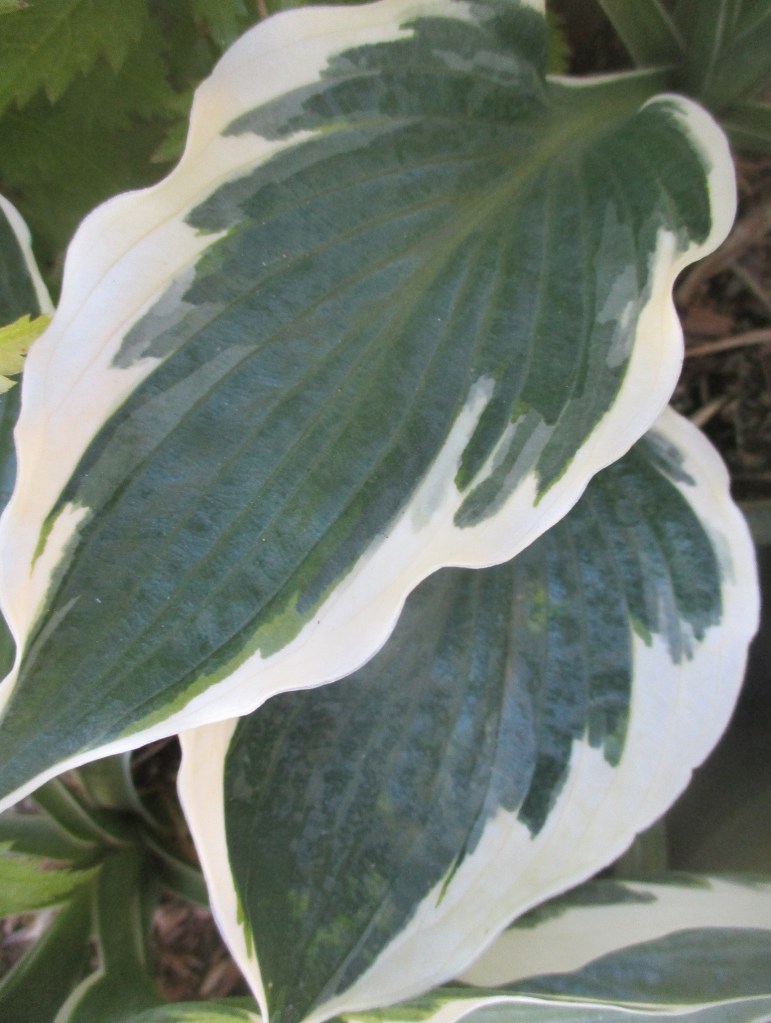
Where summer weather is cooler, some Hosta can grow three feet tall and twice as wide. Locally, only a few of the largest cultivars can grow as wide as three feet during summer. Then, they defoliate by winter. Most have broadly rounded leaves, but a few have narrow or wavy leaves. Many have paler green, yellow or white variegation, or glaucous foliage.
Hosta is uncommon here, probably because it may be somewhat demanding. It requires very regular watering to avoid desiccation. It craves organically rich soil or potting media. Fertilizer can enhance lushness, but can burn foliage if just slightly excessive. Slugs and snails can ruin foliage. However, Hosta are understory plants that tolerate a bit of shade.
Shade influences every ecosystem. Where it is scarce, some vegetation adapts to harsh exposure to sunlight. Some develops glaucous foliar color to reflect some of the sunlight. Some develops tomentum, or foliar fuzz, to shade its foliar surfaces below. Where shade is abundant, understory vegetation adapts as efficiently. Essentially, it is made for shade.
Understory vegetation naturally grows beneath larger trees and shrubbery. It is therefore more tolerant of partial shade. Some tolerates significant shade. Ferns that inhabit forest floors beneath shady redwood trees are notable examples. So are most houseplants that originated from tropical rainforest. Naturally, most live in the shade of bigger forest trees.
Not all understory vegetation is diminutive. Some Japanese maple trees can grow rather large. However, they naturally inhabit forests of trees that grow larger. Some palms begin as understory vegetation to become the tallest trees of their gardens. Their foliage simply adapts as it becomes more exposed. Banana and tree fern foliage might adapt similarly.
Such adaptation is an advantage now that home gardens are becoming shadier. Modern homes are taller, so produce bigger shadows than older homes. They are closer to other tall homes with comparable shadows. Fences are higher to compensate for the proximity of homes. Garden spaces are more compact, with less space that is not partially shaded.
No vegetation survives without sunlight. Understory vegetation is simply more tolerant of partial shade than most other sorts. It is adapted to it, just as some vegetation is adapted to extreme exposure. Generally, understory vegetation is deep green, to absorb as much sunlight as possible. For the same reason, individual leaves are typically large and lush.
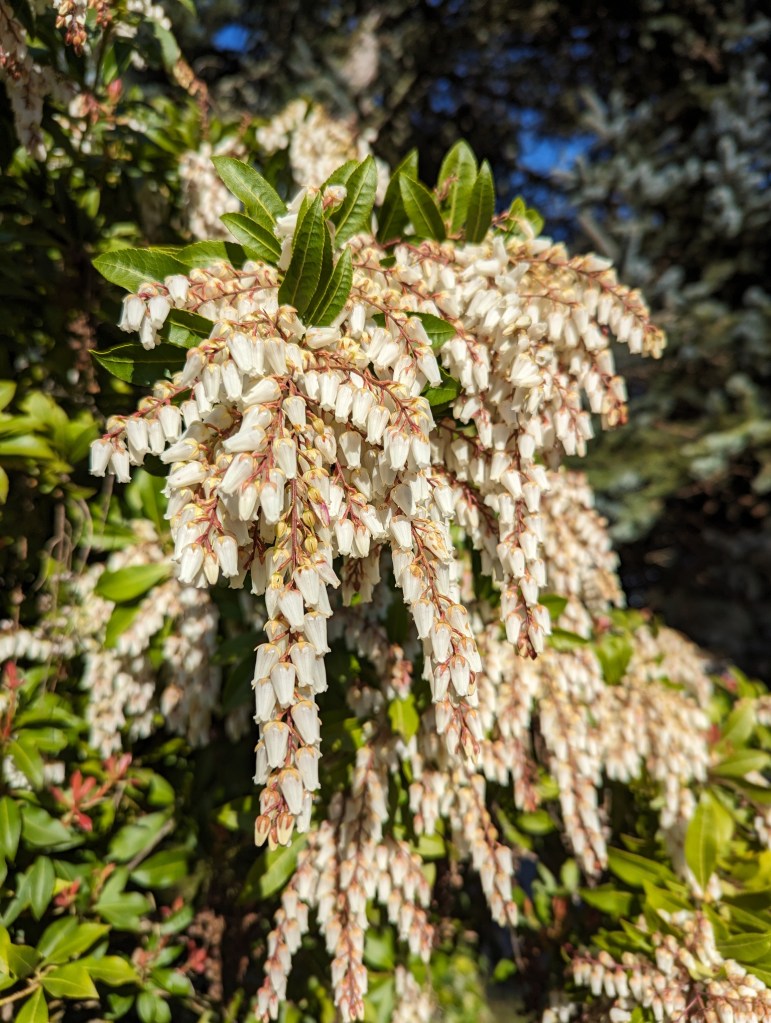
Cast iron plant seems to tolerate more shade than any other understory vegetation. Kaffir lily and hosta tolerate almost as much shade as some ferns. Rhododendron, azalea and andromeda prefer only partial shade. Excessive shade inhibits bloom. The same applies to camellia and hydrangea. Realistically, all species of understory vegetation are unique. Each tolerates a particular degree of shade that it is adapted to.
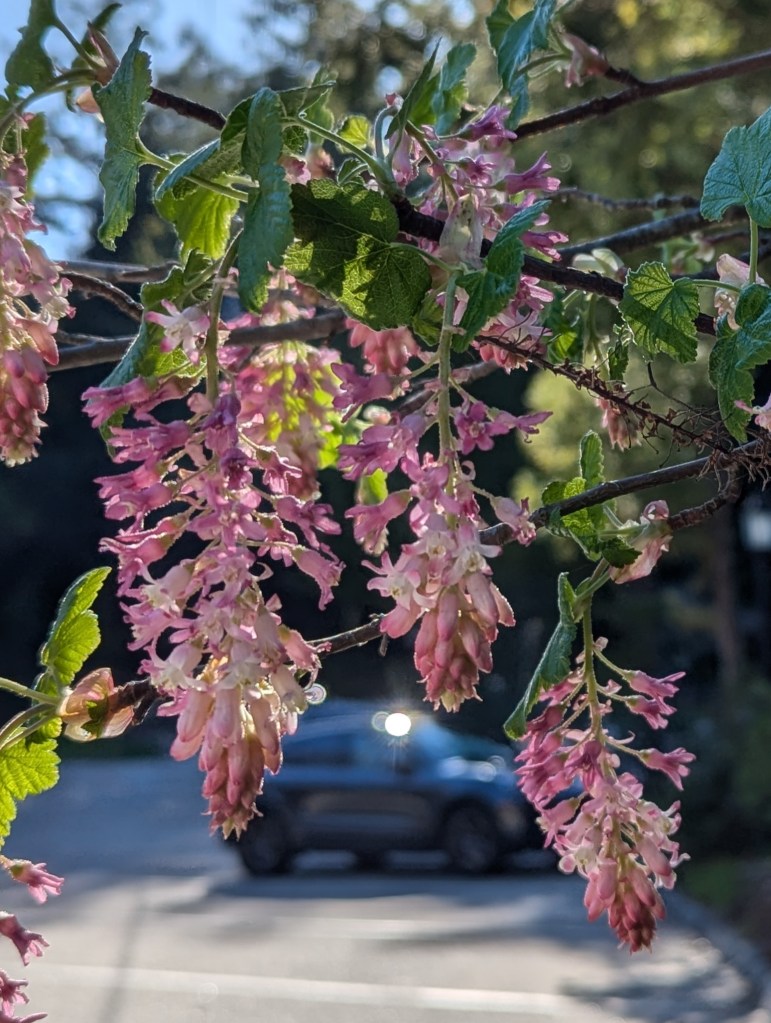
Its natural range extends from coastal Santa Barbara County to central British Columbia. Yet, red flowering currant, Ribes sanguineum, is elusive in the wild. It is more commonly observable within relaxed landscapes of native species. Individual specimens might not perform for more than a decade but can disperse seed. It behaves as if it is growing wild.
Mature specimens of red flowering currant can grow ten feet high and half as wide. Most stay lower. It is an understory species, so it tolerates a bit of shade. It may prefer shade to warm exposures. Young specimens may be wobbly enough to justify temporary staking. Removal of deteriorating old stems promotes more vigorous growth on fresh new stems.
Pendulous conical trusses of small pink flowers bloom by late winter or very early spring. Before anyone notices, birds are likely to take the few small currants that might develop. Small palmate leaves resemble those of scented geranium, and are somewhat aromatic. They turn yellow as they shed for autumn. Red flowering currant has a foresty character. It suits casual landscapes which border or merge into undeveloped areas.
Home gardens are becoming shadier. Modern homes are taller to fit closer together. Modern fences are taller to compensate. Densely evergreen trees and large shrubbery compensate more. Taller homes and fences, and denser vegetation, shade more of their smaller modern parcels. Not much sunlight can reach the soil of modern home gardens.
Portions of a garden that are too shady for gardening are not necessarily useless. During warm weather, patios, sheds and workspaces are cooler with shade. Koi generally prefer shade to sun exposure most of the time. Compost piles and woodpiles need no sunlight. Such utilization of shady areas leaves more sunny areas available for actual gardening.
Deciduous trees that let warming sunlight through for winter are less practical nowadays. They do not always obscure undesirable scenery as trees in modern landscapes should. Warming winter sunlight is not so useful to energy efficient modern homes anyway. It is useful for gardening though. That is why smaller evergreen trees are now more practical.
Such trees or large shrubbery can do what they must without creating too much shade. If they get only high enough to hide nearby windows, they should not shade solar panels. Nor should they fill eavestroughs with debris. Perhaps more importantly, they allow more sunlight through than larger trees would. Lower vegetation appreciates what it can get.
Some plants tolerate more shade than others. Some of the most tolerant are understory species. They naturally live within the partial shade of larger plants. Many have big dark green leaves to maximize sunlight absorption. Fern are familiar shade tolerant plants, but have finely textured foliage. Coleus and hosta have exquisitely colorful variegation.
Because most plants enjoy sunlight, the selection of plants for shade is limited. Rhododendron and azalea have a reputation for tolerance of shade. However, too much shade inhibits their blooms. Camellia and hydrangea tolerate a bit more shade, with less inhibition. Cast iron plant is a famously shade tolerant foliar perennial. Kaffir lily tolerates almost as much shade, and blooms splendidly.
Flowering crabapples are generally reliable for profuse bloom, but some varieties might perform and grow better where winters are cooler.
Dogwoods are certainly pretty as they bloom this time of year. They are rare, but seen often enough in nurseries to make one wonder why they are even more scarce in local gardens. Those that got sold in previous years should now be prominent features around town. The problem is that because they are not happy in local climates, dogwoods become dogwon’ts. They won’t bloom. They won’t provide good fall color. Many won’t even grow. Dogwoods prefer more humidity, so in local gardens, want to be sheltered from full sun exposure and drying wind by larger trees or buildings.
Nurseries generally stock plants that are appropriate for local climates. A few nurseries also have a few plants that would rather be somewhere else, but can be grown with certain accommodations. Reputable retail nurseries are generally careful to divulge which plants need more attention, and what their requirements are. However, many of the big garden centers in home improvement stores are more interested in selling what they can rather than selling what is actually appropriate, particularly since they thrive on turnover and replacing plants that do not survive.
Not all plants are as easy to grow as junipers and oleanders are. Japanese maples and rhododendrons like at least some degree of shelter from direct sun exposure and dry heat; but the California fan palm thrives in wicked heat. Plumerias and coleus can be damaged by even slight frost; but many apples and pears want more frost. Spruces like even moisture; but many yuccas rot without enough dry time.
This is why it is important to know how to accommodate plants that may be less than ideal for local climates. Those of us who choose to grow plants that have special needs should at least give them what they want if we expect them to perform as we want them to.