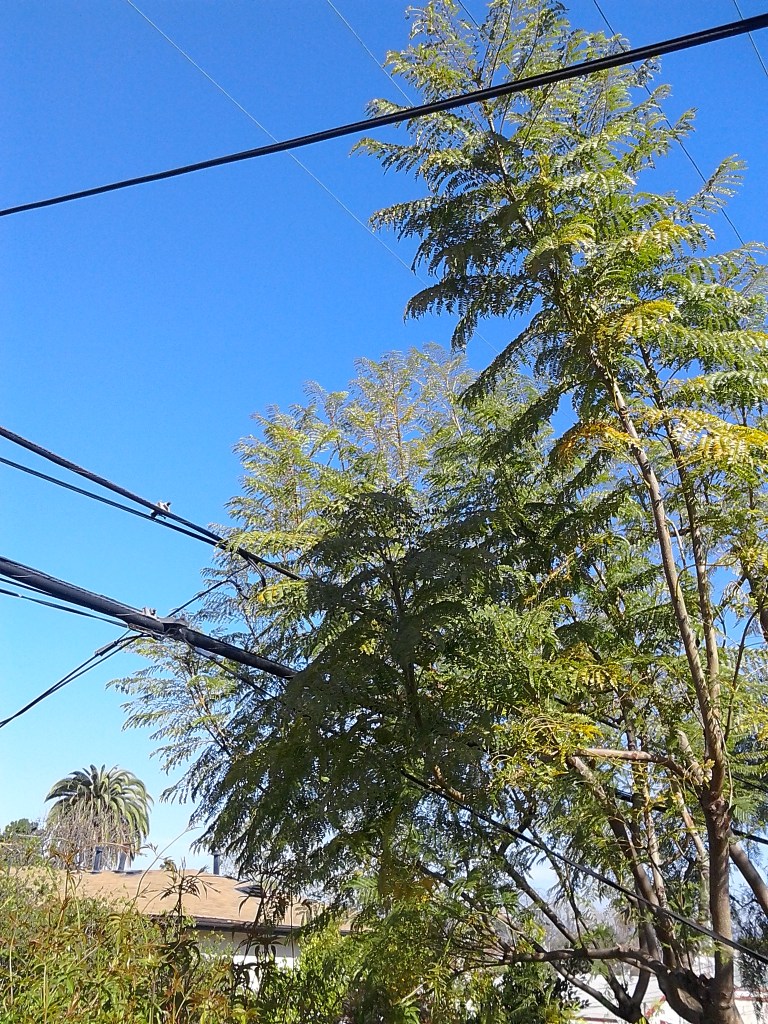
Since I did not make the drive up or down the coast very often, the rare silvery-gray Bismarck palm that I could see slowly climbing into the skyline near the edge of Highway 101 through Santa Barbara seemed to be slightly taller every time I saw it. It grew slowly, but enough to notice since I only saw it less than annually. Then, when I drove by about a month ago, it was gone.
This exemplary specimen had been quite healthy and happy (even though Bismarck palms are not supposed to be happy on the coast). There was only one problem. It was under high voltage utility cables. As it grew, it got too close to the cables, so needed to be removed in order to maintain the minimal clearance required for high voltage.
Unlike other trees, palms have only single terminal buds that grow upward. They can not develop branches to grow around cables, so only die if the single bud needs to be pruned away. Complete removal is therefore the only option when palms begin to grow into high voltage cables.
Sadly, palms often get planted under utility cables. Many Mexican fan palms grow under cables because birds that eat their fruit drop the seed there. Queen palms are popularly planted around the perimeters of back yards, and along the back fence lines that are very often directly below and parallel to high voltage cables.
Trees that are not palms can get disfigured by pruning for clearance around high voltage cables, but generally survive. Trees with central leaders (single trunks) and strict form, such as spruces and redwoods, can get be so disfigured that removal may be more practical than pruning. Trees with more irregular form, like sycamores and elms, are somewhat easier to salvage. Unfortunately, crews hired to maintain clearance are unable to prioritize the health and structure of trees that get too close to high voltage cables.
Lower cables for telephone, television and house-drops (lower voltage cables that extend from utility poles to homes and other buildings) do not often justify pruning for clearance like upper high voltage cables do. However, these lower priority cables can still be damaged if too many limbs sag onto them or become abrasive as they blow in the wind. Really, it is best to avoid problems with utility cables by selecting and planting trees that are not likely to become too obtrusive. Palms, large trees and trees that are likely to be severely disfigured by pruning to maintain clearance should be kept at safe distances.
 The electricity is still on here at 8:20 p.m.. I just turned the lights off to get the cool picture above. The
  Warnings were broadcast in local news for a few days prior. Because of the extreme potential for catastrophic forest fires, electrical service was to be disabled to our region, and large areas of California. Weather was predicted to be warm, windy and dry (with minimal humidity). Such conditions are exactly what cause fires to spread so explosively through the overgrown forests.
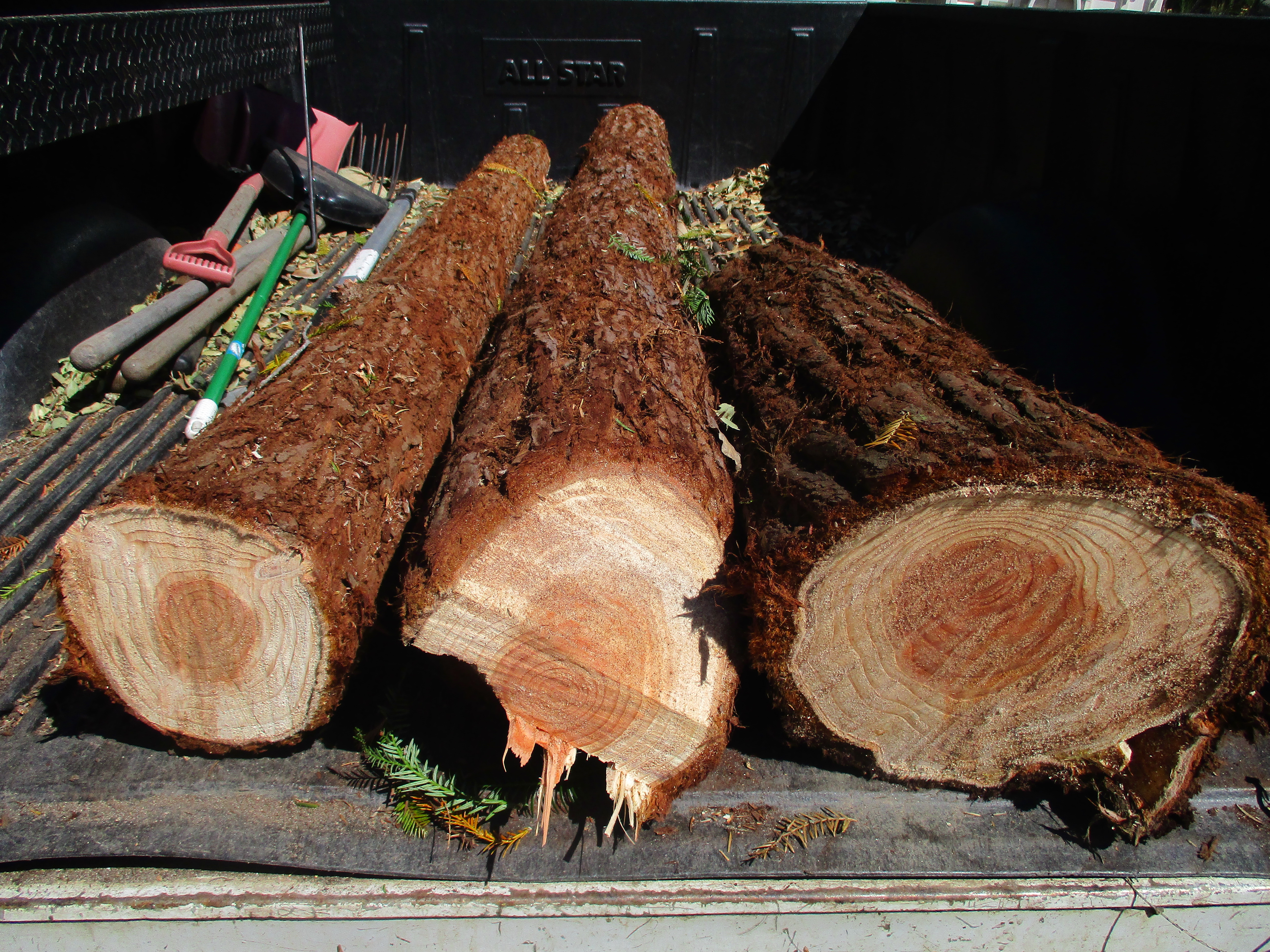
 This is not about North and South. It is about a utility pole and a pole that remained from a redwood tree that was too close to it. One is there to support a variety of cables and a streetlamp. The other just wanted to grow into a redwood tree to join the rest of the forest. One has been deceased for many years or decades. The other was alive just recently, but is now only a stump.
 Wildlife and domestic animals seem to follow me everywhere I go. When Brent and I lived in the dorms at Cal Poly, our room was known as the Jungle Room, not only because of all the greenery, but also because every little bird that got knocked out while trying to fly through the big windows at the dining room was brought to our room to recuperate. A baby squirrel that weaseled into my jacket while I was out collecting insects for an entomology class lived with us for a while. There were two baby ducks that need a bit more explaining.
 Tony Tomeo