Horridculture – Headless

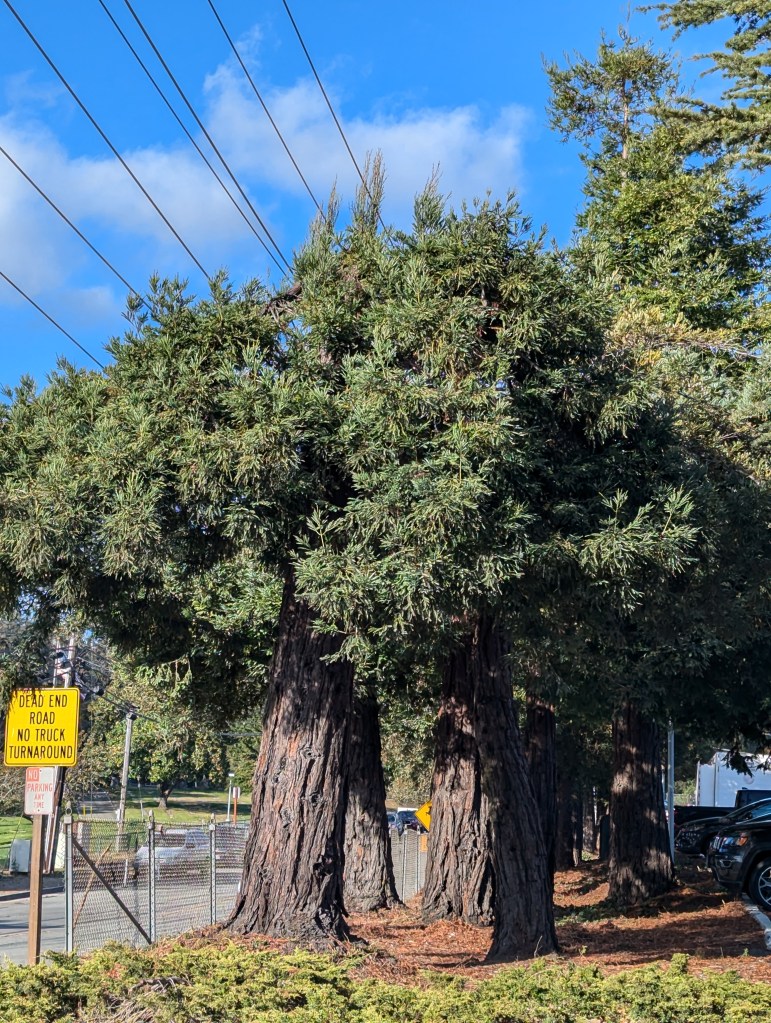
Appropriately, this picture was taken on Halloween. The ‘DEAD END’ sign and cemetery beyond, which are visible to the lower left of the picture, were also coincidental. The several headless redwood trees are the primary topic. Obviously, they were decapitated because of the electrical cables above. Otherwise, redwoods with such healthily plump trunks would be rather tall by now. After all, coastal redwoods are the tallest trees in the World. Unfortunately for them and those who are now appalled by their disfigurement, reliable and safe electrical service is more of a priority than poorly situated trees. It is no fault of the trees. Nor should this atrocity be blamed on those who executed it. Their only better option would be complete removal of the subjects, and perhaps replacement with smaller trees that will not grow tall enough to get too close to the electrical cables above. Maintenance of clearance of the vigorously upright redwoods from the cables above is a chronic problem that must be morally challenging for the arborist who must perform the necessary procedures. However, removal of several such significant trees would be very objectionable to the Community, which is very likely why these trees remain, regardless of their severe and irreparable disfigurement. Application for permits for their removal requires posting of such intentions on the trunks of the subject trees, to which neighbors would very likely protest. None of this would be such a problem now if only trees that are more appropriate to this particular situation were installed instead! Did the landscape designer who designed this landscape even visit the site during the design process, or was it all done on paper in a remote studio? Why did those who installed these trees not foresee this problem and modify the landscape plan and species selection accordingly?
Utility Clearance Can Disfigure Trees

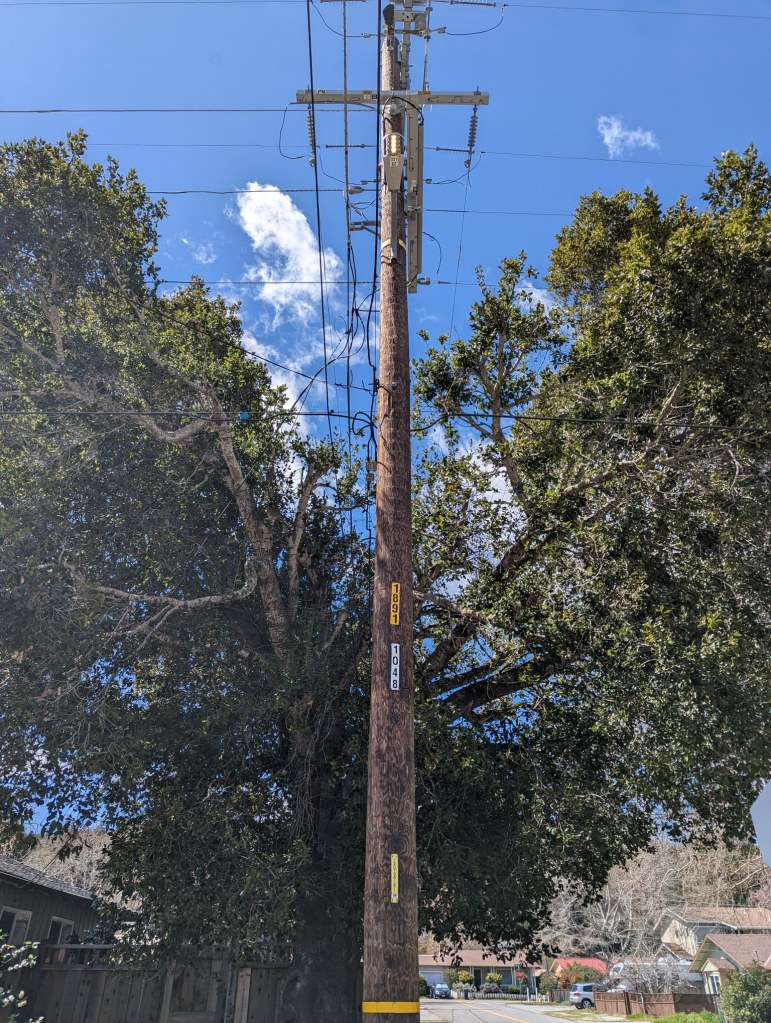
Utility cables need clearance from trees.

Last winter was a doozy! It involved historic frost, snow, rain, wind, floods and mudslides. A few roads remain closed in some regions. Major electrical outages were too numerous for prompt repair. Weather alone did not cause such outages though. It merely dislodged vegetation that did so. This demonstrates the necessity for utility clearance maintenance.

Utility pruning is a specialized but very often unpleasant sort of arboriculture. It maintains necessary clearance between vegetation and utility cables. Its unpleasantry derives from its harsh efficiency. Clearance is the priority. Proper arboricultural technique is not. There is no compromise. Trees that encroach too closely to cables are likely to regret doing so.

Proper arboricultural procedures are too expensive to justify for utility clearance pruning. Otherwise, electricity and other utilities that utilize cable would be much more expensive. Besides, for many trees within utility easements, proper arboriculture is impossible. They can not accommodate necessary pruning without disfigurement. Several can not survive such disfigurement.

Palms, for example, can not survive without their single terminal buds. They lack limbs to divert growth to. Removal of a terminal bud that encroaches too closely to utility cables is lethal. Palms generally grow only upward. Those that grow tall rapidly can not live below utility cables for long. Very few palms remain low enough to maintain minimal clearance.

Excurrent trees are generally more vulnerable to disfigurement than decurrent trees. The single central trunks of excurrent redwoods and spruces do not adapt to redirection. The several main limbs of decurrent oaks and elms are more cooperative. Compact trees that are unlikely to reach cables are least problematic. Of course, many trees are unplanned.

Arborists can repair some minor clearance pruning damage or disfigurement. They might prevent some damage by timely pruning for containment. Unfortunately, some damage is neither repairable nor preventable. Also, such procedures are too dangerous for anyone who lacks qualification for them. Typical garden enthusiasts must avoid electrical cables!