Hollies produced more bright red berries while they were more popular many years ago. Formal and perhaps lengthy hedges of exclusively female cultivars were common. A few or solitary male pollinators grew nearby, often as obscure small trees. Nowadays, males are oddly rare. Not many horticultural professionals are aware that hollies are dioecious.
English holly, Ilex aquifolium, is both the most and least favorite holly. Some who grow it appreciate its distinctively intricate foliar texture. Others detest the unpleasant prickliness of the same foliar texture. No other holly is as spiny, although most are somewhat prickly. All hollies exhibit dark green foliar color, remarkably glossy foliar sheen and rigid foliage.
English holly can grow as a small tree with a dense canopy. With pruning, most stay less than ten feet tall. Cultivars with white or yellow variegation grow slower and stay smaller. Berries are common amongst naturalized colonies which naturally include both genders. Nurseries occasionally sell cultivars of both genders, potted together to mature together.
During the 1990’s, English ivy, Hedera helix, evolved beyond small scale ground cover and became popular for pseudo-‘topiary’. It is now commonly trained onto wire frames formed into spheres, cones and all sorts of shapes. English ivy is also a nice greenery to fill in between flowering annuals and perennials in mixed urns and planters, especially where it can cascade downward.
There are all sorts of cultivars (cultivated varieties) for all sorts of applications. ‘Hahn’s Self Branching’ English ivy is probably the most practical for ground cover, since it fills in so reliably and is somewhat tolerant of partial shade. ‘Needlepoint’ had darker and more finely textured foliage; but since it does not cover larger areas so efficiently, it is instead more commonly used as greenery with mixed annuals and perennials, or for pseudo-‘topiary’. All sorts of variegated English ivy, whether alone or as a component to mixed plantings, brightens slightly shaded spots. Variegation ranges from greenish white to yellow. Leaves can be lobed, ruffled, elongated, cleft or even nearly compound; but are generally two to three inches wide. Most have three to five ‘corners’.
Adult ghost ivy growth is shrubby rather than vining. Also, it blooms and produces seed.
Ghost ivy is actually just a fancy name for variegated Algerian ivy, Hedera canarienses ‘Variegata’. Their glossy six inch wide leaves with three or five ‘corners’, are irregularly blotched with dark green, very pale green and white. Like all ivies, ghost ivy can grow as a ground cover, climb like a vine, and eventually develops self supporting branches that bloom and set seed. It may be somewhat less aggressive than unvariegated Algerian ivy, but can still overwhelm perennials, small shrubs, and even small trees.
Ivy can be allowed to climb tree trunks only if it is not allowed to wrap around and graft onto itself. Otherwise, tree trunks will become constricted as they grow and expand within their ivy wrappers. Because they climb by aerial roots, the various ivies should not be allowed to climb painted or wooden surfaces that can be damaged or succumb to rot. However, some people like the look of ivy cascading down from hefty arbors and porches enough to not mind replacing rotten parts occasionally.
Contrary to the deep green of Algerian ivy, which adds a cooling effect to sunny landscapes, ghost ivy lightens up dark areas. Ghost ivy is only rarely available in ground cover ‘mud’ flats, or in #1 (1 gallon) cans. Larger plants are not practical, since they take too much time to recover from transplant. New plants are very easy to propagate from cuttings made from pruning debris. Cuttings from shrubby adult growth become shrubby plants.
Old fashioned New Zealand flax, Phormium tenax, is becoming increasingly uncommon. It is simply too big for compact modern gardens. Even without upright stems, its vertical and olive drab leaves can reach ten feet tall. They can flare outwardly as wide as fifteen feet. One cultivar is bronzed. Another is variegated. Both are somewhat more compact.
Most modern cultivars are either Phormium colensoi or hybrids of the two species. They are more compact and more colorful. ‘Jack Spratt’ grows only about a foot and a half tall, with chocolaty bronze foliage. ‘Yellow Wave’ gets about three or four feet tall with arching foliage with yellow stripes. Others are bronzed or striped with yellow, brown, red or pink.
New Zealand flax is remarkably resilient. The evergreen foliage is so very fibrous that it can be difficult to cut. Tough rhizomes that migrate where they are not wanted propagate easily by division. Some cultivars can revert by generating less colorful mutant growth. Since it is greener, such growth is more vigorous. It can overwhelm and displace more colorful foliage.
Andromeda might be more familiar by its Latin name of Pieris. A few of its seven species, and a few of their hybrids, are popular for home gardens. All are evergreen shrubs. A few do not grow much taller and wider than three feet. Few can grow a bit more than ten feet tall and wide. In the wild, some might grow as small trees that are almost twenty feet tall.
Andromeda has glossy evergreen foliage. Individual leaves are lanceolate, perhaps with serrated margins. They are between one and three inches long, and half to an inch wide. New growth of most cultivars is as rich cinnamony red as that of photinia. A few cultivars have more pinkish or simple green new growth. A few cultivars are variegated with white.
Andromeda blooms with somewhat pendulous racemes of tiny pendulous flowers. Floral racemes are between two and four inches long. Individual flowers are between a quarter and half an inch long. Most are white. Some are pink. Most have green rachi. Some have pink rachi. Bloom is abundant for the middle of spring. Andromeda prefers partial shade.
Modern dracaena palms are more compact, more colorful and more user friendly than old fashioned sort.
(This article was deferred from yesterday morning.)
While hoping to find some of the uncommon yuccas that I still lack, I instead encountered some of their friendlier kin in a local nursery. Even though dracaena palm, Cordyline australis, is an old fashioned plant that was probably considered to be too common until the past few decades, many more colorful modern cultivars are restoring its appeal. Classic dracaena palm has olive drab foliage. The nearly as traditional bronze dracaena, ‘Atropurpurea’, has reddish bronze foliage. The more contemporary ‘Red Star’ though is deeper purplish red. ‘Pink Stripe’ has bronzy green leaves with pink edges. ‘Sundance’ has pink in the middle with green edges.
Modern cultivars also stay shorter so that their abundant foliage can be appreciated on a more personal level. The individual sword shaped leaves are about three feet long and three inches wide, a bit larger than traditional dracaena palm leaves. However, I actually prefer the traditional dracaena palms that can get taller than twenty feet and spread nearly half as wide, with sculptural bare trunks and high branches.
Any dracaena palm that gets too tall can be cut back to a more proportionate height. One of my colleagues recommends cutting about a quarter through trunks a year or more prior to cutting back, to stimulate new shoot growth just below the cut. The new growth prevents the trunks from being bare immediately after getting cut back. Overgrown heavily branched trees should first be thinned to decrease their weight before cutting partly through their trunks. Young plants can be cut back to the ground to regenerate with multiple trunks.
Billowy trusses of tiny pale white flowers add interest at the end of spring, particularly against darker foliage. I am told that the flowers of modern cultivars are slightly fragrant. However, against the olive drab foliage of older dracaena palms, I think that the blooms look rather dusty, and do not smell any better.
Boston fern is merely one of several cultivars of Nephrolepis exaltata. Its cultivar name is ‘Bostoniensis’. Variegated Boston fern, or tiger fern, is reputedly a cultivar of this cultivar. Its cultivar name is either ‘Variegata’ or ‘Tiger’. From a distance, it seems to be a yellower version of the original. Prettily intricate stripes become apparent with closer observation.
Variegated Boston fern is a bit smaller and a bit less vigorous than common Boston fern. Like all variegated cultivars, it works with a bit less chlorophyll. Mature potted specimens might get no wider or higher than three feet. Unvariegated Boston fern can be more than four feet from top to bottom. Both could be larger if their long fronds were less pendulous.
In home gardens, variegated Boston fern can get rather tattered through winter. It is likely to defoliate if exposed to even minor frost. This is why it is more popular as houseplants, usually in hanging pots. Such potted specimens rely on consistent watering. Diffused but bright sunlight is best. Occasional application of fertilizer enhances foliar color and vigor.
Variegation can be neatly symmetrical, or strikingly irregular like this.
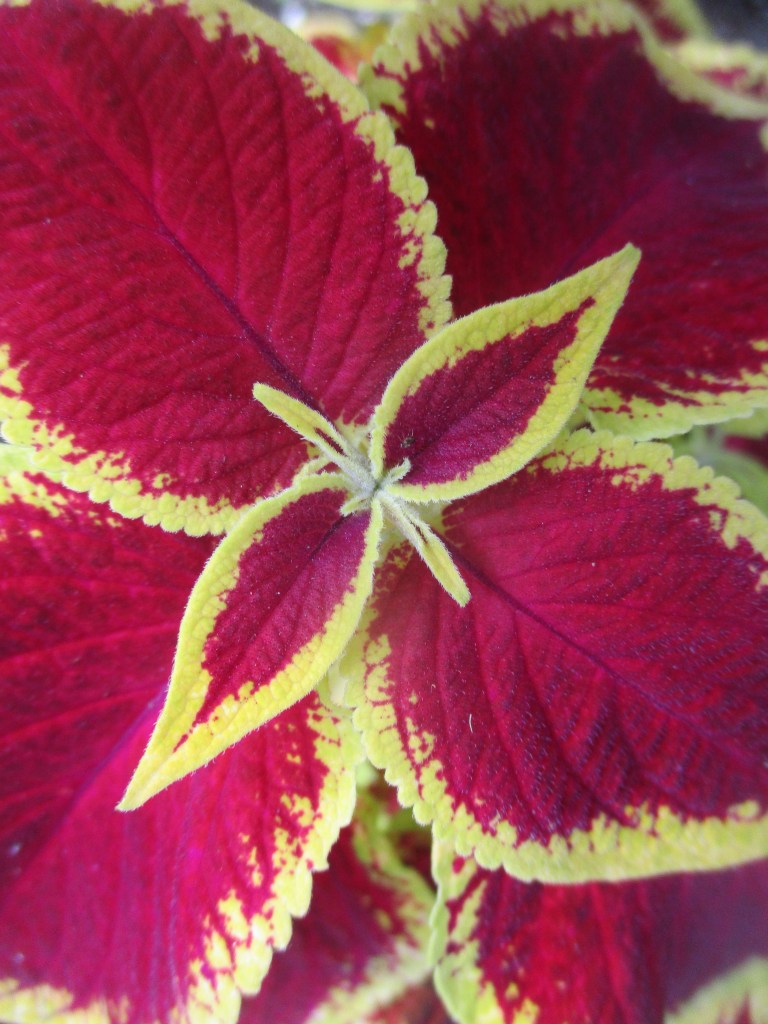
With spider plant, croton, pothos, dracaena and the various ficus, variegated foliage seems to be very popular among house plants. Remember the wildly colorful variegations of coleus when it was a popular houseplant in the 1970’s? Variegation is most commonly white or some sort of yellow; yet can be just about any color.
In the landscape, variegated shade tolerant plants brighten shady spots even without bloom. Variegated acanthus, Japanese aralia, andromeda, hydrangea, aucuba and angels’ trumpet show up nicely, especially when they can contrast with the darker green of other plants; although andromeda and hydrangea do not bloom as well in darker shade. Variegated periwinkle and English ivy are nice ground covers, (but potentially invasive).
Variegated trees, like tulip tree and certain maples, stay smaller than their unvariegated relatives, so can be proportionate to large atriums that could use their brighter foliage. Some of the variegated pittosporums likewise function like the unvariegated forms used for informal hedges, but work better in tighter spots.
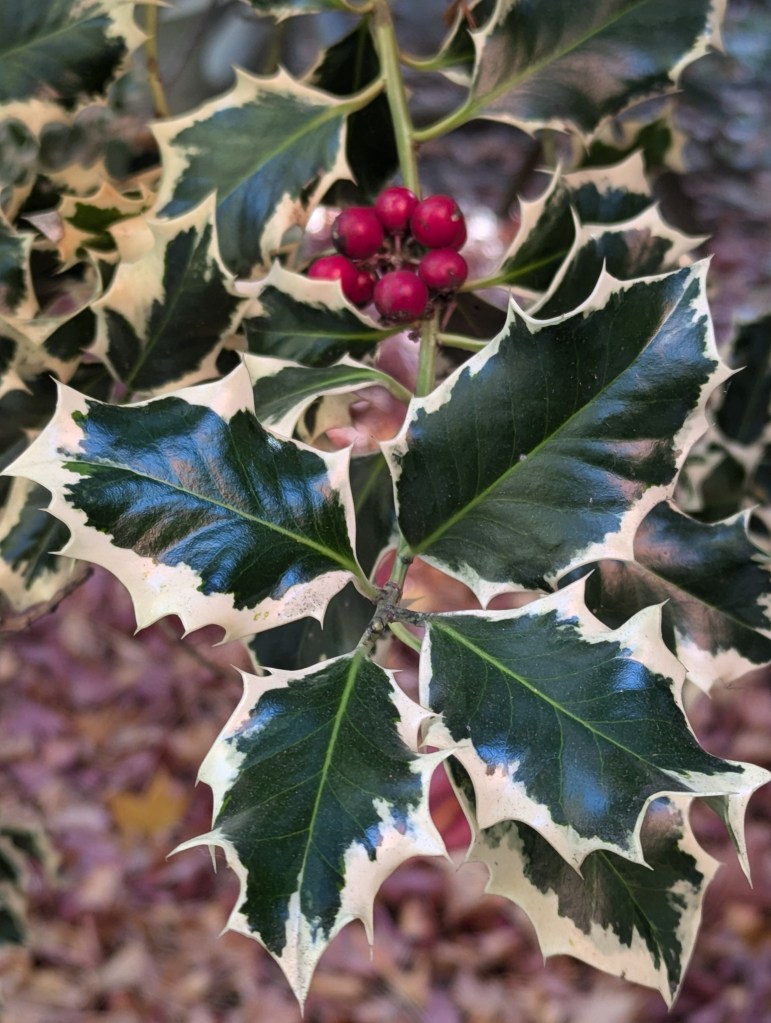
Even if there is no need to brighten areas that are already sunny, variegated holly, lily-of-the-Nile, bougainvillea, pampas grass and silverberry add nice contrast where there is an abundance of rich green foliage. (However, some people who grow variegated pampas grass are not too impressed by it.) New Zealand flax presently happens to be one of the most popular variegated perennials, with many different personalities of color to choose from. Variegated varieties of several specie of agave and yucca are striking big perennials for the sunniest and even inhospitably hot spots, as long as they are kept at a safe distance. (Many have dangerous spines and teeth!)
Some variegated plants, particularly New Zealand flax, andromeda, Pittosporum tobira and the various maples, try to produce unvariegated mutant growth that grows faster and bigger, and overwhelms the desirable variegated parts. It is therefore important to watch for and prune out unvariegated growth as it appears. For New Zealand flax, this involves diligent digging and splitting to removed unvariegated shoots from the variegated parent plants.
Bower vine bloom sporadically until cooler autumn weather.
Autumn needs to get a bit cooler before bower vine, Pandorea jasminoides, will be ready to stop blooming. It may not always bloom profusely, but it does bloom for a long time, beginning with warming spring weather. Flowers can be white, pink or white with pink throats, but are most often pink with burgundy throats. Even through late autumn and winter, the glossy evergreen foliage is appealing without bloom. Mature vines can climb more than fifteen feet high. Those with variegated foliage might stay somewhat smaller.
New England is famous for spectacular foliar color through autumn. Such color is merely seasonal though, and almost exclusive to deciduous vegetation. With few exceptions, its color range is limited to variations of yellow, orange, red or brown. It happens thousands of miles away, and is difficult to replicate on such a grand scale with locally minimal chill.
For smaller scale home gardens, there are many options for foliar color at any time of the year, regardless of chill. Some are deciduous. Most are evergreen. Colorful foliage might exhibit variegation or monochromatic coloration. Variegation might involve stripes, spots, borders, veining, or any combination of divergent colors. Some might entail a few colors.
Besides autumnal yellow, orange, red or brown, foliage can be pink, purple, blue or gray. Variegation can feature any of these colors, as well as white. The size and form of plants with foliar color ranges from small annuals and perennials to vines, shrubbery and trees. A few of such plants that are deciduous might change to different colors through autumn.
Various Hosta, Euonymus, Coprosma, Pittosporum, Hedera and Bougainvillea are some of the more popular plants with white or yellow variegation. New Zealand flax is popular for bronze, brown, gold or pink variegation. Canna can display evenly bronze or purplish foliage, white patches on green foliage, or neat yellow and pink stripes of varying widths.
Purple leaf plum and some cultivars of smoke tree, beech Eastern redbud and Japanese maple have the best purplish foliage. Other cultivars of smoke tree, as well as arborvitae, juniper, Monterey cypress and honeylocust, generate impressively yellow foliage. Agave and blue spruce contribute soft blue. Coleus impresses with various color combinations.
Whether deciduous or evergreen, most colorful foliage displays its best color while fresh and new in spring. For some, color fades through summer. Junipers that are gold through spring may be plain green by summer, particularly in dry conditions. Although light colors and variegation are appealing within shady situations, shade can inhibit such coloration.


 Tony Tomeo