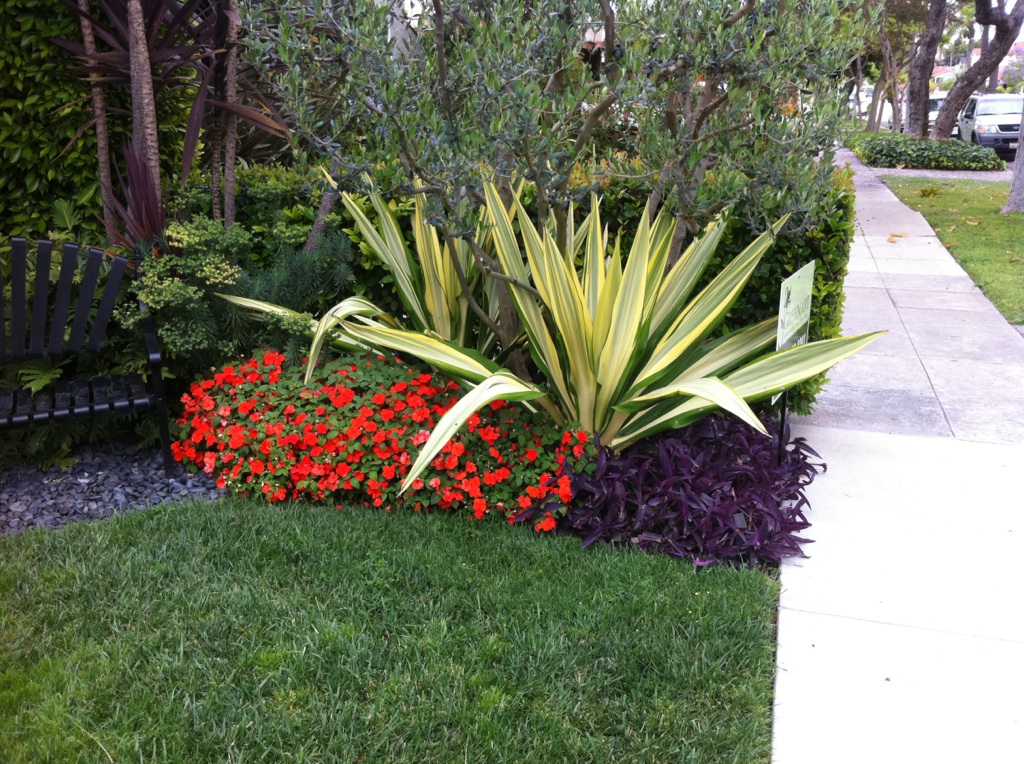
Furcraea foetida ‘Mediopicta’ looks like a big Yucca or a small Agave.
As spectacular as the bloom of Furcraea foetida ‘Mediopicta’ is, it is actually not the most desirable feature. Solitary flower spikes grow intimidatingly fast up past second story windows, and spread out several feet wide with small but abundant pale white flowers. They are certainly impressive, but are also the final act for mature plants just before they die.
Fortunately, they take several years to mature, so provide big bright yellowish green variegated foliage for many years. The other good news is that as they die, herds of pups (known as ‘bulbils’) develop and fall from the huge inflorescences. There are far more than enough pups to replace the original plants and to share with all the concerned neighbors who witnesses the crazy bloom.
Furcraea foetida ‘Mediopicta’ is not quite as tough as unvariegated (green) furcraeas, so it can be damaged both by frost or harsh exposure to sunlight. It is also a bit smaller, staying less than five feet tall (prior to bloom of course) and seven feet wide. Too much watering can cause rot.
Peperomia obtusifolia, baby rubber plant is what I suspect this to be. I can not be certain. I do not work with houseplants. I can barely remember that we studied only a few cultivars of Peperomia that happened to be popular back when we were in school during the late 1980s’. The modern cultivars that are popular now were not even developed back then. I do not remember ever getting acquainted with the simple species, which this seems to be. That makes it even more perplexing. Where did someone get this copy of the simple species that has become so rare relative to popular modern cultivars as well as formerly popular cultivars? The rarest of modern cultivars is not as rare as this original. It is an exemplary specimen, too. It is at least two feet wide and stands more than a foot tall in its wide but shallow pot. Someone has maintained it meticulously for several years. Perhaps it grew as a cutting from an even older specimen that was grown before it became so rare so long ago. Perhaps someone appreciated this original simple species as it was losing popularity to more colorful modern cultivars back then. Realistically, without any of the fancy variegation of modern cultivars, the simple green original is undoubtedly more vigorous, and perhaps significantly so. It is therefore more sustainable than cultivars, and more likely to survive and perpetuate itself by cutting for many years. Alternatively, it could have originated as a reversion from a modern cultivar. Someone may have been impressed enough by its relatively vigorous simple green foliage to grow a copy from a cutting. Perhaps relatively vigorous simple green growth merely overwhelmed and replaced original but less vigorous variegated growth. These are merely guesses about its identity, which remains a mystery.
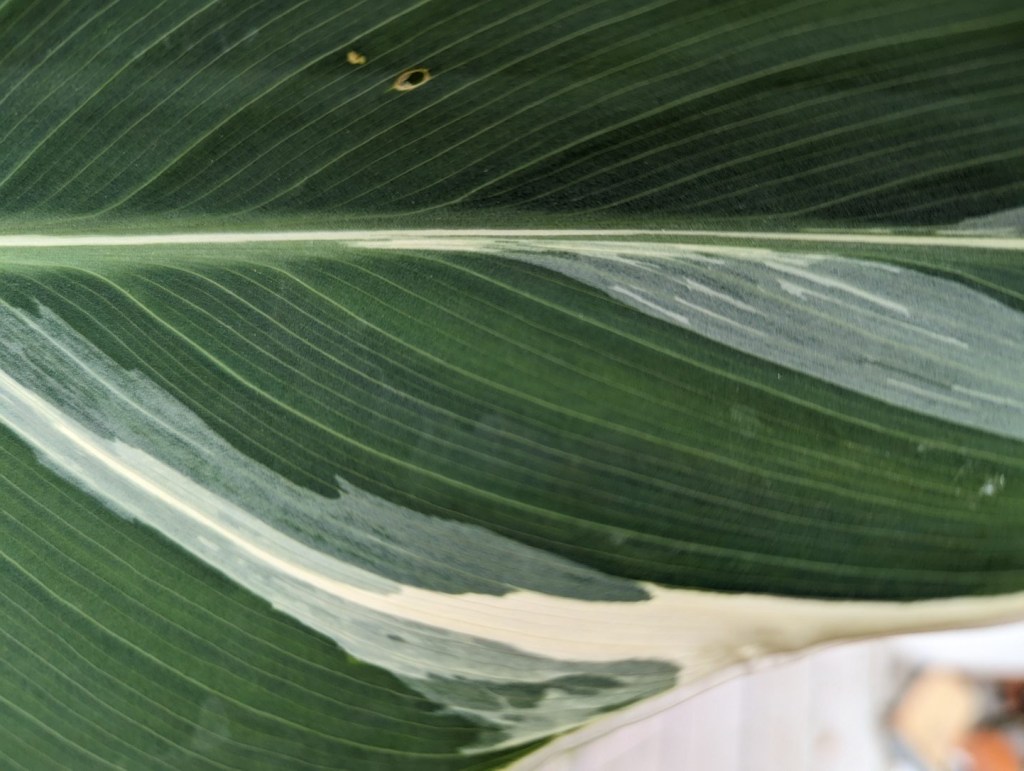
Reversion among vegetation is the loss of an aberrative genetic characteristic, such as variegation or bronze foliar color. Because most genetic aberrations that are susceptible to reversion are disadvantages, reverted growth generally performs more efficiently, and displaces remaining genetic aberrative growth. For example, because its variegated portions lack chlorophyll, variegated foliage is less vigorous than foliage that is not variegated. Therefore, if not removed, unvariegated reverted foliage is likely to grow faster and replace variegated foliage. This ‘Stuttgart’ canna leaf seems to have done the opposite of reversion, by exhibiting such extreme variegation that all green color is lacking. Fortunately, it is not as bad as it looks. This is merely very variable variegation. Just as a few leaves may be completely green without actually reverting permanently, a few leaves are extremely variegated, and on rare occasion, a few, such as this leaf, may lack any obvious green color. Leaves that developed after and above this leaf exhibited more typical variegation with both green and white. Otherwise, this particular cane would not survive for long without chlorophyll for photosynthesis. The flowers are unaffected because they derive their floral color from pigment rather than chlorophyll. White redwood foliage can survive without chlorophyll only because it can rely on resources provided by the normal growth with green foliage that it is attached to, almost parasitically. Such growth is considered to be albino, but because it merely lacks chlorophyll rather than pigment, it is technically not albino. Furthermore, it is technically not variegated, since it is so completely white, without any green chlorophyll. Oh, this is more complicated than it should be. It is probably better to simply appreciate appealing genetic aberrations such as white, variegated or other colorful foliage. ‘Stuttgart’ canna will not refresh its variegated foliage until the end of winter.
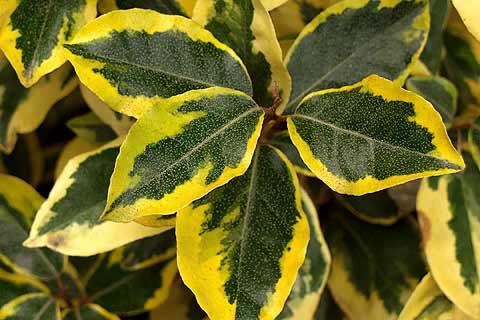
Most modern silverberry is variegated with yellow or white.
Old fashioned silverberry, Elaeagnus pungens, has always been useful for large informal hedges and barriers in difficult locations. It may not be as refined or as bright green as other plants that are more commonly used for formal hedges; but it is more adaptable to harsh exposure, since it has no problem with heat and reflected glare.
If necessary, silverberry can be shorn like privets, but is at its best with only occasional selective pruning to keep it within bounds. Without pruning, it can grow to more than ten feet high and nearly as wide. Despite its slower growth at maturity, it grows faster and fills out quite efficiently while young.
All parts of silverberry are covered with slightly raspy and silvery or ‘rusty’ tomentum (fuzz – although it is not exactly ‘fuzzy’). The one to two and a half inch long leaves often have undulate margins. The less than abundant, half inch long brownish berries taste better than they look. Somewhat spiny vigorous stems efficiently deter intrusion. Trespassers that might get through them once will not try again.
Modern cultivars (cultivated varieties) are neither as rugged as the straight species, nor as large, but have more colorful foliage. Leaves of ‘Variegata’, which is shown in the illustration, have lemony yellow or nearly white margins. ‘Marginata’ has brighter white leaf margins. ‘Maculata’ leaves are instead equipped with bright green margins around bright yellow centers. ‘Fruitlandii’ has larger silvery leaves.
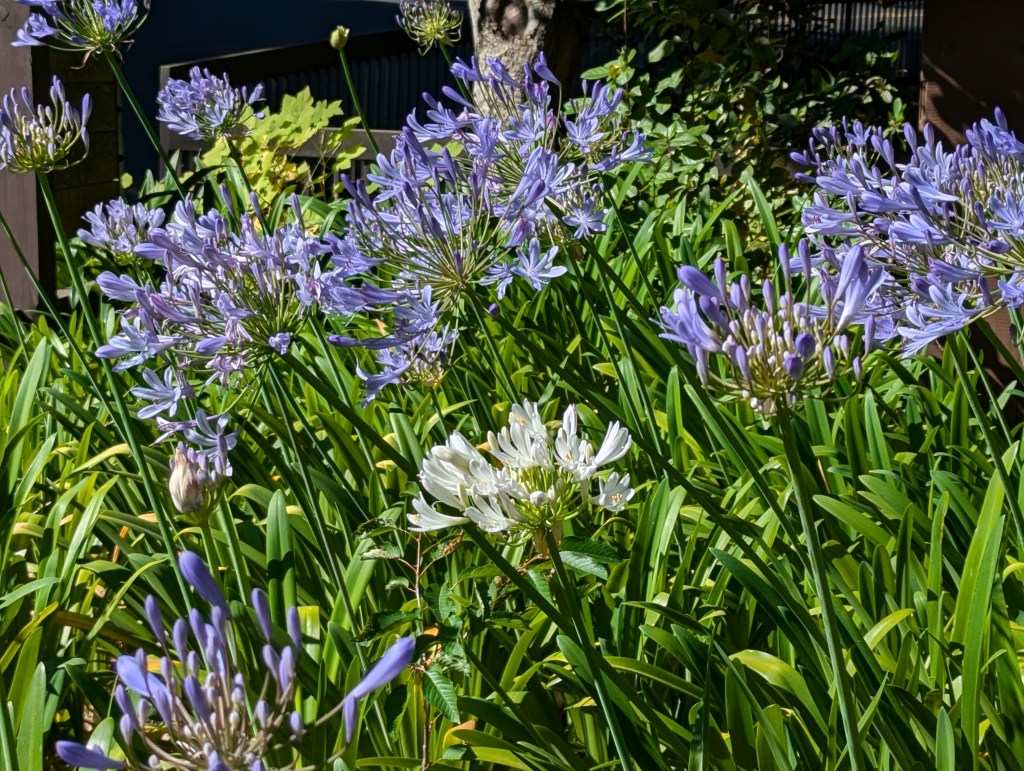
This white lily of the Nile appeared this summer within this exclusively blue colony.
Horticulturally, a sport is a genetically variant growth. Although it is more common among extensively bred or genetically aberrative cultivars than simple species, the most basic of lily of the Nile can, on rare occasion, change floral color from blue to white or from white to blue, as I mentioned on the sixth of July. Unvariegated or ‘green’ sports are a more common annoyance among some cultivars with variegated foliage, such as popular cultivars of Euonymus japonica, since they grow faster with more chlorophyll, and can overwhelm the original and more desirable variegated growth. The yellow hybrid gladiola that I posted a picture of for Six on Saturday on the twenty-ninth of June could be a sport of an adjacent orange and yellow hybrid gladiola. I did not give it much consideration because I assumed it to be the first bloom that I noticed from one of a few bulbs that somehow survived for a few years longer than expected. Until last summer, the only hybrid gladiolas to survive from a mixed batch planted years earlier had been either purple or the aforementioned orange and yellow. However, now that the yellow bloom is gone, an equally unfamiliar orangish red bloom emerged from the same small colony of bulbs that had bloomed only orange and yellow. As their common name suggests, hybrid gladiolas are hybrids, so are innately genetically unpredictable, and therefore have potential to generate sports as they multiply. Although I do not know for certain that this new orangish red hybrid gladiola did not survive without blooming for the past few years, I sort of suspect that it and the new yellow hybrid gladiola are more recently developed sports of the original orange and yellow hybrid gladiola. I hope that both are as reliably perennial as the original.
This orangish red hybrid gladiola seems to be a sport of the orange and yellow hybrid gladiola.
‘Variegata’ is a common designation for the first variegated cultivar of a species. Fancier or later distinct cultivars get fancier cultivar designations. The first three of these six are variegated, but lack a cultivar designation as if variegation is normal for the species. The fourth seems to have a few cultivars with the same designation. The last two could be the only variegated cultivars of their respective species. I can not remember ever seeing any of the first four without variegation. The fifth is still rare. The sixth is now more popular than unvariegated.
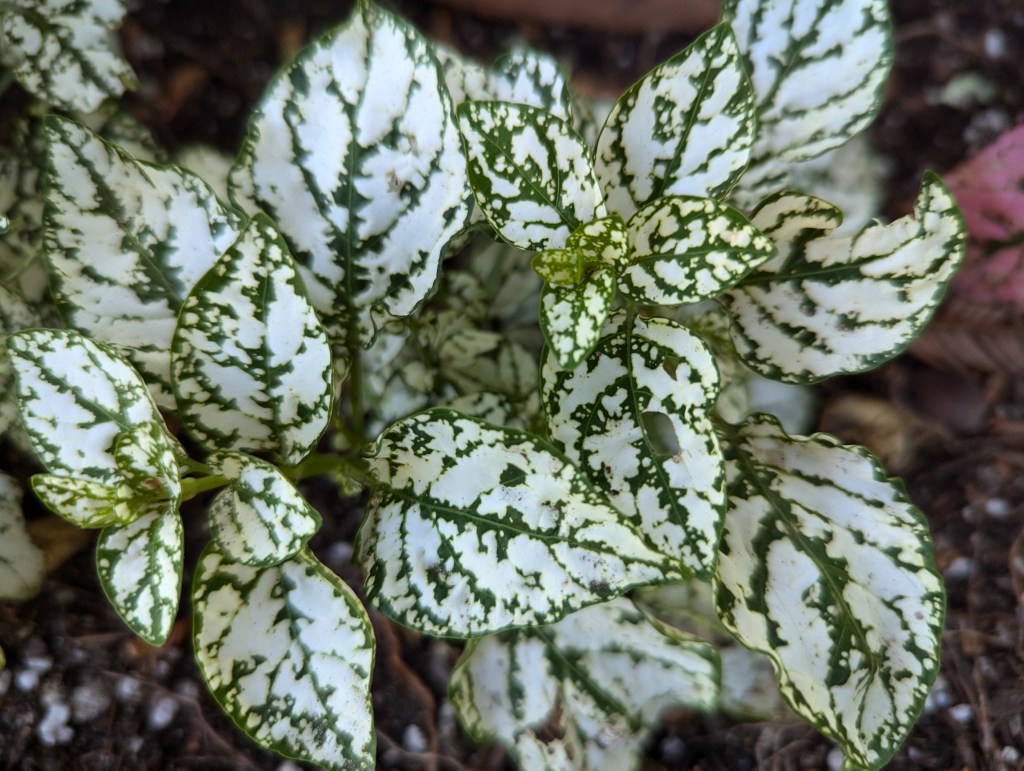
1. Hypoestes phyllostachya, polka dot plant lacks cultivar designation. This was labeled merely as white. Variation of foliar variegation indicate that they were grown from seed.
2. Hypoestes phyllostachya, polka dot plant is also pink, which is exactly how this other half of them was labeled, likewise without cultivar designation. ‘Variegata’ would suit it.
3. Hypoestes phyllostachya, polka dot plant variegation is variable. Some specimens are more green than others. At least two of the pink sort are variegated with red such as this.
4. Aucuba japonica ‘Variegata’, gold dust plant is about as variable as polka dot plant is, but is known by the same cultivar name. Of course, modern cultivars have other names.
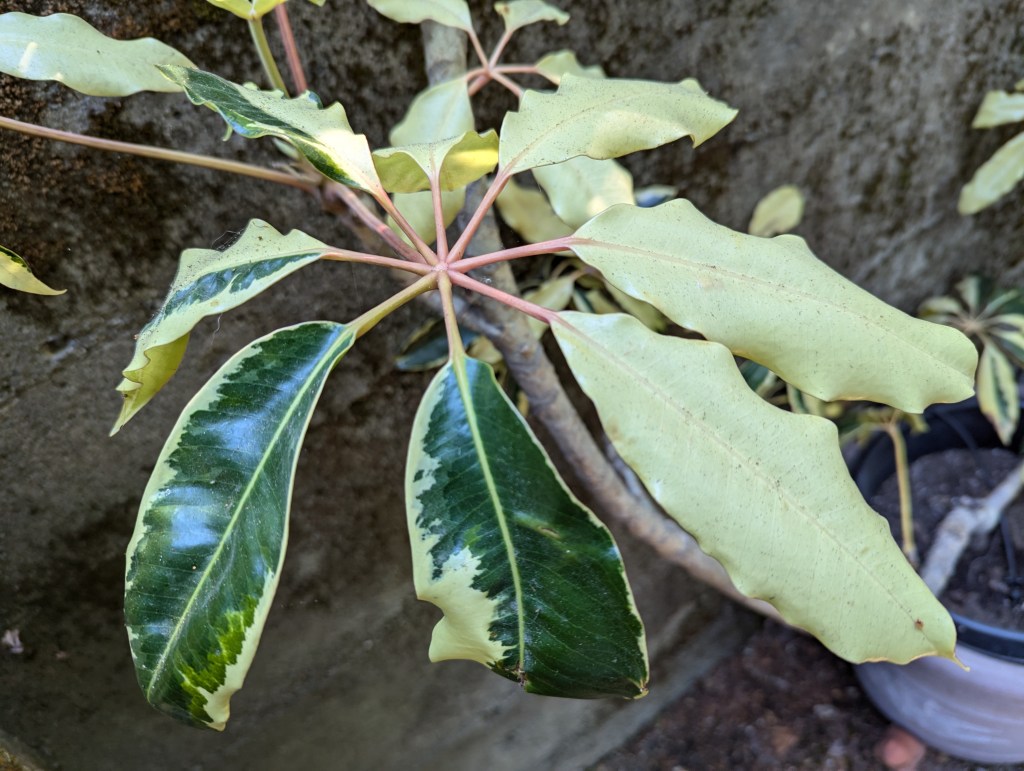
5. Tupidanthus calyptratus ‘Variegata’, mallet flower was not planned. I have wanted to grow the typical unvariegated type since I met it in 1986. Brent sent me this raggedy old but rare variegated specimen so that I would grow more for him. I am learning to like it.
6. Solandra maxima ‘Variegata’, cup of gold vine was also unplanned. I grew the typical unvariegated type to the left first. Then, Brent got me the variegated cultivar to the right. I am getting to like it because it is more docile. The unvariegated sort grows like a weed!
Floral color gets most of the attention within home gardens through spring. It should. It is the most copious and most colorful of color. Though, it is not the only color. A few species that provide floral color, and more that do not, provide colorful foliage. Similar to Olympic Medals, this foliage can be bronze, silver or gold, or variants of such. Some rivals bloom.
Colorful foliage is not the same as foliar color of deciduous foliage as it sheds in autumn. Much is evergreen. Most is most colorful while it grows through warming spring weather. Actually, most fades through summer, and some becomes simpler dark green by autumn. Afterward though, some deciduous colorful foliage also develops foliar color for autumn.
The most popular colorful foliage is variegated. This means it is partly green with stripes, margins, blotches, spots, patterns or blushes. The color range of such variegations is as variable as its pattern range. Some foliage is variegated with a few vividly distinct colors. New Zealand flax, coleus, croton and caladium are some of the more familiar examples.
Of all unvariegated colorful foliage, bronze foliage is the most variable. It includes foliage that is brown as well as reddish, purplish or perhaps dark orangish. Some emerges pink before developing a darker shade. New photinia foliage is reddish bronze only briefly as it matures as dark green. Purple leaf plum and smoke tree are famously purplish bronze.
Silver foliage is the most useful colorful foliage in the wild. At high elevations, where sun exposure is harshly intense, it is selectively reflective. It absorbs sufficient sunlight for its photosynthesis, but not enough to succumb to scald. It is how Arizona cypress and some agaves survive in the high desert. Such foliage may be gray, pallid blue or almost white.
Many species with gold foliage are the same as those with bronze foliage. New Zealand flax, smoke tree, barberry and elderberry can be either bronze or gold. Since gold foliage contains less chlorophyll than green foliage, it is a bit less vigorous. Unlike silver foliage, it serves no natural practical purpose. It survives in landscapes for visual appeal.
English holly provides traditional cut foliage, preferably with a few berries, for Christmas. It is annoyingly prickly, though. This is why holly olive, Osmanthus heterophyllus, is now a more docile option. Its foliar texture is very similar, but with slightly dulled foliar spines. It is gentle enough for corsages and boutonnieres. However, it generates no red berries.
Holly olive is popular as small and perhaps decorated potted plants for Christmas decor. Afterwards, it adapts to home gardens more efficiently than typical Holiday potted plants. Such potted plants should not retain any mylar wrapping for too long. It inhibits drainage. Also, any small decorations or fake berries should not remain as stems eventually grow.
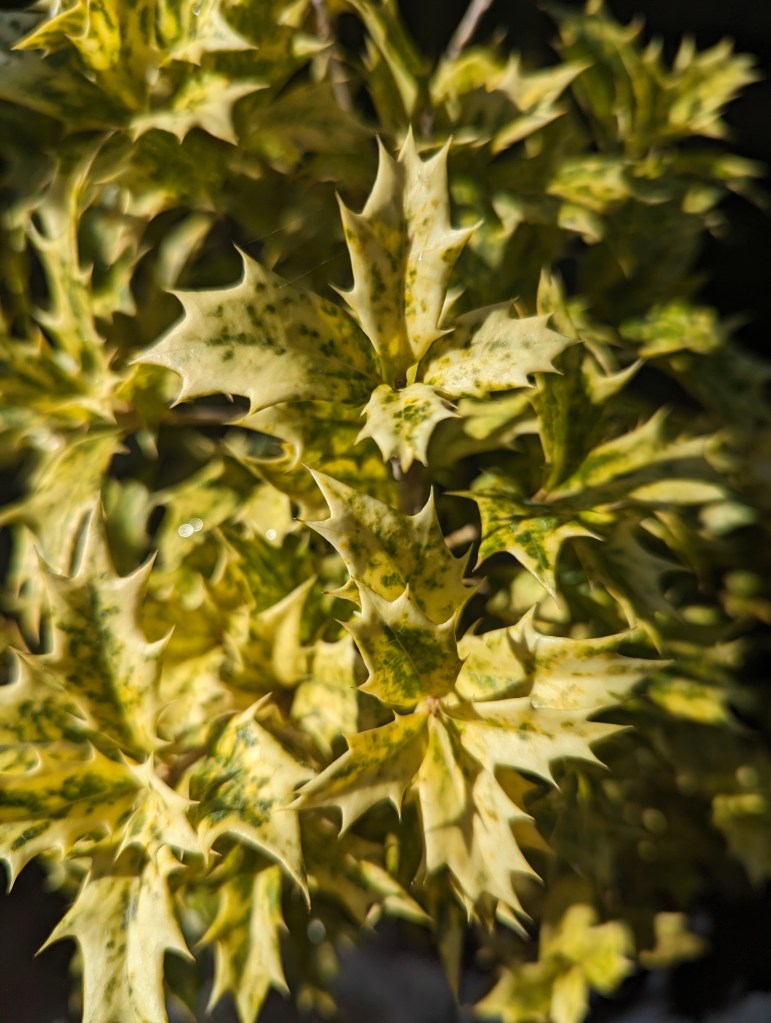
Most popular cultivars of holly olive are variegated. ‘Goshiki’, with more yellow or creamy white blotches than green, is the most popular here. Unvariegated holly olive is a classic dark drab green. All cultivars work splendidly as formal hedges. Alternatively, they might slowly grow taller than fifteen feet. The evergreen foliage becomes less spiny higher up. Tiny flowers are sweetly fragrant.
Val culture developed within the Santa Clara Valley prior to its assimilation into the San Fernando Valley. I totally know how to use “like” in a sentence, and can do so repeatedly if I like. These Six are not about Val culture during the 1980s though. They are just a few items that are sort of like each other, and five items that I like. Eventually, I will like the item that I do not yet like. Totally!
1. Sambucus nigra ‘Black Lace’ is an ornamental cultivar of European elderberry. As the name implies, it has darkly bronzed and intricately lobed foliage. All but two of the herd of cuttings that I plugged rooted. I wanted a few, but got forty-eight. I was not at all fond of this cultivar or even this species when I met it a few years ago, but I now sort of like it.
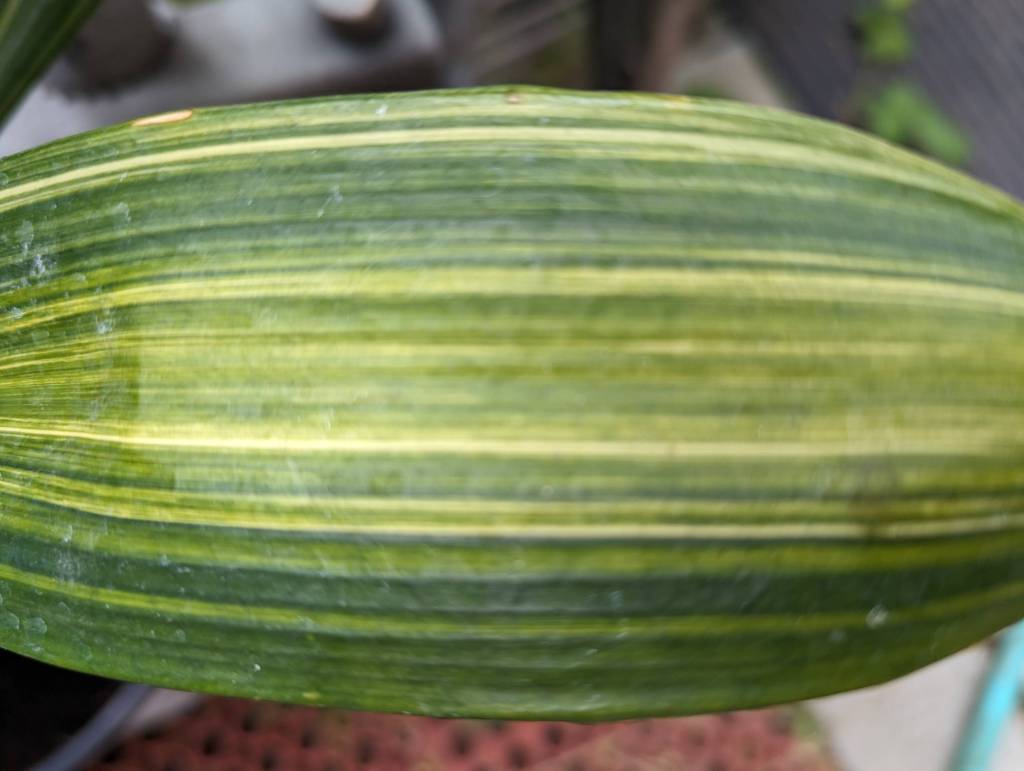
2. Clivia miniata, Kaffir lily lacks bloom now, but like ‘Black Lace’ European elderberry, provides colorfully ornamental foliage. It is variegated with these narrow yellow stripes. I believe it blooms orange. I do not know what cultivar it is. It came from Brent’s garden.
3. Canna ‘Stuttgart’, like the Cymbidium and the other two Canna, lacks a species name. Like 1, 2 and 4, it provides colorful foliage. Like 4 and 5, it is a Canna. It has a lot to like. Most importantly, it came from Tangly Cottage Gardening, and is approved by Skooter!!
4. Canna ‘Australia’ might be described like ‘Stuttgart’ Canna above, but is not approved by Skooter. Its colorful foliage is darkly bronzed, but this specimen is striped with green.
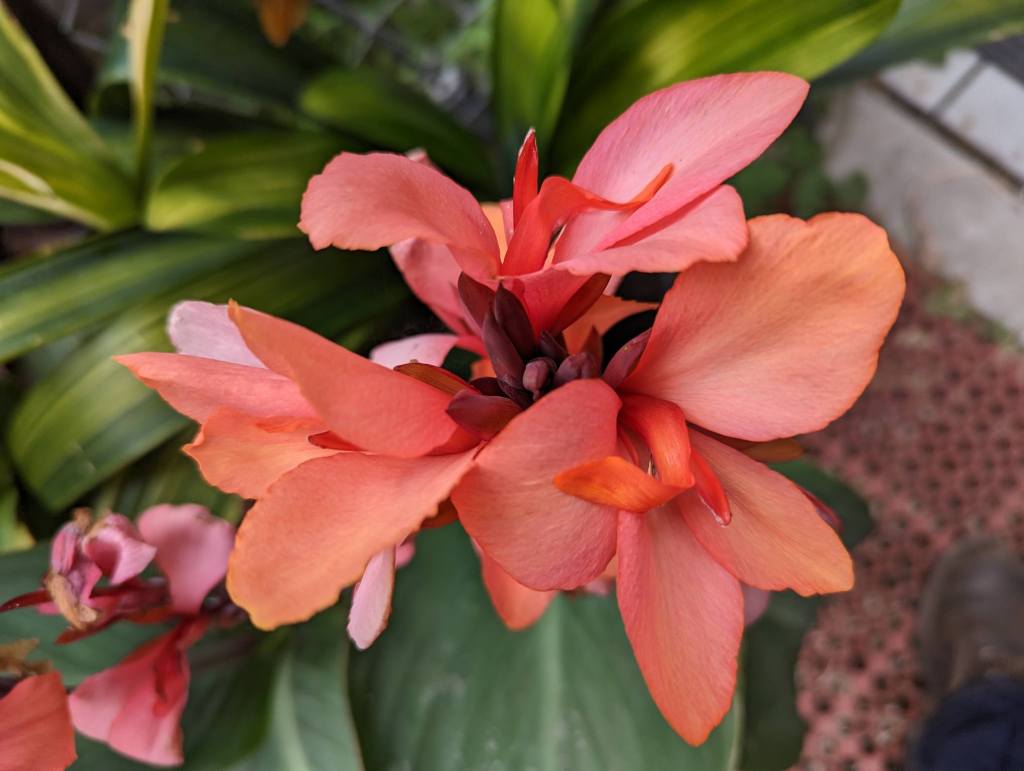
5. Canna ‘Cannova Mango’, like 3 and 4, is a Canna, but that is about its only similarity. I do not like it much because it is a modern cultivar, and it blooms with this weird color.
6. Cymbidium orchid, like 3, 4 and 5, lacks a species name. I like it because I have grown it since the early 1990s. Bloom began in March, but is only now beginning to deteriorate.
Spring bloom is the most colorful color in the garden here. It is not the only color though. Some deciduous foliage will provide color at the opposite end of the year. Bark can add a bit of color, particularly while deciduous trees defoliate for winter. So can colorful fruit. Furthermore, ornamental foliage, both deciduous and evergreen, can contribute color.
Ornamental foliage is not the same as deciduous foliage that is colorful only for autumn. The distinction is that it is colorful from the beginning. Generally, it is most colorful while fresh during spring. If both deciduous and colorful for autumn, it changes from one color scheme to another. If evergreen, it may remain more or less colorful throughout the year.
Ornamental foliage of this sort displays various colors and patterns. Variant colors might be yellow, orange, red, purple, blue, pink, bronze, white or gray. They can be variegation such as stripes, margins, blotches, spots, patterns or blushes. Alternatively, they can be monochromatic. Most fade to some degree during the warm and dry weather of summer.
The colors of ornamental foliage are not as vibrant as floral color. They are not intended to attract pollinators. In fact, most of such color serves no practical purpose. Blue, gray or white foliage mostly originates from high altitudes or harsh desert climates. It reflects a bit of excessive sunlight to avert scorch. Most other ornamental foliage is mere mutation.
In the wild, such mutant foliage is generally a disadvantage. White portions of variegated leaves contain less chlorophyll. Consequently, they can not photosynthesize as much as green portions. Such foliage only perpetuates unnaturally within cultivation because it is appealing. Some mutant ornamental foliage can revert to more vigorous greener growth.
Ornamental foliage can be annual, perennial or woody. New Zealand flax, canna, coleus and caladium are the most variably colorful. Coprosma and various pittosporum are a bit more limited. Euonymus, hosta and ivy display white or yellow variegation. Smoke tree, redbud and some maples are surprisingly diverse. Agave blue spruce and some junipers can contribute gray and blue. There are too many options to mention.










 Tony Tomeo