Renee’s Garden Seed

‘Alaska’ is a popular variegated variety of nasturtium that is available from Renee’s Garden Seed.

There is no shame in growing nasturtiums. We all know how easy they are to grow, and that they can even naturalize. Some of us even consider them to be weeds. Some of us even know them as ‘dago pansies’! Yet, they are colorful, have an abundance of appealing foliage and never seem to have a bad day. Anyone who doubts this should look at Renee’s Garden Seed Catalogue online at www.reneesgarden.com.

Renee’s Garden Seed Catalogue is like a wine list of the finest nasturtiums, even though it also includes many of the more traditional types. ‘Buttercream’ is a new nasturtium this year that blooms with semi-double cream colored flowers! Pale yellow ‘Moonlight’ and bright scarlet ‘Spitfire’ are two climbing nasturtiums that get several feet tall.

Even those of us who primarily want to get vegetable and herb seeds will want to try some of the many unusual flowers, as well as some of the more traditional flowers that are available from Renee’s Garden Seed Catalogue. Besides nasturtiums, there are also many different kinds of sweet peas, sunflowers and morning glories. ‘April in Paris’ is an intensely fragrant sweet pea with large pale yellow flowers that become blushed as they mature. ‘Royal Flush’ is a new sunflower with bi-colored flowers in combinations of gold, dark red and brown. ‘Mailbox Mix’ morning glories have both clear blue and white flowers.  

Mixed seeds may not seem like a good idea for those of us who like organized gardens; but Renee’s Garden color coded vegetable seed mixes have a distinct advantage. The seeds of different varieties within a mix are dyed different colors so they can be separated if desired. It is like getting a few packets of different seed within each mix. Individual packets of seed typically contain more seeds than necessary anyway. (Not all mixes are color coded.)

(Outdated information has been omitted from this recycled article.)

Historic Bloom

‘Stuttgart’ Canna to the left and an unidentified tall Canna with red bloom and green foliage to the right

It is not as important as it sounds. Two varieties of Canna bloomed for the first time here during the past few weeks. They are important only to me because of their origins. With very few exceptions, such as the still elusive ‘San Jose’ bearded iris, I do not pursue rare or unusual species, varieties or cultivars. Actually, most of my favorites are quite common, and most that are rare here are common where they came from. I obtained some from places I have travelled to. Most were gifts from friends, neighbors and colleagues. The Canna to the left is ‘Stuttgart’ from Tangly Cottage Gardening. This is its second season here, but it did not bloom successfully before autumn chill last year. It is the second of three different Canna musifolia here. The first has moderately bronzed foliage. The third has simple green foliage. ‘Stuttgart’ has the most distinctive foliage that is variegated with variable white bands. All three bloom with similarly subdued and pastel orange flowers, but for this first bloom, ‘Stuttgart’ is blooming with a bit more peachy pink. The Canna to the right was a gift from a friend of a friend last winter. It is the third red Canna here, but the first is an unidentified compact cultivar that gets only about half as tall with garishly big flowers, and the second is ‘Australia’ with darkly bronzed foliage. This new unidentified cultivar is quite tall with simple green foliage, which is actually what I prefer for my own garden. (Although, I like the short cultivar also because it has been here longer than anyone can remember; and I like ‘Australia’ because everyone else likes the impressively darkly bronzed foliar color. Furthermore, I like the moderately bronzed Canna musifolia because it has also been here for a very long time; and I like the simple green Canna musifolia because it was a gift from a neighbor, and it is the biggest Canna here.)

Out with the new, in with the old

Canna ‘Cannova Mango’

Canna ‘Cannova Mango’ is a relatively recent introduction to the landscapes here. I inadvertently brought it back from Southern California about two and a half years ago, without realizing that it is exactly the sort of modern cultivar that I am not at all keen on. It is new. It is improved. It blooms with a strange but trendy color. The problem is that it performs too well to not be an asset to the landscapes. Because it is so short and compact, it starts blooming early, while old fashioned Canna are still only foliar. Because it replaces older stalks with newer stalks so efficiently, it is rarely without bloom until frost. Other cultivars of the series bloom yellow, lemon (which is implied to be distinct from yellow), orange shades (?), red golden flame (?!), rose, scarlet with bronze foliage or orange with bronze foliage. The tallest are less than five feet tall. Regardless of my disdain for modern cultivars, I do not doubt that all of them perform as impressively as ‘Cannova Mango’. Nonetheless, I prefer the older and formerly common sort. A relatively compact cultivar that stays less than about four feet tall with simple green foliage and billowy but simple red bloom has been relocated through a few landscapes here since the early 1980s. Although not many rhizomes survive, I intend to grow more of it, even if not so much within the landscapes at work. Its bloom begins a bit later, and is neither as profuse nor as continuous as that of ‘Cannova Mango’, but it has history here. Besides, its more relaxed foliar texture and bloom somehow seem to be more compatible with the surrounding forested setting than the almost too refined modern cultivars, with their perfectly compact form, overly profuse bloom, and strangely modern floral color.

Unidentified old fashioned red Canna with green foliage.

Santa Cruz

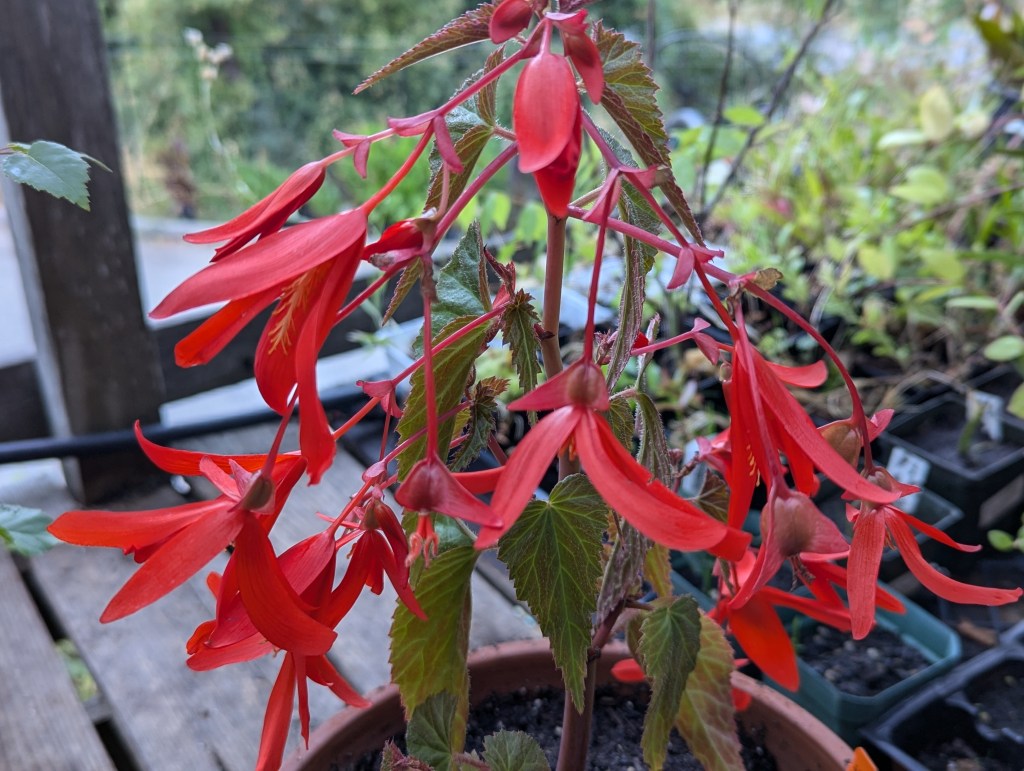
Begonia boliviensis ‘Santa Cruz’

Begonia boliviensis ‘Santa Cruz’ is one of those modern cultivars that I am typically not so keen on. It grows vigorously with abundant red bloom. ‘San Francisco’ is similar but with abundant pink bloom. ‘Santa Barbara’ is similarly similar but with abundant white bloom. All perform splendidly, like so many formerly modern cultivars that were trendy before them. I am not so keen on them merely because they are both modern and trendy. Their names do not help either. My colleague purchased ‘Santa Cruz’ from a nursery in Santa Cruz. It now lives here in Mount Hermon, which is a few miles away from Santa Cruz, but still in Santa Cruz County. I suspect that it is more popular locally because of its name. For the same reason, I suspect that ‘Santa Barbara’ is more popular in Santa Barbara, and ‘San Francisco’ is more popular in San Francisco. I also suspect that I would be less resistant to these modern cultivars if they had more appealing names, such as ‘Los Gatos’, ‘San Jose’ or ‘Palo Alto’. Perhaps the names are for the counties rather than the cities within the counties. All three of my recommendations are within Santa Clara County.

Undoing of Fragrance

Extensive breeding can compromise floral fragrance.

As I enjoy good friends and cheap coffee out on the deck, I am also savoring the sweet fragrance of the abundant white bloom of the black locust off in the distance. I know that black locust is a noxious weed that invades riparian environments; but they smell so good on such pleasantly warm spring days. Modern varieties are certainly better behaved and more colorful with their pink to purplish flowers, but their fragrance does not compare so well.

Earlier here on the deck, one of my friends and I discussed how modern Buicks are much safer than old classic Buicks are, but are not quite as elegant and stylish. It made me think of how decades ago, modern roses were developed for flower size, form, color and stem length, but in the process, were deprived of, among other qualities, their fragrance. Perhaps I would have been more attentive to my friend if the coffee were as potent as the fragrance of the black locust.

Modern varieties of many classic flowers are less fragrant than their ancestors were. This is because decades (and centuries) ago, fragrance generally had not been prioritized in breeding as much as were other physical characteristics, such as flower size, form, color and so on. The plants that were consequently used for breeding typically had the most visually appealing flowers, but lacked fragrance. Such disparity is actually quite natural among plants with variable flowers.

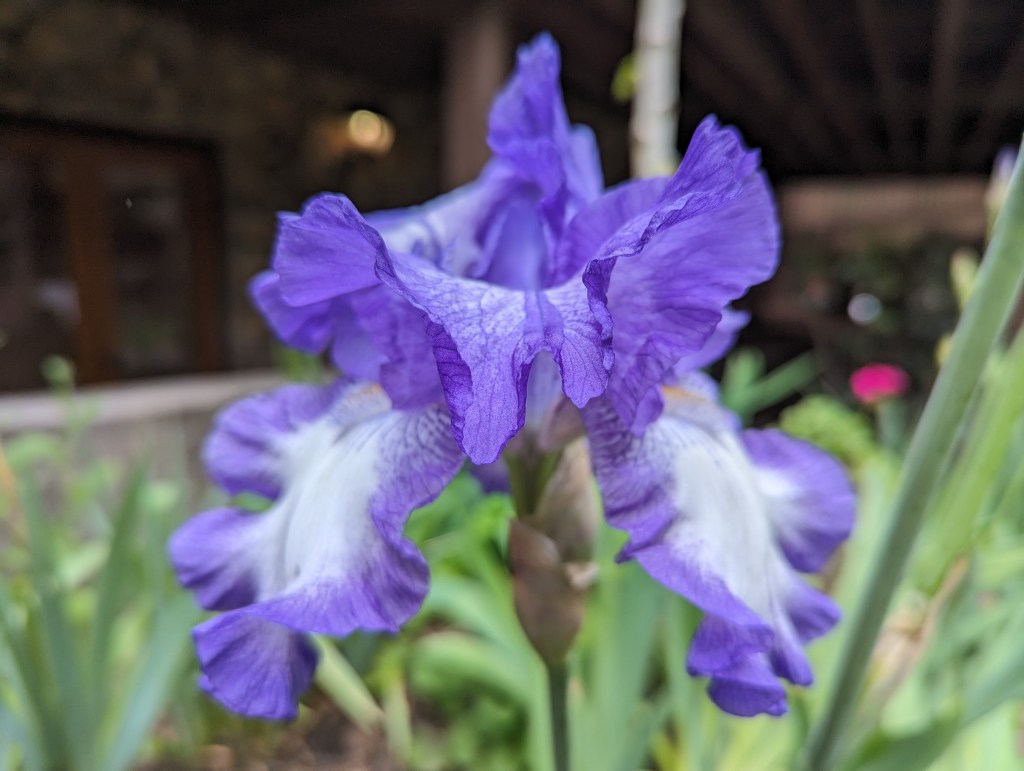
For example, most bearded iris that naturally have the biggest, fanciest and most brightly colored flowers are also the least fragrant. Their progeny that have become the modern varieties are just as flashy, and also, just as deficient of fragrance. Conversely, the relatively small and simple pale purple flowers of my favorite ‘Grandma Sheppard’ bearded iris are remarkably fragrant.

To the iris, this is all quite sensible. Their fragrance is not designed to impress us, but is merely intended to attract pollinators. If they are fragrant enough to entice the insects that bring them pollen, they do not need to waste any more effort on visual appeal. Without fragrance though, they can alternatively use color (including infrared and ultraviolet) to direct insect traffic where they need it to go in order to accomplish pollination. Almost all of the many varieties of iris prefer to specialize in one or the other; either fragrance or visual characteristics, but not both.

So many of the old classics seem to have lost some or most of their fragrance as they have ‘improved’ over the years because visual appeal has been prioritized more than fragrance. Besides flowering locusts, roses and iris, some types of honeysuckle, mock orange, sweet pea, violet, hyacinth, lily and even narcissus are less fragrant than their ancestors were. However, traditional as well as modern fragrant roses and iris seem to be gaining popularity. Fortunately, gardenia, lilac, wisteria, stock and the fragrant types of angel’s trumpet and jasmine are probably as potent as they have ever been because they have not been tampered with as much.

Dual Citizenship

As brightly colorful as Persian buttercup is, I still prefer white.

French peony Persian buttercup was added to one of our landscapes last year. They are not two different perennials, such as French peony and Persian buttercup. They are a group of cultivars of one species, Ranunculus asiaticus ‘French Peony’. Ranunculus asiaticus is the species of Persian buttercup. ‘French Peony’ is its cultivar.

So, is it French or Persian? Well, yes.

Ranunculus asiaticus, Persian buttercup is native to Southwestern Asia, Southeastern Europe, Northeastern Africa and elsewhere within the Mediterranean Region. This range could potentially include the Southern Coast of France within the Mediterranean Region, but much more likely includes Persia within Southwestern Asia. My guess would be that Persian buttercup is as Persian as its name says it is.

‘French Peony’ is a group of cultivars that could have been developed anywhere and given an appealing name that promotes its marketability, but was most likely developed in France, where most breeding of this particular species was done. My guess would be that ‘French Peony’ is as French as its name says it is.

Of course, French peony Persian buttercup could have been developed anywhere, even Persia, and merely given its appealing French name without actually being French. Alternatively, it could have been developed completely in France, from Ranunculus asiaticus from the Southern Coast of France, without actually being Persian. For that matter, it could have been developed in Greece from Greek stock.

To me, French peony Persian buttercup seems to be chicly cosmopolitan. I remember it as popular for urban window boxes within the greatest cities of the World, such as San Jose, Oakland and San Francisco. If I had not seen that it is also popular in Reno and Portland, I would consider it to be as Californian as so many other exotic species and varieties that are popular here.

These would be nice for Ronald McDonald’s garden.

Sugarless

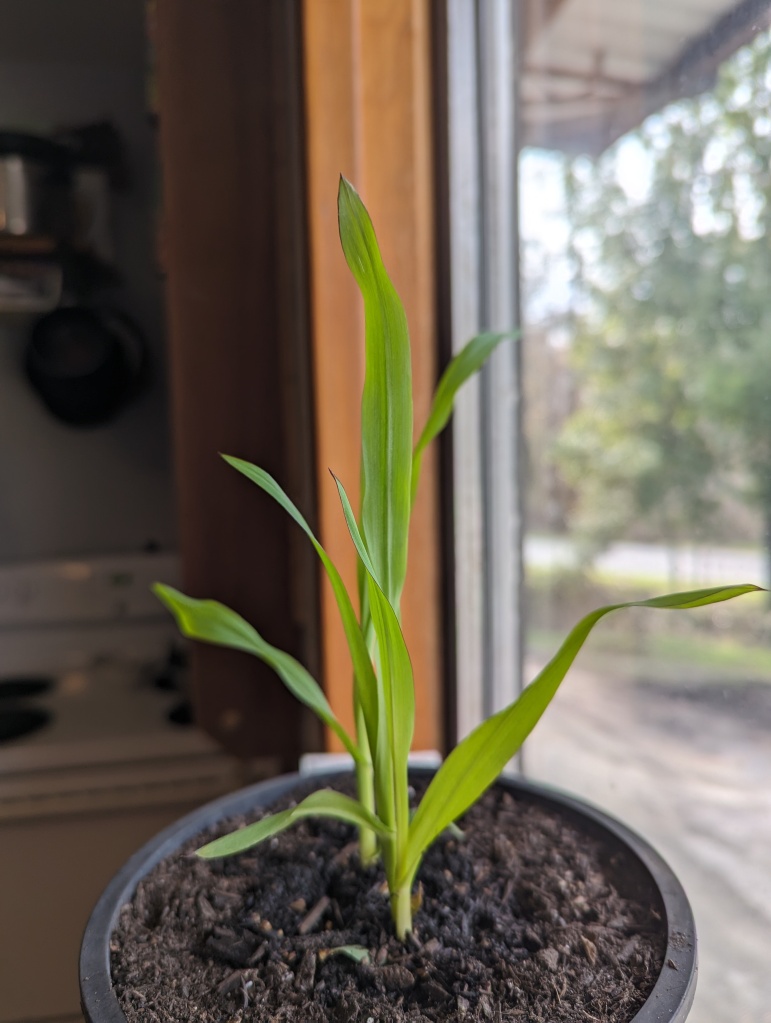
‘Pele’s Smoke’ is an ornamental sugarcane that should bronze with better exposure.

The internet is surprisingly deficient. It contains an amazing abundance of information, including a majority of information that most of us should not want. No one can filter out all the previews to disturbingly violent cinema, disturbingly idiotic political scandal, disturbingly aberrative sexual content, and so on. Yet, some of the simplest information remains mysteriously elusive.

I grow ‘Pele’s Smoke’ sugarcane only because it is what I obtained first. I grew it from scraps that I pruned from a specimen in the garden of a colleague in the Los Angeles region. It grows like a weed. I happen to enjoy growing it. It is primarily an ornamental cultivar though. With its bronze foliage, it is intended to be prettier than it is functional. Although it is considered to be productive, the canes are small and relatively tough.

I would like to grow a variety of sugarcane that is more utilitarian than ornamental. There are many varieties within three types of sugarcane that I should be able to choose from. Chewing cane is the sort that develops a soft and chewable pulp within its canes that can be chewed like a confection, leaving less inedible fibrous pith than other varieties. I do not want to bother growing chewing cane. Syrup cane may produce a bit more fibrous pith, but generates an abundance of sugar syrup, which unfortunately does not crystalize as readily as that of other varieties. I do not want to bother growing syrup cane. Crystal cane is the sort that produces the most sucrose, which should crystalize more readily than the combinations of sugars that other varieties produce. That is what I am still trying to find! Several varieties of sugarcane are available online, but very few are classified as chewing, syrup or crystal canes! I am still searching!

Horridculture – White California Poppy

White California poppies are naturally very rare.

California poppy is the official State Flower of California. Most Californians are familiar with it. We certainly know what color it should be. With few exceptions, it is bright and clear orange. Some, particularly within desert climates, are golden or more yellowish. White and pastel purple California poppies are rare aberrations. When I was a kid, finding one or the other was comparable to finding a four leaf clover for kids in Ireland. They were even a bit better though, since plants that bloomed with variant color bloomed with more than a single flower.

When I was about a freshman in high school, I found both a white and a purple California poppy just a few feet apart from each other. They happened to be at the Portola Monument in Montara, near where the Portola Expedition discovered San Francisco Bay. It was too early for seed, and I did not return for seed later. Besides, most of such seed produces plants that bloom with typical orange floral color. Nonetheless, at the time, I was very pleased to have found two very rare aberrations.

In more recent years, varieties of California poppy were developed. Some bloom with white or purple bloom. Others bloom with pink, red or yellow flowers. Some have double flowers. They are readily available from mail order catalogues and nurseries, as well as online. White or pastel purple California poppies are no longer rare or special. This sort of takes the fun out of finding one.

I suspect that the white California poppy in this less than exemplary picture is natural. Poppy seed was not likely sown here intentionally. Nonetheless, I do not know. Now that it is no longer special, its source is not so important. Realistically, their typical bright orange floral color is the best anyway.

Form Follows Function For Gardening

Star jasmine either climbs or trails.

Home gardens are components of the homes that they serve. They are the exterior of the interior. They are the environments in which homes exist. Some provide vegetables and fruits. Many provide flowers. Ideally, gardens enhance domestic experiences. Therefore, their design is as relevant as architecture. Accordingly, horticultural form follows function.

Gardens can be single open spaces or, like their associated homes, a few spaces. They benefit from features that function like those that define interior spaces. Lawns are floors. Trees are ceilings. Hedges and shrubbery are walls. Patios, decks and fences are static features. Vegetation, though, requires more discriminating selection for appropriate form.

Lawns seem to be the simplest of such functional vegetation to select. Form is not overly variable. Nevertheless, turf grass must be appropriate to its particular exposure. Some is more tolerant of partial shade than others. Some requires less water than others. Ground cover vegetation is more appropriate for many situations. Artificial turf might be an option.

Trees and shrubbery are much more diverse. Although they are the largest vegetation of a garden, some are quite small. They are evergreen or deciduous, and both have distinct advantages. While palms lack branches, other trees and shrubs develop sculptural form. Consequences for inappropriate selection of such significant vegetation can be serious.

Furthermore, different varieties of the same species can behave very differently. Junipers are practical shrubbery for some situations. However, some are prostrate ground covers. A few grow as small trees. Also, while some rosemaries are shrubbery, some are trailing. Selection of an inappropriate cultivar of an appropriate species is a rather common error.

A few species change form as they mature. With confinement, the trailing juvenile form of English ivy is a practical ground cover. However, as it encounters support, it becomes its vining adult form. This clinging growth ruins paint, and overwhelms trees and shrubbery. Star jasmine evolves from ground cover to twining vines even without changing its form.

Too Much Mix & Match Gets Sloppy

Conformity has practical application even in casual landscapes.

A combination of modern horticultural apathy and too many choices was probably the demise of conformity in home gardens. Formal hedges or even informal screens of several of the same plants are nearly obsolete. Ironically, long and low barrier hedges and so called ‘orchards’ of identical trees planted in regimented rows or grid patterns have become common in large landscapes in public spaces

Those of us who still crave formal hedges, paired trees or any such symmetry in our home gardens must be more careful with the selection of the plants that need to conform than would have been necessary decades ago when there was less variety to complicate things. It is just too easy to get different varieties of the same plant. Only plants with matching cultivar (cultivated variety) names will necessarily match. (Yet, on rare occasion, even these are inaccurate.) For example, ‘Emerald’ arborvitaes will match other ‘Emerald’ arborvitaes, but will not match ‘Green splendor’ arborvitae, no matter how they resemble each other in the nursery.

Plants that are identified by their characteristics instead of by cultivar name are riskier. Blue lily-of-the-Nile could be any one of many different cultivars with blue flowers. It is therefore best to obtain all lily-of-the-Nile for any matching group from the same group in the same nursery at the same time. What will be available next week may actually be a different variety with a different shade of blue and different foliar characteristics. Nurseries bring stock in from so many different growers.

Adding new plants to replace those that have died within established hedges or streets flanked with the same trees can be particularly difficult, especially if the old varieties are no longer available. The old fashioned yellowish Japanese boxwood that was so common for small hedges in the 1950’s has not been common in nurseries for several decades. Replacement plants are darker green. Some are even compact cultivars or different specie like English boxwood. When lined up and shorn together, they make ‘calico’ hedges.