 Coons are not much of a problem in the garden; but they can be a problem around the home. They scatter trash, eat dog and cat food, and can be dangerous to dogs and cats. They get into places we do not want them, including basements, attics, and even our homes. Once inside, they can cause significant damage.
That is why they sometimes need to be trapped. No one wants to do it, but it is sometimes necessary.
One problem that we did not consider when putting out a trap for a coon who was getting into the trash was that we might not actually catch the offending coon. Actually, not catching the coon was not as much of a problem as who we caught instead.
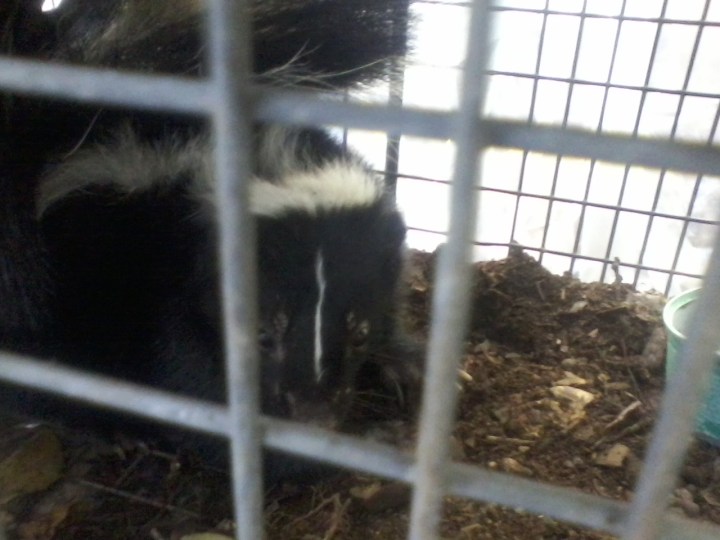
Pepe got to the trap first.
Pepe was none too happy about it.
Neither were we.
You see, Pepe, who is difficult to see in the picture, is a skunk.
Normally, skunks are more destructive to gardens than coons are. They dig grubs out of lawns, but damage the lawns at least as much as the grubs do. They pull out freshly planted seedlings because insects tend to congregate right underneath. Although they are good at controlling some types of plump insects among tough perennials, they are not very careful about getting to the insects that they pursue in more sensitive young plants and vegetable gardens.
However, this was in a situation where landscaping is minimal, and there is no lawn. Skunks had not been a problem . . . until now.
Once in the trap, we did not know what to do with Pepe. No one wanted to get close enough to open the trap. We could not leave Pepe trapped without food or water. Because Pepe had been harmless, we could have released Pepe on the spot, but instead decided to relocate Pepe nearly a mile away, on the far side of Zayante Creek, where there is more insects and water. It was a good distance between us and Pepe, but not so far that Pepe could not return if Pepe wanted to.
I got close enough to the trap to cover it with a trash bag, and then put the covered trap into a trash bag so that it was wrapped almost all the way around. Surprisingly, Pepe did not seem to mind the procedure, and watched calmly. The bagged trap went into the back of a pickup, and was taken to the relocation site. Of course, no one came with me to help.
Once at the relocation site, Pepe did not want to leave the trap. I had to literally dump Pepe out; and then step aside PROMPTLY. Once on the ground, Pepe, who had seemed to be about as big as a big kitten unfolded into a huge fluffy skunk with a big fluffy tail! I have no idea where all that fluff came from!
I had guessed that Pepe would be thirsty from his incarceration, and would be in a hurry to get down to the brambles near Zayante Creek. Instead, Pepe just stared at me sadly. I tried to explain the situation to Pepe, but my French is lacking. Apparently, Pepe did not understand.
As I turned and started to walk back to the pickup, Pepe ran past me and got there first. Pepe stopped at the open door, and looked back at me as if requesting help getting in. This was not good. I stayed back, which annoyed Pepe, who had been a good sport through this entire procedure so far. Pepe sort of hopped about with his fluffy tail flailing, as if frustrated that the floorboard of the pickup was just out of reach.
I tried to explain in English and really bad French with maybe a bit of Italian and Spanish mixed in where I could not remember the words, that the relocation site should be satisfactory. Eventually, Pepe seemed to agree to give it a try. Pepe slowly waddled away and downhill to Zayante Creek. In the second picture, that black and white blotch to the left of the roots of the alder tree is Pepe, looking back at me sadly.
 Not much bothers old fashioned junipers. They tolerate heat and frost, and anything else the weather throws at them. They do not appeal to many troublesome insects. Once established, they do not mind if they do not get much water. So, aside from over-watering and bad pruning, they are pretty indestructible. Yet, once in a while, otherwise healthy junipers die suddenly and mysteriously.
 Tony Tomeo