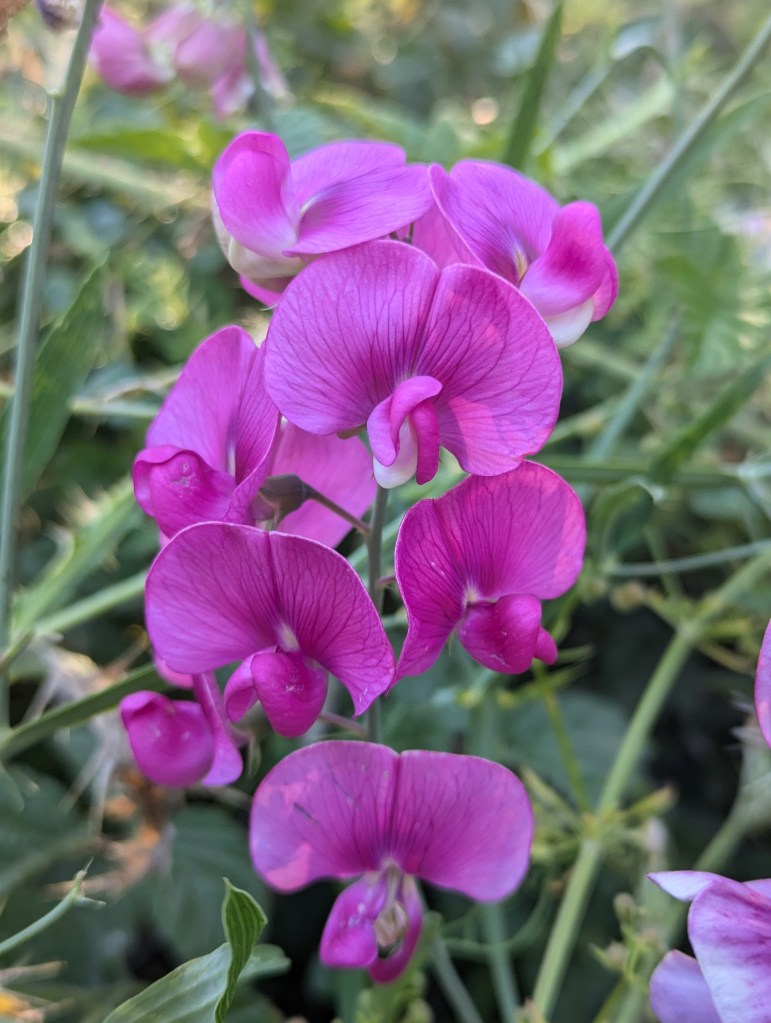
Now that the weather is getting hot, perennial pea, Lathyrus latifolius, is finishing bloom. It needs warmth to bloom, so can begin between the middle or end of spring. However, it shrivels in heat, so can finish between the beginning and middle of summer. Sometimes, it can bloom for almost three months. Sometimes, it finishes almost as soon as it starts.
Perennial pea is more popular as a naturalized wildflower than within home gardens. Its seed is rarely available from nurseries. Young seedlings might not grow very big initially. Mature specimens can vigorously climb and creep more than seven feet in any direction. Their fibrous perennial roots are very difficult to kill. Propagation by root division is easy.
Almost all perennial pea blooms with an abundance of bright pinkish magenta flowers. A rare few bloom with slightly striated light pink flowers. A bit fewer bloom with bright white flowers. Bloom resembles that of annual sweet pea, but is less frilly and lacks fragrance. Slightly bluish foliage and stems have a soft texture, and recover slowly from disruptions. Any parts can be toxic if ingested.
P was for pea last Sunday. Although the spelling has not changed since then, this is a different topic now, so is not actually a sequel. P just happens to also be for the floral fragrance of Hibbertia scandens, which, to some, resembles that of what tomcats do to designate their territory. Its several common names are no more appealing. It is known as golden guinea vine, climbing guinea flower and twining guinea flower. Rather than possibly offending others of Italian descent, I refer to it simply as snake vine. Contrary to its several other common names, it is not actually from the Guinea Region of Western Africa, but is instead from Eastern Australia and New Guinea. Incidentally, New Guinea is no more affiliated with Western Africa than it is with descendents of Italian Immigrants in America, or plump rodents who identify as pigs of the Andes Mountains on the West Coast of South America. I got a few cuttings of snake vine at the end of last September. One cutting is growing quite nicely. Another took time to bloom with this single flower that looks like Carl Junior did not quite beat the train. Its floral fragrance is almost disappointingly unobjectionable. I suspect that more are necessary to be perceptibly fragrant. From my limited experience with the species, I remember than only a profusion of bloom produced merely a slightly objectionable fragrance. Like so much of what I grow here, I have no idea of what to do with these new snake vines. Fortunately, they are more docile than the white perennial pea that I mentioned last Sunday, or the cup of gold vine that I mentioned earlier. Eventually, I should be able to accommodate some within at least one of the many refined landscapes at work. If so, I will not put enough of it within the same situation to generate annoyingly objectionable floral fragrance. Nor should any individual specimen be allowed to grow large enough to do so. I would be more tolerant of a slight bit of such fragrance within my home garden only because I happen to be fond of this species now that I have reacquainted with it.
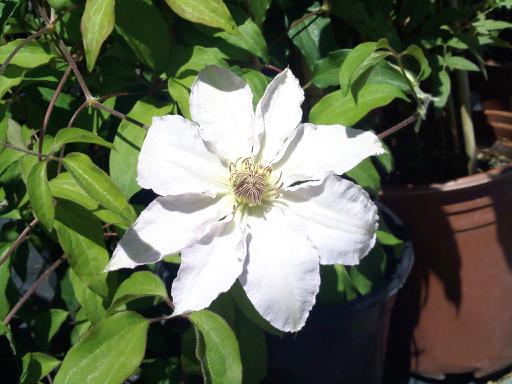
Like the big bark of a little terrier, the big and boldly colored flowers of large-flowered hybrid clematis seem to be more than their delicate vines should be able to produce. Almost all of the many modern varieties bloom with flowers that are at least three inches wide; and some have slightly ruffled double flowers. Their rich, deep, and sometimes two toned shades of red, blue, purple or pink, as well as white seem too opulent for their simple wiry stems that may climb to only six feet or so. The dark green compound leaves grab harmlessly onto light trellises, stakes or lattice. Although the foliage and flowers want sunny exposure, clematis roots do not like warm soil, so appreciate generous mulching. Some people like to give them a wide rock to disperse their roots under, or plant them next to large pots that sit directly on the soil. I planted mine on the north side of the northwestern corner of the house where the soil was always shaded, and allowed it to climb around the corner onto an iron banister on the west side.
Clematis want to be watered and fertilized regularly, and well drained organically rich soil. They should be pruned rather aggressively in winter while they seem to be dead, but are really just dormant.
Hall’s honeysuckle climbs aggressively by twining.
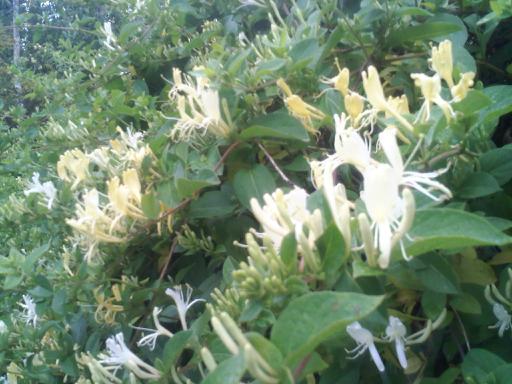
The unrefined twining vines of good old fashioned Hall’s (Japanese) honeysuckle, Lonicera japonica ‘Halliana’, seem to fit in so naturally with lilacs, hydrangeas and bearded iris; the sort of plants that grow in grandma’s garden. Grandma may need help controlling it though, since it can climb more than twenty five feet, and get overgrown and invasive. It is best pruned back to main canes or to the ground annually at the end of winter. Even though it is evergreen, it drops some of its foliage and looks rather tired by the end of winter anyway.
Just as the fragrance of the earlier spring blooming flowers gets depleted, Hall’s honeysuckle begins to bloom with its own distinct sweet fragrance, attracting bees and hummingbirds. Bloom is typically most abundant in spring, and followed by sporadic bloom until autumn. Fluctuations of weather or watering can cause subsequent phases of abundant bloom during summer. The pale white tubular (and bisymmetrical) flowers fade to pale yellow that is perhaps the color of French vanilla ice cream. The simple light green leaves are about two inches long. A few leaves on the most vigorous vines may be lobed.
Bougainvillea does not cling to its support. It merely leans on it, or must be tied.
Harvesting grapes from a pear tree last summer reminded me why it is so important to control the grape vines this year. Without proper confinement to the fence below, the grape vines had climbed into and overwhelmed the pear tree above. My neighbor who witnessed the consequences of my lack of diligence in the garden, and helped me with the harvest, mentioned that the ‘grape tree’ was more productive than the vines had been when properly maintained during the previous year. I was embarrassed about my transgression nonetheless.
My colleague in Southern California has no problem grooming the many different kinds of vines that adorn arbors, trellises, walls, fences and railings in his garden. I certainly could not let him find out that I was vanquished by my single grapevine, which he refers to as ‘Dago wisteria’. I probably remind him of how important it is to control his vines more often than I am offended by racial slurs.
The trick is to select vines that are appropriate to each particular application. Vines for small, light trellises must be relatively complaisant, like lilac vine, pink jasmine, Carolina jessamine or clematis. Aggressive vines like wisteria, grape (the ‘other’ wisteria) and the larger trumpet vines need hefty trellises or arbors. Brambles and scrambling plants like bougainvillea and climbing roses do not actively climb, so need to be tied or ‘tucked’ into their supports.
Some of the seemingly innocent vines can actually become somewhat aggressive. Mandevillea, potato vine and star jasmine have wiry stems that seem harmless enough, but can eventually tear apart lattice or light trellises. Perennial morning glory and passion vine are potentially invasive. Trailing nasturtiums and annual morning glory really are as innocent as they look, so are nice small annual vines where space is limited. I prefer pole beans though.
Vines like Boston ivy, Virginia creeper and creeping fig that attach to their supports with roots or discs (modified tendrils) are too destructive for most applications in home gardens. They are fine on unpainted reinforced concrete buildings and concrete walls, such as the retaining walls and sound walls of freeways, but will ruin paint, siding, stucco and shingles. Unlike the other vines, these lack colorful bloom. Boston ivy and Virginia creeper produce remarkable fall color though, but then defoliate revealing bare stems through winter.
Algerian and the various English ivies are good ground cover plants that will become climbing foliar (without showy blooms) vines if they reach support. Unfortunately, they root into their support like creeping fig does, so have limited practicality. Honeysuckle is an aggressive vine that can also double as a ground cover.
Wild cucumber is not a particularly substantial vine. Except for its tubers, it is quite delicate.
Wild cucumber, Marah fabacea, is also known as manroot because it develops massive tubers that can weigh as much as a man. Such tubers can supposedly weigh more than two hundred pounds, and some sources claim that they can weigh twice as much. That is a lot of storage.
Their thin leaves, slender vines, tiny flowers and fleshy fruit are not very substantial, and can not be very consumptive. They are quite watery, and leave minimal debris when cut and dried, or when they die back after frost.
So, why does wild cucumber store so much resources within their massive tubers? I have no idea. I realize that it is a survival technique, but this is major overkill. No winter is long enough to justify such extreme storage. No summer is dry enough. No wildlife is voracious enough. No forest fire burns the same place more than once in a season. Furthermore, no gardener is diligent enough.
Seriously, these things are impossible to kill. The vines pull up quite easily, with no resistance. The tuber simply makes more. Secondary vines pull up as easily as the first. The tuber simply makes more. No matter how many times the vines get pulled up, the tuber simply makes more. It never exhausts its resources. Removal of the vines deprives it of its ability to accumulate more resources, or replenish what is used to generate the vines, but it has enough to generate vines for many years.
The only way to eliminate these weeds is to dig up their massive tubers, which are fortunately not very deep underground. Even then, the tubers do not die. This one sat around through last summer, and is still viable. I suppose that we should dispose of it with the trash, since we can not compost it.
This wild cucumber tuber is bigger and much heavier than Rhody, but is smaller than average.
Blood red trumpet vine provides more lush foliage than bloom.
Abundant lush foliage is actually the main asset of blood-red trumpet vine, Distictis buccinatoria, with the sporadic clusters of three inch long tubular flowers blooming as an added benefit during warm weather. Bloom can certainly be impressive when least expected though; and has a sneaky way of getting a late blast of color out during Indian summer weather patterns, when the weather gets warm after a cool phase in autumn. Contrary to the name, the flowers are more ruddy orange with yellow throats than blood red. The rich green leaves are compound, with a pair of three inch long leaflets and a three fingered tendril reaching out from between.
The vines are somewhat aggressive and can climb more than twenty feet, so need adequate support. They should not be allowed to overwhelm smaller or slower plants, or escape out of reach into adjacent trees. The tendrils can grab onto and damage shingles and light fences, but are an advantage for covering chain link fences. Given the opportunity, blood-red trumpet vine can even climb rough cinder block or stucco walls.
Obviously, it is not cup of gold vine, Carolina jessamine, yellow jasmine, yellow trumpet vine, yellow orchid vine, yellow black eyed Susan vine or any of the vines with yellow flowers that Google suggested as its identity. It is more than obviously not lotus, which incidentally blooms with orange flowers rather than yellow, but was somehow, according to Google, a candidate for vines with yellow flowers. It is amazing what can and can not be found on Google.
Brent recognized this vine just like I did, but also like me, could not remember its identity. We had not seen much of it in many years, but could remember that it was somewhat common in coastal regions while we were in school during the late 1980s. It lived at a doughnut shop that we sometimes went to in Morro Bay, and seemed to smell as if a tom cat had marked his territory on it. I can remember it within old gardens of Carmel and Monterey, as well as Santa Cruz, where I found these cuttings. I also remember encountering it while inspecting median landscapes of some of the major roads of Morgan Hill in the late 2000s, and that it did not perform as well within the somewhat inland climate there. Brent observed that specimens in Santa Monica and Beverly Hills seemed to express the same preference for the more coastal climate of Santa Monica.
Now that I got it, I have no idea of what to do with it. I suppose that, without mentioning the faint but potentially slightly objectionable floral fragrance, I can convince neighbors that they want it in their gardens. Some of our landscapes are big enough for it to be pretty at a distance. At least I know what it is, Guinea flower, Hibbertia scandens.
Vines and annuals are not shrubbery and ground cover.
Vegetation within a planned landscape should serve a purpose. The form of such vegetation should be appropriate to such purpose. Trees provide shade. Shrubbery defines space and obscures undesirable scenery. Vines climb fences and other infrastructure. Annual bedding plants provide more seasonal color than most other vegetation. Turf grows into useful lawns. It is helpful to plan accordingly for a landscape.
Turf can not do much more than become useful lawn. It can not provide shade, obscure undesirable scenery, climb fences or provide more seasonal color than green. Nor can trees, shrubbery or vines become useful lawn. Again, each form of vegetation should be appropriate to its particular application.
Trellised rocktrumpet is not shrubbery. Rose periwinkle is not permanent ground cover.
There is so much other vegetation that would have been appropriate to this particular situation. Star jasmine, trailing lantana, trailing rosemary or even the dreaded English ivy would have been better and more permanent ground cover. Dwarf oleander, barberry, arborvitae or even dwarf New Zealand tea tree would have been better shrubbery.
Rose periwinkle is an annual bedding plant. Although it is somewhat pretty now, it will not likely survive through winter. Even if it does, it will not migrate far enough to reliably function as a ground cover.
Trellised rocktrumpet is a small but vigorous vine that will always be reliant on trellises for support. As its cheap trellises decay and deteriorate, it will eventually develop into shabby mounds of tangled vine stems, but will never be able to support itself as high as the new trellises are now. It can reach out to cover some of the ground that will be vacated by the rose periwinkle, but can not reliably function as a ground cover for this much area. It will bloom less if shorn for neatness.
I have no idea what it is, but I intend to grow it.
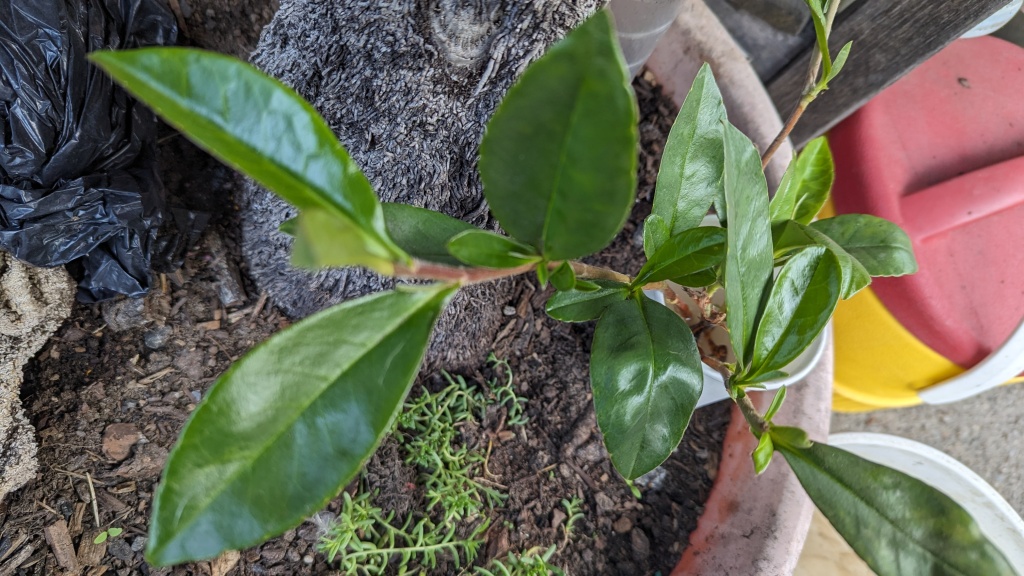
It is an evergreen vine that seems to sprawl over other vegetation rather than actually climb it. It lacks tendrils or other means with which to hold onto its support. It does not even seem to wrap around its support. Nor does it seem to get very high above the ground. It just sort of sprawls.
Its glossy leaves are rather simple, just like in the picture here.
Its bright yellow and staminate flowers, if I remember correctly, seem to resemble those of Saint John’s wort, but are a bit wider.
This vine, again if I remember correctly, seemed to be more popular years ago. I do not notice it much anymore. I can not remember when I last saw it in a nursery, or if I ever saw it a nursery. The few specimens that I am aware of inhabit old landscapes that have not been renovated in decades. I got these bits from where they were regenerating after their earlier removal from an old landscape.
Now that I have these bits, I intend to grow them, in order to get familiar with the species. I hope that I can eventually identify it. It should not be so difficult for something that had formerly been popular, or at least common enough for me to recognize it as something that had formerly been familiar.
I do not often encounter a species that I can not identify, and I even more rarely admit to it. If I do not recognize a species, I can typically recognize the genus, or at least the family, and then key it out. For this seemingly simple vine, I can not identify its family. I asked Brent, which I almost never do. He recognized it about like I did, but also could not remember its name.




 Tony Tomeo