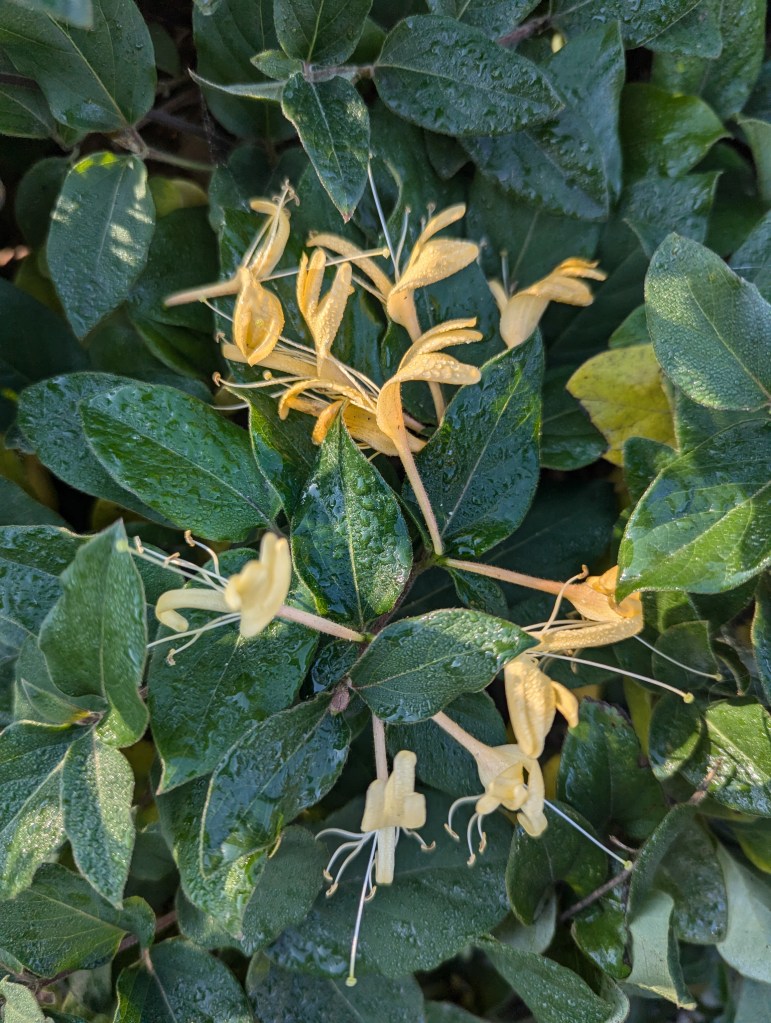
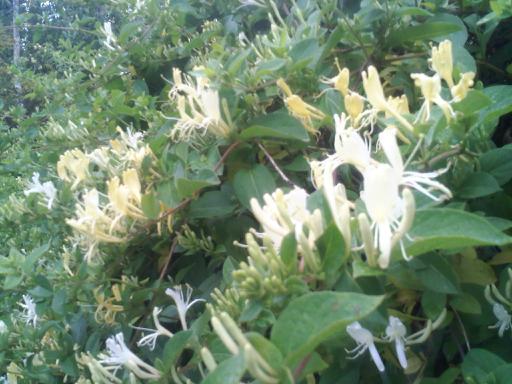
Bloom should be most abundant during late spring and summer. Within this mild climate though, it often continues sporadically through autumn. Japanese honeysuckle, Lonicera japonica, is presently blooming nicely in some areas. Its trusses of ribbony creamy white flowers fade to pale yellow. Although unimpressively colorful, they are alluringly fragrant.
Japanese honeysuckle here is almost exclusively Hall’s Japanese honeysuckle. It might be recognizable by a cultivar name of either ‘Hall’s Prolific’ or ‘Halliana’. Some botanists consider halliana to be a variety rather than a cultivar. (Variety names are neither quoted nor capitalized like cultivar names.) ‘Purpurea’, with dark but not purplish foliage, is rare.
Japanese honeysuckle, like star jasmine, is a vine that can be a ground cover. As a vine, It can climb more than thirty feet high. Unfortunately, it sometimes overwhelms shrubbery and small trees. Its twining stems can constrict the stems of other vegetation that it wraps around. As ground cover, it can get three feet deep. Leaves are two or three inches long.
During the 1990’s, English ivy, Hedera helix, evolved beyond small scale ground cover and became popular for pseudo-‘topiary’. It is now commonly trained onto wire frames formed into spheres, cones and all sorts of shapes. English ivy is also a nice greenery to fill in between flowering annuals and perennials in mixed urns and planters, especially where it can cascade downward.
There are all sorts of cultivars (cultivated varieties) for all sorts of applications. ‘Hahn’s Self Branching’ English ivy is probably the most practical for ground cover, since it fills in so reliably and is somewhat tolerant of partial shade. ‘Needlepoint’ had darker and more finely textured foliage; but since it does not cover larger areas so efficiently, it is instead more commonly used as greenery with mixed annuals and perennials, or for pseudo-‘topiary’. All sorts of variegated English ivy, whether alone or as a component to mixed plantings, brightens slightly shaded spots. Variegation ranges from greenish white to yellow. Leaves can be lobed, ruffled, elongated, cleft or even nearly compound; but are generally two to three inches wide. Most have three to five ‘corners’.
So many of the vines that we enjoy in our gardens might not be so appealing if we knew how they behave in the wild. Many of their characteristics that are often practical in garden situations are detrimental to neighboring plants in natural settings. If they can get away with it, vines can be just as brutal in our own gardens.
Creeping fig is perhaps the most brutally aggressive of vines. Like many other vines, it exploits trees for support. While it reaches the top of the trees, it wraps the tree trunks with a grafted network of stems that expands as it grows, literally strangling the trees that gave it support. By the time the supporting tree trunks decay, the creeping fig has developed its own self supporting trunk. Algerian and English ivies can do the same.
Fortunately, these vines rarely get such opportunities in garden situations. Nonetheless, they need to be kept out of trees that might otherwise get overwhelmed. Since they attach to the surfaces that they climb by aerial roots, they should not be allowed to climb onto painted surfaces, stucco, or anything else that they can damage.
Boston ivy supports itself by holdfast disks, which it leaves on everything that it gets a hold of. If the vines get removed to paint a wall, the disks remain. Like creeping fig and the ivies, Boston ivy, should therefore only be allowed to climb surfaces that are not likely to be damaged by its climbing techniques. Creeping fig and Boston ivy both happen to be quite practical for freeway infrastructure and sound-walls, but are difficult to accommodate in tame urban landscapes.
Wisteria is another very aggressive vine that can overwhelm small trees and shrubbery, but lacks aerial roots. It instead climbs by twining stems, which are safer for painted surfaces, but can constrict and crush light trellises, wooden shingles, lattice or anything else that that wrap around. It is certainly worth growing, but needs adequate support.
Bougainvillea and climbing roses do not climb on their own, but instead produce ‘scrambling’ canes that shoot upward and then lean onto their surroundings for support. If grown as vines, they need to be fastened to their support. If not pruned back occasionally, they can get quite overgrown and shrubby. Most varieties that are popular now fortunately stay small and manageable.
Honeysuckle, potato vine, blue dawn flower, evergreen clematis, star jasmine and the various trumpet vines are more manageable, but are still moderately aggressive. Carolina Jessamine, lilac vine, mandevilla, and passion vine are among the more docile of vines, only outdone by the annual vines like annual morning glory and climbing nasturtium.
Adult ghost ivy growth is shrubby rather than vining. Also, it blooms and produces seed.
Ghost ivy is actually just a fancy name for variegated Algerian ivy, Hedera canarienses ‘Variegata’. Their glossy six inch wide leaves with three or five ‘corners’, are irregularly blotched with dark green, very pale green and white. Like all ivies, ghost ivy can grow as a ground cover, climb like a vine, and eventually develops self supporting branches that bloom and set seed. It may be somewhat less aggressive than unvariegated Algerian ivy, but can still overwhelm perennials, small shrubs, and even small trees.
Ivy can be allowed to climb tree trunks only if it is not allowed to wrap around and graft onto itself. Otherwise, tree trunks will become constricted as they grow and expand within their ivy wrappers. Because they climb by aerial roots, the various ivies should not be allowed to climb painted or wooden surfaces that can be damaged or succumb to rot. However, some people like the look of ivy cascading down from hefty arbors and porches enough to not mind replacing rotten parts occasionally.
Contrary to the deep green of Algerian ivy, which adds a cooling effect to sunny landscapes, ghost ivy lightens up dark areas. Ghost ivy is only rarely available in ground cover ‘mud’ flats, or in #1 (1 gallon) cans. Larger plants are not practical, since they take too much time to recover from transplant. New plants are very easy to propagate from cuttings made from pruning debris. Cuttings from shrubby adult growth become shrubby plants.
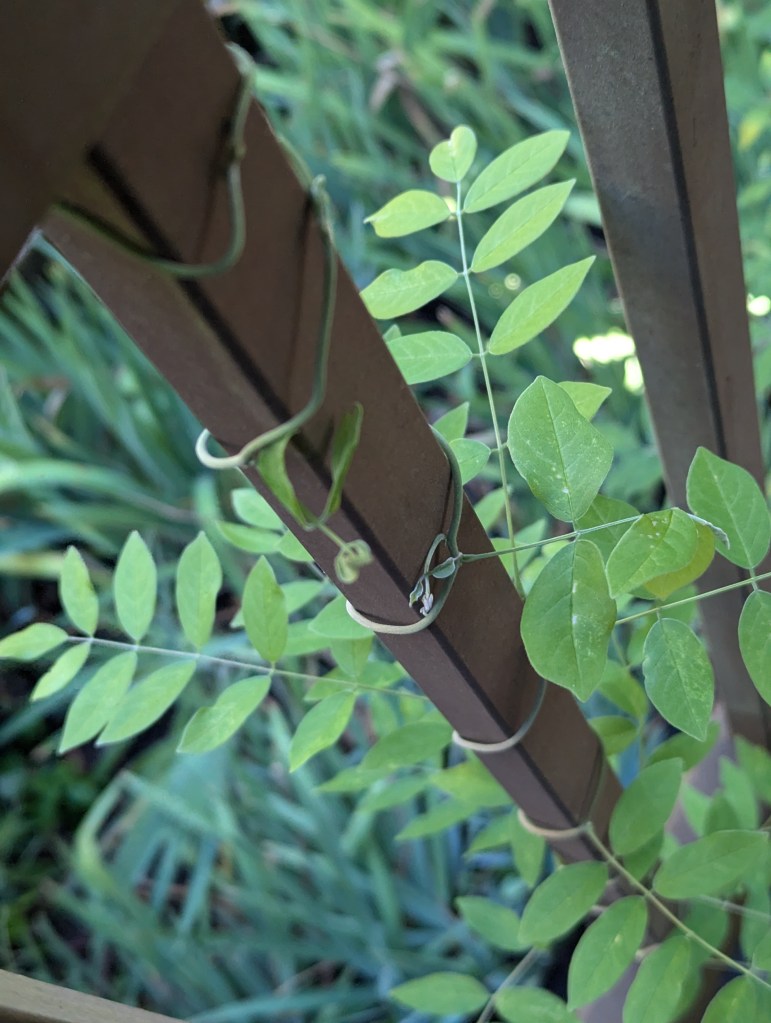
Chinese wisteria is an aggressive vine! A few that have gone wild near here have climbed high into redwoods, or spread over large areas of forest, or both. Some may have been planted intentionally, and then been abandoned. Some may be feral. Japanese wisteria may have potential to do the same, and perhaps some have already done so without being recognized as a different species from more common Chinese wisteria. Both species are spectacular while blooming within refined landscapes, but can be difficult to accommodate within the often neglected or partially forested landscapes here. That is why I am so pleased to try the much more docile American wisteria, Wisteria frutescens. I do not remember the name of this particular cultivar, but it blooms with bluish lavender floral color that is comparable to that of the more traditional Chinese wisteria. Like Chinese wisteria, other cultivars can bloom white or more purplish, and supposedly even pink, although I have yet to see even pictures of it blooming pink. It is not as spectacular, primarily because it is so much more docile, so does not grow nearly as large. Also, the floral trusses are relatively short, stout, and cylindrical in form, so protrude more rigidly outward like bottlebrush bloom, rather than more pendulously like the familiarly elongated and conical floral trusses of Chinese wisteria, or the more elegantly elongated floral trusses of Japanese wisteria. Kentucky wisteria, Wisteria macrostachya, is supposedly quite similar, but blooms later with more bluish color, rather than lavender. ‘Clara Mack’ is a cultivar that blooms white. After I see how American wisteria performs here, with its traditional wisteria colored bloom, I would also like to see how ‘Clara Mack’ Kentucky wisteria performs here. It could be a delightfully docile alternative to traditional Chinese wisteria for the White Garden.
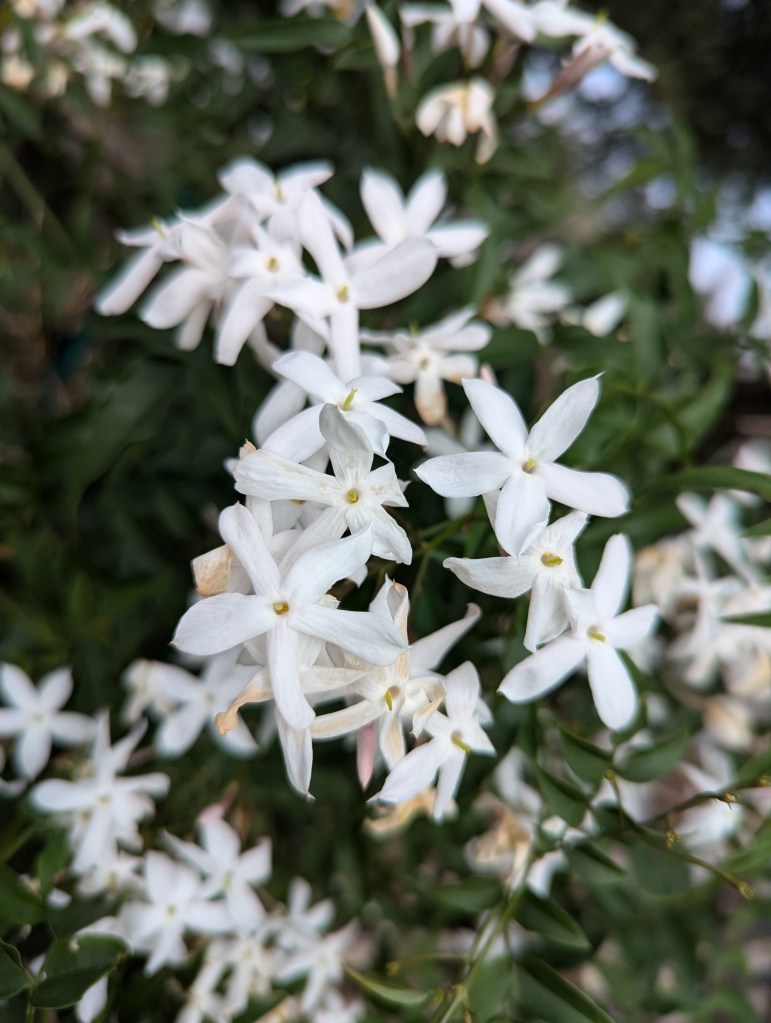
Brent and I studied horticulture through the second half of the 1980s at California Polytechnic State University at San Luis Obispo, which is known more simply as Cal Poly. San Luis Obispo is exactly halfway between where each of us came from. He came from the region west of Los Angeles, two hundred miles to the southeast, which is considered to be south by the standards of California. I came from the region west of San Jose, two hundred miles to the northwest, which is considered to be north by the standards of California. He considered San Luis Obispo to be within Northern California. I considered it to be within Southern California. Consequently, when either of us encountered a species with which we lacked prior experience, we assumed it to be regionally popular within the respectively unfamiliar half of California. Such assumptions were accurate for some species. For example, Brent was as fascinated with redwoods as I was with desert fan palms. He knew that redwoods are more popular here than in Southern California, and eventually went to experience them growing wild within their native range near Santa Cruz. I knew that desert fan palms are more popular in Southern California than here, and eventually went to experience them growing wild within their native range near Palm Springs. Pink jasmine, Jasminum polyanthum, was an odd one. Because Brent had never encountered it before, he assumed that it had been popular in Northern California. Because I had never encountered it before, I assumed that it had been popular in Southern California. In actuality, it only became commonly available throughout California at about the time that we encountered it, so had previously been popular neither here nor there. Nonetheless, to Brent, it is still as northern as it is southern to me.
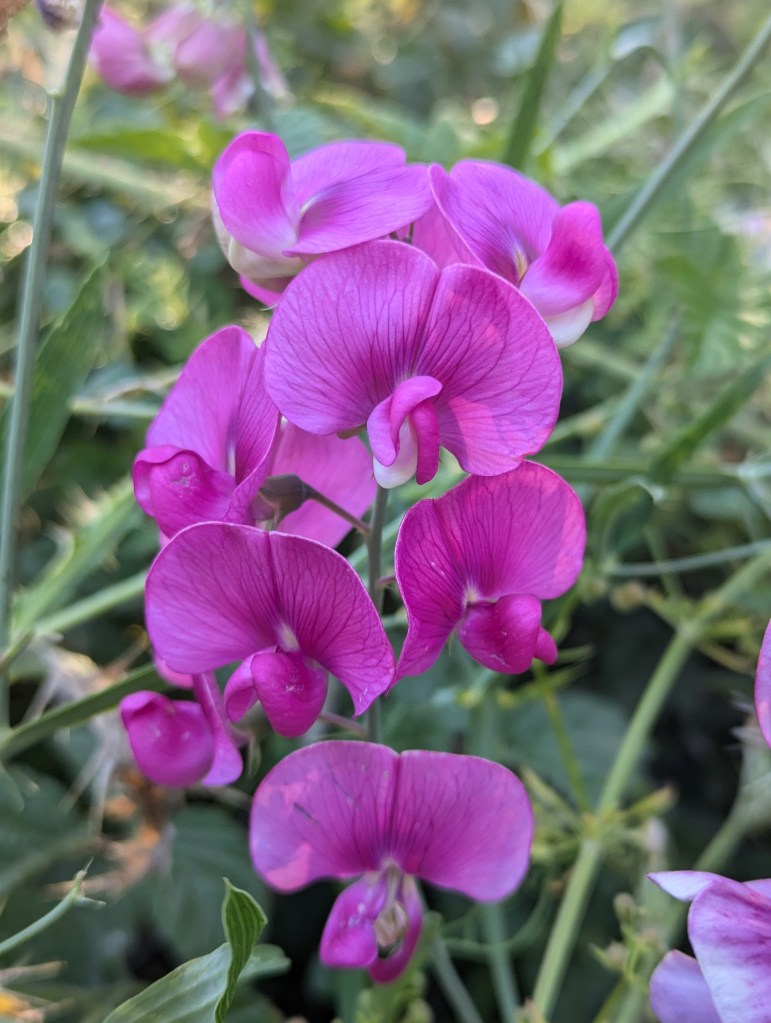
Now that the weather is getting hot, perennial pea, Lathyrus latifolius, is finishing bloom. It needs warmth to bloom, so can begin between the middle or end of spring. However, it shrivels in heat, so can finish between the beginning and middle of summer. Sometimes, it can bloom for almost three months. Sometimes, it finishes almost as soon as it starts.
Perennial pea is more popular as a naturalized wildflower than within home gardens. Its seed is rarely available from nurseries. Young seedlings might not grow very big initially. Mature specimens can vigorously climb and creep more than seven feet in any direction. Their fibrous perennial roots are very difficult to kill. Propagation by root division is easy.
Almost all perennial pea blooms with an abundance of bright pinkish magenta flowers. A rare few bloom with slightly striated light pink flowers. A bit fewer bloom with bright white flowers. Bloom resembles that of annual sweet pea, but is less frilly and lacks fragrance. Slightly bluish foliage and stems have a soft texture, and recover slowly from disruptions. Any parts can be toxic if ingested.
P was for pea last Sunday. Although the spelling has not changed since then, this is a different topic now, so is not actually a sequel. P just happens to also be for the floral fragrance of Hibbertia scandens, which, to some, resembles that of what tomcats do to designate their territory. Its several common names are no more appealing. It is known as golden guinea vine, climbing guinea flower and twining guinea flower. Rather than possibly offending others of Italian descent, I refer to it simply as snake vine. Contrary to its several other common names, it is not actually from the Guinea Region of Western Africa, but is instead from Eastern Australia and New Guinea. Incidentally, New Guinea is no more affiliated with Western Africa than it is with descendents of Italian Immigrants in America, or plump rodents who identify as pigs of the Andes Mountains on the West Coast of South America. I got a few cuttings of snake vine at the end of last September. One cutting is growing quite nicely. Another took time to bloom with this single flower that looks like Carl Junior did not quite beat the train. Its floral fragrance is almost disappointingly unobjectionable. I suspect that more are necessary to be perceptibly fragrant. From my limited experience with the species, I remember than only a profusion of bloom produced merely a slightly objectionable fragrance. Like so much of what I grow here, I have no idea of what to do with these new snake vines. Fortunately, they are more docile than the white perennial pea that I mentioned last Sunday, or the cup of gold vine that I mentioned earlier. Eventually, I should be able to accommodate some within at least one of the many refined landscapes at work. If so, I will not put enough of it within the same situation to generate annoyingly objectionable floral fragrance. Nor should any individual specimen be allowed to grow large enough to do so. I would be more tolerant of a slight bit of such fragrance within my home garden only because I happen to be fond of this species now that I have reacquainted with it.
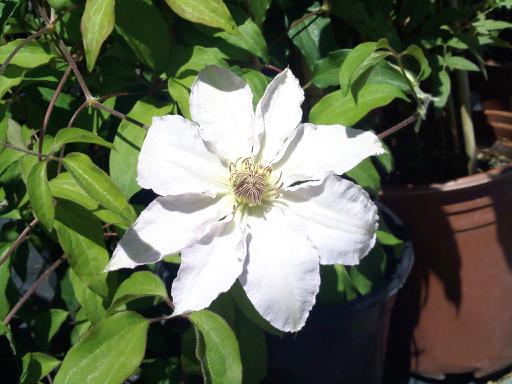
Like the big bark of a little terrier, the big and boldly colored flowers of large-flowered hybrid clematis seem to be more than their delicate vines should be able to produce. Almost all of the many modern varieties bloom with flowers that are at least three inches wide; and some have slightly ruffled double flowers. Their rich, deep, and sometimes two toned shades of red, blue, purple or pink, as well as white seem too opulent for their simple wiry stems that may climb to only six feet or so. The dark green compound leaves grab harmlessly onto light trellises, stakes or lattice. Although the foliage and flowers want sunny exposure, clematis roots do not like warm soil, so appreciate generous mulching. Some people like to give them a wide rock to disperse their roots under, or plant them next to large pots that sit directly on the soil. I planted mine on the north side of the northwestern corner of the house where the soil was always shaded, and allowed it to climb around the corner onto an iron banister on the west side.
Clematis want to be watered and fertilized regularly, and well drained organically rich soil. They should be pruned rather aggressively in winter while they seem to be dead, but are really just dormant.
Hall’s honeysuckle climbs aggressively by twining.
The unrefined twining vines of good old fashioned Hall’s (Japanese) honeysuckle, Lonicera japonica ‘Halliana’, seem to fit in so naturally with lilacs, hydrangeas and bearded iris; the sort of plants that grow in grandma’s garden. Grandma may need help controlling it though, since it can climb more than twenty five feet, and get overgrown and invasive. It is best pruned back to main canes or to the ground annually at the end of winter. Even though it is evergreen, it drops some of its foliage and looks rather tired by the end of winter anyway.
Just as the fragrance of the earlier spring blooming flowers gets depleted, Hall’s honeysuckle begins to bloom with its own distinct sweet fragrance, attracting bees and hummingbirds. Bloom is typically most abundant in spring, and followed by sporadic bloom until autumn. Fluctuations of weather or watering can cause subsequent phases of abundant bloom during summer. The pale white tubular (and bisymmetrical) flowers fade to pale yellow that is perhaps the color of French vanilla ice cream. The simple light green leaves are about two inches long. A few leaves on the most vigorous vines may be lobed.



 Tony Tomeo