Delightfully fragrant star jasmine can be either a ground cover or a climbing vine.
The strong fragrance of the inch-wide, star shaped flowers of star jasmine, Trachelospermum jasminoides, gets attention from quite a distance. Whether they bloom lightly in partial shade, or profusely enough to obscure nearly half of the foliage below, their crisp white shows up nicely against the rich waxy green of the simple two or three inch long, and inch wide leaves. Star jasmine is among the more complaisant of vines, so only climbs or creeps along the ground to about ten feet; perhaps twice as much when very mature.
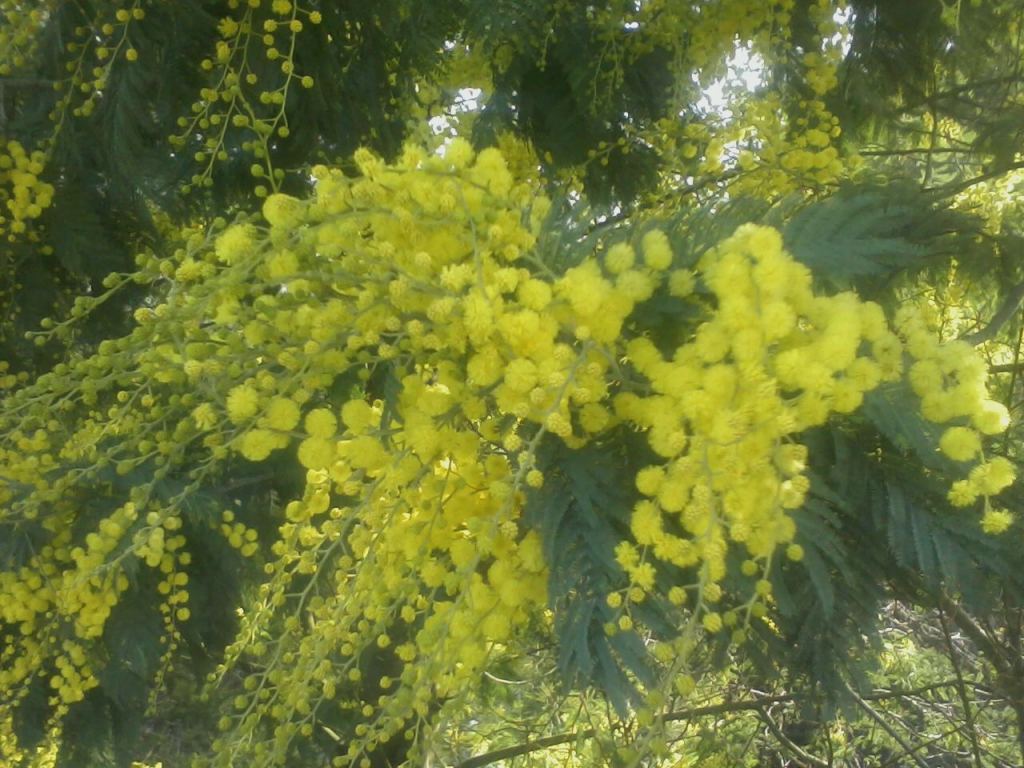
Silver wattle has a weird but effective means with which to clear space for its seedlings.
Why do forests seem to be so peaceful? Perhaps it is because most of what goes on there happens in slow motion . . . very slow motion. It is difficult to see how violent and competitive the various plants are to each other as they grow. Ironically, by bringing the serenity of a forest into our own gardens, we also bring in a certain degree of the natural violence that we are not so aware of.
Vines are some of the nastiest of plants in the forest. Only a few, like bougainvillea, manage to climb to considerable heights by simply leaning harmlessly onto taller trees for support. However, vines like the various ivies and creeping fig, grip tightly to the trunks of the trees that support them. Once such a vine reaches the top of a tree, it develops its own supportive trunk while simultaneously strangling and shading out the tree that supported it.
Some acacias and some willows have figured out how to take out some of their competition simply by clobbering them. For example, Acacia dealbata grows fast and big, but is innately unstable and does not live very long. Old trees invariably fall onto other trees, which clears patches of forest for their own seedlings.
All sorts of cypress, pine and walnut, as well as many eucalypti control their competition by overwhelming seedlings of other plants with foliar debris that leaches herbicidal chemicals into the surrounding soil. Their own seedlings do not seem to mind much, so are able to germinate and grow where space allows.
Monterey cypress, Monterey pine, California fan palm and Mexican fan palm use an even nastier technique, by incinerating their competition during forest fires. They retain as much of their own foliar debris as possible, so that during a forest fire, they burn hot enough to kill other plants and their seeds. Their own seeds though, survive the fire in protective fruiting structures. Monterey pine cones merely get cooked in a fire, and then open to disperse their seed as they begin to cool after a fire.
Like it or not, most gardens include at least some plants that are not as peaceful as they seem to be. Some have the potential to be downright violent. That is why is is important to know how the various plants behave and what they are capable of.
For examples, although bougainvillea can be trained up into arbors and trellises, creeping fig should not be allowed to climb into trees or any structures that might get damaged by its griping and strangling habits. Beards of dead fronds should be pruned from fan palms that are close enough to structures to be hazardous if they burn. Knowing our plants and maintaining them accordingly will promote the sort of harmony that we all want in the garden.
It is the Official State Flower of North Carolina!
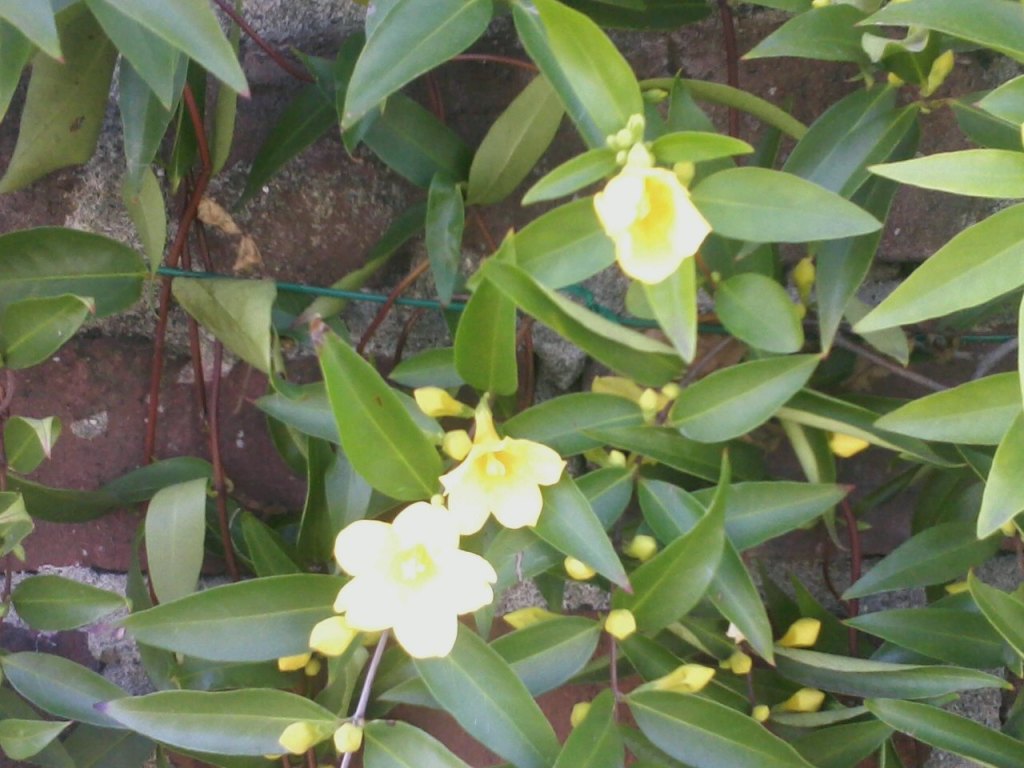
Along with lilac vine (Hardenbergia), daffodil and some acacia trees, Carolina jessamine, Gelsemium sempervirens, is one of the first flowers to bloom late in winter. The small, loose clusters of inch long and wide tubular flowers are as bright yellow as those of the various acacia and daffodil, though not nearly as abundant, and actually barely abundant enough for their pleasant fragrance to get noticed. They provide nice contrast for the deep purple of lilac vine, particularly since both are complaisant vines that are often grown together. These twining vines can be kept below first floor eaves, but barely reach second floor eaves if allowed to grow wild. Leaves are about half an inch wide and two or maybe three inch long. Because Carolina jessamine is toxic, it should not be grown where children or inquisitive puppies might eat it. Incidentally, Carolina jessamine is the state flower of South Carolina.
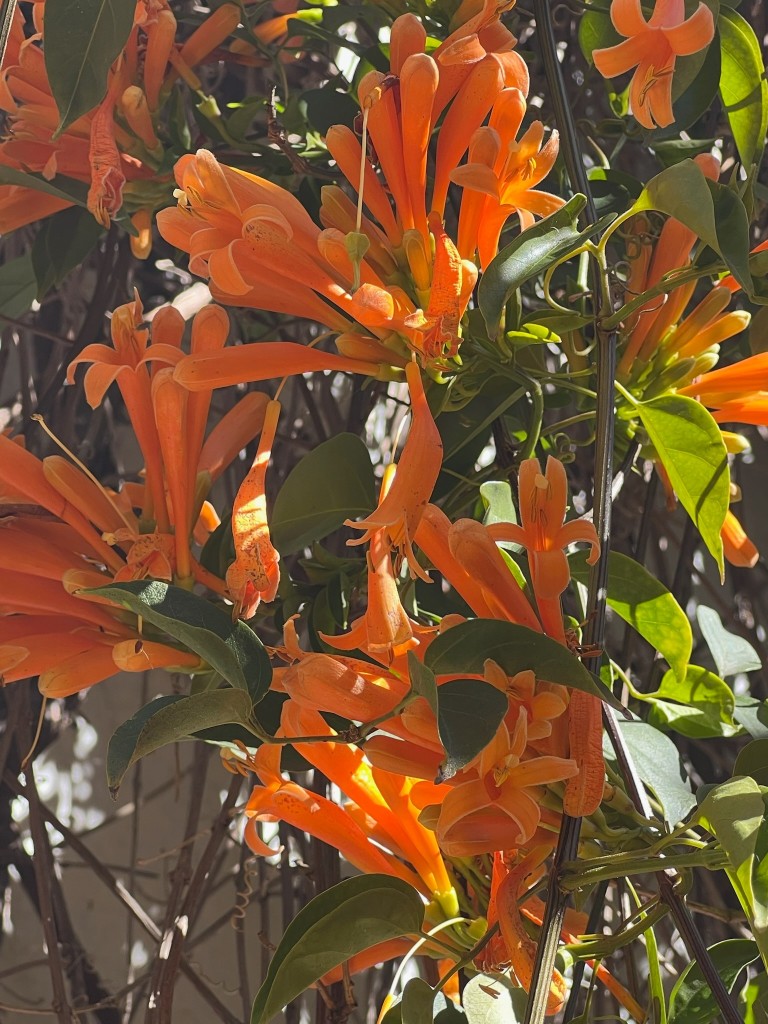
Like so many popular spring bulbs, flame vine, Pyrostegia venusta, may not delay bloom until spring as it should. Within the warmly sunny situations that it prefers, it is more likely to bloom during winter. It may wait until the end of winter or even the beginning of spring only where winter weather is cooler. Bloom is already finishing where winters are milder.
Bloom is spectacular, particularly while not much else blooms so copiously. It is about as profuse as bougainvillea bloom, but earlier. It is about as vibrant orange as poppy bloom, but earlier. With warmth, sunlight and regular watering, flame vine performs very reliably. Perhaps it should not be as uncommon as it is. Yellow blooming flame vine is quite rare.
Although a bit tamer than related red trumpet vine and royal trumpet vine, flame vine may be uncommon partly because it is so vigorous. If pruned to the ground after bloom, it can reach second story eaves to bloom there for the next season. It can grow absurdly high if it grows into trees. Its evergreen foliar tendrils can cling to and damage painted surfaces.
Chilean nightshade is less aggressive than related potato vine.
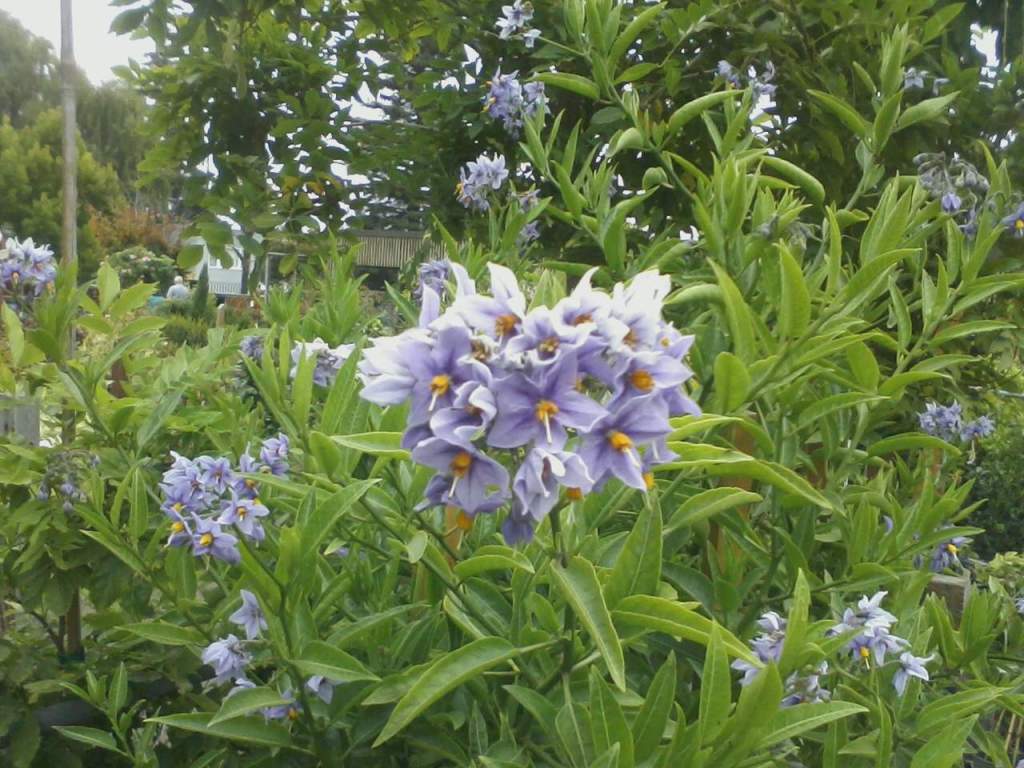
Yellow centered blue flowers like those of the familiar potato bush, on vines almost like those of the comparably familiar potato vine would be like the not so common Chilean nightshade, Solanum crispum. However, Chilean nightshade needs to be trained onto support in order to climb, and only reaches fifteen feet or so. The cultivar (cultivated variety) ‘Album’ is like a shrubbier redundancy to potato vine, since it has white flowers. ‘Glasnevin’ is the most popular cultivar because it flowers freely and is hardier to frost.
The nearly inch wide and slightly fragrant flowers bloom in small clusters from May or June until about now. Small but sometimes prominent green berries that turn yellowish orange and then dark purple are toxic. Partial shade inhibits bloom and vigor.
Bower vine bloom sporadically until cooler autumn weather.
Autumn needs to get a bit cooler before bower vine, Pandorea jasminoides, will be ready to stop blooming. It may not always bloom profusely, but it does bloom for a long time, beginning with warming spring weather. Flowers can be white, pink or white with pink throats, but are most often pink with burgundy throats. Even through late autumn and winter, the glossy evergreen foliage is appealing without bloom. Mature vines can climb more than fifteen feet high. Those with variegated foliage might stay somewhat smaller.
Good old fashioned suburbia will never bee the same. Bigger modern homes on smaller modern parcels leave little space for gardening and trees. What is not shaded by the taller homes is shaded by the taller fences, which are ‘needed’ for privacy since the homes are closer together. Building codes in most municipalities limit the height of fences, but lattice screens are often added on top for extra height.
Because lumber is not of the quality that it was when shorter light duty redwood fences were built decades ago, relatively expensive modern fences do not last nearly as long. They might last longer if they would get repaired instead of replaced when only the posts rot. Green technology seemed to work better before it became trendy.
Ironically, no one wants these bigger and bolder fences that are closer to home to be so prominent in the landscape. We try to obscure them with vines that can tear them apart, or shrubbery that can push them over. Watering these vines and shrubs accelerates rot in the posts.
Shrubbery intended to obscure a fence should not be so voracious that it wants to displace the same fence that it is intended to obscure. Some types of pittosporum work nicely because they support themselves without leaning against other features in their surroundings too much, even if they eventually get quite large. However, they do get quite thick, and can obscure a fence so well that no one would miss the fence if it were to get pushed over! A good hedge without a fence is sometimes a better option.
Many types of vines can be kept much closer to a fence than shrubbery can, but most tend to be more destructive. Star jasmine works nicely if allowed to climb a trellis directly in front of the fence, but should not be allowed to get between planks in the fence, or to get too intertwined in lattice. If it gets too fluffy, it can be shorn back like a light hedge.
Clinging vines like creeping fig can be very appealing on fences, and can be shorn like hedges, but will eventually necessitate the replacement of the fences that they climb. For those who appreciate such a tailored appearance, replacement of the affected fences every few years is a fair compromise.
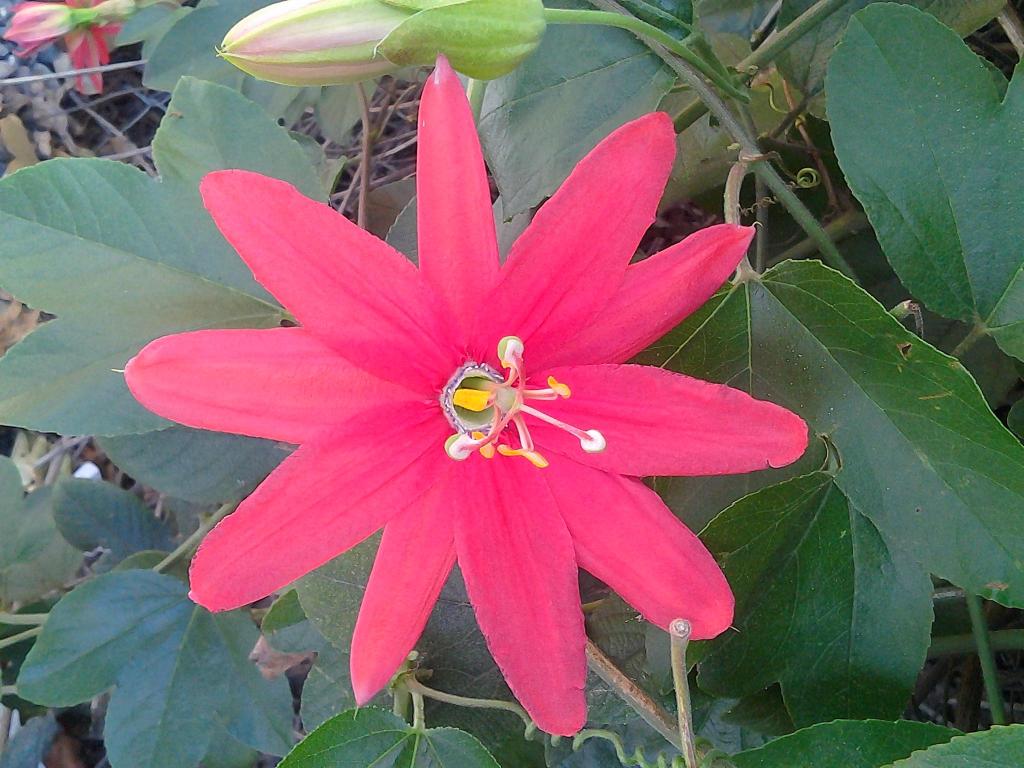
Compared to the common passion flower, the three inch wide red passion flower, Passiflora manicata, is more colorful with cherry red flowers, but does not so prominently display the weirdly distended floral parts that passion flowers are known for. Bloom is not as profuse either, particularly among vigorous vines.
However, red passion flower vine has the advantages of somewhat more resilient and greener foliage, and sturdier vines that can climb almost to thirty feet high. It grows so vigorously that it can be surprisingly overwhelming, even if pruned severely or cut to the ground at the end of each winter. It is not so rampant in light shade.
Copies (new vines) are easy to propagate by layering, which involves merely burying a section of vine while still attached to the parent vine until it develops enough roots to be separated. The buried section should be at least a few inches long. At least a few inches of the tip of the vine should extend beyond the buried section.
The fruit of red passion flower vine is considered to be toxic, but often gets eaten anyway. Fortunately, fruit rarely develops.
Boston ivy and creeping fig are good aggressive vines for freeway overpasses and sound-walls. They are resilient to harsh exposures and pollution, and help to muffle the sound of traffic. Boston ivy provides remarkable foliar color in autumn before defoliating in winter. Creeping fig provides thick evergreen foliage that overwhelms any graffiti that it can reach.
However, their aggressive behavior that is such an advantage on freeways is precisely why they are not so practical for home gardens. Boston ivy gets around so efficiently because it grabs onto surfaces with ‘holdfast disks’ (modified tendrils) that damage paint, stucco, wood and just about anything that is not built like a freeway. Creeping fig is at least as destructive with clinging aerial roots, as well as constrictive stems that can crush smaller plants, fences and anything else that it might grab hold of.
Most vines are aggressive in nature. They exploit trees for support, and then compete with them for space. Some are complaisant enough to mingle relatively peacefully with the trees that support them. Less honorable vines have no problem overwhelming the canopies of their supportive trees. Creeping fig and other related figs are known as ‘strangler figs’ because their constrictive roots and stems crush and kill the same trees that help them get above the forest canopy.
Such behavior needs to be considered when selecting vines for home gardens. Bulky and potentially constrictive wisteria vines that would tear lattice apart can be quite appealing on sturdy arbors or trellises. Lattice could instead be adorned with docile Carolina jessamine, lilac vine, mandevilla or even regularly pruned passion vine. Star jasmine and the various trumpet vines work nicely to obscure chain link fences. With regular selective pruning, pink jasmine, honeysuckle and potato vine work well on rail fences.
Climbing roses and bougainvillea do not climb on their own, but can be trained almost like vines. Some varieties stay small enough for low fences and trellises. Larger types are proportionate to larger fences and arbors.
The mostly white and blue common passion flower likely remains the most popular. After all, it is the weirdest. Elaborate and disproportionate floral parts imply that it is of another planet. Red passion flower, Passiflora racemosa, although less peculiar, is perhaps a bit more colorful. Its brick red flowers bloom randomly for as long as weather remains warm.
Flowers are about three or four inches wide. They develop in open racemes that seem to spread out somewhat evenly over the exterior of their foliage. Bloom is not profuse, but is somewhat continuous until autumn. Newer flowers replace older flowers within the same racemes. Leaves are as wide as their flowers, with three blunt lobes and axillary tendrils.
The lushly evergreen foliage can get shabby through winter, or completely ruined by just mild frost. It regenerates vigorously though. Aggressive pruning as winter finishes delays bloom, but promotes vigorous growth. Vines can potentially reach more than twenty feet. Fruit is rare without manual pollination. Fruit flavor can be bland without tropical warmth.