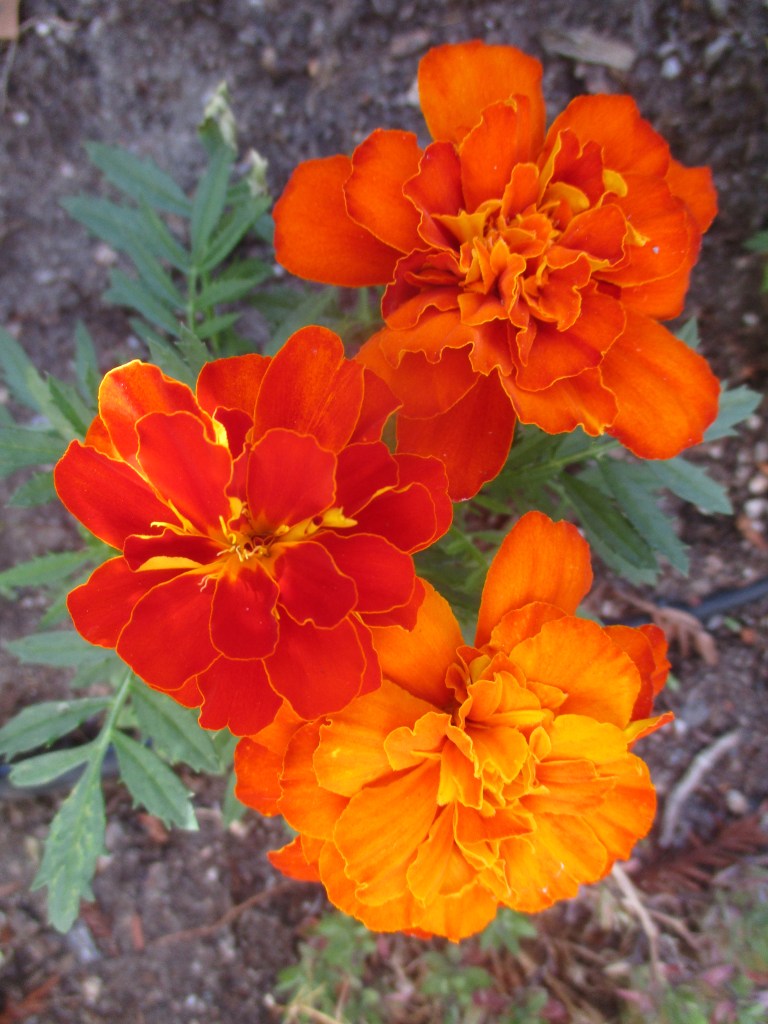
The Maya cultivated marigolds long before the French. After all, the ancestors of modern French hybrid marigolds, Tagetes patula, are endemic to Mexico and Guatemala. French horticulturists merely developed the hybrids that are now most popular. The largest might grow a foot high and wide. Otherwise, almost all grow lower as compact bedding plants.
Although many varieties of French hybrid marigold are available, their floral color ranges only through yellow, orange and red. Ruddy brown is merely dark orange. Creamy white is merely very pale yellow. Combinations of color within this minimal range are amazing nonetheless. White is rare only because richer traditional colors remain so very popular.
French marigolds are technically warm season annuals. With frequent deadheading and grooming, they can bloom from spring until frost. However, since they perform best while young, they are more popular as a shorter term annual. They often replace warm season annuals that finish a bit early, while the weather is still too warm for cool season annuals.
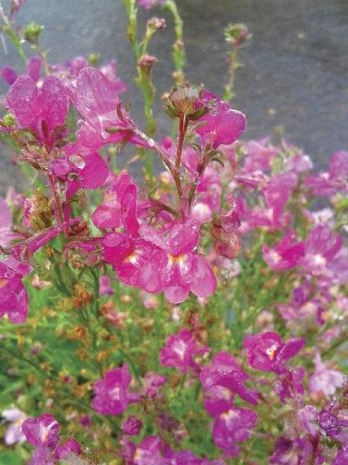
Toadflax really does look like baby snapdragon, which is its other common name. The tiny, half inch wide flowers are similarly bisymmetrical, and arranged in small trusses, although the diminutive leaves are distinctively narrow.
Common toadflax, Linaria maroccana, which is actually less common than the name implies, gets about one and a half to two feet tall and about half a foot wide. Two toned flowers bloom in summer in shades of pink, purplish pink, purple, blue, very pale yellow or red with yellow. ‘Northern Lights’ adds shades and bicolor combinations of yellow, orange and red to the mix. The more common ‘Fantasy Hybrids’ get only about half as tall and perhaps slightly wider, with earlier and slightly larger flowers in shades of yellow, blue, pink and bright pink, as well as white, mostly with slightly yellow throats.
Toadflax is a summer annual, but does not like to be too exposed to roasting heat and glare. If grown from seed, it should be sown as soon as possible after the last frost to get an early start.
Where winters are cooler, zonal geranium, Pelargonium X hortorum, performs as a warm season annual. It is perennial only with shelter from frost. Locally, traditional cultivars are so reliably perennial that they can get congested without thorough pruning and grooming after winter. Frost occasionally ruins outer growth, but rarely kills entire plants with roots.
Modern cultivars bloom more profusely and more colorfully than old cultivars, but are not quite as resilient. They are more likely to rot during the damp and cool weather of winter. They bloom exquisitely from spring through autumn though, with bright hues of red, pink, peach, salmon and white. They stay lower and more compact, so require less grooming.
The more popular modern zonal geraniums should not get much more than two feet high and wide. Their small flowers bloom on globular floral trusses that can get as wide as six inches. Traditional zonal geraniums get bigger, with smaller floral trusses. Nearly circular and aromatic leaves generally exhibit darker halos between lighter centers and margins.
Sweet alyssum is one of those warm season annuals that is too easy to grow to be taken too seriously.
Nasturtium and sweet alyssum seem to be more than warm season annuals. Like many other warm season annuals, they get established best if added to the garden just after winter, and then grow and bloom mostly during warm spring and summer weather. Then, if allowed to stay in the garden as cooler weather inhibits bloom somewhat , they survive through autumn and winter. By the time the original plants die out, new seedling emerge to replace them.
A potential ‘slight’ problem with allowing these annuals to naturalize (perpetuate naturally by sowing their own seed) is that fancier varieties eventually revert to a more genetically stable state. Sweet alyssum that can be various shades of pink or purple as well as white eventually blooms almost exclusively white after a few generations. Nasturtium that might start out with all sorts of shades of yellow, orange, red or brownish red eventually blooms with only basic bright yellow, bright orange and perhaps rarely, cherry red.
The reason that this is only a potential problem is that most of us are totally pleased with white sweet alyssum, and yellow and orange nasturtium! Another slightly more realistic potential problem with naturalization of sweet alyssum or nasturtium is that it leaves us no excuse to try different varieties. Anyone who doubts this should take a quick look through the online catalog of Renee’s Garden!
Nasturtium is easier to grow from seed than from small plants in cell pack, since small plants take time to recover from transplant. Besides only two or perhaps three of the multitude of varieties available as seed can be found in cell packs. Sweet alyssum can either be grown from cell pack or from seed, but like nasturtium, more varieties are available as seed. Although they grow throughout the year, both are still considered to be warm season annuals.
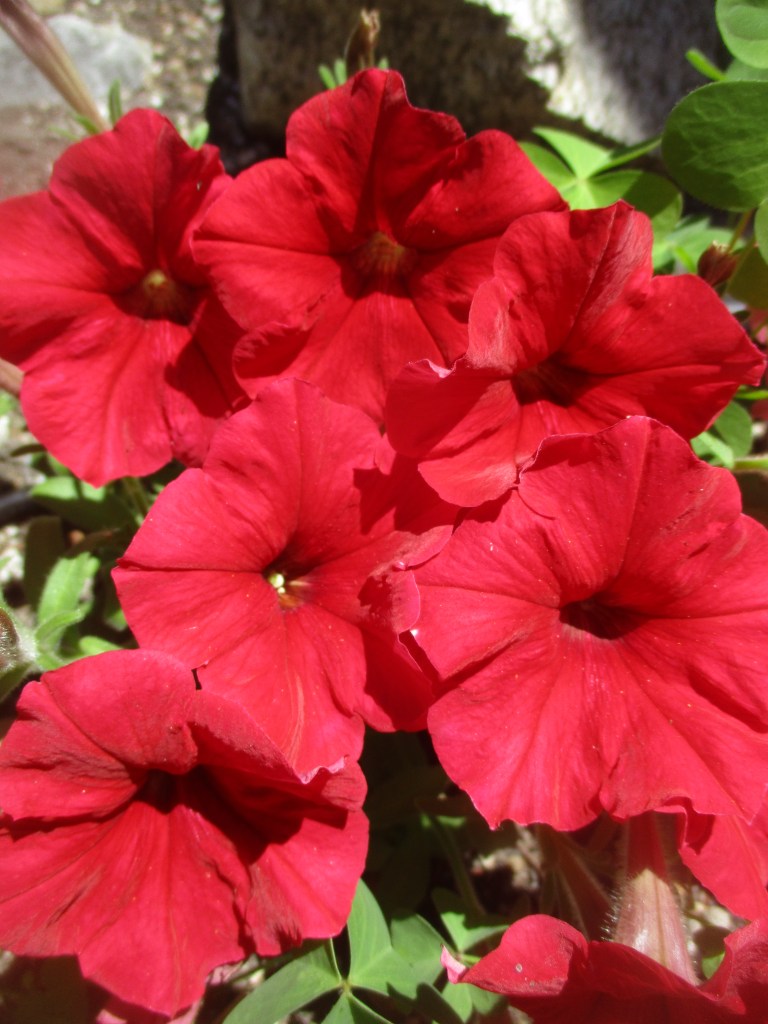
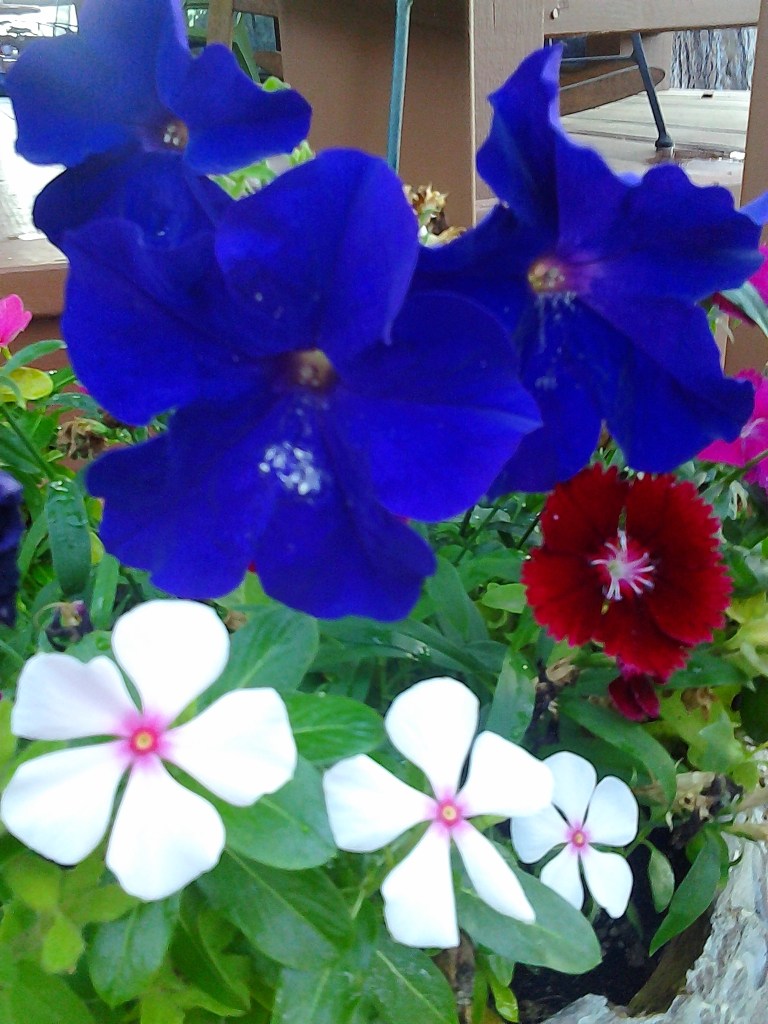
Busy Lizzy (impatiens), petunia, marigold, lobelia, cosmos and zinnia are some of the other popular warm season bedding annuals this time of year. Statice, cockscomb, verbena, moss rose and pincushion flower are also in season. Statice, tall varieties of cosmos and some varieties of zinnias make good cut flowers. Verbena, moss rose and pincushion flower are more often grown in mixed planting rather than as homogenous bedding. Although many more varieties are available as seed, cell packs of any of these warm season annuals provide more immediate results, especially this late in the season.
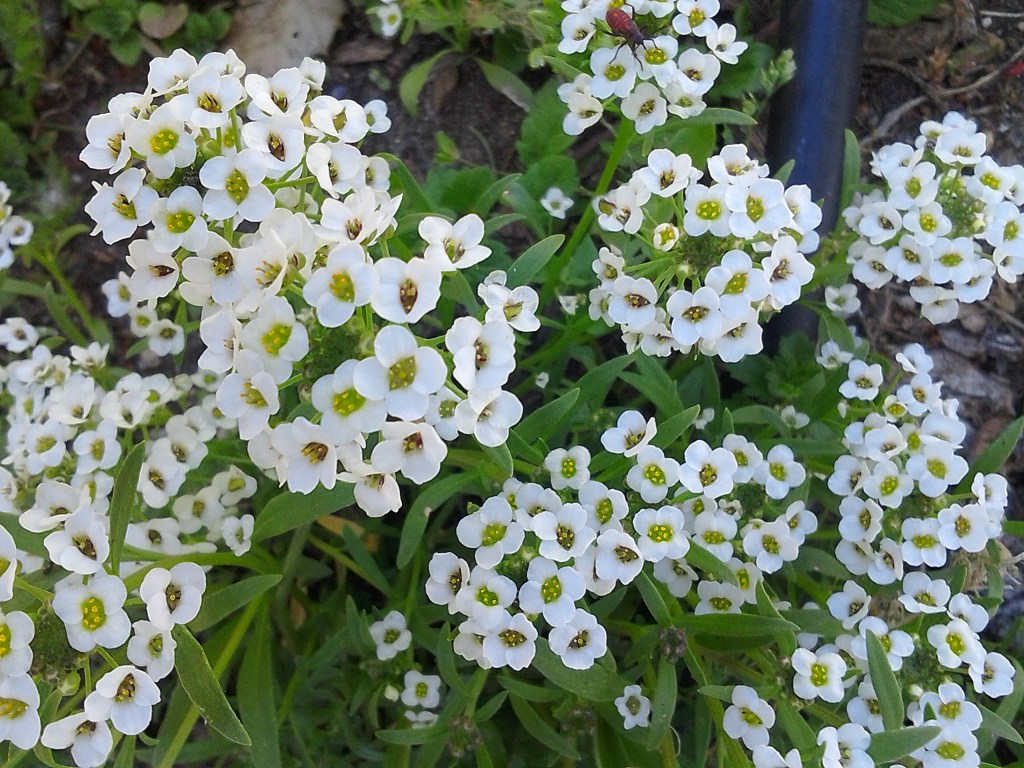
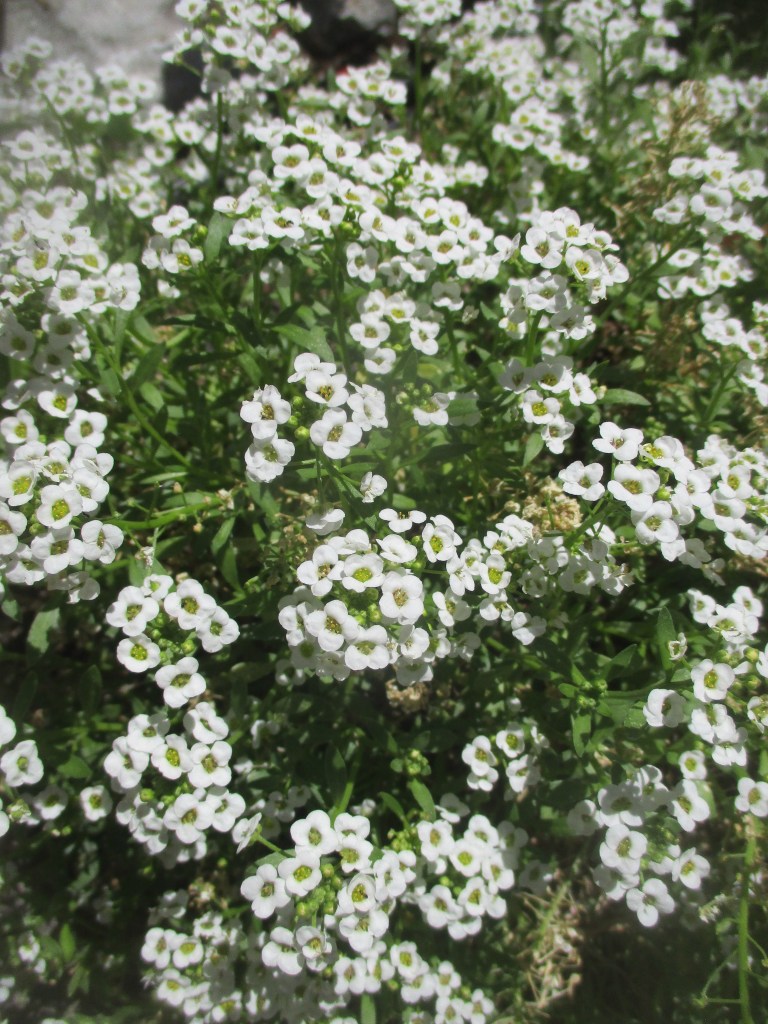
Without becoming invasive, common alyssum, Lobularia maritima, can almost naturalize in favorable situations. It disperses seed profusely, so often appears where it is an asset to the garden. Since it is so docile, it subordinates to more vigorous plants that it mingles with. It does well on loosely set stone walls. If necessary, it is easy to remove or relocate.
Common alyssum blooms with tiny but profuse white flowers. If they naturalize, varieties with pink or purple bloom eventually revert to white bloom after a few generations. Some varieties revert slower than others. Although popular as a warm season annual, alyssum can continue to bloom through next winter. Individual plants may survive for a few years.
Mature alyssum plants might get a bit higher than half a foot, but will get no higher than a foot. If they perform for more than a year, their progeny may begin to replace them before they get shabby. After removal, shabby plants, with a bit of shaking over bare spots, may share their last seed. Alyssum grows easily from seed, and is available in cell packs too.
Cool season annuals were cool just a few months ago. Now, it is getting to be about time to warm up to warm season annuals. They will become a hot commodity as winter yields to spring. Many begin to bloom with warming spring weather, and continue to bloom until autumn. Then, as the weather cools, they relinquish their space to cool season annuals.
Warm season annuals, or summer annuals (or warm season or summer bedding plants), are technically a bit early for a few regions. They should wait until after the last frost date, which might be later in the month for some climates. Even where frost is no threat, it may be too early to replace cool season annuals that continue to perform until spring weather.
Warm season annuals only seem to be seasonable now because the weather has been so pleasantly mild and even warm. Some cool season annuals are already beginning to deteriorate, which facilitates their replacement. Warm season annuals might dislike cool nights and short days, but should appreciate the opportunity to disperse their roots early.
However, some degree of risk is associated with early planting of warm season annuals. Mild frost, although unlikely, is still possible in some climates, and could necessitate frost protection for vulnerable plants. Resumption of rainy and more typically wintry weather is more likely. Heavy rain can thrash fresh bloom. Sustained dampness can cause mildew.
Like warm season vegetable plants, warm season annuals can grow from seed or small plants from cell packs or little pots. Some prefer to grow directly from seed. Others prefer transplanting. Nasturtium, for example, prefer direct sowing. Petunia, which perform well after transplant as seedlings or small plants, are likely to languish if they grow from seed.
Because seed take a bit of time to germinate, they can go into the garden slightly prior to the last frost date, and earlier than vulnerable seedlings. Similarly, they can start within a greenhouse early for later transplant. With proper scheduling, frost should no longer be a problem by the time seedlings emerge above the garden soil, or are ready for transplant. More variety is obtainable as seed.
Statice is about as colorful dried as it is while fresh.
The papery flowers of annual statice, Limonium sinuatum, are so popular as seemingly synthetic dried flowers that many garden enthusiasts are surprised to find that they are happy to bloom naturally in home gardens. The clear shades of blue, purple, pink, orange, yellow and white seem to be dyed. The one or two foot tall flower stems are outfitted with odd papery ‘wings’ that make the stems seem wider than they actually are. Deeply lobed basal foliage forms shallow rosettes. Mature plants are about one or two feet tall, and a foot or so wide. Bloom begins late in summer, and continues into autumn. Good sun exposure and good drainage are preferred. Seed can be sown directly, or young plants can be added to the garden early in spring.
Warm season annuals are now passé. Cool season annuls, such as these violas, are in.
Now that it is time for cool season annuals, it is difficult to remove warm season annuals if they are still blooming and healthy. that is probably why so many of us prefer mixed plantings, where cool season annuals can be added as needed to replace warm season annuals as they deteriorate. Some warm season annuals that are actually perennials, like wax begonia and busy Lizzie (impatiens), can be cut back and overplanted with cool season annuals, so that some might regenerate next spring as the cool season annuals finish. Petunias may be looking overgrown and tired, but are at least easier to remove without guilt.
Pansies and smaller but closely related violas are probably the two most popular of cool season annuals. They work something like petunias, but for autumn and winter. They are commonly grown in uniform beds, but work just as well in mixed plantings. There are not many colors that can not be found in pansies, although only a few of the more popular varieties can be found at any particular nursery. Some are ‘solid’ colors. The most familiar varieties have those funny ‘faces’ that pansies are known for.
The various primroses require a bit more effort because deteriorating flowers need to be removed. They can also be a problem for the few who are allergic to them (like poison oak). Like the warm season annuals that can survive as perennials through winter, some primroses, particularly English primrose, can survive through summer as perennials. English primrose displays bright cartoon shades of almost any color. Fairy primrose are more commonly pastel shades.
Stock has an intense and distinctively rich fragrance. Taller types are excellent cut flowers, but are not so practical for uniform beds. Even shorter types are probably best in mixed plantings, or in borders with lower flowers in front. The single or double flowers can be white, pink, purple and almost red.
Ornamental cabbage and kale are grown for bold rosettes of colorful pink, white or pink and white foliage. The shades of pink range from soft light pink to rich purplish pink and almost red bright pink. Cabbage provides more color. Kale has more variety of foliar texture. Ironically, both look rather weedy, and should be removed as they begin to bloom in spring.
Chrysanthemum are strikingly colorful cool season flowers, but rarely bloom as uniformly as they do when first planted. Because they bloom so profusely, they need to be groomed frequently. If they get what they want, they can perform for several years, blooming all sorts of shades of yellow, orange, red, pink, purple and white. Chrysanthemum also displays a broad range of flower structures and sizes, from minute to jumbo.
Sweet William, Iceland poppy, calendula and alyssum are also in season. Yellow or orange calendula, with single or double flowers, is best through autumn, but may mildew by winter. Alyssum is white or subdued shades of pink or purple, and is actually good throughout the year, and can self sow indefinitely.
It always seems that by the time the garden gets as productive as it can, it is already time to get ready for the next season. Pretty soon, cool season annuals will be arriving in nurseries to replace warm season annuals that had been so colorful all summer. If seeds are to be collected from summer flowers for next year, this would be a good time to do it.
Seed for certain cool season vegetables like broccoli, cauliflower, cabbage and kale, can be sown in flats or cell packs now to have seedlings ready to put out into the garden as warm season vegetables finish in autumn. If there is space available in the garden, turnips, turnip greens and beets can be sown directly. Carrots should probably wait a few weeks or so to get sown directly.
Although corn of a single variety sown in a single phase tends to ripen at the same time, different varieties planted in different phases can extend the season significantly. Those that continue to produce until autumn are greedy for nutrients and water. Squash and tomatoes likewise appreciate a bit of fertilizer and regular watering, even as the weather starts to fluctuate this late in summer. However, fertilizer does not need to be applied in the last month of expected production.
Zucchini should be harvested when they get about six inches long, not only because they are best when immature, but also because the plants are more productive if regularly deprived of their fruit. If plants have the choice, they prefer to concentrate resources into fewer large fruit instead of more small fruit. The problem is that the larger fruit is tough and lacks flavor.
Hubbard, butternut, acorn and other winter squash get the opposite treatment. Each vine should produce only a few fruits. Those that produce smaller fruits can sustain more than those that produce larger fruits. Yet, excessive fruit exhausts resources, which compromises fruit quality. The fruit that will continue to grow and ripen through autumn should already be somewhat developed. The smallest of excessive fruit, or underdeveloped fruit should be removed.
Without bloom, the richly vibrant foliar colors of coleus, Coleus scutellarioides, rival floral color of other warm season annuals. Striking foliar patterns are as exquisite as any floral display. Growth is efficient through the warmth of spring. Foliage might last until autumn. Late in its season, spikes of tiny blue flowers can be trimmed off to promote more foliage.
With bright ambient sunlight, coleus is more perennial as a houseplant. However, it may get persistent with pesky bloom as it matures. Some who grow it prefer to let bloom, and then prune it back afterward. Recovery from such pruning can be slow. Vegetative stems, without bloom, root easily as cuttings even in water. New cuttings can replace old plants.
Coleus foliage is intricately variegated with countless combinations of green, chartreuse, yellow, orange, red, burgundy, pink, white and brown. Variegation can be symmetrical or random. Leaf margins may be deeply lobed or just serrate. Modern cultivars might be no better than old fashioned sorts. Mature plants can get as tall and broad as about two feet. Some stay lower.




 Tony Tomeo