Horridculture – Car Wash

p90116Much of California is chaparral. Much of what is not chaparral is full blown desert. Some coastal climates gets quite a bit of rain; and some climates up in the Sierra Nevada are among the snowiest places in America. Generally though, the most populous and most agriculturally productive parts of California do not get much water to spare.
I certainly do not mean to say that we do not get enough water from rain and snow. We get what the region has always gotten longer than anyone can remember. Those who do not want to live in chaparral or desert need not live in California.
If there seems to be insufficient water for all of us to share, it is merely because there are too many people wanting too much of it, and too many who profit from controlling and selling it to them. Some of us conserve water and landscape accordingly. Others have no problem with vast overly irrigated lawns.
As a horticulturist who grows horticultural commodities, I use what I must for my work. I would prefer others to conserve water in home gardening, but can not complain if they choose not to. If they do not mind paying for excessive consumption of water, that is their prerogative. If rationing becomes necessary, and they do not want to pay fines, their expensive landscapes will be damaged or ruined while mine will survive.
However, it is difficult to not be disgusted with some of the waste I observe in some landscapes. One of the landscape companies that I ‘tried’ to work for years ago regularly watered almost all of their landscapes so excessively that trees succumbed to soil saturation. We then charged significantly to remove the dead or dying trees that we were hired to take care of; hence my ‘Horridculture’ articles on Wednesdays.
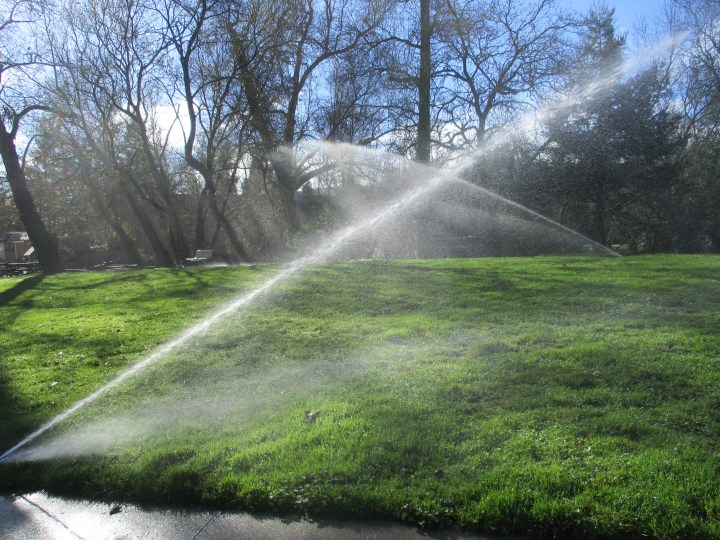
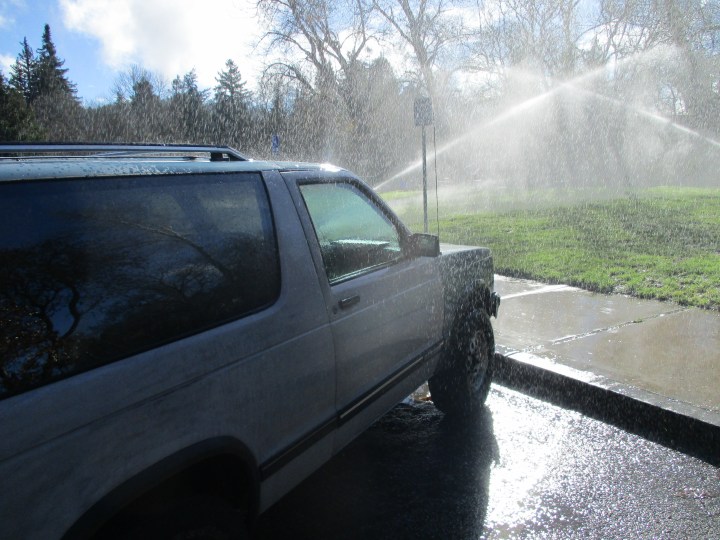
We have been getting quite a bit of rain here recently, and are expecting more rain through the next several days. The cloudy blue sky in the background of these pictures was the most blue sky we had seen in quite a while, and it lasted for only a few hours. The lawn in the park here is too swampy to walk on. Just in case there is a slight possibility that there is a small scrap of it that is not sufficiently swampy, it is getting watered generously.
I know mistakes like this happen, and that those who maintain this particular park are seriously overworked and understaffed. I am annoyed about this anyway. With all the modern technology available, why does the irrigation system not know that it is raining so much? If the irrigation system lacks the sort of technology that allows it to monitor the weather, why has no one told it that it is raining so much? If it can not be contacted by telephone, why does no one who know what the irrigation schedule is stop by to disable the system, or just close valves?! Okay, so I know they are understaffed, so I can not complain about it too much.
Nor should I complain about the parking lot getting watered. I know how easy it is for a sprinkler to get knocked out of adjustment. Besides, the windows are rolled up.
However, I am now a bit more concerned about the weather. Too much rain can cause flooding and mudslides. I already know what the forecast is; and now that the car got washed, the rain could get disastrous!p90116+

Do Not Forget Potted Plants

30918thumbAside from all the seasonal raking and dormant pruning, there is not as much to do in the garden as there was earlier in the year. Lawns do not need much mowing. Hedges do not need much shearing. Untimely mowing and shearing can actually damage lawns and hedges. Watering, which was so important while the weather was warm, is now rare in the cool weather between rain.
Watering is now so infrequent that the few plants that still need it sometimes do without. Plants that are merely sheltered by eaves probably do not mind so much because their roots are dispersed beyond the eaves. However, potted plants that are sheltered by eaves do not have that option. It may take a while in the cool and damp air, but they can slowly get uncomfortably dry.

Watering sheltered potted plants is too easy to forget about while everything that is not sheltered is getting soaked by rain. It is even more easy to forget because it is so infrequent. Things just do not dry out like they do in summer. Also, plants are less active, and many are dormant and defoliated, so really do not lose much moisture to evapotranspiration (evaporation from foliar surfaces.)

In fact, overzealous watering can be just as detrimental as neglect. Soil saturation may not be as immediately dangerous as it would be during warmer weather, but eventually kills roots. Even with adequate drainage, soil moisture can linger if plants do not consume it. Determining how much water is needed for sheltered potted plants may not be as simple as it should be.

Larger plants in smaller pots want more water than smaller plants in larger pots. Those that are exposed to wind will get dry faster than those that are protected. Hanging pots dry out the fastest. Ironically, drought tolerant plants that need the least water in the ground often want the most in pots. They are the most reliant on extensive root dispersion, which is not possible in confinement.

Some potted (frost tolerant) plants might get slightly relocated out into the weather so that they get the rain that keeps the rest of the garden well watered through winter.

When It Rains It Pours

51118thumbFor those who do not remember ancient history, this wet stuff that fell from the sky recently is known as “rain”. It used to be more common, particularly through winter. It has an unfortunate way of getting everything exposed to it quite wet. It makes soil muddy. Yet, rain has many attributes. It is composed of water, so provides much of what irrigation systems have provided for so long in the absence of rain.
Most of us have already been using less water around the garden than in the past. Some plants have suffered, and a some may have died. Surviving lawns are probably not as green as we would like them to be. Just when we think that the garden can not get by with any less, the weather takes over. Even sporadic rain mixed in with mostly sunny weather provides significant moisture.

Not only is more moisture falling from the sky, but the plants and lawns that want it become less demanding through autumn and winter. Evergreen foliage loses less moisture to evapotranspiration (evaporation from foliar surfaces) because it is exposed to less sunlight during shorter days, and because the air is cooler and more humid. Deciduous plants drop their leaves, so do not lose moisture.

Even plants that are sheltered from rain by eaves will need less water because of the cool and humid weather, and shorter days. Some potted evergreen plants that are disproportionately large relative to their pots will likely want to be watered between the rain, only because their roots are so confined. Potted deciduous plants may need their soil moistened if the weather stays dry long enough for the soil to get dry.

Automated irrigation systems need to be adjusted for the changing weather. Some systems may need to be adjusted a few times. By the time the weather gets reliably rainy and cool later in winter, some irrigation systems can be temporarily disabled until the weather gets warmer and drier in spring. Not only does this conserve water; it also makes over-watering and soil saturation less likely.

Watering Starts Where Rain Finishes

70607thumbFor a while last winter, it seemed like the rain would never stop. Obviously, it did. The warm spring weather that followed helped plants to take advantage of the rare surplus of moisture. Desert wildflowers were more colorful than they had been in many years, and maybe since 1983 in some areas. Now the weather is back to normal for here, and we must water our gardens accordingly.

There is nothing natural about irrigation (watering); but then, there is nothing natural about gardening or landscaping. Most of the plants in common landscapes are not native. They were imported from vastly diverse regions with very different climates. Because this happens to be a semi-arid ‘chaparral’ climate, most plants want more moisture than they would get here naturally from rain.

Adapting unnatural irrigation to unnatural landscaping sounds easy enough. The problem is that the many different types of plants from so many different climates each want something different. Also, some plants need unnaturally frequent irrigation to sustain unnatural behavior. For example, lawn grass that would naturally go dormant after a dry summer needs water to stay green all year.

Lawn grasses have finely textured roots near the surface of the soil, so want frequent irrigation. Trees within lawns might want larger volumes of water to reach lower roots, but do not like frequent irrigation that keeps the surface of the soil moist. The sort of regular irrigation that is good for lawn promotes shallow tree roots that ruin lawns and pavement, and are not exactly ideal for stability.

Automated irrigation is usually set to operate very early in the morning, and finish before anyone in the home is likely to be outside, or using much water inside. (Other water use can compromise pressure.) Less water evaporates before the sun comes up. Watering before midnight might seem like a better idea, but keeps foliage wetter longer, so might promote fungal diseases such as mildew. Frequency and duration (volume) of irrigation require occasional adjustments to adapt to the weather.

Happy Easter!

P80401Happy Easter!

This is one of those holidays when no one should work, which is why I wrote this a few days ago, and scheduled it to post today. I hope you are not reading this today. You have more important things to do. Lent and the forty days of fasting that goes with it are over, so you can eat all the Easter eggs and anything else you want.

The only work that should be done today are chores that can not be delayed until tomorrow. With the weather warming (at least in our region), watering might be one of those chores. For most parts of the garden, this might be the first watering since autumn. Although the rain has been meager, cool weather had kept things damp until now. Resuming watering is typically an easy task. It sounds simple enough. Water is water – right?

I get all sorts of unexpected questions in my work. In autumn, I sometimes get asked about trees that were planted in spring or summer that are suddenly turning yellow and dropping leaves; and must explain that the seemingly sickly trees are merely deciduous and defoliating for winter, which can be a major disappointment if evergreen foliage was needed. Then there are the questions about the five pound kumquat that is actually a shaddock fruit on an overgrown sucker (understock from below the graft).

About this time, many years ago, I got a call about a sad #5 (5 gallon) pistache street tree that had been planted while bare during the previous autumn. The client who planted it wanted to do what was best, so planted it in autumn so that it could settle in slowly while dormant through winter, and get an early start dispersing roots in spring. Generous rain that year provided more water than the tree needed through winter. As the rain ran out, and the weather warmed, buds swelled and began to pop. The client who planted the tree was very careful to water it when she thought it was necessary, but the new foliage immediately started to get discolored and distorted. Her remedy was to give it more water, but the health of the tree continued to decline as quickly as it was trying to foliate.

I asked all the typical questions about the tree, but only determined that it was not lacking water, and probably was not getting too much water. The symptoms exhibited by the foliage suggested soil saturation and poor drainage, but the soil drained well, and the roots seemed to be firm. I was baffled, until the client mentioned something very unexpected. I had to ask her to clarify.

She loved the tree so much that she wanted to give it the best water she could obtain. Every day, on her way back from downtown San Jose, she stopped at the Cathedral Basilica of Saint Joseph to procure a gallon of Holy Water to water it with!

That was a new one. I then had the sad duty of explaining to her that her devotion to the tree was what was killing it. The Holy Water that she had so diligently been giving it was saline. After Holy Water is blessed, some gets stored for upcoming baptisms, and the rest gets blessed salt mixed into it, mainly for sanitation. It was this salinity that was so toxic to the tree.

After a lot of fresh water was rinsed through the root system, the tree started to recover almost immediately, and eventually resumed healthy growth. The client telephoned the following autumn as the tree was coloring to inform me that it had been restored to good health, and grown through summer as if nothing had ever happened.

Rain Makes Watering Seem Obsolete

IMG_1921Watering has not been much of a concern lately. All the rain has kept our gardens too wet to work in. Some of us have been more concerned with erosion caused by runoff. Automated irrigation systems are probably disabled until the rain stops. Soil can drain somewhat between rain, but will not really dry out until the weather gets warm again. Dormant plants do not draw much moisture.
However, as strange as it may seem, there are a few plants that might want to be watered. Potted plants on roofed porches are sheltered from rain, just like houseplants. They will not dry out nearly as quickly as they would during warm summer weather, but they do eventually get dry if not occasionally watered. Hanging pots and small pots containing big plants typically dry out faster.

Plants that were moved onto porches for shelter from frost can be moved out into the rain if that would be easier than watering them. It is very unlikely that they will be damaged by frost this late. Besides, as long as it is raining, the weather can not get cold enough for frost. (In fact, any frost damage that was left through winter can be pruned away now that fresh new growth is developing.)

Small plants in the ground under big eaves might need to be watered as well, if they have not been in the ground long enough to disperse their roots beyond the eaves. Annuals do not last that long. Mature plants might have dispersed their roots well enough to get enough moisture from outside. They might not notice if the soil inside is too dry, as long as the weather is cool and humid.

Houseplants are of course in a league of their own, and as long as they are inside the home, get no water from rain. They might need less watering in winter if the home stays cooler; or they might need slightly more watering if the home heating system reduces humidity. Regardless, some might enjoy going outside to a spot sheltered from the wind, for a brief rinse from a mild rain shower.

Eventually, the weather will get warmer and drier, and automated irrigation systems will need to be reactivated. When that happens, the emitters and sprinklers should be checked for efficient function. While inactive over winter, they can get grungy or clogged with mineral deposits. Plants will not need much water early in the season. Irrigation increases as spring and summer progress.

Litter Box

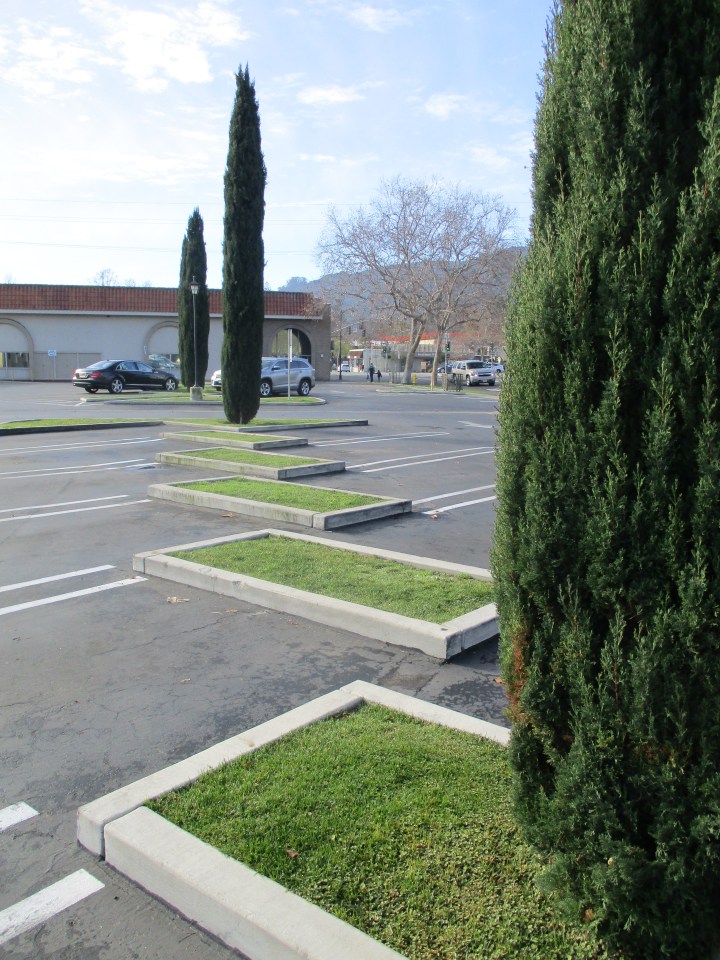
P80120+++++Perhaps I should elaborate on the ‘litter boxes’ in the ‘Six on Saturday’ post earlier this morning. As I already mentioned, they are in the same parking lot as the Leo and Leona sculptures. They were formerly inhabited by Italian cypress trees that would now be like those nearby if they had survived.
This is no joke. Someone really selected the tree that provides the least shade for hot pavement, and attracts the most birds to do what birds do on parked cars.

Because they were installed as large boxed specimens, and were watered generously enough to maintain swampy conditions in the surrounding soil, most of the cypresses could not disperse their roots fast enough, and consequently got blown over onto parked cars in their first or second winter. The survivors took many years to get established, and were bound to big and unsightly lodgepole stakes for years.

Rather than getting outfitted with ‘shade’ trees or perennials, . . . or anything, these litter box planters remain as blank and uselessly small rectangular lawns, requiring regular mowing, edging and lots of watering. Incidentally, many of us around town let our lawns die to conserve water. Brown is the new green.

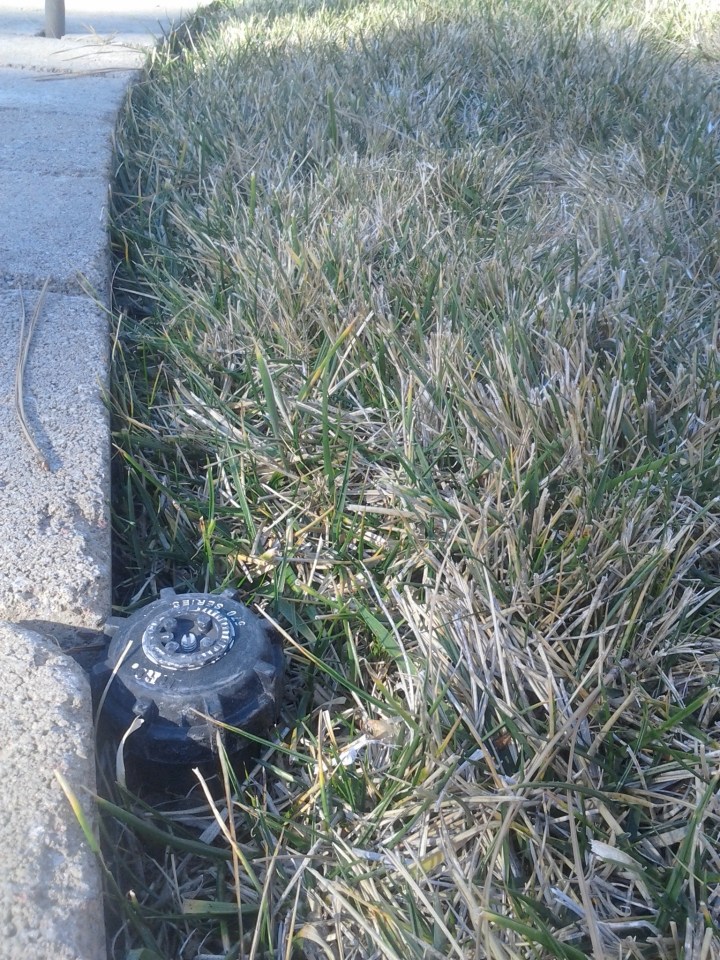
Because they are in such a high traffic area, and sometimes get run over by cars, the sprinkler heads are always in need of adjustment. They are quite generous with sharing their water with the surrounding pavement and any cars that might be parked there early in the morning, which makes the waste of water more blatant. The curbs are tripping hazards.

So, what are these litter boxes good for? Are they reserved for grave sites? ‘Very’ miniature golf perhaps? No one knows. This is not exactly a nice spot for a picnic or a game of volleyball.P80120k

The Molting Of The Chrysler

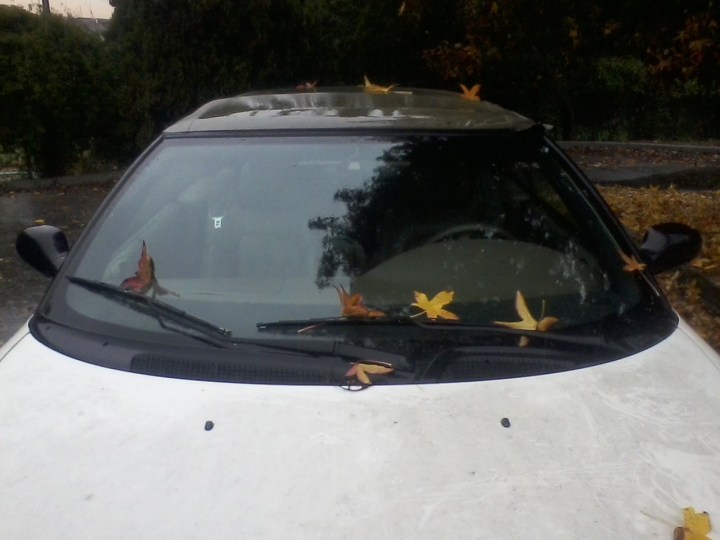
P80108+The old Chrysler looks different this time of year. Like dogs, cats, horses and deciduous plants, it adapted to the weather.

That tan canvas structure above the cab is known as a ‘roof’. It was there all along, but folded up behind the back seat. It was merely unfolded over the top of the cab. The ‘roof’ comes in handy this time of year, not only for keeping warmth within the cab, but also for keeping things out of the cab. Allow me to elaborate.

You may nave noticed that the Chrysler is wet. This is a direct result of mysterious droplets of moisture that fall from the sky. We discussed them earlier. They are known ‘rain’, and are falling from the sky presently. The ‘roof’ keeps the ‘rain’ out of the cab. Otherwise, the cab and everything in it would be as wet as the ‘roof’ is now.

The yellow, orange and reddish brown things strewn about are sweetgum leaves. You may not recognize them now because they are not green. They change color when the weather gets cool this time of year, and then get dislodged by meteorological events such as wind and the presently observed ‘rain’. The ‘roof’ excludes them from within the cab of the car.

The two devices at the bottom of the windshield are another adaptation to ‘rain’ known simply as ‘windshield wipers’. When in operation, they pivot from where they are affixed just below the windshield to literally wipe the the wet ‘rain’ away. They are a rather ingenious invention, since ‘rain’ on the windshield tends to inhibit visibility.

Just as a thick coat on a dog or horse can predict an unusually cool winter, the molting of the Chrysler is directly related to the weather. Although it can not predict ‘rain’ as early as dogs and horses can predict cold weather, it quite reliably happens immediately prior to ‘rain’. It is a good sign for the garden.

The ‘rain’ that falls immediately after the molting is composed of water, which is very important and useful to gardens and forests after such a long dry summer. As we discussed earlier, some of the water gets into the aquifer where it is stored for later use in and around our homes. We are very fortunate to have a Chrysler who is so proficient at predicting the delivery of the water that we need so much of.

Rain!

P71020Something really crazy happened last night. From out of nowhere, a profusion of drops of water started to fall from the sky! It continued to fall for a while, and got everything wet. Soil that had been dry and dusty became rather muddy. As crazy as it sounds, it is not impossible, and actually happened repeatedly last autumn, winter, and into spring. In fact, it was so abundant that the San Lorenzo River filled with all this strange sky water, and flooded worse than it had since the flood of 1982! People in other less arid climates are more familiar with this sort of thing. It is actually no mystery. It is known simply as ‘rain’.

‘Rain’ is like free water. Really, we do not need to pay for it! It falls from the sky, and waters the garden so we don’t need to. It might be the only water that areas outside of the garden get. Some plants out there have been waiting for it since it stopped falling from the sky last spring. Rain that does not soak into the ground drains into creeks and rivers, which flow into reservoirs that store it for later use. (Local reservoirs don’t really save it for later use directly, but use it to recharge groundwater; but that is another story.)

Another advantage of rain is that it tends to get things wet, which makes them less combustible. This is rather useful when forests nearby are burning. The Bear Fire near Boulder Creek is not quite extinguished. In fact, it is not yet contained. This rain should help with that. It probably will not do much for what is already burning, but should slow the already stagnating progression of the fire.